
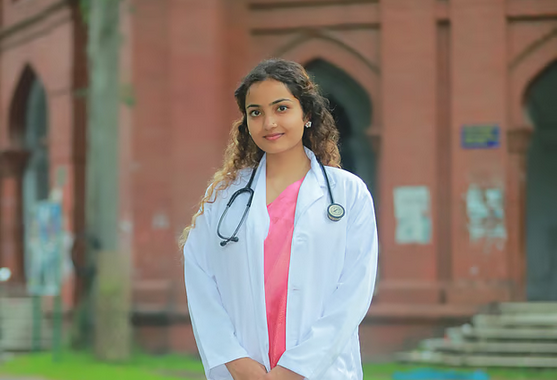

Different country, different language, different culture—studying abroad brings multiple challenges beyond academic pressure. When the degree is in a demanding field like medicine, those challenges become even tougher. Overcoming all of these, Stuti Rimal from Nepal secured tenth place in the MBBS final professional examination conducted under the University of Dhaka.
In the beginning, Stuti faced the same shock that many foreign students experience upon arriving in a new country. Before she could fully grasp the complexities of medical science in the classroom, she first had to understand the language. While her Bangladeshi classmates worried about “items” (exams), Stuti’s main concern was learning the language.
The Beginning of the Journey
From an early age, Stuti was involved in drawing, recitation, and creative writing. She also played the violin and practiced dance, and she was the captain of her school basketball team. However, when she thought about her future, she felt drawn to doing something that could have a positive impact on people’s lives. That thought led her toward this respected profession.
Stuti learned that medical colleges in Bangladesh have a very high number of patients, which allows students to closely observe more cases and learn more in practice. This motivated her to consider studying here. Under the SAARC scholarship, 19 Nepali students get the opportunity to study in Bangladesh each year—and she took that opportunity.
Language Is Not a Barrier, Language Is Love
Stuti received all kinds of support from the community of international students. When she had difficulty understanding lessons due to her lack of Bangla, she later clarified topics with Bangladeshi classmates. Seniors also extended their help generously. Even when she fell ill and had to go to the hospital, they took care of all the arrangements for her.
Medical education is not limited to books, notebooks, and laboratories—it extends to hospital wards, where learning happens directly from patients. Stuti says she learned a large part of the language from the patients themselves. As a foreigner, she received special respect from ordinary people seeking treatment. In addition, her friends, classmates, and even dormitory staff at the medical college became her “Bangla teachers.”
In the MBBS final professional examination, it is impossible to pass without communicating with patients in their own language. Skillfully understanding a patient’s problems and conducting examinations is extremely important. Stuti’s success in this regard is clearly reflected in her exam results. It is also worth mentioning that when we spoke to her for this interview, the entire conversation took place in Bangla.
Other New Experiences Beyond Language
Coming from Kathmandu to Dhaka, Stuti initially struggled with the hot climate. She grew up in a land of hills and seasonal breezes. Food was also somewhat challenging at first, but later she started cooking for herself.
She came to understand Bangladeshi culture after arriving here. Before coming, she had heard that conservative dress codes for women were mandatory. Later, she realized that people in Bangladesh are not actually rigid but rather quite liberal. As a result, she blended in easily. She said, “There are many times when, unless I speak, no one can even tell that I’m not Bangladeshi!”
She has also traveled outside Dhaka several times—visiting Sylhet and Rangpur—and has seen the sea in Cox’s Bazar and Kuakata.
Currently, Stuti Rimal is working as an intern doctor at Dhaka Medical College Hospital. For students who come from Nepal to study MBBS in Bangladesh, internship is mandatory. Undoubtedly, this experience will be a valuable asset for her future. However, there is one lingering disappointment. Bangladeshi intern doctors receive a government stipend. Foreign interns used to receive it as well until 2008, but it has not been provided since then. Stuti said, “If we received a stipend, it would give us extra motivation.”
After completing her internship, Stuti will return to Nepal to be with her mother, father, grandmother, and sister. She plans to prepare for working as a doctor in the United States. This talented young physician aspires to become a neurosurgeon in the future.
Source: The Daily Prothom Alo
You may like: Mashhun Jahan Mugdho’s world is filled with silence