
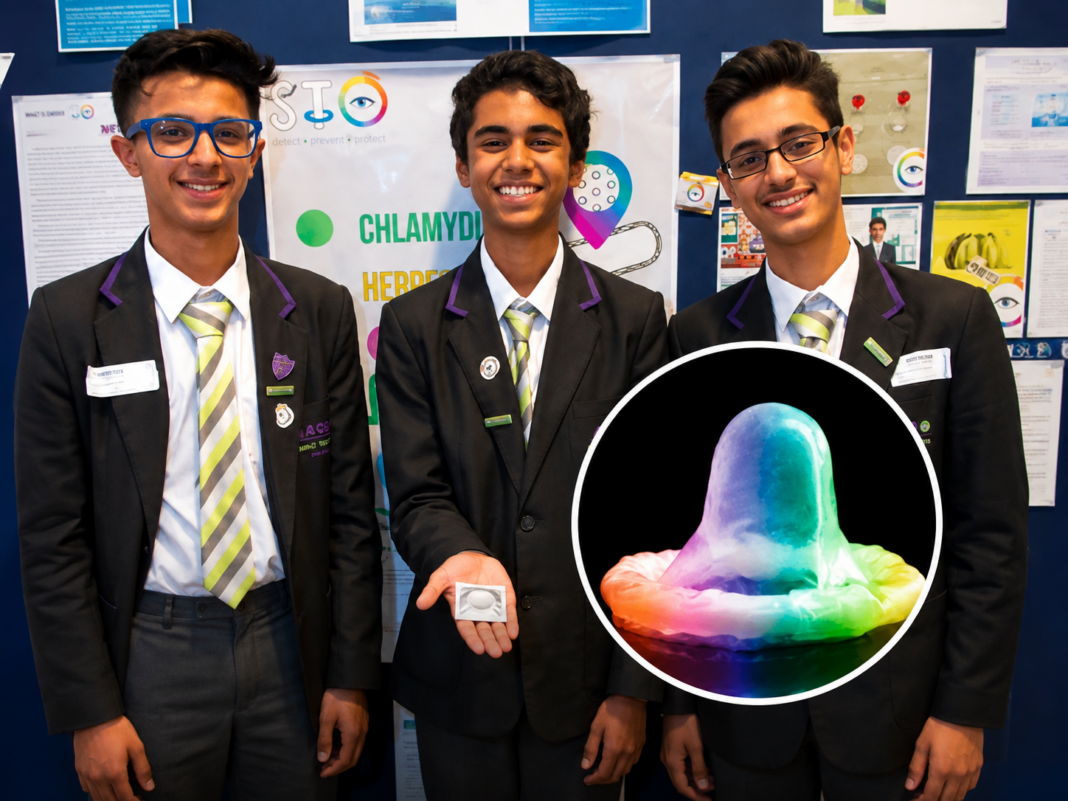

In 2015, three British teenagers turned the world of public health upside down with a single, revolutionary idea: a condom that changes color when it detects a sexually transmitted infection (STI). Daanyaal Ali, Muaz Nawaz, and Chirag Shah—students at Isaac Newton Academy in London—presented their concept, dubbed “S.T. EYE,” at the TeenTech Awards. The idea won first prize in the health category and instantly went viral.
Though it never transitioned from a student prototype into a commercial product, the concept remains a powerful case study in how technology can fight medical stigma and reshape public health.
The Science Behind the Glow
The concept of S.T. EYE relies on the brilliance of biomimicry and chemical indicators. The students proposed bonding specific antibodies to the latex surface of the condom. These antibodies would be engineered to recognize the antigens—the signature proteins—of common STIs.
When exposed to these pathogens, a chemical reaction would trigger a visible color shift:
- Green for Chlamydia
- Yellow for Herpes
- Purple for Human Papillomavirus (HPV)
- Blue for Syphilis
In theory, the technology offered an immediate, non-invasive, and completely private diagnostic tool. It aimed to take STI testing out of the intimidating atmosphere of a clinic and put it directly into the hands of individuals.
Breaking the Stigma Through Innovation
The true genius of S.T. EYE was not just the science, but its potential social impact. For generations, sexual health has been clouded by shame and hesitation. Many people avoid testing due to embarrassment, lack of access, or fear of judgment.
By turning detection into a visual cue during intimacy, the students’ concept aimed to:
- Normalize Conversations: It forced an immediate, honest dialogue between partners.
- Encourage Early Treatment: Catching an infection before symptoms appear prevents long-term health complications like infertility.
- Empower Individuals: It gave people an easy way to prioritize their own safety without relying on a partner’s word alone.
From Concept to Reality: The Unresolved Hurdles
Despite the global media frenzy, S.T. EYE never made it to pharmacy shelves. Developing such a product faces massive scientific and ethical roadblocks that have kept it a concept for over a decade.
First, accuracy is a major hurdle. In medical diagnostics, a “false positive” can cause severe psychological distress and relationship conflict, while a “false negative” gives a dangerous illusion of safety. For a condom to work as a diagnostic tool, its accuracy would need to rival laboratory blood or urine tests.
Second, manufacturing complexities are immense. Latex is treated with various lubricants and chemicals; introducing active, shelf-stable antibodies that can survive packaging and friction without degrading is an incredibly complex bio engineering challenge.
Finally, there are privacy and psychological concerns. An unexpected color change in the heat of the moment could lead to immediate distress, accusations, or conflict between partners without the immediate counsel of a medical professional.
A Lasting Legacy
While you cannot buy a color-changing condom today, the legacy of S.T. EYE lives on. It proved that the next generation of scientists is ready to tackle taboo subjects with empathy and innovation.
Today, the spirit of this invention is seen in the rise of confidential at-home STI testing kits and rapid diagnostic apps, which continue the mission the three London teenagers started: making sexual healthcare private, accessible, and free from shame. S.T. EYE may have been just a prototype, but it successfully shone a bright, undeniable light on the future of public health.