Dhaka, the capital of Bangladesh, is a city where history, business, diplomacy and modern urban life come together. Every day, the city welcomes thousands of visitors—from international business executives and diplomats to tourists, students, families and travelers from other parts of Bangladesh.
For anyone planning to spend a few nights in the capital, choosing the right hotel can make a significant difference.
Some travelers prioritize luxury and world-class facilities. Others want to stay close to the airport, while business travelers may prefer Gulshan, Banani or central Dhaka for convenient access to corporate and diplomatic districts.
Dhaka now offers a wide range of accommodation options, including internationally recognized five-star hotels as well as established local properties.
Here is a look at 10 of the best-known hotels in Dhaka, selected for their location, reputation, facilities, comfort and overall appeal. This is not an official ranking; the order is intended as a curated selection rather than a definitive league table.
1. InterContinental Dhaka
A blend of heritage and modern luxury
Located on Minto Road, InterContinental Dhaka is one of the capital’s most established luxury hotels.
Its central location makes it particularly convenient for visitors who need access to government offices, diplomatic areas, business districts and major attractions.
The hotel combines the character of an established international property with modern accommodation and hospitality facilities.
Guests can choose from a range of rooms and suites, while the property also offers restaurants, fitness and leisure facilities, meeting spaces and other services expected from a premium international hotel.
Why choose InterContinental Dhaka?
Its biggest strengths are its central location, international hospitality standards and established reputation.
Best suited for: Business travelers, diplomats, international visitors, families and travelers looking for a premium stay in central Dhaka.
Radisson Blu Water Garden Hotel is one of Dhaka’s best-known five-star properties and has a particularly appealing location for travelers who want to remain close to the airport.
Situated on Airport Road, the hotel is only a short distance from Hazrat Shahjalal International Airport.
One of its defining characteristics is its green and relatively peaceful environment, which provides a contrast to Dhaka’s busy urban landscape.
The hotel offers modern accommodation, restaurants, extensive meeting facilities, a fitness center, spa services and an outdoor pool. Its official website describes the property as combining business comfort with a resort-style atmosphere.
Why choose Radisson Blu Water Garden?
Its location is particularly convenient for travelers with early flights, late arrivals, business meetings or airport-related travel.
Best suited for: International travelers, business guests, families, conference attendees and airport travelers.
Pan Pacific Sonargaon Dhaka has long been one of the most recognizable names in the city’s luxury hospitality sector.
Located at 107 Kazi Nazrul Islam Avenue, the hotel occupies a central position close to major business districts and attractions.
The hotel describes itself as a five-star urban retreat combining traditional hospitality with modern facilities. Its amenities include multiple restaurants and bars, an outdoor swimming pool, fitness facilities, spa and wellness services, business facilities and extensive meeting spaces.
The hotel is also particularly well positioned for conferences, corporate events and other large gatherings.
Its accommodation ranges from standard rooms to large suites, including the Bengali Suite and International Suite.
Why choose Pan Pacific Sonargaon?
For travelers looking for central location, established reputation and a traditional luxury-hotel experience, it remains one of Dhaka’s strongest options.
Best suited for: Business travelers, families, international visitors, conference guests and luxury travelers.
Le Méridien Dhaka is another prominent five-star hotel in the northern part of the capital.
Its location near the airport makes it particularly useful for international travelers and business visitors who need convenient airport access.
As part of the Marriott portfolio, the hotel combines contemporary design with international hospitality standards.
Its facilities include modern accommodation, dining options, fitness and leisure facilities, meeting spaces and other amenities designed for both business and leisure travelers.
Why choose Le Méridien Dhaka?
For travelers who want modern luxury combined with convenient airport access, Le Méridien is an attractive choice.
Best suited for: International visitors, business travelers, families and premium travelers.
Crowne Plaza Dhaka Gulshan is located on Gulshan North Avenue, placing it close to one of the city’s major corporate and diplomatic zones.
For business travelers, this can be a major advantage.
Instead of spending a significant amount of time traveling across Dhaka for meetings, guests can stay close to offices, restaurants and diplomatic establishments.
The hotel combines modern accommodation with dining, meeting and leisure facilities.
Why choose Crowne Plaza Dhaka Gulshan?
Its strongest advantage is its business-oriented location in Gulshan.
Best suited for: Corporate travelers, executives, international visitors and guests looking for premium accommodation in Gulshan.
Located in Gulshan, Amari Dhaka is a modern luxury hotel that combines contemporary design with elements inspired by local culture.
Amari’s brand emphasizes a combination of contemporary hospitality and local character, and Dhaka is one of the destinations in its international portfolio.
The hotel’s location makes it convenient for guests visiting Dhaka for business, diplomatic activities or leisure.
Its accommodation, dining and leisure facilities make it a suitable choice for travelers looking for an upscale stay without leaving the Gulshan area.
Why choose Amari Dhaka?
Its combination of modern design, location and contemporary hospitality makes it a popular choice for both business and leisure travelers.
Best suited for: Business travelers, couples, families and visitors looking for modern accommodation in Gulshan.
Six Seasons Hotel is an established luxury property located in Gulshan 2, one of Dhaka’s most prestigious residential and diplomatic areas.
Its location is particularly useful for visitors who need access to Gulshan’s corporate offices, restaurants, shopping destinations and diplomatic establishments.
The hotel offers accommodation, dining facilities, leisure amenities and event spaces.
Unlike some of the international chain hotels on this list, Six Seasons has developed its own identity as a local premium hospitality brand.
Why choose Six Seasons Hotel?
Its main attractions are its Gulshan 2 location, comfortable accommodation and established local reputation.
Best suited for: Business travelers, families, corporate guests and visitors seeking a premium local hotel.
Hotel Sarina is located in Banani, another major business and diplomatic area of Dhaka.
According to the hotel’s official website, it is designed for both business and leisure travelers and is located close to Hazrat Shahjalal International Airport as well as the city’s business and diplomatic districts.
The property features 180 rooms and suites, three restaurants, a lobby café and lounge, two bars, banquet facilities, a health club and a swimming pool.
Its location also puts guests close to Banani’s many restaurants, offices and commercial establishments.
Why choose Hotel Sarina?
It is a strong option for travelers who want to stay in Banani while maintaining access to premium hotel facilities.
Best suited for: Business travelers, families, international visitors and guests staying around Banani.
There is no single “best hotel in Dhaka” for every traveler.
The right choice depends on your purpose, budget, location and preferred facilities.
Best for airport access
Radisson Blu Water Garden and Le Méridien Dhaka are particularly convenient for travelers who prioritize proximity to the airport.
Best for business travelers in Gulshan
The Westin Dhaka, Crowne Plaza Dhaka Gulshan, Renaissance Dhaka Gulshan, Amari Dhaka and Six Seasons Hotel are all worth considering.
Best for central Dhaka
InterContinental Dhaka and Pan Pacific Sonargaon Dhaka offer convenient central locations.
Best for Banani
Hotel Sarina Dhaka is a natural choice for travelers who want to stay in Banani.
Best for a greener, resort-style atmosphere
Radisson Blu Water Garden stands out for its landscaped surroundings and wellness facilities.
What Should You Check Before Booking a Hotel in Dhaka?
Choosing a hotel should involve more than simply looking at its star rating.
1. Location
Dhaka’s traffic can significantly affect travel time.
A hotel that looks close on a map may take considerably longer to reach during busy hours.
2. Room Type
Check whether you need a single room, double room, twin room, suite or another category.
3. Breakfast
Find out whether breakfast is included in your room rate or charged separately.
4. Airport Transfer
If you arrive late at night or have an early-morning flight, airport transfer services can be especially useful.
5. Swimming Pool and Fitness Facilities
For longer stays, leisure and wellness facilities can make a significant difference.
6. Cancellation Policy
Always read the cancellation and refund terms before confirming a reservation.
7. Total Cost
The displayed room rate may not always represent the final amount you will pay. Taxes, service charges and other fees may apply.
Always check the final payable amount before booking.
Why Dhaka’s Hotel Industry Matters
Dhaka is the economic, commercial and diplomatic center of Bangladesh.
The city hosts major corporations, international organizations, embassies, development agencies and multinational companies.
As a result, demand for quality accommodation remains strong.
But hotels serve more than business travelers.
Visitors also come to Dhaka for medical treatment, tourism, education, family events, conferences and international programs.
A good hotel therefore becomes more than a place to sleep.
It becomes part of a visitor’s experience of the city and, for international guests, sometimes part of their first impression of Bangladesh.
Final Thoughts
The “best” hotel in Dhaka ultimately depends on what you need.
For some travelers, luxury is the priority.
For others, location matters more.
Some want quick access to the airport, while others prefer the business districts of Gulshan and Banani or the central areas of Dhaka.
Nevertheless, InterContinental Dhaka, The Westin Dhaka, Radisson Blu Water Garden, Pan Pacific Sonargaon, Le Méridien Dhaka, Crowne Plaza Dhaka Gulshan, Renaissance Dhaka Gulshan, Amari Dhaka, Six Seasons Hotel and Hotel Sarina Dhaka are among the city’s notable accommodation options.
Before making a reservation, compare the hotel’s location, room type, facilities, guest reviews, cancellation policy and final price.
That way, you are more likely to choose a hotel that fits your trip rather than simply choosing the one with the highest star rating.
Frequently Asked Questions
What are the best hotels in Dhaka?
Some of Dhaka’s most notable luxury hotels include InterContinental Dhaka, The Westin Dhaka, Radisson Blu Water Garden, Pan Pacific Sonargaon, Le Méridien Dhaka, Crowne Plaza Dhaka Gulshan, Renaissance Dhaka Gulshan, Amari Dhaka, Six Seasons Hotel and Hotel Sarina.
Which are the best five-star hotels in Dhaka?
Dhaka has several internationally recognized and established five-star properties, including InterContinental Dhaka, The Westin Dhaka, Radisson Blu Water Garden, Pan Pacific Sonargaon and Le Méridien Dhaka.
Which hotel is best for travelers near Dhaka airport?
Radisson Blu Water Garden and Le Méridien Dhaka are among the most convenient premium options for travelers who prioritize airport access.
Which area is best for hotels in Dhaka?
Gulshan, Banani, central Dhaka and the airport area are among the most popular locations, depending on whether the visitor prioritizes business, sightseeing or airport access.
Which hotel is best for business travelers in Dhaka?
The Westin Dhaka, Crowne Plaza Dhaka Gulshan, Renaissance Dhaka Gulshan, Radisson Blu Water Garden and Pan Pacific Sonargaon are strong options for business travelers.
Are hotels in Dhaka expensive?
Prices vary significantly depending on the hotel, room type, season and booking date. Luxury five-star hotels generally cost more, while Dhaka also has many mid-range and budget accommodation options.
What should I consider before booking a hotel in Dhaka?
Consider location, room type, facilities, breakfast, airport transportation, cancellation policy, taxes and the final total price before booking.
After completing higher secondary education, every student faces a major question: What should I study at university, and which career path should I choose? It may seem that this single decision will determine the direction of an entire life. Finding the right answer has now become more complicated than ever. Technology, particularly artificial intelligence or AI, is rapidly changing the way we work, learn and think.
There is one important point students should remember. Those entering university today will graduate in approximately four years. During this period, AI-powered technologies are likely to bring significant changes to the workplace. According to the World Economic Forum’s Future of Jobs Report 2025, 170 million new jobs are expected to be created globally by 2030, while around 92 million jobs are projected to disappear. That would result in a net increase of approximately 78 million jobs.
The same report shows that the fastest-growing professions, in percentage terms, include Big Data Specialists, with projected growth of 110 percent, followed by FinTech Engineers at 90 percent and AI and Machine Learning Specialists at 82 percent. Other professions high on the list include Software and Application Developers at 57 percent, Security Management Specialists at 53 percent, and Data Analysts and Scientists at 41 percent.
This list makes one thing clear: it is not only a particular profession that will become more valuable. Demand for skills related to technology, information security and data-driven decision-making is also expected to grow significantly. The pace of change is so rapid that it is difficult to predict with certainty what the job market of the future will look like.
Historian Yuval Noah Harari has said, “For the first time in human history, nobody knows what the job market will look like in 20 or 30 years.” Therefore, students should recognize that the reality of the subject they choose to study today may not look the same four years from now.
This is why fields such as Computer Science, Data Science, Software Engineering and Information Technology are likely to become even more important. At the same time, demand for skilled professionals in areas such as Machine Learning, Robotics, Cybersecurity and the Internet of Things (IoT) is expected to grow rapidly. For students who enjoy mathematics, logic and statistics, these fields could offer exciting opportunities.
However, one point needs to be made clear: AI is not only relevant to Computer Science.
AI is increasingly being used across almost every field, including business, medicine, agriculture, law and journalism. AI-powered document analysis in law, data-driven crop-yield forecasting in agriculture and AI-assisted disease diagnosis in healthcare are just a few examples.
Therefore, regardless of what subject a student chooses to study, becoming familiar with technology and learning how to use it effectively is becoming almost essential. In the future, technological literacy will likely be considered a valuable supporting skill in nearly every profession.
Students should therefore consider developing basic knowledge of data analysis, programming and technology alongside their primary field of study.
How Can Students Prepare for an AI-Driven Future?
The next question is: How can students prepare themselves for a future shaped by AI?
First, instead of being afraid of AI-related technologies, students should become familiar with them and learn how to use them effectively.
Second, they should develop skills that AI cannot easily replicate—such as leadership, effective communication, creative thinking, problem-solving and the ability to build meaningful relationships with people.
Third, students need to move beyond the idea that learning ends with graduation. They should develop a mindset of lifelong learning.
Futurist Alvin Toffler made a similar observation decades ago: “The illiterate of the 21st century will not be those who cannot read and write, but those who cannot learn, unlearn and relearn.”
In an era of rapid technological change, there will be something new to learn four years from now, and something else to learn ten years from now. The ability to keep learning may therefore become one of the greatest qualifications for the future.
A. B. M. Shawkat Ali, Vice-Chancellor of Bangladesh University of Business and Technology (BUBT)
A Message for Parents
Parents also have an important role to play.
Instead of putting excessive pressure on their children or pushing them toward a particular field, parents should help them develop the ability to adapt to change.
In the long run, giving greater importance to a child’s genuine interests, abilities and willingness to learn may produce better results than focusing solely on examination results or social expectations.
The Most Important Career Decision
Ultimately, students should not feel overwhelmed when choosing what to study. The wisest approach is to find a balance between personal interests, individual abilities and the realities of the future job market.
Technology will change. The nature of professions will change as well.
But three qualities are unlikely to become outdated:
A willingness to learn. The desire to develop new skills. The ability to adapt to change.
These may prove to be among the most valuable qualities in an AI-driven world.
The student who begins developing these qualities today will be better prepared to thrive in the world of tomorrow.
Long before modern Bangladesh took shape, wealthy zamindar families built magnificent residences that reflected their power, prosperity, and refined taste. Among the most spectacular of these historic estates is Mohera Zamindar Bari, located in the tranquil village of Mahera in Mirzapur Upazila of Tangail District. Built in the late nineteenth century, the sprawling complex continues to captivate visitors with its stately mansions, elegant gardens, and timeless architectural beauty.
Often celebrated as the “White House of Bengal,” Mohera Zamindar Bari owes its nickname to its striking white buildings, grand colonial-style design, and carefully maintained surroundings. Today, the estate serves as the Bangladesh Police Training Centre (BPTC), yet it remains one of the country’s most popular heritage attractions, offering visitors a rare opportunity to experience the legacy of Bengal’s zamindar era in an exceptionally well-preserved setting.
Quick Facts
Official Name: Mohera Zamindar Bari
Bengali Name: মহেরা জমিদার বাড়ি
Nickname: The White House of Bengal
Location: Mohera Village, Mirzapur Upazila, Tangail District, Bangladesh
Distance from Tangail Town: Approximately 18 km
Established: Around 1890
Founders: Zamindars Kalicharan Saha and Ananda Saha
Current Use: Bangladesh Police Training Centre (BPTC)
Open to Visitors: Yes
A Legacy of the Saha Zamindars
The story of Mohera Zamindar Bari dates back to the late nineteenth century when Bengal was under British colonial rule.
The estate was established around 1890 by the influential zamindar brothers Kalicharan Saha and Ananda Saha, members of a wealthy Hindu landowning family. During the British era, zamindars collected land revenue, managed extensive estates, and often built magnificent residences that reflected their wealth and prestige.
Rather than constructing a single palace, the Saha family developed an impressive estate consisting of multiple mansions, administrative buildings, gardens, ponds, and courtyards. Together, these structures created one of the most elegant zamindar complexes in eastern Bengal.
Why Is It Called the “White House of Bengal”?
Visitors often wonder why Mohera Zamindar Bari is popularly known as the “White House of Bengal.”
The answer becomes obvious the moment one enters the estate.
Its brilliant white buildings, symmetrical façades, majestic columns, wide staircases, and beautifully landscaped grounds evoke comparisons with the famous White House in Washington, D.C. Although the architecture is not identical, the estate’s stately appearance and graceful proportions have earned it this affectionate nickname among locals and tourists alike.
Today, the title has become an important part of the estate’s identity and tourism appeal.
An Architectural Masterpiece
Mohera Zamindar Bari is widely regarded as one of the finest examples of late colonial architecture in Bangladesh.
The estate showcases a harmonious blend of:
European neoclassical architecture
Colonial design elements
Traditional Bengali craftsmanship
Decorative arches
Ornamental balconies
Elegant verandas
Classical columns
High ceilings
Intricate plasterwork
Unlike many abandoned zamindar houses across Bangladesh, Mohera remains remarkably well preserved, allowing visitors to appreciate the beauty of its original architectural design.
The Four Grand Lodges
The estate is famous for its four magnificent residential buildings, each possessing its own unique architectural character.
Chowdhury Lodge
Perhaps the most photographed building in the complex, Chowdhury Lodge impresses visitors with its elegant façade, grand entrance, and refined colonial architecture. It serves as the visual centerpiece of the estate.
Ananda Lodge
Named after Ananda Saha, this graceful mansion reflects the refined lifestyle of Bengal’s aristocracy. Spacious verandas, decorative windows, and balanced proportions make it one of the estate’s architectural highlights.
Maharaja Lodge
As its name suggests, Maharaja Lodge exudes royal elegance. Its imposing design and decorative features symbolize the prestige enjoyed by the zamindar family during the height of their influence.
Kalicharan Lodge
Dedicated to founder Kalicharan Saha, this beautiful building demonstrates the family’s appreciation for European-inspired architecture while incorporating local craftsmanship.
More Than Just Palaces
Mohera Zamindar Bari is not limited to its four famous lodges.
The estate also includes several historically significant buildings, such as:
Naib Bhaban (Manager’s Residence)
Kachari Bhaban (Administrative Office)
Rani Bhaban (Women’s Residence)
Service quarters
Courtyards
Gardens
Ornamental gateways
Together, these structures illustrate how a large zamindari functioned as both a residence and an administrative center.
Three Beautiful Ponds
Adding to the estate’s charm are three large ponds (dighis) surrounded by mature trees and lush greenery.
These ponds once served practical purposes such as water supply and household use, while also enhancing the estate’s landscape.
Today they create a peaceful atmosphere where visitors can enjoy reflections of the historic buildings, making them favourite spots for photography and relaxation.
From Zamindar Estate to Police Training Centre
Following the abolition of the zamindari system after the Partition of the Indian subcontinent, the estate gradually lost its original function.
Rather than allowing the magnificent complex to fall into ruin, the Government of Bangladesh later converted it into the Bangladesh Police Training Centre (BPTC).
The adaptation has played a significant role in preserving the historic buildings through regular maintenance and security.
Unlike many abandoned zamindar mansions across the country, Mohera Zamindar Bari remains in excellent condition thanks to its continued institutional use.
A Popular Tourist Destination
Although the estate functions as a police training centre, it welcomes visitors throughout much of the year.
Families, students, history enthusiasts, architecture lovers, and photographers all find Mohera Zamindar Bari an ideal destination for a day trip.
Photography Paradise
Mohera Zamindar Bari has become one of the most photographed heritage sites in Bangladesh.
Its white buildings, colourful flowers, green lawns, tree-lined walkways, and tranquil ponds provide stunning backdrops for photography.
The estate is particularly beautiful during the morning and late afternoon when soft sunlight enhances the elegant white façades.
How to Reach
Location:
Mohera Village
Mirzapur Upazila
Tangail District
Bangladesh
The estate is located approximately 18 kilometres from Tangail town along the Dhaka–Tangail Highway. Visitors travelling from Dhaka can reach the site in around two hours by road, making it an ideal weekend destination.
Visitor Information
Current Authority: Bangladesh Police Training Centre (BPTC)
Open to Tourists: Yes (subject to government regulations and security requirements)
Best Time to Visit: November to March, when the weather is pleasant for outdoor exploration.
Visitors are advised to respect the rules of the training centre, avoid entering restricted areas, and help preserve the cleanliness of this important heritage site.
Why Mohera Zamindar Bari Matters
Mohera Zamindar Bari is far more than a beautiful palace.
It represents the social, economic, and cultural history of nineteenth-century Bengal. The estate reflects the lifestyle of the zamindar class, the architectural influence of British colonial rule, and the remarkable craftsmanship of local artisans.
Its continued preservation as the Bangladesh Police Training Centre has ensured that future generations can still admire one of the country’s most elegant heritage landmarks.
Whether you are fascinated by history, architecture, photography, or simply wish to spend a peaceful day surrounded by nature and heritage, Mohera Zamindar Bari offers an unforgettable experience.
More than 130 years after its construction, the “White House of Bengal” continues to stand proudly—its graceful buildings, serene ponds, and timeless beauty reminding visitors of a remarkable chapter in Bangladesh’s architectural and cultural history.
Nestled in the quiet village of Masjidkur in Amadi Union of Koyra Upazila, Khulna, stands one of Bangladesh’s lesser-known yet historically significant Islamic monuments—the Masjidkur Mosque. Hidden for centuries beneath layers of earth and vegetation, this remarkable fifteenth-century mosque represents the architectural brilliance of the Bengal Sultanate and the enduring legacy of the legendary Muslim saint and administrator, Khan Jahan Ali.
Although it does not receive the same international recognition as the Sixty Dome Mosque in nearby Bagerhat, Masjidkur Mosque possesses immense archaeological, historical, and architectural value. Today, it is a protected monument under the Department of Archaeology of Bangladesh, serving both as an active place of worship and an important cultural heritage site.
Quick Facts
Official Name: Masjidkur Mosque
Bengali Name: মসজিদকুঁড় মসজিদ
Location: Masjidkur Village, Amadi Union, Koyra Upazila, Khulna District, Bangladesh
Construction Period: Approximately 1450–1490 CE
Builder: Traditionally attributed to Bura Khan (Borhan Khan) and Fateh Khan, disciples of Khan Jahan Ali
Protected By: Department of Archaeology, Bangladesh
Current Status: Active mosque and archaeological monument
A Legacy Connected to Khan Jahan Ali
The story of Masjidkur Mosque begins with the remarkable expansion of Islamic settlements into the southern delta of Bengal during the fifteenth century.
The celebrated Muslim saint, administrator, and builder Khan Jahan Ali played a transformative role in developing the southwestern region of Bengal. While he is most famous for constructing the UNESCO World Heritage monuments of Bagerhat, historical traditions suggest that some of his trusted followers expanded settlements even farther south toward present-day Koyra.
Among these followers were Borhan Khan, popularly known as Bura Khan, and his son Fateh Khan. Historical accounts indicate that they governed the Amadi region between approximately 1450 and 1490 and established the mosque as both a religious center and a symbol of Islamic administration in the area.
Why Is It Called “Masjidkur”?
The mosque’s name has a fascinating origin.
Unlike many historic mosques that have retained their original names, this monument earned its identity through rediscovery.
For centuries, the mosque lay buried beneath soil, vegetation, and forest growth. After the Partition of India, local people rediscovered the structure during excavation. Since the mosque was literally dug out from the ground, it became known as “Masjidkur,” with “kur” referring to digging or excavation in local usage.
Over time, the surrounding settlement itself adopted the mosque’s name, making the monument the identity of the entire village.
Architecture: A Classic Example of Bengal Sultanate Design
Masjidkur Mosque reflects many defining characteristics of fifteenth-century Bengal Sultanate architecture.
The mosque is perfectly square in plan.
External dimensions: 16.76 metres on each side
Internal dimensions: 12.19 metres on each side
Wall thickness: Approximately 7 feet (over 2 metres)
Its massive brick walls were designed not only for structural stability but also to maintain a naturally cool interior throughout the year.
One of the mosque’s most impressive features is its nine-domed roof, supported internally by four stone pillars arranged in a square. These pillars divide the prayer hall into nine equal bays, each originally crowned with a dome—a design popular during the Sultanate period in Bengal.
Nine Domes That Define Its Identity
The mosque originally consisted of:
Nine hemispherical domes
Four interior stone columns
Twelve supporting arches
Thick brick walls
Corner towers
The nine-dome arrangement was both structurally efficient and aesthetically elegant, allowing the roof load to be distributed evenly while creating a spacious prayer hall.
This architectural style can also be seen in several other mosques built under the influence of Khan Jahan Ali across southern Bengal.
Nine Entrance Arches
The mosque is notable for its symmetrical entrances.
Except for the western qibla wall, every side contains three arched doorways, making a total of nine entrances.
This design allows excellent ventilation and natural lighting—an important consideration in the humid climate of southern Bangladesh.
The western wall houses beautifully designed mihrabs, indicating the direction of Makkah.
A Naturally Cool Interior
Visitors frequently remark on the mosque’s surprisingly cool interior, even during the hottest summer months.
The reason lies in its medieval engineering:
Exceptionally thick walls
High brick domes
Large arched openings
Cross ventilation
Heat-resistant traditional construction materials
These passive cooling techniques enabled worshippers to pray comfortably centuries before modern air-conditioning existed. Local worshippers continue to experience this unique feature today.
Rediscovered After Centuries
One of the most fascinating chapters in the mosque’s history is its rediscovery.
Following centuries of neglect, much of the building became buried under layers of earth and vegetation.
Unlike many historical monuments that remained continuously visible, Masjidkur Mosque virtually disappeared from sight until excavations revealed its hidden structure.
Interestingly, no foundation inscription was found during the excavation. As a result, historians rely on architectural analysis and historical traditions to estimate its construction period and builders.
Present Condition and Conservation Challenges
Today, the mosque remains under the protection of the Department of Archaeology of Bangladesh.
Although conservation work has been carried out periodically, heritage experts and local residents have expressed concern over the gradual deterioration of the structure.
Recent observations have identified:
Peeling plaster
Surface cracks
Fading decorative elements
Weather-related damage
Limited restoration has been undertaken to keep the mosque functional for daily prayers, but experts argue that comprehensive conservation is necessary to preserve this important monument for future generations.
Tourism Potential
Located near the Sundarbans, Masjidkur Mosque has significant potential as a cultural tourism destination.
Visitors can combine a trip to the mosque with exploration of:
Rural Khulna
The Kapotaksha River
Traditional villages
Nearby Sundarbans attractions
Its peaceful surroundings, medieval architecture, and historical significance make it an ideal destination for history enthusiasts, photographers, architecture students, and cultural travelers.
How to Reach
Location:
Masjidkur Village Amadi Union Koyra Upazila Khulna District, Bangladesh
From Khulna city, visitors generally travel by road to Koyra and then continue toward Amadi Union before reaching Masjidkur village. The mosque stands close to the Kapotaksha River in a serene rural landscape.
Why Masjidkur Mosque Matters
Masjidkur Mosque is far more than an old brick building.
It is a surviving witness to the spread of Islam into the southern Bengal delta, the visionary leadership of Khan Jahan Ali and his followers, and the remarkable engineering skills of fifteenth-century Bengal.
Its rediscovery from beneath the earth adds a unique chapter to Bangladesh’s archaeological history, while its continuing use as a mosque demonstrates the enduring connection between heritage and living faith.
Nearly six centuries after its construction, this quiet monument still stands—its nine domes, thick walls, and timeless elegance continuing to tell the story of a remarkable era in Bengal’s history.
Discover the inspiring journey of Bangladeshi scholar Neela Wan Rakhine, who worked at a clinic to finance her education before earning fully funded PhD offers from three U.S. universities. Learn how she achieved her dream and get a step-by-step guide to applying for PhD scholarships abroad.
From a Small Clinic in Cox’s Bazar to an American University
Success stories often begin in places that seem ordinary.Some begin in large cities with prestigious schools and abundant resources.Others begin in small villages, modest homes, or workplaces where dreams quietly grow despite financial hardship.The story of Neela Wan Rakhine belongs to the second category.Years before receiving admission offers from prestigious universities in the United States, Neela spent her days working at a pathology clinic in Cox’s Bazar.She earned around 4,000 Bangladeshi Taka per month.Part of that income helped support her family.The rest she carefully saved so she could afford university admission tests.
She had no expensive coaching classes.No privileged academic environment.No shortcuts.Only determination.Today, that same young woman has earned fully funded PhD opportunities from three American universities, choosing Clemson University for her doctoral studies in Teaching and Learning.Her journey proves that determination, consistency, and purpose can often overcome limited resources.This is not simply the story of one student’s success.It is a roadmap for thousands of young people who dream of studying abroad.
Who Is Neela Wan Rakhine?
Neela Wan Rakhine is a Bangladeshi educator and researcher from Cox’s Bazar, belonging to the indigenous Rakhine community.She completed her undergraduate studies in Pali at the University of Chittagong before earning a master’s degree in Education from the Asian University for Women.Her academic interests gradually shifted toward educational research, teacher training, curriculum development, and improving learning opportunities for disadvantaged communities.Instead of viewing education merely as a pathway to personal success, Neela came to see it as a tool for transforming society.That vision eventually led her to pursue doctoral research in the United States.
Growing Up in Cox’s Bazar
Neela’s childhood was shaped by financial hardship.Her father, Mongfruthen Rakhine, worked as a tailor and was the sole breadwinner of a family of four.Like many lower-middle-income families, every educational expense required careful planning.Private coaching classes were simply beyond the family’s means.But financial hardship never reduced Neela’s curiosity.
She studied diligently, completing:
SSC from Cox’s Bazar Government Girls’ High School
HSC from Cox’s Bazar Government Women’s College
She understood from an early age that education represented the most powerful opportunity to change her future.Unfortunately, not everyone shared that belief.Some relatives questioned why a girl needed so much education.They suggested she would eventually become a housewife anyway.Rather than discouraging her, those comments strengthened her determination.Instead of arguing, she decided to answer through achievement.
Working at a Clinic While Preparing for University
For many students, preparing for university entrance exams is already stressful.Now imagine doing it while working a job to support your family.That was Neela’s reality.Without the financial ability to attend admission coaching, she accepted a job at a local pathology clinic during her university admission period.The salary was modest—about BDT 4,000 per month.Yet every taka mattered.Part of her earnings went toward helping her family meet daily expenses.The remaining money was carefully saved to pay for university application fees, travel expenses, and admission tests.
While many of her peers spent their entire days studying, Neela divided her time between work and books.Her schedule demanded discipline.She worked during the day, studied whenever she could, and continued preparing for one of the most important examinations of her life.Looking back, those months became one of the strongest foundations of her character.Financial hardship did not delay her dream—it strengthened her determination.
Choosing the University of Chittagong
When the university admission results were published, Neela achieved something she had worked tirelessly for.She earned admission to the Department of Pali at the University of Chittagong.For many people unfamiliar with the subject, choosing Pali may seem unusual.However, the decision reflected Neela’s long-standing interest in Buddhist philosophy, language, and history.Growing up in the Rakhine community, she had developed an appreciation for Buddhist teachings from an early age.Studying Pali allowed her to explore that intellectual and cultural heritage in greater depth.University life also exposed her to a wider world.She met students from different regions, cultures, and backgrounds.These experiences broadened her perspective and encouraged her to think beyond academic success alone.
Learning Beyond the Classroom
University education was never limited to textbooks for Neela.She believed learning also happened through experience.During her undergraduate years, she became actively involved in several student organizations, including:Bangladesh Rakhine Students’ Association
Angan
Rendezvous Cultural Group
Through these organizations, she developed valuable leadership skills.She learned how to organize events, communicate with diverse groups of people, manage projects, and work effectively in teams.These experiences later became surprisingly important during scholarship applications.International universities often look beyond grades.They seek students who demonstrate leadership, community engagement, and the ability to contribute beyond the classroom.Without realizing it at the time, Neela was already building a profile that would one day strengthen her PhD applications.
Academic Performance
Neela completed her bachelor’s degree with a CGPA of 3.45.While this was a strong academic result, what made her profile stand out was that her achievements extended far beyond examination scores.She had practical work experience.She had leadership experience.She had volunteer experience.She had teaching experience.This balanced profile would later become one of her greatest strengths.It is an important reminder for students that prestigious universities rarely evaluate applicants based solely on grades.Instead, they often look for evidence of curiosity, perseverance, leadership, and real-world impact.
Discovering a Passion for Education
After completing her undergraduate studies, Neela realized that her greatest passion was no longer confined to language or religious studies.She had discovered something even more meaningful.She wanted to become an educator.This realization inspired her to pursue a Master’s degree in Education at the Asian University for Women (AUW) in Chattogram.At AUW, she studied modern educational theories, curriculum development, teaching methods, classroom assessment, and educational leadership.She graduated with a CGPA of 3.52, further strengthening her academic foundation.More importantly, she found the research field that would shape her future career.
She became deeply interested in questions such as:
Why do some students learn faster than others?
How can teachers improve classroom learning?
What makes an education system effective?
How can indigenous children receive quality education without losing their language and identity?
These questions eventually became the driving force behind her decision to pursue a PhD.
Teaching Became More Than a Profession
Even while studying, Neela was already teaching.She worked as a private tutor.She volunteered to teach children.She created educational videos.She even provided online lessons for students from Myanmar.Every classroom experience strengthened her conviction that education changes lives.Rather than simply delivering lessons, she enjoyed helping students discover confidence in themselves.Those experiences convinced her that improving education requires more than good teachers—it also requires strong research, effective policies, and innovative teaching methods.That realization would soon guide her toward doctoral research in the United States.
Marriage, Family Support, and the Strength to Dream Bigger
For many women in South Asia, marriage is often seen as the end of their academic ambitions.
Neela Wan Rakhine wanted to prove that it did not have to be.
While pursuing her master’s degree, she got married to Ni Ja Rakhine. Like many newly married women, she suddenly found herself balancing multiple responsibilities—family, household duties, academic commitments, and career aspirations.
Managing all these responsibilities was not always easy.
There were assignments to complete, classes to attend, research to conduct, and family obligations that required equal attention.
Yet instead of asking her to abandon her dreams, her husband became one of her strongest supporters.
Neela has repeatedly acknowledged that every successful journey needs people who believe in you even during moments of uncertainty.
She often credits both her father and her husband for encouraging her to continue her education when giving up would have been much easier.
Their support did not remove the challenges.
It gave her the confidence to overcome them.
Her story also sends an important message to families: when parents and spouses invest in a woman’s education, they invest in the future of an entire community.
Becoming an Educator Beyond the Classroom
Neela never viewed teaching as simply standing in front of a classroom and delivering lectures.She believed that education should empower learners, improve communities, and create opportunities for those who have historically been left behind.This philosophy guided every step of her professional journey.While completing her master’s degree, she began working as a Teacher Trainer on a UNICEF-supported education project.
Rather than teaching children directly, she trained teachers—helping them develop better classroom practices, interactive teaching methods, and learner-centered approaches.The experience gave her a broader understanding of how educational systems function.She realized that improving one teacher could positively influence hundreds or even thousands of students over time.That realization strengthened her interest in educational research.
Working with the Asian University for Women
Following her work with UNICEF, Neela also contributed to educational initiatives at the Asian University for Women (AUW).These programs allowed her to collaborate with educators from different countries and cultures.Working in such an international academic environment expanded her understanding of global education challenges.She learned that while education systems differ across countries, many challenges remain surprisingly similar.Teachers everywhere strive to engage students more effectively.Schools everywhere seek better learning outcomes.Communities everywhere hope education will create better futures for the next generation.These experiences gradually shaped the research questions she hoped to explore during her PhD.
Joining 10 Minute School
Neela’s passion for education eventually led her to one of Bangladesh’s best-known online learning platforms—10 Minute School.There she worked as an English Trainer and Content Creator.The role introduced her to digital education on a much larger scale.Instead of teaching only a small classroom, her educational content had the potential to reach learners across the country.
She gained valuable experience in:
Designing online learning materials
Creating engaging educational content
Communicating complex ideas clearly
Teaching through digital platforms
Understanding modern educational technology
These skills became increasingly important because the future of education is no longer limited to traditional classrooms.Online learning, blended education, and digital teaching tools are now transforming how students learn around the world.
Founding Chalung Academy
Among all of Neela’s achievements, one initiative perhaps reflects her heart more than any degree or scholarship.She founded Chalung Academy.The academy was created to support children from her own indigenous Rakhine community through mother tongue-based education.For many indigenous children, education presents a unique challenge.They often begin school in a language different from the one spoken at home.
This language barrier can affect confidence, learning outcomes, and long-term academic success.Neela wanted to help change that.Through Chalung Academy, she worked to ensure that children could begin learning in an environment that respected both their language and their cultural identity.The project reflected her belief that education should never require children to abandon who they are.Instead, quality education should celebrate diversity while creating equal opportunities.
Leadership That Extended Beyond Academics
When American universities evaluate PhD applicants, they rarely focus only on grades.
They also ask an important question:
“Will this applicant make a meaningful contribution to society?”
By the time Neela applied for doctoral programs, her answer was already visible through her work.
She had:
Taught students.
Trained teachers.
Created educational content.
Worked with international organizations.
Led community initiatives.
Founded an educational institution.
Supported indigenous learners.
Continued learning despite financial hardship.
These experiences demonstrated leadership, initiative, and long-term commitment to educational development.For admissions committees, these qualities often distinguish an excellent applicant from a truly exceptional one.
Preparing for the Biggest Academic Challenge
Although Neela had built an impressive academic and professional profile, earning admission to a fully funded PhD program in the United States would require another level of preparation.She carefully researched universities whose faculty members specialized in education, curriculum development, teacher training, and learning sciences.
She refined her academic résumé.She prepared research interests.She strengthened her statement of purpose.She communicated with universities.Most importantly, she developed a clear vision.She wasn’t applying simply because she wanted to study abroad.She knew exactly why she wanted a PhD and how she hoped to use that knowledge after graduation.Admissions committees appreciate applicants with purpose.Neela had one.
A Dream Begins to Take Shape
Years earlier, while working in a small pathology clinic to save money for university admission, studying in America had seemed almost unimaginable.Now, after years of education, teaching, leadership, and perseverance, that dream was beginning to feel within reach.Soon, emails from American universities would begin arriving.And each one would bring life-changing news.
Winning Three Fully Funded PhD Offers in the United States
For many students, receiving admission from one international university is a dream come true.
Receiving offers from two is exceptional.
Receiving three PhD offers from universities in the United States is an achievement that reflects years of careful preparation, academic dedication, and professional growth.
That is exactly what Neela Wan Rakhine accomplished.
After years of studying, teaching, conducting educational projects, volunteering, and building a strong academic profile, she submitted applications to several American universities.
Soon, the results began arriving.
One after another, universities recognized her potential.
By the end of the admission cycle, Neela had earned opportunities to pursue doctoral studies at three respected American universities.
Each offer represented years of perseverance finally being rewarded.
Three Universities, Three Opportunities
Neela received admission offers from:
Clemson University – PhD in Teaching and Learning (Fully Funded)
Indiana University – PhD in Curriculum and Instruction (Fully Funded)
Kent State University – PhD in Curriculum and Instruction (Admission offered, with additional funding arrangements under discussion)
For any student, choosing between multiple universities can be difficult.
Each institution had respected faculty members, strong research opportunities, and excellent academic reputations.
Instead of selecting the most famous name, Neela focused on something more important.
She asked herself a simple question:
“Which university is the best place for the research I want to conduct?”
That question guided her final decision.
Why Clemson University?
After carefully comparing the programs, Neela accepted the offer from Clemson University.
Several factors influenced her decision.
First, the university offered full financial support for five years, allowing her to concentrate on research without worrying about tuition fees or living expenses.
Second, Clemson’s doctoral program closely matched her research interests.
She plans to specialize in Teaching and Learning, an area that examines how students learn most effectively, how teachers can improve classroom instruction, and how educational systems can create better learning environments.
For someone who has already worked as a teacher, trainer, educational content creator, and community educator, the program was an ideal match.
It represented not only an academic opportunity but also the next logical step in a career devoted to improving education.
What Does a Fully Funded PhD Mean?
Many students hear the phrase “fully funded PhD” but are unsure what it actually includes.
In most American universities, a fully funded doctoral program generally provides:
Full tuition waiver
A monthly or annual living stipend
Health insurance (at many universities)
Research or teaching assistantship opportunities
Access to university research facilities
Library resources
Academic conference support (in many cases)
This means that instead of paying for their education, doctoral students are financially supported while conducting research, teaching undergraduate courses, or assisting professors.
However, funding packages differ from one university to another, so applicants should always review the official offer carefully before making a decision.
Why American Universities Selected Neela
Many students assume that international universities admit only applicants with perfect grades.
Grades are important.
But they are only one part of a much larger picture.
Neela’s application stood out because it demonstrated consistency across several areas.
Strong Academic Foundation
She completed both her bachelor’s and master’s degrees with solid academic performance while steadily improving her knowledge and research skills.
Professional Experience
Unlike many applicants whose experience is limited to classrooms, Neela had already worked in education through:
UNICEF projects
Teacher training programs
Asian University for Women initiatives
10 Minute School
Community education
These experiences showed that she could connect academic theory with real educational practice.
Leadership
Admissions committees also value applicants who create positive change.
Neela demonstrated leadership by founding Chalung Academy, an initiative dedicated to improving educational opportunities for indigenous children through mother tongue-based learning.
That achievement reflected initiative, vision, and social commitment.
Clear Research Goals
Perhaps the strongest part of her application was clarity.
She knew exactly what she wanted to research.
She was not applying simply because she wanted a foreign degree.
She wanted to investigate better teaching methods, improve educational quality, and eventually contribute to Bangladesh’s education system.
Universities appreciate applicants whose research goals align with their long-term career ambitions.
Neela’s application communicated that vision clearly.
Leaving Bangladesh with the Intention of Returning
For many students, studying abroad becomes the beginning of a permanent life overseas.
Neela’s dream is different.
She has repeatedly expressed her desire to return to Bangladesh after completing her PhD.
Her ambition is not merely to earn another academic qualification.
She wants to apply what she learns to improve education in her own country.
In particular, she hopes to contribute to:
Teacher development
Educational research
Curriculum improvement
Indigenous education
Girls’ education
Equal access to quality learning
Having grown up as a member of the indigenous Rakhine community, she understands the educational barriers that many minority students face.
She believes that research should ultimately improve people’s lives—not remain confined to academic journals.
A Journey That Inspires Thousands
Neela’s story carries an important message.
She did not begin her journey with wealth, privilege, or extraordinary advantages.
She began with determination.
She worked while preparing for university.
She continued studying despite financial challenges.
She volunteered.
She taught.
She created educational content.
She built leadership experience.
She supported her community.
Step by step, those experiences came together to form an application that impressed some of the world’s leading universities.
Her success reminds young people that remarkable opportunities are rarely created overnight.
They are built through years of consistent effort.
How to Get a Fully Funded PhD Abroad: A Complete Guide for Bangladeshi Students
Neela Wan Rakhine’s story is inspiring.
But inspiration alone is not enough.
Many students read success stories and wonder:
“Could I do the same?”
The answer is yes—provided you prepare strategically and remain consistent over several years.
A fully funded PhD is not awarded because someone is lucky.
It is awarded because an applicant has demonstrated academic ability, research potential, leadership, and a clear purpose.
Here is a practical roadmap for students who dream of studying abroad.
Step 1: Build a Strong Academic Foundation
Everything begins with your undergraduate degree.
Although there is no universal CGPA requirement, most competitive PhD applicants have consistently good academic records.
However, grades alone will not guarantee admission.
Admissions committees also want evidence that you enjoy learning beyond examinations.
Read books.
Take online courses.
Attend workshops.
Participate in seminars whenever possible.
The habit of learning continuously is one of the strongest qualities a future researcher can develop.
Step 2: Gain Research Experience
Research experience is often more valuable than many students realize.
If your university has opportunities to assist faculty members with research projects, volunteer.
Write research papers.
Present papers at conferences.
Publish articles if possible.
Learn academic writing.
Become familiar with research methods.
Even small research experiences can significantly strengthen your application.
Step 3: Develop Leadership and Community Impact
American universities want students who will contribute to society.
Leadership does not necessarily mean becoming president of a student club.
It means solving problems.
Volunteer.
Teach underprivileged children.
Organize educational events.
Create learning resources.
Launch a community project.
Work with NGOs.
Support environmental initiatives.
Every meaningful activity demonstrates initiative and responsibility.
Step 4: Improve Your English
Since most international PhD programs are taught in English, applicants usually need to demonstrate language proficiency.
Common English proficiency tests include:
IELTS
TOEFL
Duolingo English Test (accepted by many universities)
Always check the university’s official admission requirements because they vary.
Some universities waive English test requirements under specific circumstances.
Step 5: Identify Your Research Interest
One of the biggest mistakes applicants make is saying:
“I want to study in America.”
That is not a research goal.
Instead, ask yourself:
What problem do I want to solve?
Which subject excites me?
What questions do I want to investigate for the next five years?
Your research interest becomes the foundation of your application.
Step 6: Search for Universities
Do not apply blindly.
Instead, search for universities whose faculty members conduct research related to your interests.
Useful sources include:
University websites
Google Scholar
Academic conference websites
ResearchGate
LinkedIn
Academic departments’ faculty pages
Read professors’ recent publications.
Study their research areas.
Identify whose work aligns with your interests.
Step 7: Contact Professors Professionally
Many PhD applicants contact professors before submitting formal applications.
A good email should be:
Short
Respectful
Personalized
Professional
Introduce yourself briefly.
Explain your research interests.
Mention why their research interests you.
Attach your CV if appropriate.
Avoid sending the same generic email to dozens of professors.
Step 8: Write an Outstanding Statement of Purpose (SOP)
The SOP is one of the most important documents in your application.
A strong SOP should answer:
Who are you?
What inspired your research interests?
What academic experiences prepared you?
Why this university?
Why this professor?
What are your future goals?
How will this PhD help your country or field?
An SOP should tell a coherent story rather than simply listing achievements.
Step 9: Build a Professional CV
A competitive academic CV usually includes:
Education
Research experience
Publications
Conferences
Teaching experience
Scholarships
Leadership
Volunteer activities
Professional skills
Awards
Languages
Remember:
A CV should demonstrate growth—not merely collect information.
Step 10: Prepare Strong Recommendation Letters
Recommendation letters matter.
Choose professors or supervisors who know your work well.
A detailed letter from someone familiar with your abilities is usually far more valuable than a generic letter from a famous person.
Build genuine academic relationships long before application season begins.
Common Mistakes Students Make
Many excellent students are rejected because they make avoidable mistakes.
Some of the most common include:
Applying without clear research interests.
Sending identical SOPs to every university.
Writing poorly structured CVs.
Contacting professors with unprofessional emails.
Applying only to famous universities.
Ignoring application deadlines.
Giving up after the first rejection.
Remember:
Rejection is part of almost every successful academic journey.
Persistence matters.
Useful Websites for Finding PhD Opportunities
Students should regularly explore:
Official university websites
FindAPhD
PhD Portal
DAAD (Germany)
Fulbright Program
Erasmus+
Commonwealth Scholarships
Chevening (for master’s)
EducationUSA
Professors’ personal webpages
Google Scholar
The best opportunities are often found through careful research rather than social media posts.
What Makes an Applicant Stand Out?
Looking at Neela Wan Rakhine’s journey, several qualities clearly distinguished her application.
She combined:
Strong academics.
Teaching experience.
Leadership.
Community service.
International perspective.
Clear research goals.
Professional experience.
Long-term commitment to education.
No single achievement secured her admission.
Together, they created a compelling academic profile.
Career Timeline
Early Years Born and raised in Cox’s Bazar in a Rakhine family.
School Education Completed SSC from Cox’s Bazar Government Girls’ High School.
College Education Completed HSC from Cox’s Bazar Government Women’s College.
University Admission Worked at a pathology clinic while preparing for university entrance examinations.
University of Chittagong Completed a Bachelor’s degree in Pali (CGPA 3.45).
Asian University for Women Completed a Master’s degree in Education (CGPA 3.52).
Professional Career
Teacher Trainer (UNICEF projects)
Teacher Trainer (Asian University for Women)
English Trainer and Content Creator (10 Minute School)
Community Leadership
Founded Chalung Academy to support indigenous children’s education.
2026
Received PhD offers from:
Clemson University
Indiana University
Kent State University
Accepted Clemson University’s fully funded PhD offer in Teaching and Learning.
Frequently Asked Questions
Who is Neela Wan Rakhine?
Neela Wan Rakhine is a Bangladeshi educator and researcher from Cox’s Bazar who received PhD offers from three universities in the United States and accepted a fully funded position at Clemson University.
Which university did Neela Wan Rakhine choose?
She chose Clemson University to pursue a fully funded PhD in Teaching and Learning.
What did Neela Wan Rakhine study in Bangladesh?
She earned a Bachelor’s degree in Pali from the University of Chittagong and a Master’s degree in Education from the Asian University for Women.
Why is Neela Wan Rakhine’s story inspiring?
Because she worked at a pathology clinic to finance her education, overcame financial hardship, became an educator and community leader, and eventually earned multiple fully funded PhD opportunities in the United States.
What is a fully funded PhD?
A fully funded PhD generally includes tuition coverage, a living stipend, health insurance (where applicable), and opportunities to work as a teaching or research assistant.
Can Bangladeshi students get fully funded PhD scholarships?
Yes. Every year, many Bangladeshi students receive fully funded PhD opportunities in countries such as the United States, Canada, the United Kingdom, Australia, Germany, Japan, South Korea, and several European nations.
Is research experience important for PhD admission?
Yes. Research experience significantly strengthens an application because it demonstrates academic curiosity and the ability to conduct independent scholarly work.
What should students do during university if they want to study abroad?
Maintain good grades, participate in research, improve English proficiency, develop leadership skills, volunteer in meaningful activities, and build strong relationships with faculty members.
Final Thoughts
Neela Wan Rakhine’s journey reminds us that extraordinary success rarely happens overnight.
It is built through thousands of ordinary days—days spent studying after work, saving money when resources are scarce, volunteering without expecting recognition, and believing in a dream long before others can see it.
From a modest pathology clinic in Cox’s Bazar to a fully funded doctoral program at Clemson University, her story is not merely about academic achievement. It is about resilience, purpose, and the transformative power of education.
Perhaps the most inspiring part of her journey is not that she is leaving Bangladesh to study abroad.
It is that she hopes to return.
She dreams of improving education, empowering indigenous communities, supporting girls’ education, and helping future generations access opportunities that once seemed beyond reach.
For every young reader wondering whether financial hardship, limited resources, or discouraging words can define their future, Neela’s life offers a powerful answer.
Dream boldly. Prepare patiently. Work consistently. And let your achievements speak louder than your circumstances.
Editor’s Note (Recommended for Teenagers)
At Teenagers – Inspiring Young Minds Worldwide, we believe stories like Neela Wan Rakhine‘s deserve to be preserved because they do more than celebrate individual success. They become practical roadmaps for the next generation. If even one student begins preparing today for a scholarship abroad after reading this story, then Neela’s journey will have inspired yet another life—continuing the ripple effect of education across borders.
For many children growing up in Bangladesh, power cuts were an inconvenience. For Tonima Tasnim Ananna, they were magical.Long before she became an astrophysicist, before she studied at Cambridge and Yale, and before she was recognized by Scientific American as one of the young scientists whose work could shape the future of science, she was simply a curious little girl standing under the night sky in Dhaka’s Badda neighborhood.
In those days, the city looked very different. There were fewer high-rise buildings, and when electricity disappeared during load-shedding, the sky suddenly came alive. Thousands of stars emerged from the darkness. Sometimes she spotted floating sky lanterns. Neighbors gathered outside, children played, and the universe seemed much closer than it does today.Her mother often told stories about planets, stars, and galaxies. Those stories ignited a fascination that has never faded.Like many children, Tonima dreamed of becoming an astronaut.Life eventually took her in a different—but equally extraordinary—direction.Instead of traveling into space, she chose to uncover its deepest secrets.
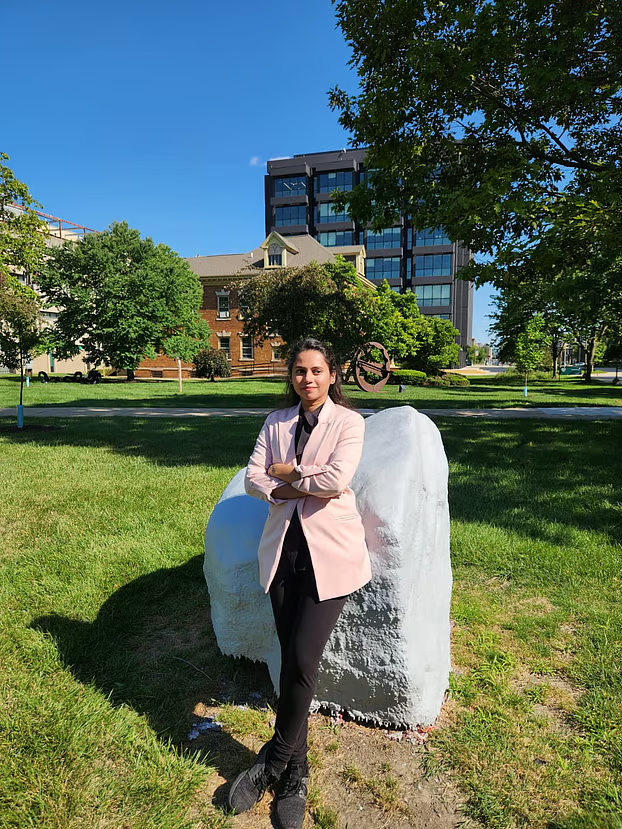
Today, Dr. Tonima Tasnim is an astrophysicist at Wayne State University in the United States, where she studies one of the most mysterious objects in the universe: supermassive black holes.
A Bangladeshi Scientist Among the World’s Most Promising Minds
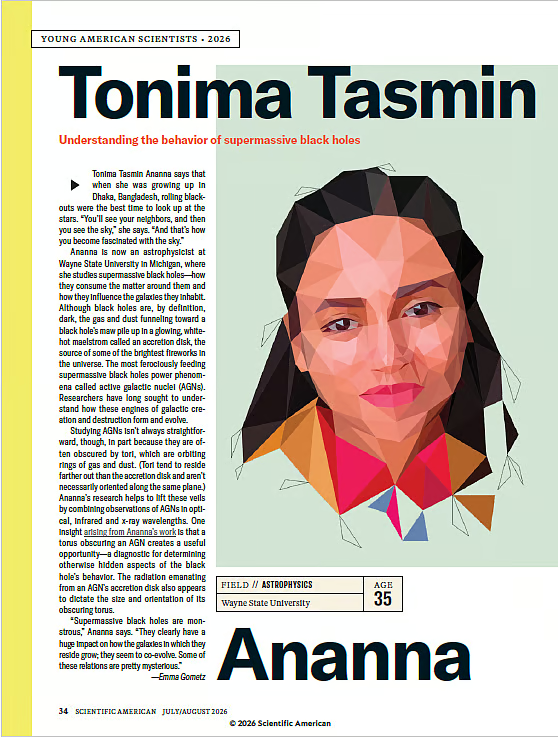
In 2026, one of the world’s oldest and most respected science magazines, Scientific American, published a special issue titled “The Future of Science.”Rather than celebrating famous Nobel Prize winners or veteran researchers, the magazine looked ahead.It selected 28 young scientists from different fields whose discoveries could transform our understanding of the world in the coming decades.Among them was a name that made Bangladesh proud:Tonima Tasnim.
For any scientist, appearing in Scientific American is a remarkable achievement. Being selected as one of the researchers expected to shape the future of science is even more extraordinary. It placed Tonima alongside some of the brightest emerging scientific minds on Earth.Yet for her, this recognition represents another milestone—not the destination. Her greatest passion remains understanding how the universe itself evolved.
Chasing the Biggest Mysteries in the Cosmos
If someone asked what the universe’s greatest unsolved mystery is, many astronomers would point toward black holes.Black holes are regions where gravity is so powerful that nothing—not even light—can escape.At the center of almost every large galaxy, including our own Milky Way, lies a supermassive black hole, containing millions or even billions of times the mass of our Sun.But one enormous question continues to puzzle scientists.How did these cosmic giants become so massive so quickly after the Big Bang?That question lies at the heart of Tonima Tasnim’s research.
Using advanced observations, computer simulations, and theoretical models, she investigates how supermassive black holes formed, how they grew over billions of years, and how they influence the galaxies surrounding them.Understanding black holes isn’t just about satisfying curiosity.These mysterious objects help determine how galaxies evolve, how stars are born, and perhaps even how the universe itself changes over time.Every new discovery brings humanity one step closer to understanding its cosmic origins.
From Dhaka to the World’s Best Universities
Tonima’s journey demonstrates that talent can flourish anywhere when paired with determination.She studied at Manarat International School and College in Dhaka before continuing her education abroad.Her academic journey took her through some of the world’s most respected institutions. She studied at Haverford College in the United States, continued her academic development through the University of Cambridge in the United Kingdom, and later earned her Ph.D. at Yale University, one of America’s most prestigious Ivy League universities.
At Yale, she worked under the supervision of Professor Claudia Megan Urry, a world-renowned astrophysicist and former President of the American Astronomical Society.For a young researcher, learning under one of the leading figures in modern astrophysics was both a privilege and an opportunity to contribute to cutting-edge research.Those years refined not only her scientific skills but also her ability to ask the kinds of questions that lead to groundbreaking discoveries.
Learning Beyond the Classroom
Tonima’s education was never limited to lectures and textbooks.She sought opportunities wherever science was pushing boundaries.She completed internships at organizations recognized around the world for scientific excellence, including NASA and CERN, the European laboratory famous for operating the Large Hadron Collider, the world’s largest particle accelerator.Although her primary research focuses on astrophysics rather than particle physics, these experiences exposed her to international collaborations, advanced technologies, and multidisciplinary scientific thinking.Modern science rarely happens in isolation.The biggest discoveries emerge when researchers from different countries and different disciplines work together. Tonima’s career reflects exactly that spirit.
Recognition That Came Early
Long before Scientific American celebrated her achievements, the international scientific community had already begun paying attention.In 2020, Science News selected her among its SN 10: Scientists to Watch, recognizing researchers who were making exceptional contributions early in their careers.Her work also gained remarkable attention within the astrophysics community.One of her research papers was recognized among the most downloaded and most widely read articles featured in The Astrophysical Journal’s annual review.Such recognition is significant because scientific influence is measured not only by awards but also by how often other researchers read,discuss, and build upon your work.In science, ideas matter most when they inspire further discovery.
A Scientist Who Loves Teaching
Although research is central to her career, Tonima doesn’t see herself only as a scientist.She is also an educator.At Wayne State University, she divides her time between research and teaching.When asked which she enjoys more, her answer is simple:Both.Research allows her to explore questions no one has answered before.Teaching allows her to share that excitement with students.She particularly enjoys environments where she can interact with people, exchange ideas, and encourage curiosity.That balance makes her career deeply fulfilling.After all, every great scientist was once inspired by a great teacher.
Giving Back to Bangladesh
Despite building an international academic career, Tonima has never forgotten where she came from.She actively supports Bangladeshi students interested in science.The first Ph.D. student she supervised was a Bangladeshi researcher—a meaningful milestone for someone who understands the challenges many young scientists face.She has also worked with WiSTEM (Women in Science, Technology, Engineering and Mathematics), helping encourage girls and young women from Bangladesh to pursue careers in STEM fields.Representation matters.When young students see someone from their own country conducting world-class research, impossible dreams begin to feel achievable.Tonima hopes to become that example for future generations.
The Girl Who Could Never Stop Reading
Scientific curiosity wasn’t Tonima’s only passion. She was also an enthusiastic reader. As a child, she devoured almost anything she could find.Comic books like Nonte Phonte and Chacha Chaudhary.Humorous magazines.The imaginative worlds of Sukumar Ray, Satyajit Ray, and Humayun Ahmed.Global fantasy classics such as Harry Potter and The Lord of the Rings.If she visited a relative’s house and discovered an interesting book, she would often finish reading it before leaving.Even today, reading remains part of her daily routine.She rarely goes to bed without spending time with a book.That lifelong reading habit helped nurture something every scientist needs:Imagination.Science begins not with answers but with questions.And questions often begin in the imagination.
Still Dreaming of Space
As a child, Tonima wanted to become an astronaut.Today she studies black holes instead.Does that mean she abandoned her childhood dream?Not at all.When asked whether she still hopes to travel into space someday, she smiles and says,“I haven’t given up hope yet.”That answer perfectly captures her personality.Optimistic.Curious.Always looking upward.
Why Her Story Matters
Tonima Tasnim’s story is not simply about academic excellence.It is about curiosity surviving into adulthood.It is about a girl who looked at stars during power cuts and decided to spend her life understanding them.It is about proving that a child growing up in Dhaka can contribute to humanity’s understanding of the universe.Most importantly, it reminds young readers that science is not reserved for people born in famous laboratories or wealthy countries.Great scientists are often ordinary children who never stop asking extraordinary questions.The stars that fascinated T0nima during those quiet nights over Dhaka are the same stars visible from every corner of Earth.The difference is that while many people simply admire them, a few dedicate their lives to understanding them.Tonima Tasnim is one of those few.And if Scientific American is right, her discoveries may help shape the future of science itself.
Suggested Related Articles
Lamin Yamal: The Teenager Rewriting Football History
Discover the inspiring story of The Boy Who Became a Professor Before Most Students Enter College, His Name is Nathan Thomas, the American engineering prodigy who became the world’s youngest male professor at just 18 years old, breaking a Guinness World Records milestone that had stood for over 300 years.The Boy Who Taught College Before Most Teenagers Started It
At an age when most teenagers are busy preparing college applications, worrying about entrance exams, or wondering what they want to study in the future, Nathan Thomas had already crossed a milestone that very few people achieve in a lifetime.At just 18 years and 346 days old, he walked into a college classroom—not as a student, but as the instructor.In August 2023, Nathan officially began teaching C for Engineers, a programming course at Miami Dade College in Florida, USA. That appointment made him the youngest male professor in recorded history, according to Guinness World Records. In doing so, he broke a record that had stood unchallenged for an astonishing 306 years.
The Boy Who Became a Professor Before Most Students Enter College
The previous record belonged to Scottish mathematician Colin Maclaurin, who became a professor in 1717 at the age of 19. For more than three centuries, no younger man had officially reached that position—until Nathan Thomas rewrote history.Yet his story is about much more than a world record.It is a story of curiosity, discipline, supportive parents, extraordinary education, and a lifelong passion for solving problems. More importantly, it reminds teenagers everywhere that age is not always the greatest measure of ability.
Nathan’s journey also challenges one of society’s strongest assumptions—that expertise comes only with age. Standing in front of a classroom filled with students, some only months younger than himself, he proved that knowledge, preparation, and dedication can earn respect regardless of birth date.His achievement quickly attracted international attention. News outlets around the world reported the remarkable story of the teenager who had become a college professor before many of his peers had even selected a university major.
Soon afterward, Guinness World Records officially recognized his accomplishment, placing his name alongside some of history’s most exceptional individuals.But remarkable achievements rarely happen overnight.Nathan’s story began many years earlier—with a curious child who loved numbers.
A Childhood Built Around Curiosity
Nathan Thomas was born into a family where engineering was not simply a profession—it was part of everyday life.Both of his parents are engineers, and from an early age they encouraged curiosity instead of simply providing answers. Rather than telling him how something worked, they inspired him to investigate, experiment, and understand the principles behind it.Many children enjoy taking toys apart.Nathan wanted to understand how the world itself worked.
Electric circuits, mathematical puzzles, computers, and logical thinking fascinated him long before most children encountered these subjects in school.Instead of viewing mathematics as a difficult subject, he treated it like a game—one where every problem had a beautiful solution waiting to be discovered.His parents noticed something unusual.Nathan did not merely memorize information. He genuinely wanted to understand it.That difference would shape the rest of his education.
When School Could No Longer Keep Up
Gifted children often face an unexpected challenge.The problem is not that learning is difficult.The problem is that learning becomes too easy.As Nathan progressed through elementary education, his ability to absorb new concepts rapidly meant traditional classroom instruction no longer matched his pace.Many exceptionally gifted students become bored in such situations.Nathan became even more eager to learn.His parents realized that if they wanted to keep feeding his intellectual curiosity, they needed opportunities beyond the standard school curriculum.Fortunately, Florida offers dual-enrollment and accelerated educational pathways that allow exceptionally capable students to begin college-level study at unusually young ages.Nathan was ready.
Entering College at Just Ten Years Old
Most ten-year-olds are adjusting to upper elementary school.Nathan Thomas was stepping onto a college campus.At only 10 years old, he began studying at Miami Dade College, one of the largest public colleges in the United States.The milestone was extraordinary.College classrooms demand independence, discipline, and critical thinking—qualities that many adults still struggle to develop.Yet Nathan embraced the challenge.Being surrounded by much older classmates did not intimidate him.Instead, it motivated him.He focused on learning rather than comparing himself with others, an attitude that would later become one of the central lessons he shares with young people.His experience also demonstrated an important truth about education:Learning is not defined by age.It is defined by readiness.
More Than Just a Gifted Student
People often describe prodigies as naturally talented.But talent alone rarely explains extraordinary success.Nathan’s academic journey required countless hours of study, persistence, and self-discipline.Engineering is widely considered one of the most demanding academic fields in the world.Students must master advanced mathematics, physics, programming, electronics, and problem-solving simultaneously.Nathan tackled these subjects years earlier than most people.His success reflected not only exceptional intelligence but also remarkable work ethic.That combination—curiosity supported by discipline—would eventually distinguish him from thousands of other gifted students.
Why Mathematics Became His Favorite Language
When asked about his interests, Nathan has often pointed to mathematics as his favorite subject.To many students, mathematics is a collection of formulas.To Nathan, it became a universal language.Mathematics trains the mind to recognize patterns, think logically, and solve problems systematically.Those skills naturally extend into engineering, computer programming, artificial intelligence, and countless other disciplines.As his understanding deepened, engineering became the perfect field through which he could apply mathematical thinking to real-world problems.Instead of asking “What is the answer?”, Nathan preferred asking “Why does this work?”That mindset separated him from ordinary high-achieving students.
Learning Beyond the Classroom
One reason Nathan advanced so quickly was that his education did not end when classes finished.Like many exceptionally successful learners, he viewed education as a continuous process rather than something limited to textbooks or examinations.Every project became an opportunity to learn something new.Every challenge became another puzzle waiting to be solved.This lifelong-learning mindset would later become one of his greatest strengths as both an engineer and an educator.Ironically, the skills that made him an outstanding student would eventually make him an outstanding teacher.
The Road Toward an Extraordinary Future
By the time many teenagers were beginning high school, Nathan had already accumulated years of college experience.Each academic milestone pushed him further ahead.The pace of his education surprised even experienced academics.Yet Nathan himself never seemed interested in chasing records.His focus remained fixed on learning.The world record would come later.Long before Guinness World Records recognized his achievement, Nathan had already established something even more valuable:a habit of pursuing knowledge simply because he loved it.That passion would soon carry him toward one of the most remarkable educational achievements of the twenty-first century.
From Engineering Prodigy to the World’s Youngest Male Professor
Racing Through Higher Education
Nathan Thomas was only getting started.After beginning college at the age of 10, he continued progressing through his studies at an astonishing pace. His intellectual curiosity, combined with years of disciplined learning, enabled him to complete university-level coursework far earlier than almost anyone thought possible.
At 14 years old, Nathan enrolled at Florida International University (FIU), one of the leading public research universities in the United States. While many teenagers his age were entering high school, Nathan was preparing to study one of the world’s most demanding disciplines—Electrical Engineering.
Engineering is often regarded as one of the toughest university majors. Students are expected to master advanced mathematics, physics, electronics, programming, circuit design, signal processing, and analytical problem-solving. Completing such a degree is a challenge even for outstanding college students.Nathan was still a teenager.Yet instead of being overwhelmed, he flourished.His professors soon recognized that he possessed more than exceptional intelligence. He had the persistence required to tackle difficult concepts and the humility to keep asking questions whenever he encountered something unfamiliar.That mindset would become one of the defining characteristics of his academic journey.
Earning Two Engineering Degrees Before Adulthood
Nathan’s progress accelerated even further.Before celebrating his eighteenth birthday, he had accomplished something extraordinarily rare.He completed both his Bachelor’s and Master’s degrees in Electrical Engineering at Florida International University.For most students, earning these two degrees requires six to eight years of higher education.Nathan completed the journey while many of his peers were still preparing for high school graduation.His achievement reflected far more than academic speed.Graduate-level engineering requires original thinking, advanced mathematical modeling, research skills, and the ability to solve complex real-world problems.
Success demands patience, discipline, and a deep understanding of theory.Nathan demonstrated all of these qualities before reaching adulthood.His educational journey also challenged another common misconception—that gifted children eventually “slow down” when academic work becomes more difficult.In Nathan’s case, the opposite happened.The more advanced the subjects became, the more fascinated he seemed.
Choosing to Teach Instead of Simply Building
Many engineering graduates dream of joining leading technology companies.Some hope to work in robotics.Others pursue careers in aerospace, renewable energy, artificial intelligence, or semiconductor design.Nathan could have followed any of those paths.Instead, he made a decision that surprised many people.He chose to teach.For Nathan, education wasn’t merely about acquiring knowledge.It was about sharing it.In interviews, he has explained that helping another person understand a difficult concept brings him enormous satisfaction.That philosophy would eventually shape his professional career.
Walking Into the Classroom as the Instructor
In August 2023, Nathan accepted an appointment at Miami Dade College, the very institution where his own college journey had begun years earlier.The moment carried profound symbolism.The child who had entered the college as a ten-year-old student was now returning as a faculty member.His first course was “C for Engineers,” an introductory programming class designed for engineering students.Programming is an essential skill in modern engineering.From embedded systems and robotics to automation and artificial intelligence, engineers rely heavily on programming languages to solve practical problems.Nathan was now responsible for teaching those skills to college students.There was just one unusual detail.He was younger than many of them.
Teaching Students Almost His Own Age
Imagine entering a classroom where the professor appears to be another student.That was the experience many learners had during Nathan’s first semester as an instructor.Some students were only a few months older than he was.Others were almost exactly the same age.Naturally, people wondered whether his youth might become an obstacle.Would students take him seriously?Would classroom authority become an issue?
Nathan didn’t seem concerned.Instead of trying to prove himself through age or status, he focused on preparation.He knew his subject thoroughly.He explained difficult concepts clearly.He encouraged questions.Most importantly, he treated every student with respect.His confidence came from competence rather than seniority.It didn’t take long for students to recognize that they were learning from someone who genuinely understood both the material and the challenges beginners face.
“Age Isn’t Important in the Classroom”
Nathan has spoken openly about teaching students who are close to his own age.Rather than seeing it as awkward, he views it as largely irrelevant.According to him, the purpose of a classroom is simple:Everyone is there to learn.Knowledge—not age—is what matters.He has explained that his responsibility is to teach as effectively as possible and help students succeed.That perspective reflects a mature understanding of education.A good teacher is not defined by birthdays.A good teacher is defined by preparation, communication, patience, and the ability to inspire others.Nathan believes that once learning begins, age fades into the background.The focus shifts to understanding ideas.
Learning by Teaching
One of Nathan’s most memorable observations concerns something experienced educators have known for centuries:Teaching is one of the best ways to learn.He has said that while solving a difficult engineering problem is rewarding, helping another person understand that same problem feels even more meaningful.Explaining ideas forces teachers to think more deeply.Questions from students often reveal new perspectives.Unexpected mistakes create opportunities for fresh insights.
As a result, teachers frequently continue learning alongside their students.Nathan embraces this process.Rather than seeing himself as someone who has all the answers, he views education as a collaborative journey where both instructor and learner grow together.That philosophy has earned admiration from educators as well as students.
Breaking a Record That Survived Three Centuries
When Nathan officially joined the faculty at Miami Dade College, historians noticed something remarkable.His age was unprecedented.At 18 years and 346 days, he became the youngest known male professor in modern recorded history.The achievement was officially recognized by Guinness World Records.The record carried extraordinary historical significance because it had survived for more than three centuries.
The previous holder was the Scottish mathematician Colin Maclaurin, one of the eighteenth century’s greatest mathematical minds.Maclaurin became Professor of Mathematics at Marischal College in Aberdeen in 1717, when he was 19 years old.For 306 years, nobody had officially broken that milestone.Nathan Thomas finally did.It was not merely a personal achievement.It represented the continuation of a tradition in which exceptional young scholars challenge conventional expectations.
Who Was Colin Maclaurin?
To understand the significance of Nathan’s accomplishment, it’s worth looking briefly at the man whose record stood for over three centuries.Colin Maclaurin was one of Scotland’s greatest mathematicians.A brilliant student from childhood, he entered university at an unusually young age and quickly earned recognition for his extraordinary abilities.Later in his career, he became one of Sir Isaac Newton’s strongest supporters, helping explain and expand Newton’s revolutionary ideas in mathematics and physics.
Today, mathematics students around the world still encounter concepts bearing Maclaurin’s name.The Maclaurin Series, a special form of the Taylor Series, remains one of the most important tools in calculus, engineering, economics, computer science, and physics.Breaking a record held by someone of Maclaurin’s historical stature makes Nathan’s achievement even more remarkable.It links an American engineering educator from the twenty-first century with one of Scotland’s greatest scientific minds from the eighteenth.
Recognition Around the World
Once Guinness World Records announced Nathan’s achievement, the story quickly spread across international media.Educators praised his dedication.Students admired his humility.Scientists and engineers viewed his journey as evidence that exceptional talent can emerge at any age when curiosity is supported by opportunity.Yet Nathan himself remained remarkably modest.Rather than celebrating the record as his ultimate goal, he continued focusing on teaching, engineering, and lifelong learning.That attitude may explain why so many people find his story inspiring.The world record is impressive.But the passion behind it is even more extraordinary.
More Than a Guinness Record
It is easy to reduce Nathan Thomas to a headline:
“The World’s Youngest Male Professor.”But that description captures only one moment in a much larger story.His journey demonstrates what can happen when intellectual curiosity meets disciplined effort over many years.The record may have taken only one day to achieve.Preparing for it took nearly a lifetime.And Nathan’s story was far from over.While teaching engineering students, he quietly began preparing for an entirely new academic challenge—one that surprised almost everyone who had followed his remarkable career.Instead of pursuing another engineering degree, he turned toward an unexpected field:Law.
Engineering, Law, Life Lessons & Inspiring the Next Generation
A Surprising Turn: Why an Engineer Chose to Study Law
By the time Nathan Thomas became the world’s youngest male professor, he had already achieved more than many professionals accomplish in an entire career.He had entered college at ten.Completed undergraduate and graduate degrees in electrical engineering before turning eighteen.Broken a 306-year-old Guinness World Record.Started teaching engineering students.Most people would have expected him to continue climbing the engineering ladder—perhaps pursuing a Ph.D., joining NASA, working in Silicon Valley, or conducting cutting-edge research.
Instead, Nathan surprised everyone.He enrolled in the University of Miami School of Law.At first glance, engineering and law appear to have little in common. One deals with mathematics, electronics, and technology; the other focuses on legislation, legal reasoning, and public policy.But Nathan saw a connection that many people overlook.
Protecting Innovation Instead of Just Creating It
Throughout history, engineers have changed the world through inventions.From smartphones and electric vehicles to artificial intelligence and renewable energy, engineers constantly create technologies that reshape everyday life.Yet every invention raises an important question:
Who owns the idea?
That is where intellectual property law comes in.Intellectual property (IP) law protects creations of the human mind—patents, copyrights, trademarks, and trade secrets. Without these protections, inventors could lose control over their innovations, discouraging future research and development.Nathan realized that understanding technology alone was not enough.He also wanted to understand the legal framework that protects innovation.His long-term goal is to specialize in intellectual property law, combining technical expertise with legal knowledge.It is an unusual career path—but one perfectly suited to someone who enjoys solving complex problems from multiple perspectives.
The Value of Thinking Across Disciplines
Nathan’s decision reflects an increasingly important trend in the modern world.Many of today’s biggest challenges cannot be solved through expertise in only one field.Artificial intelligence involves computer science, ethics, and law.Medical technology combines biology, engineering, and public policy.Cybersecurity requires programming, psychology, and international regulations.Professionals who understand more than one discipline often become especially valuable because they can bridge the gap between different areas of knowledge.Nathan’s journey demonstrates that learning does not have to follow a straight line.Sometimes the most exciting opportunities emerge where different fields intersect.
Growing Up in an Engineering Family
Behind every remarkable young person is usually a network of people who believed in them long before the rest of the world noticed.For Nathan, that foundation began at home.Both of his parents are engineers.Growing up in such an environment meant that conversations about science, mathematics, technology, and problem-solving were a natural part of everyday life.But what made the greatest difference was not simply their profession.It was their attitude toward learning.Rather than pushing Nathan toward achievements or world records, they encouraged curiosity.Questions were welcomed.Experiments were encouraged.Mistakes became opportunities to learn.This approach helped Nathan develop an important habit: instead of memorizing answers, he learned to ask better questions.That habit has remained with him throughout his education and career.
Success Is Never a Solo Journey
Stories about child prodigies often create the impression that extraordinary talent develops in isolation.Reality is usually far more complicated.Exceptional achievement typically depends on several factors working together:
Natural curiosity.
Consistent hard work.
Supportive parents.
Dedicated teachers.
Access to educational opportunities.
Personal discipline.
Nathan’s story illustrates how these elements can reinforce one another.His intelligence opened doors.His discipline allowed him to walk through them.His family and educators helped keep those doors open.
Advice That Every Teenager Should Hear
Perhaps the most inspiring part of Nathan Thomas’s story is not the Guinness World Record.It is the message he shares with young people.In an age dominated by social media, teenagers constantly compare themselves with others.Someone else seems smarter.Someone else appears more successful.Someone else has already achieved more.Nathan believes this way of thinking is harmful.He encourages young people not to compare their journey with anyone else’s.Everyone develops at a different pace.Some people discover their passion early.Others need years to find the right direction.Neither path is wrong.According to Nathan, the important thing is to continue moving forward at your own speed.That advice carries special weight because it comes from someone whose achievements naturally invite comparison.Ironically, the world’s youngest professor tells teenagers not to measure themselves against him.Instead, he encourages them to become the best version of themselves.
Excellence Without Arrogance
One quality repeatedly highlighted by those who have met Nathan is his humility.Despite his remarkable accomplishments, he rarely speaks as though he has reached the finish line.Instead, he talks about learning.Improving.Helping students.Exploring new ideas.This attitude reflects what psychologists often call a growth mindset—the belief that abilities can continue developing through effort, practice, and experience.People with this mindset tend to welcome challenges instead of fearing them.Failure becomes feedback.Success becomes motivation rather than a destination.Nathan’s career demonstrates this philosophy in action.Every milestone became the starting point for another challenge.
Why Teaching Gives Him Joy
Nathan has often explained that one of the most satisfying parts of teaching is watching another person suddenly understand a difficult concept.Every teacher recognizes that moment.A student struggles.Questions are asked.Different explanations are tried.Then suddenly everything clicks.For the student, it feels like discovering a hidden door.For the teacher, it feels equally rewarding.Nathan says that helping someone else solve a problem often brings him even greater satisfaction than solving the problem himself.That perspective reveals something important about education.Teaching is not simply transferring information.It is helping another human being build confidence.
Lessons for Parents
Nathan’s story also offers valuable insights for families.Many parents dream of raising academically successful children.His journey suggests that genuine curiosity may be more important than constant pressure.Parents can encourage learning by:
Asking children what interests them.
Allowing them to explore different subjects.
Celebrating effort rather than only grades.
Encouraging questions instead of expecting immediate answers.
Creating an environment where learning feels exciting rather than stressful.
Not every child will become a Guinness World Record holder.But every child can develop a lifelong love of learning.That may be an even greater gift.
Lessons for Teachers
Educators can also learn from Nathan’s story.Gifted students sometimes require challenges beyond the standard curriculum.When their curiosity is encouraged instead of restricted, extraordinary potential can emerge.Nathan’s own experience shows the importance of recognizing individual learning speeds.Education should not simply ask:
“How old is the student?”
It should also ask:
“Is the student ready?”
Providing flexible pathways for exceptional learners benefits not only those students but society as a whole.
Nathan Thomas Present Picture
Lessons for Teenagers Around the World
Nathan Thomas’s journey is inspirational not because everyone should try to become a professor before turning nineteen.That would miss the point entirely.His story teaches something much more universal.Curiosity matters.Consistency matters.Discipline matters.Humility matters.Most importantly, learning never stops.Whether someone dreams of becoming an engineer, artist, entrepreneur, scientist, musician, athlete, or teacher, the same principle applies:Extraordinary achievements are usually built from ordinary habits repeated consistently over many years.Nathan simply began those habits earlier than most.
Beyond the Headlines
Media headlines naturally focus on records.“Youngest Male Professor.””Teenager Breaks 306-Year-Old Record.”Those headlines are accurate.But they tell only part of the story.The deeper story is about lifelong curiosity.About parents who encouraged exploration.About teachers who recognized exceptional ability.About a student who became a teacher.About an engineer who decided to study law.About someone who values helping others learn as much as personal achievement.Those are the qualities that make Nathan Thomas memorable long after the headlines fade.
Legacy, Timeline, FAQs & Why Nathan Thomas Matters
More Than a Guinness World Record
History remembers people who achieve something first.The first person to walk on the Moon.The youngest Olympic champion.The fastest runner.The youngest university professor.Nathan Thomas now belongs to that rare group of individuals whose names are attached to a world record.Yet, if you asked him what defines his success, the answer would probably not be “breaking a Guinness World Record.”His interviews consistently point toward something much simpler:Learning.Teaching.Helping others.Growing every day.That perspective may be the greatest reason his story resonates so strongly with young people around the world.Records can eventually be broken.Character lasts much longer.
Living in the Age of Artificial Intelligence
Nathan’s journey arrives at an interesting moment in history.Today’s teenagers are growing up in the age of Artificial Intelligence (AI).Tools like ChatGPT, robotics, machine learning, quantum computing, autonomous vehicles, and biotechnology are transforming nearly every profession.Some young people worry that AI will replace jobs.Nathan’s story suggests another way of thinking.Instead of fearing technology, he learned how to understand it.Instead of competing against machines, he mastered the science behind them.His later decision to study law reflects another important reality:As technology becomes more powerful, society will increasingly need people who understand both engineering and ethics, innovation and regulation, invention and intellectual property.The future will belong not only to specialists, but also to people who can connect different fields of knowledge.Nathan is preparing for exactly that future.
Success Is a Marathon, Not a Sprint
Looking only at Nathan’s achievements can make his journey seem impossibly fast.College at ten.University at fourteen.Two engineering degrees before eighteen.Professor before nineteen.Law school before twenty.It feels like a sprint.In reality, it was anything but.Behind every milestone were thousands of hours of reading, studying, practicing, solving problems, making mistakes, asking questions, and trying again.Success is often described as luck.Nathan’s story suggests something different.Opportunity may open the door.Preparation determines whether someone is ready to walk through it.
What Young Readers Can Learn
Every teenager who reads Nathan Thomas’s story will take away something different.Some may become inspired by engineering.Others may admire his discipline.Some may realize that age does not have to define potential.Perhaps the most valuable lesson is this:Your timeline does not have to look like anyone else’s.Nathan’s journey is extraordinary because it is unusual.Most successful people do not become professors at eighteen.Most Nobel Prize winners did not.Most entrepreneurs did not.Most great writers did not.Most Olympic champions did not.Every remarkable person follows a different path.Comparing your Chapter One with someone else’s Chapter Twenty rarely leads to happiness.Nathan himself has encouraged young people to avoid exactly that mistake.Instead of asking,“Why am I not where someone else is?”a better question is,“Am I learning more than I was yesterday?”That is a comparison everyone can win.
A New Definition of Success
Modern society often measures success using visible achievements:Degrees.Awards.Titles.Money.Followers.World records.Nathan’s story reminds us that these are outcomes—not starting points.The real foundation is curiosity.Without curiosity, learning becomes a chore.Without discipline, talent fades.Without humility, knowledge stops growing.Without kindness, success becomes lonely.Nathan appears to understand this better than many people twice his age.
Quick Facts About Nathan Thomas
Category
Information
Full Name
Nathan Thomas
Nationality
American
Known For
World’s Youngest Male Professor
Guinness Record
Youngest Male Professor
Record Age
18 years, 346 days
Record Recognized
2023
Teaching Institution
Miami Dade College
First Course Taught
C for Engineers
Academic Field
Electrical Engineering
Undergraduate Degree
Florida International University
Graduate Degree
Master’s in Electrical Engineering
Current Study
University of Miami School of Law
Career Goal
Intellectual Property Law
Nathan Thomas Timeline
Early Childhood
Developed an early fascination with mathematics, engineering, and technology while growing up in an engineering family.
Age 10
Began studying at Miami Dade College, becoming one of its youngest students.
Age 14
Entered Florida International University to study Electrical Engineering.
Before Age 18
Completed both Bachelor’s and Master’s degrees in Electrical Engineering.
August 2023
Started teaching C for Engineers at Miami Dade College.
Age 18 Years, 346 Days
Officially became the World’s Youngest Male Professor, according to Guinness World Records.
Present
Teaching engineering while studying law at the University of Miami School of Law with the goal of specializing in intellectual property law.
Five Fascinating Facts About Nathan Thomas
1. He Broke a Record That Lasted Longer Than Many Countries Have Existed
Nathan’s Guinness World Record had survived for 306 years—longer than the existence of the United States itself.
2. He Returned to Teach at the Same College Where He Studied
Few people become professors at their alma mater.Nathan accomplished that before turning nineteen.
3. His Students Were Nearly His Own Age
Some students sitting in his classroom were only months older than their professor.
4. He Didn’t Stop After Engineering
Instead of focusing only on technology, he expanded into law, demonstrating the value of interdisciplinary education.
5. His Greatest Advice Isn’t About Intelligence
Rather than telling young people to become geniuses, Nathan encourages them to stop comparing themselves with others.
Frequently Asked Questions
Who is Nathan Thomas?
Nathan Thomas is an American engineer and educator who became the world’s youngest male professor after joining the faculty of Miami Dade College at the age of 18 years and 346 days.
What world record did Nathan Thomas break?
He broke the Guinness World Record for the Youngest Male Professor, surpassing a record that had remained unbeaten since 1717.
Who held the previous record?
The previous record belonged to Scottish mathematician Colin Maclaurin, who became a professor at the age of 19 in 1717.
What subject does Nathan Thomas teach?
He began teaching C for Engineers, an introductory programming course designed for engineering students.
What did Nathan Thomas study?
He earned both Bachelor’s and Master’s degrees in Electrical Engineering from Florida International University.
Why is he studying law?
Nathan hopes to specialize in Intellectual Property Law, helping protect inventions, patents, and technological innovation.
What advice does Nathan Thomas give teenagers?
He encourages young people not to compare themselves with others, reminding them that everyone progresses at a different pace.
Editorial Note
Nathan Thomas’s story should not be interpreted as a standard for every teenager.His educational journey is exceptionally rare.Every learner develops differently.The true inspiration lies not in becoming the youngest professor, but in remaining curious, working consistently, and using knowledge to help others.
Final Thoughts
Nathan Thomas’s life demonstrates what becomes possible when exceptional curiosity is supported by determination, opportunity, and humility.His story is remarkable because it combines brilliance with generosity. He didn’t simply learn quickly—he chose to teach. He didn’t stop after engineering—he pursued law to better understand how innovation can be protected. And despite achieving a world record, he continues to encourage others to focus on their own path rather than competing with someone else’s timeline.In an era where success is often measured by social media likes, rankings, or instant recognition, Nathan offers a refreshing alternative.Learn deeply.Stay humble.Help others.Keep asking questions.The title of World’s Youngest Male Professor may one day belong to someone else.But the values that carried Nathan Thomas to that achievement—curiosity, perseverance, and a lifelong love of learning—will never go out of style.
Suggested Related Articles
Lamin Yamal: The Teenager Rewriting Football History
Emma Watson: The Brilliant Actress Who Grew Up to Inspire the World
For millions of people around the globe, Emma Watson will forever be remembered as Hermione Granger—the brilliant young witch whose intelligence, courage, and kindness helped Harry Potter defeat the darkest forces of evil.
Yet Emma Watson’s real-life story is every bit as inspiring as the fictional character she portrayed.
Unlike many child actors who struggle to balance fame with education and personal growth, Emma chose a different path. She proved that success in Hollywood and excellence in education could go hand in hand. While starring in one of the biggest film franchises in history, she continued her studies, graduated from one of America’s most respected universities, became a United Nations Goodwill Ambassador, championed gender equality through the globally recognized HeForShe campaign, and established herself as one of the most respected young women of her generation.
Today, Emma Watson is admired not only for her acting talent but also for her intelligence, humility, social activism, and commitment to creating a better world.
Her journey demonstrates that true success is measured not only by fame or wealth but also by character, compassion, and the positive impact one leaves on society.
This biography explores Emma Watson’s remarkable life—from her early childhood in France to her rise as an international film star, university graduate, humanitarian, and global role model.
Quick Facts
Information
Details
Full Name
Emma Charlotte Duerre Watson
Known As
Emma Watson
Date of Birth
April 15, 1990
Birthplace
Paris, France
Nationality
British
Profession
Actress, Activist, Model
Famous For
Hermione Granger in the Harry Potter films
Education
Brown University
Years Active
1999–Present
Languages
English, French (basic childhood exposure)
Major Organization
UN Women
Notable Campaign
HeForShe
Height
Approximately 5 ft 5 in (165 cm)
Table of Contents
Early Life and Family
Childhood in France and England
Discovering a Passion for Acting
Winning the Role of Hermione Granger
Harry Potter: A Decade That Changed Everything
Balancing Fame and Education
Brown University and Academic Journey
Life After Harry Potter
Becoming Belle in Beauty and the Beast
Emma Watson’s Work with the United Nations
The HeForShe Campaign
Personal Life and Interests
Awards and Achievements
Lesser-Known Facts
Timeline
Frequently Asked Questions
Legacy
Early Life and Family
Emma Charlotte Duerre Watson was born on April 15, 1990, in Paris, France.
Although millions recognize her as one of Britain’s most famous actresses, relatively few people know that she actually spent the first years of her life in France.
Her parents, Chris Watson and Jacqueline Luesby, were both British lawyers working in Paris when Emma was born.
This unique beginning exposed Emma to different cultures from an early age.
Although she was too young to become fluent in French, she developed an appreciation for different languages and cultures that would later influence her worldview.
Emma often describes her childhood as happy, curious, and filled with imagination.
She loved storytelling, dressing up as different characters, reading books, and performing for family members long before she ever stepped onto a professional film set.
A Difficult Family Transition
When Emma was about five years old, her parents divorced.
After the separation, Emma moved with her mother to Oxfordshire, England.
Despite the divorce, both parents remained actively involved in raising her.
Emma spent time with both sides of her family and maintained close relationships with her younger brother, Alex Watson, who would later appear in modeling campaigns and occasionally work in the entertainment industry.
The experience of growing up between two homes taught Emma independence and adaptability at a young age.
Rather than allowing family changes to discourage her, she developed resilience that would later help her navigate the enormous pressures of international fame.
Growing Up in Oxfordshire
Life in Oxfordshire was much quieter than life would later become.
Emma attended local schools and enjoyed many ordinary childhood activities.
She loved:
Reading novels
Performing short plays
Writing stories
Singing
Dancing
Playing games with friends
Teachers quickly noticed that she possessed remarkable confidence when speaking in front of groups.
She enjoyed reciting poems and participating in school performances.
Even before acting professionally, Emma displayed natural communication skills and stage presence.
Her love of books also became an important part of her identity.
It is perhaps fitting that the girl who would eventually play Hermione Granger—one of literature’s greatest book lovers—was herself an enthusiastic reader.
A Curious and Determined Child
Friends and teachers often described Emma as hardworking, thoughtful, and determined.
Unlike many children who quickly lost interest in difficult tasks, Emma enjoyed learning new skills.
Whether practicing lines for a school performance or preparing for classroom presentations, she believed in giving her very best effort.
This attitude would become one of the defining characteristics of her career.
Years later, film directors frequently praised Emma not only for her talent but also for her professionalism and dedication.
Even as a child, she treated every opportunity as something valuable rather than something to take for granted.
Oxford Dragon School and Stage Training
Emma attended the prestigious Dragon School in Oxford for part of her early education before later continuing her studies elsewhere.
Alongside her regular schooling, she joined the Stagecoach Theatre Arts school.
There, she studied:
Acting
Singing
Dance
The classes allowed Emma to develop confidence while learning the technical foundations of stage performance.
She performed in numerous student productions and won several school drama competitions.
Her teachers quickly realized she possessed exceptional natural ability.
Unlike many children who memorized lines mechanically, Emma understood how to express emotion through performance.
That rare quality would soon open the door to one of the greatest opportunities in modern film history.
The Dream That Changed Everything
Around the age of nine, Emma’s drama teachers heard that filmmakers were searching across Britain for young actors to play the three central characters in an upcoming adaptation of J. K. Rowling’s bestselling novel:
Harry Potter and the Philosopher’s Stone.
Thousands of children dreamed of becoming part of the magical world of Hogwarts.
Very few would even receive an audition.
Emma almost didn’t believe she had a chance.
She had never appeared in a professional film.
She had no Hollywood experience.
She was simply a talented schoolgirl who loved acting.
But sometimes, extraordinary journeys begin with ordinary dreams.
Little did Emma know that the auditions she was about to attend would change not only her own life—but also the history of modern cinema.
Discovering a Passion for Acting and Winning the Role of Hermione Granger
Every successful actor has one audition that changes everything.
For Emma Watson, that moment came when she was only nine years old.
At the time, she had never appeared in a professional film, never worked with a famous director, and never imagined that she would soon become one of the world’s most recognizable young actresses.
Yet within a few months, her life would change forever.
Falling in Love with Acting
Emma’s passion for acting developed long before Hollywood entered her life.
At school, she loved taking part in drama classes and stage performances. She enjoyed pretending to be different characters and expressing emotions through storytelling.
Her teachers at Stagecoach Theatre Arts noticed something unusual about her.
Emma wasn’t simply memorizing lines.
She understood how to become the character.
Whether she was performing a fairy tale, reading poetry, or acting in a school play, she approached every performance with confidence and enthusiasm.
She also enjoyed public speaking, which helped her become comfortable performing in front of audiences.
These early experiences built the foundation for everything that followed.
The Harry Potter Casting Begins
In the late 1990s, British author J. K. Rowling had already become one of the world’s most famous writers.
Her Harry Potter novels had captivated millions of readers across the globe.
When Warner Bros. decided to bring the books to the big screen, the filmmakers faced an enormous challenge.
They needed to find three children who could convincingly portray:
Harry Potter
Ron Weasley
Hermione Granger
The search became one of the largest casting processes ever organized for a children’s film.
Thousands of boys auditioned for Harry.
Thousands more competed for Ron.
And countless young girls dreamed of becoming Hermione.
The filmmakers wanted unknown British children instead of established Hollywood stars.
They believed authenticity mattered more than fame.
Emma’s Teacher Encouraged Her
Interestingly, Emma herself did not aggressively pursue the audition.
Instead, one of her drama teachers believed she would be perfect for Hermione Granger.
The teacher encouraged Emma to audition.
At first, Emma treated it as an exciting opportunity rather than a life-changing event.
She assumed the chances of being selected were incredibly small.
After all, thousands of other talented girls were competing for exactly the same role.
Still, she decided to give it her best effort.
That decision would alter the course of her life forever.
A Character Surprisingly Similar to Emma
During the auditions, casting directors quickly noticed something remarkable.
Emma naturally possessed many of Hermione Granger’s defining qualities.
Like Hermione, she was:
Intelligent
Curious
Confident
Hardworking
Articulate
Passionate about learning
She wasn’t pretending to be Hermione.
In many ways, she already shared the character’s personality.
Casting director Janet Hirshenson later remarked that Emma possessed extraordinary confidence for someone so young.
She spoke clearly, maintained eye contact, and demonstrated natural charisma.
Instead of appearing nervous, she seemed genuinely excited by the challenge.
Several Rounds of Auditions
Winning the role was far from easy.
Emma progressed through multiple rounds of auditions.
Each stage became more demanding than the previous one.
She performed scenes from the book, read dialogue with other young actors, and participated in screen tests.
With every successful audition, the competition became smaller.
Thousands of hopeful children gradually became hundreds.
Then dozens.
Eventually, only a handful remained.
Emma still didn’t know whether she would be chosen.
She continued attending school while quietly hoping for good news.
J. K. Rowling’s Approval
One of the most important moments came when J. K. Rowling herself watched Emma’s audition.
Rowling had always been protective of her beloved characters.
She wanted the actors to truly capture the spirit of the books.
After seeing Emma’s performance, Rowling reportedly felt she had found her Hermione.
She later explained that Emma reminded her very much of the character she had imagined while writing the novels.
For Emma, although she did not know it at the time, this approval would become one of the most significant moments of her career.
Receiving the Life-Changing Phone Call
One day, Emma received the news every young actor dreams of hearing.
She had been selected to play Hermione Granger.
Imagine being nine years old and learning that you will star in one of the biggest movie franchises ever created.
Emma later admitted that the excitement was almost impossible to describe.
Her family celebrated together.
Friends, teachers, and classmates were thrilled.
Yet Emma still had little idea how dramatically her life was about to change.
Meeting Daniel Radcliffe and Rupert Grint
Soon after being cast, Emma met the two boys who would become her closest colleagues for the next decade.
Daniel Radcliffe had been chosen as Harry Potter.
Rupert Grint would play Ron Weasley.
At first, the three children were naturally shy around one another.
But that awkwardness quickly disappeared.
Long rehearsals, acting exercises, and shared experiences helped them form genuine friendships.
Over the following ten years, they would grow up together both on and off the screen.
Few acting partnerships in cinema history have lasted through so much of childhood and adolescence.
Preparing to Become Hermione
Although Emma already resembled Hermione in many ways, she still worked hard to understand every aspect of the character.
She carefully read the Harry Potter novels.
She studied Hermione’s personality.
She learned how Hermione thought, spoke, and reacted in different situations.
Emma wanted audiences to believe they were watching the Hermione from the books—not simply a young actress reading lines.
Her dedication impressed the filmmakers.
Even at such a young age, she displayed remarkable professionalism.
First Days on the Film Set
Walking onto the Harry Potter set for the first time felt almost magical.
Massive castle-inspired sets had been built to recreate Hogwarts School of Witchcraft and Wizardry.
There were moving staircases, ancient-looking classrooms, magical props, and hundreds of crew members working together.
For a child who had never been inside a professional film studio, it was an unforgettable experience.
Everything seemed enormous.
Everything seemed real.
Emma later recalled feeling both excited and overwhelmed.
Despite the scale of the production, the directors worked patiently with the young actors, helping them feel comfortable in front of the cameras.
Learning the Art of Filmmaking
Unlike experienced adult actors, Emma had to learn filmmaking while actually making one of the biggest movies in the world.
She gradually discovered:
How cameras worked.
Why scenes were filmed repeatedly.
How to maintain emotional continuity.
How visual effects would later create magical spells.
Why patience was essential during long filming days.
Each day became both a school lesson and an acting lesson.
Emma has often said that growing up on the Harry Potter set gave her an education unlike any other.
The Beginning of a Global Phenomenon
When filming began, no one—not even the cast or the filmmakers—could fully predict what Harry Potter would become.
Everyone hoped the movie would succeed.
Few imagined it would evolve into one of the most successful film franchises in history.
For Emma Watson, however, one thing had already become clear.
The little girl who had once performed in school plays had stepped into an entirely new world.
She was no longer simply a student with a love for acting.
She was about to become Hermione Granger—a character who would inspire generations of readers and moviegoers around the globe.
Life Lesson
Emma Watson’s journey to becoming Hermione Granger teaches an important lesson:
Sometimes, extraordinary opportunities begin with an ordinary recommendation.
Emma did not come from a famous acting family.
She had no professional film experience.
What set her apart was her preparation, confidence, curiosity, and willingness to give every audition her best effort.
Talent may open a door, but dedication is what allows someone to walk through it.
Harry Potter and the Beginning of Worldwide Fame
When Harry Potter and the Philosopher’s Stone premiered in November 2001, it wasn’t simply another family film.
It became the beginning of one of the most successful movie franchises in cinematic history.
For Emma Watson, who had just turned eleven, it marked the start of a completely new life.
Overnight, she went from being an ordinary schoolgirl in Oxfordshire to an internationally recognized actress whose face was known in almost every corner of the world.
Filming the First Harry Potter Movie
Although audiences experienced the magic in just over two hours, creating the first Harry Potter film required months of hard work.
The young cast spent countless hours filming scenes inside enormous studio sets built at Leavesden Studios in England.
Every classroom, corridor, staircase, and common room at Hogwarts had to be carefully designed.
The filmmakers wanted readers of J. K. Rowling’s novels to feel that the magical school had truly come to life.
For Emma, everything was new.
She had to learn how to act naturally while cameras, lights, microphones, and hundreds of crew members surrounded her.
Unlike experienced actors, she was discovering filmmaking one day at a time.
Yet she adapted remarkably quickly.
Working with Legendary Actors
One of the greatest advantages Emma had was the opportunity to work alongside some of Britain’s finest actors.
The Harry Potter cast included legendary performers such as:
Richard Harris (Albus Dumbledore)
Maggie Smith (Professor McGonagall)
Alan Rickman (Professor Snape)
Robbie Coltrane (Hagrid)
Fiona Shaw (Petunia Dursley)
Julie Walters (Molly Weasley)
John Hurt (Mr. Ollivander)
For a young actress, sharing scenes with performers of such extraordinary experience was an education in itself.
Emma later spoke about how generous these actors were.
Instead of treating the children as inexperienced newcomers, they encouraged them, shared advice, and helped create a comfortable working environment.
Maggie Smith, in particular, became someone Emma deeply admired for her professionalism and elegance.
Bringing Hermione Granger to Life
Hermione Granger was already one of the most beloved characters in children’s literature.
Readers expected Emma to portray her perfectly.
That was no small responsibility.
Emma carefully studied Hermione’s personality.
She understood that Hermione was much more than the clever girl who always knew the right answer.
She was loyal.
Brave.
Compassionate.
Determined.
And sometimes wonderfully stubborn.
Emma balanced all of these qualities beautifully.
She made Hermione feel intelligent without becoming arrogant and confident without losing her warmth.
Her performance quickly won the hearts of both readers and newcomers alike.
Friendship Beyond the Cameras
One reason the Harry Potter films feel so authentic is the genuine friendship between the three lead actors.
Daniel Radcliffe, Rupert Grint, and Emma Watson spent so much time together that they naturally became close friends.
Between scenes, they laughed, played games, joked with one another, and occasionally teased each other like ordinary children.
Those real friendships created believable chemistry on screen.
As the years passed, audiences watched not only the fictional friendship between Harry, Ron, and Hermione grow stronger but also the real friendship between Daniel, Rupert, and Emma.
Balancing School and Filming
Despite starring in a major Hollywood production, Emma’s parents insisted that education remain a priority.
Filming schedules were carefully organized to include classroom lessons.
Professional tutors accompanied the young actors throughout production.
Emma spent hours studying mathematics, English, science, history, and other subjects between filming scenes.
This discipline became one of the defining features of her childhood.
While millions of children dreamed of becoming movie stars, Emma continued worrying about homework and exams just like her classmates.
She later admitted that maintaining her education helped her stay grounded despite the extraordinary fame surrounding her.
The World Premiere
When Harry Potter and the Philosopher’s Stone was finally ready for release, Emma experienced something she had never imagined.
She attended glamorous movie premieres.
Walked along red carpets.
Met journalists from around the world.
Signed autographs for excited fans.
Thousands of people gathered simply to catch a glimpse of the young cast.
For someone who had been an ordinary schoolgirl only a short time earlier, the experience felt surreal.
Emma later admitted that she found the sudden attention exciting but also overwhelming.
A Global Box Office Success
The film exceeded every expectation.
Within weeks, Harry Potter and the Philosopher’s Stone became one of the highest-grossing movies of the year.
Families, children, teenagers, and adults all embraced the magical world of Hogwarts.
Critics praised the faithful adaptation of J. K. Rowling’s novel and highlighted the performances of the three young leads.
Many reviewers were especially impressed that children with virtually no professional film experience could carry such an enormous production with confidence.
Emma Watson received widespread praise for her portrayal of Hermione Granger.
Her performance was intelligent, energetic, and remarkably mature for someone her age.
Becoming a Role Model
After the film’s release, countless young girls around the world began identifying with Hermione Granger.
Unlike many fictional heroines, Hermione was admired not because of her appearance but because of her intelligence, courage, and love of learning.
Emma appreciated this message.
She often said she was proud that girls admired Hermione for being clever and hardworking.
It challenged the stereotype that intelligence was something to hide.
Instead, Hermione showed that knowledge could be a source of strength.
This positive influence would remain one of the Harry Potter series’ greatest legacies.
Adjusting to Fame
Fame brought incredible opportunities, but it also created new challenges.
Emma could no longer walk through public places without being recognized.
Photographers followed the young actors.
Journalists wanted interviews.
Fans requested photographs and autographs.
Even simple family outings attracted attention.
Fortunately, Emma’s parents worked hard to ensure that she continued experiencing as normal a childhood as possible.
They encouraged her to stay focused on school, friendships, and family life rather than becoming consumed by celebrity.
That strong support system helped Emma avoid many of the difficulties that often affect child stars.
Growing with Hermione
One unique aspect of the Harry Potter series was that audiences watched Emma grow up in real time.
Unlike most film franchises, which are completed over a few years, Harry Potter was filmed across an entire decade.
Viewers witnessed Emma transform from an eleven-year-old schoolgirl into a confident young woman.
At the same time, Hermione Granger matured alongside her.
This rare connection between actor and character made Emma’s performance feel especially authentic.
Many fans felt as though they were growing up with her.
Awards and Recognition
Emma’s performance in the first Harry Potter film earned her several nominations and awards recognizing outstanding young talent.
Critics praised her natural screen presence, emotional intelligence, and ability to capture Hermione’s personality.
Industry professionals quickly realized that Emma Watson was far more than a lucky newcomer.
She possessed genuine acting ability and enormous potential.
Hollywood had discovered a remarkable young talent whose career was only beginning.
Life Lesson
Emma Watson’s early success teaches an important lesson:
Fame may arrive unexpectedly, but character determines whether success lasts.
Despite becoming one of the world’s most famous children, Emma continued studying, respecting her parents, learning from experienced actors, and treating others with kindness.
These qualities helped her build not only a successful career but also a respected reputation that has endured for more than two decades.
Growing Up at Hogwarts: A Decade That Shaped Emma Watson (2002–2011)
Very few actors spend an entire decade playing the same character.
Even fewer have the privilege of growing up alongside millions of fans who watch every stage of their childhood and adolescence.
For Emma Watson, the Harry Potter series was far more than a collection of films.
It became her school, her workplace, her second home, and a defining chapter of her life.
Between 2001 and 2011, audiences witnessed Emma transform from an eleven-year-old newcomer into one of the most respected young actresses in the world. At the same time, Hermione Granger evolved from an eager first-year student into one of modern literature’s greatest female heroes.
Returning to Hogwarts
After the enormous success of Harry Potter and the Philosopher’s Stone, Warner Bros. quickly confirmed a sequel.
For Emma, this meant returning to the magical world she had come to love.
Although the excitement remained, she was no longer the nervous newcomer who had stepped onto the set for the first time.
She now understood how films were made, knew the crew members by name, and had developed close friendships with Daniel Radcliffe and Rupert Grint.
Each return to Hogwarts felt a little like returning to school after summer vacation.
The cast reunited, shared stories from their time apart, and prepared to create another magical adventure.
Harry Potter and the Chamber of Secrets (2002)
The second film expanded Hermione’s role and allowed Emma to show greater emotional range.
Hermione continued to impress teachers with her intelligence and determination, but audiences also saw her vulnerability.
One memorable moment came when Hermione was attacked by the Basilisk and became petrified.
Although she spent much of the film unable to speak, her character’s cleverness ultimately helped Harry and Ron solve the mystery surrounding the Chamber of Secrets.
Emma’s confident performance demonstrated that her success in the first film had not been a coincidence.
She was steadily becoming a stronger actress.
Harry Potter and the Prisoner of Azkaban (2004)
Many fans consider Prisoner of Azkaban one of the finest films in the entire series.
Directed by Alfonso Cuarón, the movie introduced a darker, more emotionally mature tone.
Emma embraced the challenge.
Hermione was no longer simply the clever student who always had the right answer.
She became more independent, courageous, and emotionally complex.
One of the film’s most memorable scenes occurs when Hermione punches Draco Malfoy after he insults Hagrid.
Audiences cheered.
It became one of Hermione’s most iconic moments.
Emma delivered the scene with perfect timing and confidence.
The film also explored Hermione’s use of the magical Time-Turner, allowing Emma to portray both urgency and intelligence throughout the story.
Learning from Great Directors
Each Harry Potter film introduced Emma to new directors, each bringing a different artistic vision.
She worked with:
Chris Columbus
Alfonso Cuarón
Mike Newell
David Yates
Every director challenged her in different ways.
Chris Columbus focused on creating wonder and warmth.
Alfonso Cuarón encouraged natural performances and emotional realism.
Mike Newell emphasized energy and teenage relationships.
David Yates brought darker themes and psychological depth.
Rather than repeating the same performance, Emma adapted her acting style to match each filmmaker’s vision.
These experiences became an extraordinary education in cinema.
Harry Potter and the Goblet of Fire (2005)
As Emma entered her teenage years, so did Hermione.
The fourth film introduced audiences to a different side of her character.
For the first time, viewers saw Hermione attending the Yule Ball.
When she descended the grand staircase wearing a beautiful pink gown, both the characters and the audience realized she had grown from a little girl into a confident young woman.
The moment became one of the most memorable scenes in the series.
Emma later admitted that filming the Yule Ball felt strange because she and the other young actors were experiencing many teenage emotions in real life as well.
The line between growing up on screen and growing up off screen often became blurred.
Facing Teenage Fame
As Emma became older, media attention increased dramatically.
Fashion magazines wanted her on their covers.
Television programs requested interviews.
Photographers followed her during public appearances.
Unlike many teenagers, Emma couldn’t simply make mistakes without public attention.
Every hairstyle, every outfit, every interview became headline news.
This level of scrutiny could have been overwhelming.
Yet Emma remained remarkably composed.
She often credited her family for helping her stay grounded.
Her parents reminded her that popularity could disappear quickly, but education and character would remain forever.
Harry Potter and the Order of the Phoenix (2007)
By the fifth film, Emma had become one of the franchise’s strongest performers.
Hermione took on greater leadership responsibilities as a founding member of Dumbledore’s Army.
Emma portrayed Hermione’s determination with maturity and confidence.
The emotional stakes also became much higher.
The students were no longer simply learning magic.
They were preparing to confront genuine danger.
Emma’s performance reflected this growing seriousness.
Critics noted that she had developed into a sophisticated actress capable of handling both emotional drama and lighter moments.
Considering Leaving the Series
Around this time, Emma faced one of the most difficult decisions of her young life.
She considered leaving the Harry Potter series before it was completed.
The pressure of constant filming, worldwide fame, and balancing education had become exhausting.
She worried about losing a normal childhood.
She also wondered whether spending her teenage years on one film series might limit her future opportunities.
The filmmakers understood her concerns.
So did Daniel Radcliffe and Rupert Grint.
Ultimately, after careful thought and discussions with her family, Emma decided to remain with the project.
Years later, she said she never regretted that decision.
Completing the story meant honoring both the fans and the character who had changed her life.
Harry Potter and the Half-Blood Prince (2009)
The sixth film shifted attention toward relationships and emotional development.
Hermione’s friendship with Ron gradually evolved into something deeper.
Emma portrayed these subtle emotions with remarkable sensitivity.
Her scenes with Rupert Grint displayed believable awkwardness, affection, jealousy, and humor.
These moments added warmth to a story that was becoming increasingly dark as Lord Voldemort’s power grew.
Audiences appreciated seeing Hermione not only as an exceptional student but also as an ordinary teenager experiencing friendship, love, and uncertainty.
A Childhood Unlike Any Other
By the end of the decade, Emma had spent more time on film sets than most actors spend in an entire career.
She celebrated birthdays between filming schedules.
She completed homework in dressing rooms.
She grew taller with each new movie.
Millions of fans watched her mature year after year.
Although the experience was extraordinary, it also meant sacrificing many ordinary childhood experiences.
Emma later reflected that she sometimes missed the anonymity enjoyed by other teenagers.
However, she remained grateful for the opportunities Harry Potter had given her.
Hermione Granger: A New Kind of Heroine
Before Harry Potter, many female characters in children’s fantasy stories were often portrayed as supporting figures waiting to be rescued.
Hermione Granger changed that image forever.
She was brilliant without apology.
She solved problems through intelligence rather than violence.
She demonstrated courage without losing kindness.
She challenged unfairness and defended those who needed help.
Emma Watson understood the importance of this representation.
She often said she was proud that young girls admired Hermione for her intelligence and determination.
The character inspired countless readers to embrace curiosity, confidence, and education.
Life Lesson
Emma Watson’s teenage years remind us that growing up is challenging for everyone—even global celebrities.
Despite extraordinary fame, she continued learning, questioning herself, making difficult decisions, and striving to become a better person.
Her story teaches that success should never prevent personal growth.
In fact, true success often depends on continuing to learn, no matter how famous one becomes.
Choosing Education Over Fame: The Final Harry Potter Years and Brown University
By the late 2000s, Emma Watson had already achieved what many actors spend an entire lifetime pursuing.
She had starred in one of the most successful film franchises in history, earned worldwide recognition, won numerous awards, and become one of Hollywood’s most famous young stars.
Most people expected her to focus entirely on acting.
Instead, Emma made a decision that surprised both the entertainment industry and millions of fans.
She chose to continue her education.
For Emma Watson, knowledge was never something to sacrifice for fame.
The Final Harry Potter Films
The last novel in J. K. Rowling’s series, Harry Potter and the Deathly Hallows, was so extensive that filmmakers decided to divide it into two separate movies.
This allowed the story to remain faithful to the original book while giving important characters—including Hermione Granger—the development they deserved.
Filming the final installments was an emotional experience for everyone involved.
By then, Emma had spent nearly half her life working with the same cast and crew.
The people around her were no longer just colleagues.
They had become a second family.
Saying Goodbye to Hermione
When production finally ended in 2010, the moment was deeply emotional.
Emma later admitted that saying goodbye to Hermione Granger felt like saying goodbye to a close friend.
For ten years, Hermione had been part of her daily life.
She had grown up wearing Hogwarts robes, carrying spell books, and speaking lines that millions of fans could recite by heart.
Walking away from that world was not easy.
Many cast members cried during the final days of filming.
Emma herself described the experience as one of the most emotional moments of her career.
Although the Harry Potter journey had ended, its influence on her life would remain forever.
A Different Kind of Dream
While many young celebrities immediately searched for their next blockbuster film, Emma began thinking about university.
She had always loved learning.
Books had been an important part of her childhood.
School had remained a priority even during the busiest years of filming.
She believed education offered something that fame never could—a deeper understanding of the world.
In interviews, Emma often explained that she wanted to experience life beyond movie sets.
She wanted to meet people from different backgrounds, challenge herself academically, and grow as a person.
Choosing Brown University
In 2009, Emma announced that she would attend Brown University, an Ivy League institution in Providence, Rhode Island, United States.
The decision surprised many people.
Some expected her to choose a drama school in Britain.
Others assumed she would postpone higher education altogether.
Instead, Emma enrolled to study English Literature, a subject perfectly suited to someone who had always loved reading and storytelling.
Her choice reflected her belief that education should be pursued for personal growth, not merely for career advancement.
Life as an Ordinary Student
Despite being one of the world’s most recognizable actresses, Emma wanted to experience university life as normally as possible.
She attended lectures.
Completed assignments.
Participated in classroom discussions.
Studied in libraries.
Lived among fellow students.
Worked on group projects.
Of course, complete anonymity was impossible.
Classmates recognized her immediately, and curious students sometimes gathered to catch a glimpse of the famous actress.
Even so, Brown University made considerable efforts to respect her privacy and treat her like any other student.
Emma appreciated that balance.
She wanted to be known not only for the films she had made but also for the work she produced in the classroom.
Balancing Hollywood and Higher Education
Managing both university and an international acting career required extraordinary discipline.
Emma often divided her time between academic semesters and film productions.
When filming commitments became intense, she temporarily adjusted her course schedule rather than abandoning her studies.
She later explained that balancing these responsibilities was one of the greatest challenges she had ever faced.
There were days when she would move from a film set to an academic assignment with little time to rest.
Yet she remained committed to both.
Her determination demonstrated that success in one field does not require giving up another.
A Graduation That Inspired Millions
In 2014, after years of balancing lectures, essays, examinations, and film projects, Emma Watson graduated from Brown University with a bachelor’s degree in English Literature.
Her graduation became international news.
For many young fans, the moment carried a powerful message.
Here was one of the world’s biggest movie stars proving that education still mattered.
Emma’s achievement inspired students around the globe to continue their own studies, regardless of their personal ambitions.
She showed that learning is not an obstacle to success—it is part of success.
Breaking the Child Star Stereotype
Hollywood history includes many child actors whose careers became difficult as they entered adulthood.
Some struggled to find meaningful roles.
Others found it hard to adjust to life outside the spotlight.
Emma Watson chose a different path.
Instead of allowing fame to define her identity, she built a life based on multiple strengths.
She became:
A successful actress
A university graduate
A thoughtful public speaker
A humanitarian
A role model for young people
This balanced approach helped her transition from child star to respected adult professional.
Continuing to Learn
Even after graduating, Emma continued speaking about the importance of lifelong learning.
She encouraged young people to remain curious.
She often discussed the value of reading widely, asking thoughtful questions, and exploring ideas beyond one’s comfort zone.
Her love of literature remained evident throughout her interviews.
Whether discussing novels, philosophy, or social issues, Emma demonstrated that intellectual curiosity can be just as inspiring as artistic talent.
Why Education Matters
Emma Watson’s educational journey became significant for another reason.
It challenged a common misconception—that extraordinary career success eliminates the need for formal education.
Emma believed the opposite.
Education helped her understand different cultures, perspectives, and social challenges.
It strengthened her confidence.
It improved her communication skills.
And it prepared her for future leadership roles beyond the film industry.
A Role Model for Teenagers
Many teenagers around the world face pressure to choose between academic achievement and pursuing their dreams.
Emma Watson’s story suggests that the choice is not always one or the other.
With determination, careful planning, and hard work, it is often possible to pursue both.
Her example encourages young people to develop multiple talents instead of limiting themselves to a single path.
Life Lesson
Emma Watson’s decision to attend Brown University teaches one of the most valuable lessons in her biography:
Fame may open doors, but education helps you understand the world beyond those doors.
Knowledge gives confidence.
Learning develops character.
And curiosity continues to shape a person long after applause fades.
Emma proved that earning a university degree was not a distraction from her career—it was an investment in becoming a wiser, more complete human being.
Life Beyond Harry Potter: Building a New Career and Becoming a Global Voice
When the final Harry Potter film was released in 2011, many people wondered what Emma Watson would do next.
For nearly ten years, audiences had known her almost exclusively as Hermione Granger.
Would she continue acting?
Would she disappear from Hollywood?
Or would she struggle to escape the shadow of the role that had made her famous?
Emma knew these questions existed.
Instead of rushing into another blockbuster, she made thoughtful career choices that allowed her to prove she was much more than a child star.
At the same time, she began using her growing influence to speak about education, equality, sustainability, and social change.
It marked the beginning of an entirely new chapter in her life.
Stepping Away from Hermione
Leaving behind an iconic character is one of the greatest challenges any actor can face.
Audiences often associate performers so strongly with one role that accepting them as someone else becomes difficult.
Emma understood this reality.
Rather than trying to replace Hermione with another fantasy heroine, she deliberately chose diverse roles that challenged her acting abilities.
She wanted directors and audiences to see Emma Watson—not simply Hermione Granger.
This careful approach helped her gradually build an independent identity in the film industry.
The Perks of Being a Wallflower (2012)
Emma’s first major post-Harry Potter success came with The Perks of Being a Wallflower, based on Stephen Chbosky’s bestselling novel.
She played Sam, a compassionate, free-spirited high school senior who befriends a shy freshman struggling with loneliness and emotional trauma.
The role was completely different from Hermione.
Sam was relaxed, emotional, artistic, and spontaneous.
Emma adopted an American accent and portrayed the character with remarkable sensitivity.
Critics praised her performance, noting that she had successfully stepped beyond the Harry Potter universe.
The film became especially popular among teenagers because it explored themes such as:
Friendship
Mental health
Identity
Growing up
First love
Finding acceptance
Many reviewers considered it one of Emma’s finest performances.
Exploring New Genres
Instead of repeating similar characters, Emma deliberately experimented with different genres.
She appeared in The Bling Ring (2013), directed by Sofia Coppola.
The film was inspired by the true story of teenagers who burglarized celebrities’ homes in Hollywood.
Emma played Nicki Moore, a fame-obsessed teenager whose personality differed dramatically from her own.
The role surprised audiences because it allowed Emma to portray a flawed and morally complicated character.
It demonstrated her willingness to take creative risks.
Noah (2014)
Emma next joined legendary filmmaker Darren Aronofsky in the biblical epic Noah.
She portrayed Ila, an adopted member of Noah’s family.
Unlike many of her previous roles, the film required intense emotional performances rather than humor or youthful adventure.
Working alongside actors such as Russell Crowe, Jennifer Connelly, and Anthony Hopkins gave Emma another valuable opportunity to learn from experienced performers.
Although opinions about the film were mixed, critics generally praised Emma’s emotional depth.
Returning to Fairy Tales
In 2017, Emma accepted one of the biggest roles of her post-Harry Potter career.
She was cast as Belle in Disney’s live-action adaptation of Beauty and the Beast.
For many fans, it seemed like a perfect match.
Belle, much like Hermione, loves books, values intelligence, and refuses to let others define her future.
Emma felt a strong connection to the character.
She admired Belle’s curiosity, independence, and kindness.
Before filming began, Emma spent months preparing.
She received vocal training for the musical sequences and worked closely with the filmmakers to ensure Belle remained a strong, modern heroine while respecting the beloved animated classic.
A Worldwide Box Office Triumph
Released in 2017, Beauty and the Beast became one of the year’s biggest commercial successes.
The film earned well over $1 billion at the global box office, making it one of the highest-grossing musicals ever produced.
Emma’s performance received praise for capturing Belle’s intelligence and compassion rather than portraying her simply as a traditional fairy-tale princess.
Millions of children who had grown up watching Emma as Hermione now introduced a new generation to her through Belle.
It was another defining milestone in her career.
Choosing Quality Over Quantity
Unlike many Hollywood stars who appear in several films every year, Emma has always been selective.
She often chooses projects that genuinely interest her rather than accepting every commercial opportunity.
This approach means audiences see her less frequently than some actors.
However, it has allowed her to maintain a reputation for thoughtful decision-making and artistic integrity.
Emma has explained in interviews that she values balance.
She wants time for reading, traveling, activism, and personal growth—not only acting.
Becoming a UN Women Goodwill Ambassador
One of the most significant turning points in Emma Watson’s life came not in a film studio but at the United Nations.
In 2014, she was appointed a UN Women Goodwill Ambassador.
The role reflected something many fans had already noticed.
Emma was passionate about education, equal opportunities, and human rights.
She wanted to use her international platform to encourage positive social change.
Rather than simply lending her name to charitable campaigns, Emma became deeply involved in understanding the issues she discussed.
She met experts, read extensively, and prepared carefully before speaking publicly.
The Famous HeForShe Campaign
Later in 2014, Emma delivered one of the most memorable speeches of her life at the United Nations headquarters in New York.
There, she launched the global HeForShe campaign.
The initiative encouraged men and boys to become active supporters of gender equality rather than viewing it as an issue affecting only women.
Emma emphasized that equality benefits everyone.
She argued that stereotypes harm both women and men by limiting their opportunities and expectations.
Her speech quickly spread across the internet.
Millions of people watched it.
World leaders, educators, students, and celebrities praised her thoughtful and balanced message.
The speech remains one of the defining moments of her public life.
Speaking with Courage
Taking a public stand on important social issues is rarely easy.
Emma received widespread admiration, but she also faced criticism from people who disagreed with her views.
Despite this, she continued speaking respectfully and thoughtfully.
She consistently encouraged dialogue instead of division.
Emma has often said that meaningful conversations begin when people listen to one another with openness and empathy.
Her calm, well-researched approach earned respect even from many who held different opinions.
Promoting Education Around the World
Education has remained one of Emma Watson’s lifelong priorities.
She has repeatedly spoken about the importance of ensuring that girls everywhere have access to schools, books, and opportunities to learn.
Having experienced the value of education herself, Emma believes that knowledge empowers individuals and strengthens communities.
Her advocacy reflects a simple but powerful belief:
Education changes lives.
Sustainable Fashion
Emma has also become a strong supporter of sustainable fashion.
Rather than focusing only on expensive designer clothing, she encourages consumers to think about how clothes are produced and their impact on the environment.
At major film premieres and public events, Emma has often worn outfits created using environmentally responsible materials or ethical production methods.
She believes fashion can be both beautiful and responsible.
By using her public appearances to promote sustainability, Emma has encouraged conversations about environmental responsibility within one of the world’s largest industries.
More Than an Actress
Today, Emma Watson is admired for many different reasons.
She is respected as:
An accomplished actress
A university graduate
A passionate reader
A thoughtful speaker
A humanitarian
A sustainability advocate
A role model for young people
Her career demonstrates that success is not limited to a single profession.
It is possible to contribute to society in many different ways.
Life Lesson
Emma Watson’s life after Harry Potter teaches a valuable lesson:
True success is not about remaining famous.
It is about continuing to grow.
Instead of relying on past achievements, Emma challenged herself with new acting roles, completed her university education, supported meaningful causes, and used her voice to encourage thoughtful conversations around the world.
She showed that influence becomes most powerful when it is used to inspire others.
Emma Watson’s Personal Life, Awards, Legacy, and Lasting Influence
For many celebrities, public attention focuses mainly on movies, awards, and glamorous appearances.
Emma Watson’s story is different.
While she has enjoyed remarkable success in the entertainment industry, many people admire her just as much for the person she is away from the cameras.
Her love of learning, passion for books, commitment to social causes, and thoughtful approach to life have helped shape her reputation as one of the most respected public figures of her generation.
A Lifelong Love of Reading
One of the qualities Emma Watson shares most closely with Hermione Granger is a deep love for books.
Reading has always been one of her favorite hobbies.
She has often described books as a way to understand different cultures, ideas, and perspectives.
Unlike many celebrities whose social media pages focus mainly on fashion or entertainment, Emma frequently recommends books that encourage readers to think critically about society, history, psychology, and human relationships.
She has spoken about how literature helped her grow both personally and intellectually.
Her passion for reading eventually inspired her to launch a global book initiative.
“Our Shared Shelf”
In 2016, Emma founded Our Shared Shelf, an online book club that encouraged people from around the world to read and discuss books together.
The project focused on literature exploring equality, identity, history, and social issues.
Thousands of readers from different countries joined the discussions.
Rather than simply recommending books, Emma actively participated by sharing her own reflections and encouraging respectful conversations among readers.
The initiative reflected her belief that books can build understanding between people from different backgrounds.
Living Away from Constant Public Attention
Despite being one of the world’s most recognizable actresses, Emma has always valued privacy.
Unlike many celebrities who constantly share details of their personal lives, she prefers to keep much of her life outside the spotlight.
She has explained that maintaining personal boundaries helps her stay mentally balanced and focused on what truly matters.
Emma believes that not every moment needs to be shared publicly.
This decision has allowed her to maintain a relatively normal life despite global fame.
Hobbies and Interests
Beyond acting, Emma enjoys a wide variety of interests.
These include:
Reading novels
Traveling
Yoga
Meditation
Fashion
Sustainable living
Photography
Writing journals
Spending time with family and friends
Learning about history and philosophy
She has often said that curiosity is one of the most valuable qualities a person can possess.
Emma enjoys learning about subjects that have nothing to do with acting because she believes every new experience helps people grow.
A Thoughtful Fashion Icon
Emma Watson has also become an influential figure in the fashion industry.
However, unlike many fashion celebrities, she has consistently promoted ethical and sustainable fashion.
She encourages designers and consumers to think about:
Fair working conditions
Environmentally friendly materials
Responsible manufacturing
Reducing waste
At several major film premieres, Emma intentionally wore clothing made from recycled or sustainably sourced materials.
Her message is simple:
Fashion should not only look beautiful—it should also respect people and the planet.
Awards and Recognition
Over the course of her career, Emma Watson has received numerous awards and honors for both her acting and humanitarian work.
Some of her notable recognitions include:
Young Artist Award nominations
MTV Movie & TV Awards
People’s Choice Awards
Teen Choice Awards
National Movie Awards
British Artist of the Year recognitions
Humanitarian honors for her work with UN Women
While awards are meaningful, Emma has often emphasized that the opportunity to inspire others is far more important than collecting trophies.
Emma Watson’s Greatest Achievements
Throughout her life, Emma has accomplished many remarkable milestones.
Among the most significant are:
Becoming Hermione Granger in the Harry Potter films.
Growing from a child actor into a respected adult performer.
Graduating from Brown University.
Serving as a UN Women Goodwill Ambassador.
Launching the global HeForShe campaign.
Promoting education and gender equality worldwide.
Encouraging sustainable fashion.
Inspiring millions of young readers through literature and public speaking.
Together, these achievements demonstrate that success can extend far beyond the entertainment industry.
Interesting Facts About Emma Watson
Here are some fascinating facts many readers may not know:
Emma was born in Paris, France.
Her parents are both lawyers.
She was only nine years old when she auditioned for Harry Potter.
Harry Potter was her first professional acting job.
She grew up while filming all eight Harry Potter movies.
She graduated from Brown University with a degree in English Literature.
She enjoys reading far more than watching television.
Emma has supported numerous educational initiatives around the world.
She speaks some French because of her early childhood in France.
She has consistently advocated for sustainable fashion.
She enjoys writing journals and reflecting on personal growth.
She values privacy despite being an international celebrity.
She has worked with some of Britain’s greatest actors.
She believes curiosity is one of life’s greatest strengths.
Millions of girls have cited Hermione Granger as an inspiration because of Emma’s performance.
Career Timeline
1990
Born in Paris, France.
1995
Moved to England after her parents separated.
1999
Auditioned for Harry Potter.
2001
Made her film debut in Harry Potter and the Philosopher’s Stone.
2002
Appeared in Harry Potter and the Chamber of Secrets.
2004
Starred in Harry Potter and the Prisoner of Azkaban.
2005
Appeared in Harry Potter and the Goblet of Fire.
2007
Starred in Harry Potter and the Order of the Phoenix.
2009
Appeared in Harry Potter and the Half-Blood Prince.
2010–2011
Completed the Harry Potter and the Deathly Hallows films.
2012
Starred in The Perks of Being a Wallflower.
2014
Graduated from Brown University and became a UN Women Goodwill Ambassador.
2014
Launched the global HeForShe campaign.
2017
Starred as Belle in Disney’s Beauty and the Beast.
2020s
Continued supporting education, sustainability, and humanitarian initiatives while remaining selective about acting projects.
Frequently Asked Questions (SEO Section)
Who is Emma Watson?
Emma Watson is a British actress, activist, and model best known for playing Hermione Granger in the Harry Potter film series.
When was Emma Watson born?
She was born on April 15, 1990.
Where was Emma Watson born?
She was born in Paris, France.
What is Emma Watson famous for?
She is famous for portraying Hermione Granger and for her advocacy for education, gender equality, and sustainable fashion.
Which university did Emma Watson attend?
She graduated from Brown University with a degree in English Literature.
What is the HeForShe campaign?
HeForShe is a global initiative launched by UN Women that encourages men and boys to support gender equality. Emma Watson became one of its most prominent ambassadors.
Is Emma Watson still acting?
Emma has remained selective about acting roles while also focusing on advocacy, education, and other personal projects.
What are Emma Watson’s hobbies?
Reading, traveling, yoga, sustainable fashion, writing, and learning about history and philosophy.
Why is Emma Watson considered a role model?
Because she has successfully balanced acting, higher education, humanitarian work, and personal integrity while using her influence to promote positive social change.
What can teenagers learn from Emma Watson?
That intelligence, kindness, education, curiosity, and hard work are powerful qualities that can lead to lasting success.
Emma Watson’s Legacy
Emma Watson’s influence extends far beyond cinema.
As Hermione Granger, she inspired millions of children to value knowledge, bravery, and friendship.
As a university graduate, she demonstrated that education remains valuable regardless of fame.
As a UN Women Goodwill Ambassador, she encouraged meaningful conversations about equality and opportunity.
As a public figure, she has shown that success is not measured only by awards or wealth but also by the positive impact a person has on others.
For today’s teenagers, Emma Watson represents something increasingly rare: a global celebrity who has consistently encouraged learning, compassion, responsibility, and thoughtful leadership.
Her journey reminds us that dreams can begin in unexpected places, but they are sustained by discipline, curiosity, and a willingness to keep growing.
Final Thoughts
Emma Watson’s biography is more than the story of a talented actress. It is the story of a young girl who embraced opportunity without losing her love of learning, who achieved worldwide fame without abandoning her values, and who transformed her influence into a force for positive change.
Whether remembered as Hermione Granger, Belle, a Brown University graduate, or a global advocate for equality, Emma Watson continues to inspire millions of people to believe that true success comes from combining talent with integrity, ambition with humility, and achievement with service.
In a world that often celebrates popularity, Emma Watson reminds us that character is what leaves the deepest and most lasting legacy.
Suggested Related Articles
Lamin Yamal: The Teenager Rewriting Football History
For millions of fans around the world, Tom Holland is the face of Spider-Man. His energetic personality, athletic skills, natural humor, and emotional performances have made him one of the most beloved actors of his generation.
But long before he became Peter Parker, Tom Holland was simply a cheerful boy from southwest London who loved dancing far more than acting. His journey from a dance school student to one of Hollywood’s biggest stars is a story of talent, relentless hard work, discipline, and courage.This is the complete story of Tom Holland—from his childhood and family life to his rise as Marvel’s Spider-Man and one of the most successful young actors in the world.
Quick Facts
Full Name
Thomas Stanley Holland
Popular Name
Tom Holland
Date of Birth
June 1, 1996
Birthplace
Kingston upon Thames, London, England
Nationality
British
Profession
Actor, Producer
Years Active
2008–Present
Famous For
Spider-Man in the Marvel Cinematic Universe
Height
5 ft 8 in (173 cm)
Parents
Dominic Holland and Nicola Elizabeth Frost
Brothers
Sam, Harry, Patrick
Zodiac Sign
Gemini
Table of Contents
Early Life
Family Background
Childhood Personality
Education
Discovering Dance
Billy Elliot: The Beginning
First Steps into Acting
The Impossible
Becoming a Child Star
Auditioning for Spider-Man
Life Inside Marvel
Major Movies
Awards
Personal Life
Charity Work
Fun Facts
Frequently Asked Questions
Early Life
Thomas Stanley Holland was born on June 1, 1996, in Kingston upon Thames, a historic town in southwest London, England.Few people could have imagined that this cheerful British boy would one day become one of the world’s biggest movie stars.Tom grew up in a close-knit and supportive family. Unlike many Hollywood celebrities, his childhood was remarkably normal. He attended school, played with friends, argued with his brothers, and spent countless hours dancing.Even as a little boy, Tom possessed enormous energy. Sitting still was never easy for him. He constantly wanted to move, jump, run, climb, or dance.That restless energy would later become one of his greatest strengths as an actor.
Growing Up in Southwest London
Kingston upon Thames is known for its beautiful riverside, parks, schools, and peaceful neighborhoods.Tom often described his childhood as happy and full of laughter.His parents encouraged creativity rather than forcing their children into any particular career.This supportive environment helped Tom discover his own interests naturally.Unlike many child actors, Tom never grew up under intense pressure to become famous.Instead, fame came as a consequence of years of dedication.
A Childhood Filled with Movement
From an early age, Tom displayed remarkable physical coordination.
He loved:
Running
Climbing
Dancing
Gymnastics
Playing outdoors
Teachers noticed he was energetic and expressive.His parents realized he learned through movement rather than sitting quietly.This would later make him uniquely suited for physically demanding movie roles.
An Ordinary Boy with Extraordinary Determination
Looking back, Tom’s childhood appears surprisingly ordinary.He wasn’t born into Hollywood.He didn’t have famous movie-star parents.He wasn’t surrounded by film studios.Instead, he built his career step by step through dedication and continuous improvement.His story reminds young people that extraordinary dreams often begin in ordinary homes.
Family Before Fame
Long before movie premieres and red carpets, Tom’s life revolved around family dinners, school, dance practice, and spending time with his brothers. Those early years shaped the humility and grounded personality for which he is widely admired today.
Family Background: The Creative Family That Shaped Tom Holland
One of the biggest reasons behind Tom Holland’s success is the family in which he was raised.Long before he became Spider-Man, Tom grew up in a home filled with laughter, creativity, storytelling, and artistic expression.Unlike many Hollywood stars, Tom did not come from a wealthy celebrity family. However, he did grow up in a household where imagination, hard work, and perseverance were highly valued.His parents never pushed him toward fame. Instead, they encouraged him to discover his own passions.That freedom would eventually change his life.
Father: Dominic Holland
Tom’s father, Dominic Holland, is a well-known British comedian, author, broadcaster, and writer.Before Tom became famous, Dominic had already built a respected career in British entertainment.He performed stand-up comedy across the United Kingdom and appeared on television and radio programs.Dominic also wrote numerous books and newspaper columns.Growing up with a professional storyteller had a profound influence on Tom.Instead of simply telling bedtime stories, Dominic often entertained his children with humor, clever observations, and imaginative tales.Tom has said that his father’s sense of humor greatly influenced his own personality.Fans often notice Tom’s quick wit during interviews, and much of that playful personality reflects the environment in which he grew up.
Mother: Nicola Elizabeth Frost
Tom’s mother, Nicola Elizabeth Frost, is a professional photographer.Unlike Dominic, she generally prefers staying away from the public spotlight.Photography taught her patience, observation, and creativity—qualities that also influenced her children.She carefully documented family memories while allowing her sons to enjoy a relatively normal childhood.Tom has often spoken about how supportive his mother has always been.Whether attending dance performances or encouraging auditions, Nicola played a vital role in her son’s early development.Even after Tom became an international superstar, she continued treating him like any other son.That normal family atmosphere helped keep Tom grounded despite worldwide fame.
Four Brothers, One Unbreakable Bond
Tom is the oldest of four brothers.
His younger brothers are:
Sam Holland
Harry Holland
Patrick Holland
Growing up in a house with four energetic boys meant life was rarely quiet.The brothers played football together.They wrestled.They competed constantly.Sometimes they argued.But they also supported one another through every stage of life.Their close relationship remains strong today.Unlike many celebrity families, the Holland brothers frequently appear together and openly celebrate each other’s achievements.
Sam Holland
Sam is Tom’s twin by just a few minutes? Actually, Sam is Tom’s younger brother by birth?No—this is a common misconception.Tom does not have a twin brother.Sam is one of his younger brothers, but they are not twins.Sam has occasionally worked in filmmaking and has appeared alongside Tom at public events. He generally keeps a much lower public profile.
Harry Holland
Harry has followed a path closer to Tom’s profession.He has appeared in several acting projects and has also worked behind the scenes in filmmaking. Many Marvel fans enjoy spotting Harry in cameo appearances within some productions involving Tom.The brothers share a close friendship that extends beyond family life.
Patrick Holland
Patrick is the youngest brother.Compared with Tom and Harry, Patrick has largely remained outside the entertainment industry.The Holland family has always respected each brother’s individual interests rather than expecting everyone to follow the same career.
A Home Filled with Creativity
Imagine growing up in a house where:
Your father writes comedy.
Your mother captures beautiful photographs.
Your brothers constantly perform, joke, and create stories.
That environment naturally encouraged confidence.Tom learned how to communicate with people from an early age.He became comfortable performing in front of others long before entering professional theatre.
Learning Humility Before Fame
Despite Dominic’s success as a comedian, the Holland family lived relatively modestly.Tom has often said that his parents made sure he understood the value of money.When acting opportunities began arriving, they insisted that education and good manners remained important.This approach helped Tom avoid many of the difficulties that child actors sometimes face.
The Family’s Biggest Decision
When Tom started showing exceptional dancing talent, his parents faced an important choice.Professional theatre demanded enormous commitment.Rehearsals were exhausting.School schedules became complicated.Travel increased dramatically.Instead of making decisions for Tom, his parents discussed every opportunity carefully. Only after ensuring that Tom truly wanted to pursue performing did they allow him to move forward.That thoughtful parenting would prove to be one of the most important decisions in his life.
Strong Family Support During Success
As Tom’s career expanded from theatre to Hollywood, his family remained deeply involved. They celebrated his successes. They helped him stay emotionally balanced. Most importantly, they reminded him that fame should never define who he is. Even today, Tom frequently credits his parents and brothers for keeping him grounded. Many fans admire not only Tom’s acting talent but also the kindness and humility that clearly reflect his upbringing.
Childhood, School Life, and the Discovery of Dance
Long before audiences around the world knew him as Spider-Man, Tom Holland was simply an energetic schoolboy who loved moving more than sitting still.His childhood was filled with sports, games, laughter, and an unexpected passion that would completely transform his future—dance. Ironically, Tom never dreamed of becoming a movie star during his early childhood. His first love was performing through movement. That passion eventually became the foundation of his acting career.
Growing Up as an Active Child
Tom’s parents quickly realized that he had far more energy than most children. He was always climbing furniture. Running around the house. Jumping from one activity to another. He enjoyed physical challenges and rarely liked staying indoors for long periods. Friends later described him as cheerful, curious, fearless, and always ready to make people laugh. Those personality traits remain visible today whenever he appears in interviews.
Education
Tom attended Donhead Preparatory School, a Roman Catholic preparatory school in Wimbledon, southwest London. From an academic perspective, he was an average student. However, teachers noticed something different about him. He had remarkable confidence when performing in front of others. He also learned quickly through physical activity rather than traditional classroom instruction. Later, he continued his education at Wimbledon College before eventually balancing school with an increasingly demanding acting career. Like many young performers, managing homework alongside rehearsals became one of his biggest challenges.
Living with Dyslexia
Tom Holland has openly spoken about having dyslexia, a learning difference that can make reading, spelling, and writing more challenging. Rather than hiding it, Tom has used his experience to encourage young people who face similar difficulties. He has often emphasized that dyslexia did not define his future. Instead, he found areas where he could truly excel. His story is an important reminder that academic struggles do not prevent someone from achieving extraordinary success. Many successful actors, entrepreneurs, scientists, and artists have overcome learning differences through determination and support.
Discovering Dance
Everything changed when Tom joined Nifty Feet Dance School in Wimbledon. Initially, dance was simply another enjoyable activity.
He learned:
Hip-hop
Street dance
Acrobatics
Rhythm
Stage movement
Very quickly, instructors realized that Tom possessed unusual natural ability. He was flexible. Fast. Athletic. Most importantly, he loved practicing. Unlike many children who became bored after a few lessons, Tom wanted to improve every week. That dedication caught the attention of his teachers.
A Performance That Changed Everything
One day, Tom performed with his dance group at the Richmond Dance Festival. Among the audience was renowned choreographer Lynne Page, who had worked on major theatre productions. She immediately noticed the young dancer’s remarkable stage presence. Tom wasn’t the tallest child. He wasn’t the loudest. But he had something difficult to teach—natural charisma. Lynne Page believed he had the potential to succeed in professional musical theatre. That single performance became one of the most important turning points in Tom’s life. Sometimes a life-changing opportunity begins with a single audience member.
The Billy Elliot Audition
After being spotted by Lynne Page, Tom was invited to audition for the stage musical Billy Elliot the Musical, based on the acclaimed film of the same name. The auditions were far from easy. Hundreds of talented boys hoped to earn a role. For Tom, it became one of the greatest challenges he had ever faced. The selection process lasted many months. He attended repeated auditions. Dance evaluations. Acting workshops. Singing lessons. Physical training. Each stage eliminated more candidates. Many children would have become discouraged.Tom did not.
Training Like a Professional
Even before receiving the role, Tom’s daily routine became incredibly demanding.
His schedule often included:
School lessons
Dance practice
Acting classes
Singing coaching
Fitness exercises
Homework
He trained for nearly two years before finally earning one of the most prestigious roles available to a child performer in London’s West End. That period taught him discipline, resilience, and professionalism. These lessons would later help him survive the intense demands of Hollywood filmmaking.
Learning Confidence
Theatre transformed Tom in ways that extended far beyond performance.
He learned how to:
Control nervousness
Perform before thousands of people
Remember complex choreography
Work as part of a professional team
Accept constructive criticism
Keep improving every day
These experiences became the building blocks of the confident actor audiences know today.
Dance Became His Secret Superpower
Years later, when Marvel Studios searched for a new Spider-Man, Tom’s dance background unexpectedly became one of his greatest advantages. His balance, agility, flexibility, and body control allowed him to perform many complex action scenes with remarkable realism. Even today, stunt coordinators frequently praise his athletic ability. Many fans assume Tom learned these skills specifically for Spider-Man. In reality, they began years earlier in a small dance school in London. Without dance, there may never have been Tom Holland’s Spider-Man.
A Lesson for Young Dreamers
Tom’s childhood teaches an important lesson. Success does not always begin with a grand plan. Sometimes it begins with a hobby. A single class. A supportive teacher. Or one unexpected opportunity. Tom joined dance simply because he enjoyed it. He never imagined it would eventually lead him to Broadway-style theatre, Hollywood, and the Marvel Cinematic Universe. His story encourages young people to pursue what they genuinely love, because passion often opens doors that careful planning alone cannot.
Billy Elliot: The Role That Changed Tom Holland’s Life Forever
Every successful actor has one defining opportunity—the role that changes everything.For Tom Holland, that role was not Spider-Man.It was Billy Elliot.Years before wearing Marvel’s famous red-and-blue suit, Tom spent years proving himself on one of the world’s most demanding theatre stages.Without Billy Elliot the Musical, there might never have been a Hollywood career, let alone Spider-Man.This chapter tells the remarkable story of how a young dancer from London earned one of the toughest child roles in theatre and emerged as one of Britain’s brightest young performers.
What Is Billy Elliot?
Before understanding Tom’s journey, it’s important to understand why Billy Elliot was such a prestigious production.Billy Elliot began as a critically acclaimed British film released in 2000.Set during the 1984–85 UK miners’ strike, it tells the story of an 11-year-old boy who secretly dreams of becoming a ballet dancer despite growing up in a community where boys were expected to play boxing rather than dance.The film became an international success because it was about much more than dance.
It celebrated:
Following your dreams
Challenging stereotypes
Family love
Perseverance
Courage
In 2005, the story was adapted into the hugely successful West End musical, featuring music by Elton John. The lead role quickly became one of the most demanding child performances in the world.
Why Was Billy Elliot So Difficult?
Many people assume child actors simply memorize lines. Billy Elliot required far more.
The actor had to:
Act convincingly
Dance professionally
Sing live
Perform difficult ballet routines
Execute energetic tap dancing
Display emotional depth
Maintain stamina during lengthy performances
Finding one child capable of doing all these things was incredibly difficult. Finding several talented boys to rotate performances was even harder. Tom Holland became one of the very few selected.
Two Years of Preparation
Tom did not receive the role overnight. His training lasted nearly two years. During this period, he trained almost every day.
His schedule included:
Ballet lessons
Tap dance
Acting classes
Singing lessons
Physical conditioning
Rehearsals
While most children his age spent evenings playing games or watching television, Tom devoted countless hours to improving his skills. His family made sacrifices as well. His parents adjusted schedules. Teachers supported his education. His brothers cheered him on. Success became a family effort.
First Appearance on Stage
Tom initially joined the production in a supporting role. This allowed directors to observe how he handled professional theatre.
They watched:
His discipline
Confidence
Ability to learn quickly
Interaction with fellow performers
He impressed everyone. Gradually, producers became convinced he was ready for the lead role.
Becoming Billy Elliot
In September 2008, Tom officially debuted as Billy Elliot in London’s famous West End. He was only 12 years old. For many children, speaking in front of an entire classroom feels intimidating. Tom suddenly found himself performing before thousands of theatre lovers from around the world. Night after night. Under bright stage lights. With live musicians. Professional actors. Complex choreography. There was no opportunity to stop and restart. Every performance had to be nearly perfect.
Winning the Audience
Almost immediately, audiences fell in love with Tom’s performance.
Critics praised:
His natural acting
His remarkable dancing
His emotional authenticity
His energy
His confidence
Many reviewers commented that he captured Billy’s innocence while also portraying the determination that made the character unforgettable. For a twelve-year-old performer, such praise was extraordinary.
Performing with Consistency
One of the greatest challenges in theatre is consistency. Movies allow multiple takes. Theatre does not. If something goes wrong, performers must continue. Tom learned to remain calm under pressure. Whether he felt tired, nervous, or excited, the audience expected the same high-quality performance every night. This professional discipline became one of his greatest strengths. Years later, Marvel directors would praise his reliability on enormous film productions.
Learning Teamwork
Billy Elliot also taught Tom that great performances are never created alone.
Each show depended on:
Fellow actors
Musicians
Costume designers
Lighting technicians
Stage managers
Makeup artists
Choreographers
Tom developed enormous respect for everyone working behind the scenes. Even today, he frequently thanks crew members during interviews. That humility began during his theatre years.
Building Extraordinary Confidence
Standing before packed theatres several nights each week transformed Tom as a performer.
He learned:
How to connect emotionally with audiences.
How to recover from mistakes.
How to stay focused under intense pressure.
How to deliver believable performances repeatedly.
These experiences gave him confidence that many actors develop only after years in the film industry.
Recognition Beyond the Theatre
Tom’s performances attracted attention throughout Britain’s entertainment industry. Casting directors began noticing him. Agents became interested. Producers realized they had discovered a remarkably talented young performer. Although Tom was still a child, his professional reputation was already growing. The theatre had become his training ground. Hollywood would soon come calling.
The End of One Journey—The Beginning of Another
Tom concluded his run in Billy Elliot in 2010. Leaving the stage was emotional. He had spent years preparing for the role and countless performances bringing Billy to life. However, another opportunity was already waiting. Film producers had started searching for young actors capable of handling emotionally demanding roles. Tom possessed something rare. He could act. He could dance. He could perform under pressure. He could connect with audiences. These qualities soon helped him land a film that would introduce him to the world. That film was The Impossible. It would change his life forever.
Lessons from Billy Elliot
Tom Holland‘s experience in Billy Elliot offers valuable lessons for young readers:
Great success is usually built on years of preparation.
Hard work often happens long before anyone notices.
Small opportunities can become life-changing.
Confidence grows through practice, not luck.
Teamwork is just as important as individual talent.
Following your passion can open unexpected doors.
Perhaps most importantly, Tom’s story reminds us that every world-famous star once stood where every beginner stands—taking the very first step.
The Impossible: The Movie That Introduced Tom Holland to the World
Every great actor has one project that proves they belong among the very best. For Tom Holland, that breakthrough came with The Impossible (2012). Although he had already impressed audiences on the West End stage, Hollywood was an entirely different world. Film acting demanded a new set of skills. There were no live audiences, no long stage performances, and no immediate applause. Instead, every facial expression, every tear, and every emotion would be captured forever on camera. At just 14 years old, Tom faced the biggest challenge of his young life. The result would completely change his career.
The Story Behind The Impossible
The Impossible is based on the true story of a family caught in the devastating 2004 Indian Ocean tsunami, one of the deadliest natural disasters in modern history. On December 26, 2004, a massive undersea earthquake triggered enormous tsunami waves that struck countries across Southeast Asia.More than 230,000 people lost their lives. Millions were affected. The film tells the incredible survival story of a family separated during the disaster and desperately trying to find one another amid unimaginable destruction. Unlike fictional disaster films, The Impossible was inspired by the real experiences of María Belón and her family. This emotional foundation made the movie even more powerful.
Landing the Role of Lucas Bennett
After numerous auditions, Tom was selected to play Lucas Bennett, the eldest son of the family. Lucas is intelligent, caring, and unexpectedly courageous. Throughout the film, he transforms from an ordinary teenager into someone forced to make life-and-death decisions. For such an emotionally demanding role, the filmmakers needed someone who could portray fear, hope, love, and maturity with complete authenticity. Tom’s theatre experience gave him an important advantage. His emotional honesty during auditions convinced the filmmakers they had found the right actor.
Working with Hollywood Legends
For a teenager, sharing the screen with Academy Award–nominated actors could have been intimidating.
Tom’s on-screen parents were played by:
Naomi Watts
Ewan McGregor
Both actors were already internationally respected stars. Instead of treating Tom like an inexperienced child actor, they welcomed him warmly and helped him grow throughout filming. Tom later spoke about how much he learned simply by observing them work. Watching experienced performers taught him lessons that no acting school could provide.
Director J. A. Bayona’s Confidence
Spanish filmmaker J. A. Bayona, who directed the movie, quickly recognized Tom’s exceptional maturity. He later praised Tom’s professionalism and emotional intelligence. Bayona understood that Lucas was the emotional heart of the film. Many scenes depended almost entirely on Tom’s performance. That was an enormous responsibility for someone still in his early teens. Tom embraced the challenge.
Filming Was Physically Exhausting
Making The Impossible was far more demanding than most audiences realize. Many scenes were filmed inside enormous water tanks. Actors spent countless hours soaked in water. They repeated difficult sequences again and again.
Tom had to:
Swim for long periods.
Perform emotional scenes while exhausted.
Work in cold water.
Complete physically demanding rescue sequences.
The production aimed for realism rather than relying entirely on computer-generated effects. As a result, filming became incredibly challenging.
Learning Emotional Acting
One of Tom’s greatest strengths in The Impossible was his emotional authenticity.
The movie required him to portray:
Terror
Shock
Grief
Responsibility
Compassion
Hope
Many experienced actors struggle with such emotional range. Tom delivered performances that felt remarkably natural. Audiences believed every moment. Instead of appearing like a child pretending to be frightened, Tom genuinely made viewers feel Lucas’s fear.
The Hospital Scene
One of the film’s most memorable sequences takes place in a crowded hospital. Lucas helps injured strangers while desperately searching for family members. These scenes demanded extraordinary emotional control. Tom had to express fear without exaggeration. He had to appear brave while remaining vulnerable. Critics later described these scenes as some of the strongest performances by any young actor that year.
Critical Acclaim
When The Impossible premiered in 2012, critics praised nearly every aspect of the film. While Naomi Watts received widespread award recognition, many reviewers were equally impressed by Tom Holland. Major newspapers and film critics highlighted his maturity, emotional depth, and confidence. Some even predicted that Hollywood had discovered its next great young actor. For someone appearing in his first major feature film, this level of praise was extraordinary.
Awards and Recognition
Tom’s performance earned him numerous nominations and awards. Among the most notable was the National Board of Review Award for Breakthrough Performance. He also received nominations from several critics’ organizations recognizing outstanding young actors. These honours confirmed that Tom was far more than a talented child performer. He was becoming one of the industry’s brightest new stars.
How The Impossible Changed Everything
Before this film, Tom Holland was known mainly within British theatre. After its release, casting directors across Hollywood knew his name.
Producers recognized several rare qualities:
Emotional maturity.
Strong screen presence.
Professional discipline.
Athletic ability.
Natural charisma.
These qualities soon attracted the attention of some of the world’s biggest film studios. Among them was Marvel Studios. At the time, Marvel was searching for a completely new actor to play one of the world’s most famous superheroes. Tom had no idea that the biggest audition of his life was approaching.
Lessons from The Impossible
This chapter of Tom Holland’s journey teaches several valuable lessons:
Great opportunities often arrive after years of preparation.
Working with talented people accelerates personal growth.
Emotional honesty is one of an actor’s greatest strengths.
Success comes from treating every opportunity seriously, no matter how small.
One outstanding performance can completely transform a career.
For Tom, The Impossible was not just another movie. It was the bridge between a promising child performer and a future international superstar. The world had finally discovered him. Marvel would soon make him unforgettable.
The Road to Spider-Man: The Audition That Changed Tom Holland’s Life Forever
Some auditions change careers. Others change history. Tom Holland’s audition for Spider-Man did both. In 2015, thousands of young actors dreamed of becoming the next Peter Parker. It was one of the most sought-after roles in Hollywood. Whoever won the part wouldn’t just star in one film—they would become the face of one of the world’s most beloved superheroes for years to come. The competition was fierce. The pressure was immense. Yet, when it was over, a 19-year-old British actor from London emerged victorious. This is the remarkable story of how Tom Holland became Spider-Man.
Why Was Marvel Looking for a New Spider-Man?
By 2015, Spider-Man had already been portrayed by two successful actors. First came Tobey Maguire, whose trilogy introduced millions of moviegoers to Peter Parker. Later, Andrew Garfield brought a fresh interpretation in The Amazing Spider-Man films. Although both actors earned praise, Marvel Studios had a new vision. For the first time, Spider-Man would officially join the Marvel Cinematic Universe (MCU). That meant Peter Parker needed to interact naturally with heroes like:
Iron Man
Captain America
Black Widow
Thor
Hulk
Marvel wanted a younger Peter Parker—one who actually looked and felt like a high school student. Finding that actor became one of the studio’s biggest priorities.
What Marvel Was Looking For
Marvel wasn’t searching for someone who simply looked like Spider-Man. They wanted someone who could combine several qualities:
Natural humour.
Emotional depth.
Athletic ability.
Physical agility.
Boyish charm.
Intelligence.
Confidence without arrogance.
Most importantly, they wanted someone audiences could instantly like. Peter Parker is an ordinary teenager who suddenly receives extraordinary powers. That balance is incredibly difficult to portray.
Thousands of Actors Competed
The casting process became one of Hollywood’s most secretive auditions. Reports suggested that thousands of young actors from around the world were considered. Many well-known rising stars auditioned. Marvel kept almost every detail confidential. Actors signed strict non-disclosure agreements. Even family members often knew very little. Tom later admitted that the process felt incredibly stressful because no one could tell whether they were progressing or being quietly eliminated.
Tom’s First Audition
Tom’s agent informed him about the opportunity. He immediately began preparing. Unlike many auditions, this wasn’t simply about reading lines.
Marvel wanted to evaluate:
Acting ability.
Comic timing.
Emotional performance.
Physical movement.
Chemistry with other actors.
Tom threw himself into preparation. His years of theatre training proved invaluable. He already knew how to perform under pressure.
His Dance Background Became a Secret Weapon
Most actors entering the audition had traditional acting experience. Tom possessed something unusual.
Years of dance had given him:
Exceptional balance.
Acrobatics.
Flexibility.
Body awareness.
Natural movement.
During action tests, these abilities stood out immediately. Casting directors could easily imagine him swinging between skyscrapers. Unlike many actors who required stunt doubles for simple movements, Tom could perform impressive physical actions himself. Marvel loved that.
The Famous Screen Test
After several rounds of auditions, only a handful of candidates remained. Tom advanced to one of the most important stages. He participated in chemistry tests with established Marvel actors. One particularly memorable screen test paired him with Robert Downey Jr., who played Tony Stark (Iron Man). Their conversation felt surprisingly natural. Instead of appearing intimidated, Tom interacted with Robert exactly as Peter Parker would interact with Tony Stark. Their chemistry impressed everyone in the room. Marvel executives realized they had found something special.
Chris Evans Also Helped Test Him
Tom also performed scenes with Chris Evans, who portrayed Captain America. Again, the results were extremely encouraging. Directors noticed that Tom could convincingly hold his own alongside some of Hollywood’s biggest stars. For a teenager with relatively limited film experience, that was remarkable.
Marvel’s Secret Decision
Behind closed doors, Marvel Studios president Kevin Feige, producers, and directors carefully reviewed every audition.
They examined:
Acting performances.
Screen chemistry.
Physical skills.
Personality during interviews.
Tom consistently ranked near the top in every category. Eventually, the decision became unanimous. Marvel had found its new Spider-Man.
Tom Didn’t Know He Had Won
One of the most famous stories from Tom’s career involves how he discovered the news. Marvel kept the decision secret for several days. Tom repeatedly checked online for updates. Then one day, while browsing Instagram, he noticed Marvel had posted an announcement. The caption revealed that Tom Holland would play Spider-Man. Tom later joked that he thought the account had been hacked. He rushed downstairs shouting to his family. His younger brother reportedly replied: “I already knew.” Tom was stunned. The dream he had worked toward for years had finally become reality.
The Phone Call from Marvel
Shortly afterward, Marvel officially contacted Tom to congratulate him. Kevin Feige personally welcomed him into the Marvel family. Tom later described the moment as one of the happiest days of his life. He called friends. He celebrated with family. Years of auditions, rehearsals, disappointments, and hard work had finally paid off.
Preparing to Become Spider-Man
Winning the role was only the beginning. Tom now faced months of preparation.
He trained extensively in:
Strength training.
Gymnastics.
Parkour.
Martial arts.
Wire work.
Acrobatics.
His dance background accelerated the process. Many movements that challenged other actors felt natural to him. Marvel’s stunt coordinators quickly realized they had cast someone exceptionally athletic.
Why Tom Was Different
Marvel believed Tom represented something audiences had never fully seen before. His Peter Parker genuinely looked like a teenager. He appeared awkward. Funny. Excited. Nervous. Intelligent. Kind. Instead of portraying Spider-Man as an experienced superhero, Tom showed viewers a young person still learning how to balance school, friendships, family, and enormous responsibility. That authenticity resonated with millions of fans.
A Dream That Began in a Dance Studio
Looking back, Tom’s journey seems almost unbelievable. A young boy joined a dance class in London. A choreographer noticed him. He performed in Billy Elliot. A disaster film introduced him to Hollywood. Then Marvel entrusted him with one of the most valuable characters in entertainment history. Every stage of his journey prepared him for the next. Nothing happened overnight.
Lessons from the Spider-Man Audition
Tom Holland’s story offers several powerful lessons:
Opportunities often come after years of unseen preparation.
Unique skills can become unexpected advantages.
Confidence grows through experience.
Success requires patience.
Every audition—even unsuccessful ones—teaches valuable lessons.
Hard work eventually creates opportunities that luck alone cannot.
Most importantly, Tom proved that talent becomes truly extraordinary when combined with humility, discipline, and relentless dedication.
Becoming Spider-Man: The Role That Made Tom Holland a Global Superstar
For years, Tom Holland had dreamed of becoming a successful actor. Now, that dream had become reality. But becoming Spider-Man was only the beginning. The real challenge was convincing millions of passionate Marvel fans that he truly deserved the role. Spider-Man wasn’t just another superhero. He was one of the most beloved fictional characters in history. Every fan had an opinion about who should play Peter Parker. Some wanted Tobey Maguire back. Others preferred Andrew Garfield. Many doubted whether an unknown 19-year-old British actor could possibly become the next Spider-Man. Tom knew he had something to prove.
Joining the Marvel Family
When Tom arrived at Marvel Studios for the first time, he found himself surrounded by actors he had admired for years. These weren’t just movie stars. They were the Avengers.
Suddenly, Tom was working alongside:
Robert Downey Jr.
Chris Evans
Scarlett Johansson
Anthony Mackie
Sebastian Stan
Jeremy Renner
Paul Rudd
For a young actor who had grown up watching superhero films, the experience felt surreal. Tom later admitted that during his first days on set, he often felt like a fan pretending to be an actor.
Keeping the Biggest Secret
Marvel Studios is famous for protecting its secrets. Tom received scripts with many pages missing. Sometimes actors only received scenes they needed to film. Important plot twists were hidden even from the cast. This level of secrecy surprised Tom. He later joked that Marvel trusted almost nobody. Ironically, fans would later discover that Tom himself found it extremely difficult to keep Marvel secrets.
Filming Captain America: Civil War
Tom’s first appearance as Spider-Man came in Captain America: Civil War (2016). Although Spider-Man had only a relatively small amount of screen time, Marvel wanted every moment to be unforgettable. Directors Anthony Russo and Joe Russo carefully introduced Peter Parker before revealing Spider-Man. The audience first met an ordinary teenager living in Queens with his Aunt May. Then came the moment that changed everything.
“Queens.”
One of the film’s most memorable scenes begins when Tony Stark visits Peter Parker’s modest apartment. Tony casually asks where Peter lives. Peter replies:
“Queens.”
That single word instantly reminded audiences of Spider-Man’s comic-book roots. Marvel wasn’t trying to reinvent Peter Parker. They were bringing him home. Fans immediately recognized the authentic spirit of the character.
Meeting Tony Stark
The relationship between Peter Parker and Tony Stark became one of the emotional foundations of Tom Holland’s Spider-Man trilogy. Unlike previous Spider-Man films, this version showed Peter as a teenager who deeply admired Iron Man.
Tony became:
Mentor
Teacher
Father figure
Inspiration
Robert Downey Jr. and Tom Holland developed genuine chemistry both on and off screen. Their natural friendship made every shared scene feel authentic. Many critics later described their relationship as one of the Marvel Cinematic Universe’s greatest strengths.
The Airport Battle
Spider-Man’s first superhero appearance takes place during the famous airport battle. Fans still remember Peter’s excited introduction. Instead of acting like a seasoned superhero, he behaves exactly like a teenager meeting his childhood heroes. He enthusiastically greets Captain America. He talks constantly. He admires everyone. His excitement feels completely genuine. That youthful energy immediately distinguished Tom’s Spider-Man from previous versions.
“Hey, Everyone!”
Perhaps Tom’s most famous first line as Spider-Man is simply: “Hey, everyone!” The line lasts only two words. Yet it perfectly captured Peter Parker’s personality. Friendly. Awkward. Excited. Funny. Within seconds, audiences understood exactly who this Spider-Man was.
Performing His Own Stunts
One reason Marvel loved Tom was his athletic ability. Thanks to years of dance training and physical preparation, he performed many of his own action scenes.
These included:
Flips
Wall movements
Acrobatics
Wire sequences
Running stunts
Although professional stunt performers still handled the most dangerous scenes, Tom completed far more physical work than many superhero actors. His natural movement made Spider-Man appear incredibly agile.
Fans Begin to Believe
Before the movie’s release, many fans questioned Marvel’s decision. After watching Captain America: Civil War, opinions changed dramatically. Audiences praised Tom’s performance because he finally looked and acted like a believable high-school student. Many comic-book readers felt this was the closest live-action version to the original Spider-Man created by Stan Lee and Steve Ditko. Within days, social media filled with praise. A new Spider-Man had arrived.
Praise from Critics
Film critics highlighted several qualities that made Tom stand out:
Natural humour
Emotional sincerity
Excellent chemistry with Robert Downey Jr.
Convincing physical performance
Authentic teenage personality
Instead of copying Tobey Maguire or Andrew Garfield, Tom created his own unique interpretation. That originality earned widespread respect.
The Pressure of Success
Although audiences loved him, Tom understood that expectations had become even higher. Marvel had already announced a solo Spider-Man movie. Millions of fans expected him to carry an entire blockbuster on his shoulders. For someone only 20 years old, that responsibility was enormous. Rather than feeling overwhelmed, Tom returned to training. He wanted every new film to surpass the previous one.
Life Changed Overnight
Following Captain America: Civil War, Tom’s life transformed almost instantly. People recognized him in airports. Fans gathered outside hotels. Interview requests multiplied. Magazine covers followed. Major brands became interested in partnerships. Within months, he had become one of Hollywood’s fastest-rising young stars. Yet friends and family noticed something reassuring. Tom himself had not changed very much. He remained humble, funny, and grateful.
The Birth of a New Spider-Man Era
Marvel’s gamble had succeeded. Instead of replacing previous Spider-Men, Tom introduced a fresh chapter. His Peter Parker represented:
Youth.
Optimism.
Curiosity.
Intelligence.
Vulnerability.
Hope.
For an entire generation growing up in the Marvel era, Tom Holland became their Spider-Man.
Lessons from Civil War
Tom’s Marvel debut offers valuable lessons:
Preparation creates confidence.
Authenticity matters more than imitation.
Great mentors can accelerate success.
First impressions are important—but only when supported by genuine talent.
Remaining humble after success earns lasting respect.
Tom didn’t become beloved simply because he wore the Spider-Man suit. He became beloved because he made audiences believe there was a real teenager behind the mask.
Spider-Man: Homecoming – The Movie That Proved Tom Holland Was Born to Play Spider-Man
Winning the role of Spider-Man was a dream. Appearing in Captain America: Civil War introduced Tom Holland to the world. But starring in his own Spider-Man film was an entirely different challenge. The success or failure of Spider-Man: Homecoming rested largely on the shoulders of a 20-year-old actor. Millions of fans were waiting. Critics were watching closely. Marvel Studios and Sony Pictures had invested hundreds of millions of dollars. Tom had one mission: Prove that he could carry one of the world’s biggest superhero franchises on his own. He succeeded beyond anyone’s expectations.
Returning Spider-Man to High School
One of Marvel’s biggest goals was to return Spider-Man to his original identity. Peter Parker wasn’t meant to be an experienced superhero. He was supposed to be a teenager.
Someone who worried about:
Homework
Exams
Friends
School trips
Crushes
Family responsibilities
…while secretly saving the world. Tom Holland perfectly fit that vision. Unlike previous Spider-Man actors, he was close enough in age to convincingly portray a high-school student. That authenticity became one of the movie’s greatest strengths.
Becoming Peter Parker Every Day
Tom didn’t simply wear the Spider-Man costume. He tried to understand Peter Parker as a real teenager.
He studied:
Teenage behavior
School friendships
Awkward conversations
Nervous excitement
Everyday body language
Marvel wanted Peter to feel like someone audiences could actually know. Tom often improvised small reactions, facial expressions, and nervous movements that made the character feel genuine. Those little details made a huge difference.
Months of Physical Training
Although Tom was already athletic, Homecoming demanded even more. His preparation included:
Strength Training
Building lean muscle while remaining agile.
Gymnastics
Improving flips, landings, and aerial movement.
Parkour
Learning how to move naturally across walls, rooftops, and obstacles.
Flexibility
Reducing injury while increasing mobility.
Wire Training
Performing scenes where Spider-Man swings through New York City. Marvel’s trainers were impressed by how quickly Tom learned new physical skills. His dance background continued to give him a major advantage.
Life Inside the Spider-Man Suit
Many fans assume wearing the Spider-Man costume must be exciting. According to Tom, it was also incredibly difficult.
The suit was:
Tight
Warm
Heavy after long filming hours
Difficult to remove without assistance
Filming action scenes often required wearing the costume for many consecutive hours. Simple tasks such as drinking water or using the restroom became surprisingly complicated. Despite these challenges, Tom rarely complained. He understood that playing Spider-Man came with responsibilities many actors would gladly accept.
Working with Director Jon Watts
Director Jon Watts wanted audiences to feel that Peter Parker was experiencing superhero life for the first time. Instead of creating an overly serious film, Watts encouraged humor, curiosity, and youthful energy. Tom appreciated this approach. Rather than portraying Spider-Man as a perfect hero, he portrayed him as someone who:
Made mistakes.
Became nervous.
Got excited.
Sometimes talked too much.
Was still learning.
That humanity made audiences connect with Peter immediately.
Michael Keaton as the Vulture
One of the film’s greatest strengths was its villain. Academy Award-winning actor Michael Keaton portrayed Adrian Toomes, also known as the Vulture. Unlike many comic-book villains, Toomes wasn’t evil simply for the sake of being evil. He believed society had treated ordinary working people unfairly. This complexity made him one of Marvel’s most respected antagonists. Tom later said acting opposite Michael Keaton taught him valuable lessons about subtle, believable performances.
Zendaya Joins the Story
Spider-Man: Homecoming also introduced audiences to Zendaya as Michelle, later revealed as MJ. At first, her role seemed relatively small. However, viewers quickly noticed the natural chemistry between Tom and Zendaya. Neither actor knew that their friendship would eventually become one of Hollywood’s most talked-about relationships. During filming, they simply enjoyed working together. Their playful interactions brought authenticity to every shared scene.
Robert Downey Jr.’s Guidance
Although Iron Man appears only briefly, Robert Downey Jr.’s presence had a major impact on Tom. On screen, Tony Stark teaches Peter Parker an important lesson: “If you’re nothing without the suit, then you shouldn’t have it.” Off screen, Robert offered similar encouragement. He reminded Tom that audiences would remember his performance—not merely the costume. That advice stayed with Tom throughout his career.
The Ferry Scene
One of the movie’s most unforgettable sequences involves a Staten Island ferry splitting apart. Spider-Man desperately tries to hold the two halves together using his web-shooters. The scene represents more than physical strength. It demonstrates Peter’s determination to save people, even when success seems impossible. Eventually Iron Man arrives to help. The moment becomes one of Peter’s most important learning experiences. Heroes sometimes need help too.
Learning Responsibility
Throughout Homecoming, Peter repeatedly wants to prove himself worthy of joining the Avengers. Instead of immediately rewarding him, Tony Stark teaches patience. Peter learns that true heroism isn’t measured by:
Expensive technology.
Powerful suits.
Public recognition.
It is measured by character. Helping one person can matter just as much as saving the entire world. This lesson reflects Spider-Man’s most famous principle: “With great power comes great responsibility.” Although the line isn’t spoken directly in the film, its message shapes Peter’s entire journey.
The Movie’s Release
Spider-Man: Homecoming premiered in July 2017. Expectations were enormous.Fortunately for Marvel and Sony, audiences embraced the film almost immediately.
Fans praised:
Tom Holland’s performance.
The humor.
The emotional storytelling.
The realistic teenage atmosphere.
The action sequences.
The relationship between Peter and Tony.
Many critics described it as the best Spider-Man film in years.
Box Office Success
The film became a major commercial success. It earned more than $880 million worldwide, making it one of the highest-grossing superhero films of its year. More importantly, it confirmed that audiences accepted Tom Holland as the new Spider-Man. Marvel’s decision had been validated.
Becoming a Worldwide Icon
Following Homecoming, Tom Holland’s popularity exploded. His social media following grew rapidly. Young fans admired him. Parents appreciated his positive image. Interview clips featuring his humor spread across the internet. He became one of the most recognizable young actors in the world. Yet those who knew him best noticed something remarkable. Despite global fame, Tom remained the same polite, energetic, and humble young man from London.
Lessons from Spider-Man: Homecoming
This chapter offers several important lessons:
Authenticity connects more deeply than perfection.
True heroes continue learning.
Humility strengthens success.
Preparation builds confidence.
Character matters more than popularity.
Tom Holland didn’t become beloved because he played Spider-Man. He became beloved because he reminded audiences that beneath every superhero is an ordinary person trying to do the right thing. That humanity became the heart of his Spider-Man.
From Friendly Neighborhood Hero to an Avenger: Tom Holland’s Rise to Global Superstardom
After the enormous success of Spider-Man: Homecoming, Tom Holland was no longer simply the newest actor in the Marvel Cinematic Universe. He had become one of its brightest young stars. But the biggest challenge of his career was still ahead. Marvel Studios was preparing two films that would change modern cinema forever:
Avengers: Infinity War (2018)
Avengers: Endgame (2019)
Together, these movies would become one of the most ambitious storytelling projects in film history. For Tom Holland, they also became the films that transformed him from a popular superhero actor into a true global icon.
For decades, Spider-Man had largely worked alone. Now, Peter Parker would fight alongside legends he had admired since childhood. Imagine being a teenager and suddenly standing next to:
Iron Man
Captain America
Thor
Doctor Strange
Black Panther
Guardians of the Galaxy
That is exactly how Peter Parker felt. Tom portrayed this excitement brilliantly. Rather than pretending Spider-Man belonged among these legendary heroes, he showed Peter reacting exactly as an ordinary teenager would—with amazement. That realism made audiences connect with him even more.
Avengers: Infinity War
Released in April 2018, Avengers: Infinity War became one of the biggest films ever made. Marvel brought together dozens of superheroes in a battle against the powerful Titan, Thanos. Spider-Man’s role was larger than ever before. Peter ignored Tony Stark’s instructions and secretly boarded a spaceship heading into deep space. His reason was simple. People needed help. And helping people was what Spider-Man did best.
The Iron Spider Suit
During the film, Peter receives the advanced Iron Spider Suit, designed by Tony Stark. The new suit featured:
Enhanced protection
Advanced AI assistance
Mechanical spider legs
Improved combat abilities
Space survival capability
For Peter, it represented more than new technology. It symbolized Tony Stark’s growing trust in him. Their relationship had evolved far beyond mentor and student. They had become almost like father and son.
The Relationship That Defined a Generation
One of the MCU’s greatest emotional achievements was the bond between Tony Stark and Peter Parker. Tony rarely admitted his feelings. Peter desperately wanted Tony’s approval. Together they formed one of Marvel’s most touching relationships. Robert Downey Jr. and Tom Holland developed genuine affection for one another behind the scenes as well. That real friendship made every emotional scene feel authentic.
“Mr. Stark… I Don’t Feel So Good.”
Few scenes in superhero history have affected audiences as deeply as the ending of Infinity War. After Thanos snaps his fingers using the Infinity Gauntlet, half of all life in the universe begins disappearing. Peter slowly realizes something is wrong. He looks at Tony. Then quietly says: “Mr. Stark… I don’t feel so good.” Moments later he adds: “I don’t want to go.” Peter clings desperately to Tony before turning to dust. The scene lasts only a short time. Yet millions of viewers around the world were left heartbroken.
Why This Scene Was So Powerful
Interestingly, Tom Holland later revealed that he knew very little about the full story while filming. Marvel kept the plot highly secret. The directors simply instructed him to imagine a frightened teenager who knew he was dying and desperately didn’t want to leave the person he trusted most. Tom’s emotional honesty turned the scene into one of the MCU’s most unforgettable moments. Even today, “I don’t want to go” remains one of the most quoted lines in Marvel history.
A Performance That Earned Universal Praise
Critics praised Tom’s ability to express fear without exaggeration. Instead of delivering a dramatic speech, Peter reacted exactly as a real teenager might. Confused. Scared. Desperate. His vulnerability reminded audiences that beneath the superhero costume was still a young boy. That humanity became Tom Holland’s greatest strength.
Avengers: Endgame
When Avengers: Endgame premiered in 2019, it became one of the most anticipated movies ever released. Fans around the world wondered one thing: Would Spider-Man return? The answer came during one of cinema’s greatest battle sequences. After Hulk reversed Thanos’s snap, Peter Parker returned through Doctor Strange’s magical portals. The audience erupted with applause in theatres across the globe. Spider-Man was back.
Reuniting with Tony Stark
One of the most emotional moments in Endgame occurs when Peter reunites with Tony Stark. Peter begins enthusiastically explaining everything that happened after returning. Tony says nothing. Instead, he simply hugs him. For many fans, that silent embrace spoke louder than words. It perfectly captured their relationship.
Saying Goodbye
Sadly, Endgame also marked the end of Tony Stark’s journey. After Iron Man sacrificed himself to save the universe, Peter lost the mentor who had believed in him from the very beginning. Tom portrayed Peter’s grief with remarkable sincerity. Watching the teenager mourn his hero became one of the film’s most emotional moments.
Spider-Man: Far From Home
Only months later, Tom returned in Spider-Man: Far From Home (2019). This film explored Peter Parker’s life after Tony Stark’s death. For the first time, Peter had to ask himself an important question: Could he become his own hero? Throughout the story, Peter struggles with grief, responsibility, and self-confidence. Rather than trying to become the next Iron Man, he gradually learns an important lesson. The world doesn’t need another Tony Stark. It needs Spider-Man.
Working with Jake Gyllenhaal
The film introduced Jake Gyllenhaal as Quentin Beck, also known as Mysterio. Initially appearing as a trustworthy ally, Beck eventually reveals himself as one of Spider-Man’s most dangerous enemies. Tom later praised Jake’s generosity and professionalism during filming. Working alongside experienced actors continued helping him refine his craft.
Box Office Success Continues
Far From Home became another enormous commercial success. It earned more than $1.1 billion worldwide, becoming the highest-grossing Spider-Man film ever made at the time. This achievement proved something important. Tom Holland wasn’t simply popular because he appeared alongside the Avengers. Audiences were willing to watch him lead the franchise on his own.
Becoming One of Hollywood’s Biggest Young Stars
By the end of 2019, Tom Holland had achieved something few actors accomplish before turning 25. He had starred in multiple billion-dollar films. He had become one of the world’s most recognizable actors. He appeared on magazine covers across the globe. Major luxury brands sought partnerships. Yet interviews revealed that Tom remained remarkably humble.
He often credited:
His parents.
His brothers.
His theatre training.
His early dance teachers.
His Marvel colleagues.
Rather than claiming success belonged entirely to him, he consistently acknowledged those who helped him along the way.
Lessons from the Avengers Era
Tom Holland’s Avengers journey teaches powerful lessons:
Great heroes never stop learning.
Mentors play an important role in personal growth.
Vulnerability can be more powerful than strength.
Humility earns lasting admiration.
True courage often means facing fear rather than avoiding it.
By the end of Endgame and Far From Home, Tom Holland had accomplished something extraordinary. He was no longer simply playing Spider-Man. For millions of young people around the world, he had become Spider-Man.
Spider-Man: No Way Home – The Film That United Three Generations of Spider-Man Fans
Some movies become blockbusters. Some become cultural phenomena. And a very rare few become unforgettable moments in cinema history. Released in December 2021, Spider-Man: No Way Home was more than just another superhero movie. It became a worldwide celebration of Spider-Man’s legacy, bringing together characters, villains, and emotions from two decades of Spider-Man films. For Tom Holland, it was the most challenging—and arguably the finest—performance of his career.
A Hero Whose Identity Is No Longer Secret
Spider-Man: Far From Home ended with a shocking revelation. News reports broadcast Peter Parker’s secret identity to the world. For the first time, everyone knew: Spider-Man was Peter Parker. His ordinary teenage life immediately collapsed. Suddenly, Peter and everyone close to him—including Aunt May, MJ, and Ned—became the focus of media attention, public debate, and legal investigations. Tom portrayed Peter’s panic with remarkable realism. He wasn’t worried only about himself. He feared for the safety of the people he loved.
Seeking Help from Doctor Strange
Desperate to restore normal life, Peter turned to Doctor Stephen Strange. He asked for an extraordinary favor: Could the world simply forget that Peter Parker was Spider-Man? Doctor Strange agreed to cast a powerful memory-altering spell. But Peter kept interrupting the spell, asking Strange to spare certain people from forgetting. The unstable magic accidentally shattered the boundaries between universes. That single mistake changed everything.
The Multiverse Opens
For the first time in Spider-Man movie history, characters from previous film franchises entered Tom Holland’s world. Villains began appearing from alternate universes.
Among them were:
Green Goblin
Doctor Octopus
Electro
Sandman
Lizard
For longtime Spider-Man fans, it felt like a dream. Characters they had loved for nearly twenty years were suddenly sharing the screen with Tom Holland.
Keeping Hollywood’s Biggest Secret
Perhaps no Marvel production has ever guarded a secret as carefully as No Way Home. For months, fans speculated that Tobey Maguire and Andrew Garfield would return. Marvel denied everything. Andrew Garfield repeatedly insisted during interviews that he was not in the movie. Tom Holland also had to avoid revealing anything. Considering his playful reputation for accidentally revealing spoilers, many fans joked that Marvel probably watched him every minute. The secrecy only increased excitement.
The Return of the Spider-Men
Midway through the film, audiences finally witnessed one of the greatest surprises in superhero cinema. Ned accidentally opened magical portals. Instead of finding Tom Holland’s Peter Parker… Another Spider-Man stepped through. It was Andrew Garfield. Moments later… Tobey Maguire appeared. Movie theaters around the world erupted with applause, cheers, and even tears. Three generations of Spider-Man had finally come together. It was a moment fans had imagined for years but never truly believed would happen.
Learning from Those Who Came Before
One of the film’s greatest strengths wasn’t the action.
It was the conversations between the three Spider-Men.
Each Peter Parker carried different emotional scars.
Tobey’s Spider-Man spoke about responsibility and loss.
Andrew’s Spider-Man admitted he had become consumed by anger after losing Gwen Stacy.
Tom’s Peter listened carefully.
These conversations transformed his understanding of heroism.
Instead of competing with one another, the three Spider-Men supported each other like brothers.
Aunt May’s Greatest Lesson
The emotional turning point of the movie comes after Green Goblin launches a devastating attack.
Peter’s beloved Aunt May is fatally injured.
As Peter desperately tries to help her, she quietly delivers the words that define Spider-Man across generations:
“With great power, there must also come great responsibility.”
Shortly afterward, she dies.
For Tom Holland’s Peter Parker, this became the most painful loss of his life.
His grief was overwhelming.
For a moment, he even considered revenge.
Tom Holland’s Most Powerful Performance
Many critics believe No Way Home contains Tom Holland’s strongest acting performance.
His portrayal of grief, guilt, anger, and heartbreak felt deeply authentic.
This wasn’t simply a superhero fighting villains.
It was a young man confronting unbearable loss while trying not to lose his humanity.
Tom balanced intense emotional scenes with humor and hope, demonstrating how much he had matured as an actor since The Impossible.
Choosing Mercy Instead of Revenge
Near the film’s climax, Peter finally defeats Green Goblin.
Filled with rage over Aunt May’s death, he prepares to kill him.
Before he can act, Tobey Maguire’s Spider-Man quietly stops him.
No words are necessary.
One simple gesture reminds Peter of everything Aunt May believed.
Heroes protect life.
They do not seek revenge.
Peter lowers the weapon.
It is one of the defining moments of Tom Holland’s Spider-Man.
The Ultimate Sacrifice
The multiverse continues collapsing.
Doctor Strange explains that only one solution remains.
Everyone in the world must forget Peter Parker completely.
Not just that he is Spider-Man.
Forget Peter Parker entirely.
This means:
MJ will no longer remember him.
Ned will forget their lifelong friendship.
Happy Hogan will lose his connection to Peter.
The Avengers will no longer know him personally.
Peter accepts the sacrifice.
He chooses the safety of the world over his own happiness.
It is perhaps the most selfless decision he has ever made.
A New Beginning
At the end of the film, Peter quietly visits MJ at the café where she works.
She has no memory of him.
He considers telling her everything.
But after seeing a bandage from injuries she suffered because of knowing Spider-Man, he changes his mind.
He realizes that protecting those he loves sometimes means letting them go.
It is a heartbreaking but deeply mature decision.
Peter moves into a small apartment, sews a new homemade Spider-Man suit, and begins life once again as a friendly neighborhood hero.
The ending brings the character closer than ever to his classic comic-book roots.
A Record-Breaking Success
Released while the global film industry was still recovering from the COVID-19 pandemic, Spider-Man: No Way Home exceeded every expectation.
The film earned over $1.9 billion worldwide, making it:
One of the highest-grossing films of all time.
The highest-grossing Spider-Man movie in history.
One of Sony Pictures’ most successful films ever.
One of the biggest post-pandemic box office successes.
Audiences praised its emotional storytelling, nostalgic surprises, and Tom Holland’s outstanding performance.
Critical Acclaim
Critics highlighted several aspects of Tom’s work:
His emotional maturity.
His convincing portrayal of grief.
His chemistry with Zendaya.
His scenes alongside Tobey Maguire and Andrew Garfield.
His evolution from a teenage superhero into a truly responsible adult.
Many reviewers described No Way Home as the film in which Tom Holland fully became the definitive Spider-Man of his generation.
Lessons from No Way Home
This chapter offers some of the most meaningful lessons in Tom Holland’s journey:
True maturity often comes through loss.
Great power requires compassion, not vengeance.
Sometimes the hardest choice is also the right one.
Real heroes sacrifice personal happiness for the greater good.
Forgiveness is often more powerful than revenge.
For Tom Holland, Spider-Man: No Way Home was far more than another blockbuster.
It was the culmination of years of growth—as an actor, as a storyteller, and as the face of one of the world’s most beloved superheroes.
Beyond Spider-Man: Tom Holland’s Personal Life, Other Movies, Business Ventures, and the Man Behind the Mask
For many people, Tom Holland will always be Spider-Man.
However, limiting his career to one superhero role would overlook the remarkable range he has demonstrated as an actor, producer, philanthropist, and entrepreneur.
Away from Marvel, Tom has deliberately chosen projects that challenge him in different ways. He has played soldiers, treasure hunters, drug addicts, voice actors, and historical figures. At the same time, he has remained deeply connected to his family, his charitable work, and the values that shaped his childhood.
This chapter explores the person behind the famous Spider-Man suit.
Expanding Beyond the Marvel Universe
After becoming one of Hollywood’s biggest young stars, Tom faced an important challenge.
Many actors who become famous through superhero movies struggle to convince audiences that they can play other characters.
Tom wanted to avoid being permanently labeled as “only Spider-Man.”
He intentionally accepted roles that were dramatically different.
Each project allowed him to develop new acting skills and prove his versatility.
The Lost City of Z (2016)
One of Tom’s earliest non-Marvel films after joining the MCU was The Lost City of Z.
The historical adventure tells the story of British explorer Percy Fawcett and his search for an ancient civilization in the Amazon rainforest.
Tom played Jack Fawcett, the explorer’s son.
Although his role was relatively small, the film gave him valuable experience working in serious historical drama.
The Current War (2017)
Tom also appeared in The Current War, a historical drama about the rivalry between inventors Thomas Edison and George Westinghouse.
The film explored one of history’s most important technological competitions—the battle over electrical power systems.
Working alongside respected actors in period dramas helped Tom continue broadening his acting range.
Spies in Disguise (2019)
Tom also entered the world of animation.
In Spies in Disguise, he voiced Walter Beckett, a brilliant young scientist.
The film paired him with Will Smith, who voiced the lead character.
Voice acting required an entirely different approach.
Instead of relying on facial expressions and body language, Tom had to communicate emotion using only his voice.
The experience strengthened another aspect of his performance skills.
The Devil All the Time (2020)
Perhaps Tom’s boldest career decision came with The Devil All the Time.
This dark psychological drama was completely different from the colorful optimism of Spider-Man.
Tom portrayed Arvin Russell, a young man growing up amid violence, trauma, and moral conflict.
The role demanded emotional intensity rarely seen in his earlier work.
Critics praised his dramatic performance, noting that he successfully stepped outside audiences’ expectations.
The film proved that Tom could handle mature, psychologically complex characters.
Cherry (2021)
Another major turning point came with Cherry, directed by Anthony and Joe Russo—the same filmmakers who directed several Avengers films.
Tom played a young soldier suffering from post-traumatic stress disorder (PTSD) who later develops opioid addiction.
The character experiences profound emotional and psychological struggles.
Preparing for the role required extensive research and emotional commitment.
Although the film received mixed reviews, many critics praised Tom’s fearless performance and willingness to take creative risks.
It demonstrated his determination to grow beyond blockbuster entertainment.
Uncharted (2022)
In 2022, Tom starred in Uncharted, based on the immensely popular PlayStation video game series.
He played Nathan Drake, a witty treasure hunter searching for legendary lost riches.
The film reunited him with large-scale action filmmaking while allowing him to portray a completely different type of hero.
Nathan Drake is adventurous, resourceful, humorous, and constantly improvising.
The role suited Tom’s natural charisma.
The movie became a major commercial success and introduced him to another passionate fan community.
Voice Acting in Pixar’s Onward
Tom also voiced Ian Lightfoot in Pixar’s animated film Onward.
He worked alongside Chris Pratt, who voiced Ian’s older brother.
The story explored themes of family, courage, and growing up.
Tom’s warm and emotional vocal performance resonated with audiences of all ages.
It further demonstrated his versatility across different forms of storytelling.
Founding Billy17
In 2025, Tom and his brothers launched Billy17, a non-alcoholic beer brand.
The inspiration came from Tom’s own decision to embrace a healthier lifestyle and explore alcohol-free alternatives.
Rather than simply licensing his name to a product, he became actively involved in building the brand.
Billy17 reflects Tom’s interest in entrepreneurship and responsible business.
It also shows that he is thinking beyond acting as he plans for the future.
The Brothers Trust
One of Tom’s proudest achievements has little to do with Hollywood.
Together with his family, he actively supports The Brothers Trust, a charitable foundation established by the Holland family.
The organization raises money for numerous charities supporting children, medical research, education, and community projects.
Instead of focusing on a single cause, The Brothers Trust collaborates with many organizations to maximize its impact.
Tom frequently participates in fundraising events, auctions, and public campaigns.
He has repeatedly said that helping others gives him a sense of purpose beyond acting.
A Strong Family Bond
Despite global fame, Tom remains remarkably close to his parents and brothers.
Family gatherings remain an important part of his life.
He often shares humorous stories about his brothers during interviews.
Unlike many celebrities, Tom rarely presents himself as larger than life.
He frequently credits his family for keeping him grounded.
His parents continue to remind him that kindness and humility matter far more than fame.
Relationship with Zendaya
One of the most discussed aspects of Tom’s personal life is his relationship with actress Zendaya, whom he met while filming Spider-Man: Homecoming.
For years, the two insisted they were simply close friends.
Fans frequently speculated about a possible romance.
Eventually, their relationship became public.
Since then, they have become one of Hollywood’s most admired young couples.
Both Tom and Zendaya have consistently expressed a desire to keep much of their relationship private.
They believe that maintaining personal boundaries helps protect their lives away from public attention.
This balance between openness and privacy has earned them widespread respect.
Hobbies and Interests
Away from film sets, Tom enjoys a surprisingly ordinary life.
His hobbies include:
Golf
Cooking
Traveling
Watching football (soccer)
Spending time with family
Walking his dogs
Fitness training
He has also spoken about enjoying home improvement projects and relaxing away from the constant attention that comes with international fame.
A Love of Practical Stunts
Unlike many actors, Tom genuinely enjoys performing physically demanding scenes.
Whenever safety allows, he prefers completing his own stunts.
Years of dance, gymnastics, and athletic training have given him exceptional body control.
Nevertheless, he has always emphasized the importance of respecting professional stunt performers, acknowledging that they perform many of the most dangerous sequences.
Remaining Grounded
Perhaps the most remarkable aspect of Tom Holland’s success is how little fame appears to have changed him.
Interviewers consistently describe him as:
Friendly
Polite
Funny
Self-deprecating
Grateful
Hardworking
Rather than presenting himself as a superstar, Tom often laughs at his own mistakes and openly admits when he feels nervous.
That authenticity has helped him maintain a genuine connection with audiences around the world.
Looking Toward the Future
Although Spider-Man remains a defining part of his career, Tom has repeatedly expressed interest in exploring many different creative paths.
These include:
Producing films
Developing original stories
Continuing dramatic acting
Expanding his business ventures
Supporting charitable causes
Mentoring younger performers
His ambition extends far beyond playing a single character.
Tom wants to build a long, meaningful career that continues evolving over decades.
Lessons Beyond the Mask
Tom Holland’s journey offers valuable lessons for young people everywhere:
Success should never stop personal growth.
Family and humility provide lasting stability.
Taking creative risks leads to long-term development.
Giving back to society is just as important as achieving personal success.
Fame is temporary, but character endures.
Behind one of cinema’s most recognizable superhero costumes is a young man who still values the lessons he learned as a child in southwest London.
That may be the greatest reason audiences continue to admire him.
Tom Holland: Awards, Legacy, Complete Filmography, FAQs, and the Inspiring Story Behind a Global Icon
Every generation has a few actors who define an era.
For previous generations, it may have been Charlie Chaplin, Leonardo DiCaprio, or Daniel Radcliffe.
For millions of young people growing up in the 2010s and 2020s, Tom Holland has become one of those defining faces.
His journey—from a dance student in London to one of the world’s highest-paid and most admired actors—shows that extraordinary success is rarely an accident. It is built through years of discipline, humility, resilience, and continuous learning.
In this final chapter, we explore Tom Holland’s achievements, his complete body of work, lesser-known facts, and the legacy he is already creating.
Major Awards and Honors
Although Tom is still relatively young, he has already received numerous awards from critics, film organizations, and audiences around the world.
Some of his most notable honors include:
National Board of Review Award
Breakthrough Performance (The Impossible)
BAFTA Rising Star Award
Winner (2017)
One of Britain’s most prestigious honors for emerging actors.
Saturn Awards
Recognized multiple times for his performances as Spider-Man.
People’s Choice Awards
Won several fan-voted awards for:
Favorite Movie Star
Favorite Superhero
Favorite Action Star
Teen Choice Awards
Received multiple awards thanks to his enormous popularity among younger audiences.
Kids’ Choice Awards
Won several Nickelodeon awards as Favorite Movie Actor.
Critics’ Awards
Throughout his career, Tom has received nominations from numerous critics’ associations for both dramatic and blockbuster performances.
Complete Filmography
Theatre
Billy Elliot the Musical (West End)
Feature Films
2012
The Impossible
2013
How I Live Now
2015
In the Heart of the Sea
2016
Captain America: Civil War
Edge of Winter
2017
Spider-Man: Homecoming
The Lost City of Z
Pilgrimage
The Current War
2018
Avengers: Infinity War
2019
Avengers: Endgame
Spider-Man: Far From Home
Spies in Disguise (Voice)
2020
Dolittle (Voice)
The Devil All the Time
2021
Cherry
2022
Uncharted
2024
(At the time of this biography, Tom continues developing several major film projects while preparing for the next chapter of his acting career.)
Television
Although Tom is primarily known for films, he has also appeared in television interviews, documentaries, and special productions throughout his career.
Voice Acting
Tom has built a successful career in animation.
Notable voice roles include:
Ian Lightfoot (Onward)
Walter Beckett (Spies in Disguise)
His expressive voice and emotional delivery have made him equally successful in animated storytelling.
Business Ventures
Tom has gradually expanded beyond acting.
His major business interests include:
Billy17 (Non-alcoholic beer brand)
Production development
Brand partnerships
Fashion collaborations
Creative content production
Rather than relying only on acting income, he has begun building long-term business opportunities.
Charity Work
Tom remains deeply committed to philanthropy.
Through The Brothers Trust, he has supported numerous charitable causes including:
Children’s hospitals
Medical research
Educational organizations
Community charities
Disaster relief efforts
He regularly participates in fundraising campaigns and charity events.
Lesser-Known Facts About Tom Holland
Here are some fascinating facts that many fans may not know:
1. He has dyslexia.
Tom has openly discussed his learning difference and hopes his story inspires young people facing similar challenges.
2. He originally wanted to become a dancer.
Acting was not his first dream.
Dance opened the door.
3. He performs many of his own stunts.
His gymnastics and dance background make him unusually athletic.
4. He loves golf.
Golf is one of his favorite hobbies when he isn’t filming.
5. He accidentally spoils movie secrets.
Marvel fans affectionately joke that Tom struggles to keep secrets.
His interviews often include humorous moments where he nearly reveals important plot details.
6. His family remains incredibly close.
Despite worldwide fame, Tom still spends considerable time with his parents and brothers.
7. He loves dogs.
He has frequently shared photos of his beloved pets.
8. He enjoys cooking.
Tom has mentioned that cooking helps him relax during breaks from filming.
9. He dislikes excessive celebrity attention.
Whenever possible, he prefers living quietly rather than constantly seeking publicity.
10. He still feels nervous before filming.
Even after starring in billion-dollar movies, Tom says nerves remind him that he cares about doing his best.
Frequently Asked Questions (SEO Section)
How old is Tom Holland?
Tom Holland was born on June 1, 1996.
Where was Tom Holland born?
He was born in Kingston upon Thames, London, England.
How tall is Tom Holland?
Approximately 173 cm (5 ft 8 in).
Is Tom Holland British?
Yes.
He is British.
Who are Tom Holland’s parents?
His father is comedian and writer Dominic Holland.
His mother is photographer Nicola Frost.
Does Tom Holland have siblings?
Yes.
He has three younger brothers:
Sam
Harry
Patrick
Is Tom Holland married?
No.
As of this writing, he is not married.
Is Tom Holland dating Zendaya?
Tom and Zendaya have publicly acknowledged their relationship while keeping many details of their personal lives private.
What was Tom Holland’s first movie?
His first major feature film was The Impossible (2012).
What was Tom Holland doing before acting?
He trained as a dancer and performed in Billy Elliot the Musical.
Does Tom Holland do his own stunts?
Yes.
Whenever it is safe and appropriate, he performs many of his own stunts.
What is Tom Holland’s most successful movie?
Among his films, Spider-Man: No Way Home is his highest-grossing solo Spider-Man movie, while Avengers: Endgame is one of the highest-grossing films in cinema history.
What charities does Tom Holland support?
He actively supports numerous causes through The Brothers Trust.
Why is Tom Holland so popular?
Fans admire him because he combines:
Talent
Humor
Humility
Athletic ability
Kindness
Authenticity
Timeline of Tom Holland’s Life
1996 – Born in London.
2006–2008 – Trained in dance and auditioned for Billy Elliot.
2008 – Debuted in London’s West End.
2012 – Starred in The Impossible.
2016 – Debuted as Spider-Man.
2017 – Led Spider-Man: Homecoming.
2018 – Appeared in Avengers: Infinity War.
2019 – Starred in Avengers: Endgame and Spider-Man: Far From Home.
2021 – Delivered his acclaimed performance in Spider-Man: No Way Home.
2022 onward – Continued expanding into dramatic films, business ventures, and producing.
Tom Holland’s Legacy
It is still early in Tom Holland’s career.
Many of his greatest performances may still lie ahead.
Yet he has already achieved what countless actors dream of:
He became the face of one of the world’s most iconic superheroes.
He earned the respect of critics and audiences alike.
He avoided the pitfalls that often challenge child performers.
He successfully transitioned into mature dramatic roles.
He remained grounded despite extraordinary fame.
Perhaps his greatest achievement is not that he played Spider-Man.
It is that millions of young people see him as someone who proves success and kindness can exist together.
Final Thoughts
Tom Holland’s story is not simply about becoming famous.
It is about discovering a passion, working tirelessly to improve, embracing opportunities, learning from failure, staying humble in success, and never forgetting the people who helped along the way.
From a young boy dancing in a small London studio to a global superstar inspiring millions, Tom’s journey reminds us that greatness is built one step at a time.
His career is still unfolding, and new chapters are certain to be written.
But whatever roles he chooses in the future, one thing is already clear:
Tom Holland has earned his place among the defining actors of his generation.
About This Biography
This feature has been prepared as part of the Teenagers Biography Series, which introduces inspiring personalities from around the world through comprehensive, reader-friendly, and educational biographies. It is designed to help young readers understand not only the achievements of remarkable individuals but also the values, perseverance, and life lessons behind their success.
Suggested Related Articles
Lamin Yamal: The Teenager Rewriting Football History
The Mechanical Engineering Department of Bangladesh Army University of Science and Technology (BAUST), Saidpur, has added another milestone to its growing reputation in engineering and innovation. A student team named ‘Mecha Bots’ has emerged as the National Champion in the Robotics Sumo Competition at the National Science Fiction Fair 2.0, demonstrating exceptional technical expertise, creativity, and teamwork.
The competition was held on 21 July 2026 at Khwaja Yunus Ali University in Sirajganj, where teams from universities across Bangladesh competed in one of the country’s most exciting robotics contests. In the Robotics Sumo event, autonomous or remotely controlled robots compete inside a circular arena, attempting to push their opponents out of the ring—a challenge that demands precision engineering, intelligent design, and strategic control.
Facing strong competition from some of the nation’s brightest young engineers, BAUST’s Mecha Bots displayed outstanding performance throughout the tournament to secure the championship title. The victory reflects not only the team’s technical excellence but also the university’s growing emphasis on practical engineering education and research-driven innovation.
This is not the team’s first national achievement. Earlier, Mecha Bots earned the position of Second Runner-up in the Battle Bot Competition at the IUT Techathlon National and Rover Summit, proving that their recent success is the result of continuous hard work and steady improvement rather than a one-time accomplishment.
Robot sumo competitions have become increasingly popular worldwide as they provide students with practical experience in mechanical design, electronics, embedded systems, programming, sensor integration, and real-time decision-making. These competitions encourage participants to transform classroom knowledge into real-world engineering solutions while strengthening teamwork, problem-solving abilities, and innovation.
BAUST authorities congratulated the team on their remarkable achievement, describing it as a shining example of the university’s commitment to producing technologically skilled graduates capable of competing at the national level. The university also expressed its best wishes for the team’s future endeavors, hoping they will continue to represent BAUST and Bangladesh with distinction in upcoming robotics competitions.
As Bangladesh steadily advances toward a technology-driven future, achievements like this demonstrate the growing strength of the country’s young engineers. The success of Mecha Bots serves as an inspiration for aspiring innovators across the nation, proving that dedication, creativity, and technical excellence can place Bangladeshi students among the country’s best in robotics and engineering.
Thai youth representatives won a total of 32 awards at the World Mathematics Invitational (WMI) 2026, an international mathematics competition held on 13 July at the Chiba Prefecture Cultural Hall in Japan.
More than 1,300 students from 25 countries took part in this year’s competition. Thailand fielded a team of 27 students, who returned home with nine gold medals, five silver medals, 10 bronze medals, one merit award and several special prizes.
Phumithep Klungurai, president and who holds the position of Vice president of the WMI committee, said the performance of the Thai representatives this year reflected the potential of Thai students on the international stage.
Among the standout performers was Piyaphat Wanotthayan, a Grade 4 student from Anuban Sisaket School, who achieved the second-highest score worldwide in his grade. He also received The STAR of WORLD, recognising the highest-scoring contestant from Thailand, as well as the Legend Award (2024–2026) and the Diamond Award.
Another Thai student, Phat Suwanwisan of Chulalongkorn University Demonstration Elementary School, placed third worldwide in the Grade 5 category and also received a Diamond Award. TravelGuides & Travelogues
Thailand also secured two Legend Awards, presented to contestants who have won either a gold medal or a Diamond Award for three consecutive years at the WMI. The recipients were Thitaree Thamwijitrakul of Anuban Sisaket School and Theerawat Chantarotai of Knightsbridge House International School Nonthaburi, both of whom also won gold medals.
The Diamond Award is presented to contestants who finish among the top 3% of participants in their respective grade levels.The World Mathematics Invitational (WMI) is an annual international mathematics competition that brings together students from Asia, Europe, the Americas and Oceania to showcase their analytical thinking and mathematical problem-solving abilities.
For many students, mathematics is just another subject in the classroom. But for Egim Talukder, a Class VII student of Scholastica Senior Campus, Uttara, mathematics became a gateway to the world.
Egim has earned a Silver Medal at the World Mathematics Invitational (WMI) Final 2026, one of the world’s leading international mathematics competitions. Held in Japan, the event brought together more than 2,300 talented students from over 30 countries, making the achievement even more remarkable.
The official WMI winners’ list confirms Egim Talukder of Bangladesh as a Silver Medal recipient in his division, placing him among the world’s top young mathematical minds.
A Competition That Rewards Excellence
The World Mathematics Invitational is designed to identify and nurture mathematical talent across the globe. Students first compete in preliminary rounds in their own countries. Only those who perform exceptionally well qualify for the international final, where they face some of the brightest young problem-solvers from kindergarten through Grade 12.
Success in WMI requires far more than memorizing formulas. Contestants are challenged to think critically, recognize patterns, solve unfamiliar problems, and apply logic under time pressure—skills that are valuable far beyond mathematics.
A Proud Moment for Bangladesh
Egim’s accomplishment is not only a personal milestone but also a proud moment for Scholastica and for Bangladesh. His success reflects the growing ability of Bangladeshi students to compete confidently on the global academic stage.
Bangladesh performed impressively at the WMI Final 2026, with its national team winning 27 international awards, including Diamond, Gold, Silver, Bronze, and Merit distinctions.
Why Competitions Matter
International academic competitions are about much more than medals.
They encourage students to:
Develop analytical and creative thinking.
Build confidence by solving challenging problems.
Learn resilience through both success and failure.
Meet talented peers from different countries and cultures.
Discover that learning can be exciting, competitive, and inspiring.
Even students who do not win often return with stronger problem-solving skills, greater motivation, and a clearer understanding of their own potential.
A Message to Young Learners
Egim Talukder’s journey reminds us that excellence is built through curiosity, consistent practice, and perseverance. Every great achievement begins with a single problem solved, a single question asked, and a willingness to keep learning.
For young people everywhere, his Silver Medal is more than an award—it is a reminder that dedication and passion can open doors to the world.
Congratulations to Egim Talukder, his family, teachers, and Scholastica on this outstanding achievement. May this success inspire many more young mathematicians to dream bigger, work harder, and represent their countries with pride.
In the age of social media, where millions of photographs are uploaded every hour, only a handful of faces manage to capture global attention. Among them are two American sisters whose remarkable beauty, charming personalities, and inspiring family story turned them into worldwide icons before they were even old enough to understand fame.
Their names are Ava Marie Clements and Leah Rose Clements.
Often described by magazines, photographers, and millions of fans as “the most beautiful twins in the world,” the sisters have become two of the most recognizable child models of their generation. But behind the dazzling photographs, luxury fashion campaigns, and millions of Instagram followers lies a story of loving parents, unexpected challenges, hard work, and a family determined to ensure that fame would never replace childhood.
Today, Ava and Leah are not simply famous for their appearance. They have grown into confident teenagers, balancing school, sports, friendships, modeling, and social media while inspiring countless young people around the globe.
This is their complete story.
A Surprise Arrival
Every remarkable story begins somewhere.For Ava Marie and Leah Rose Clements, it began on July 7, 2010, in California, United States.Their parents, Jaqi Clements and Kevin Clements, were already excited about welcoming twins into their family. Like most parents expecting twins, they anticipated an early delivery, but the girls surprised everyone by arriving even sooner than expected.The twins were born about four and a half weeks premature.Fortunately, despite arriving ahead of schedule, both babies were healthy. Their parents were relieved and overjoyed.Years later, Jaqi laughed while recalling the experience.
“Knowing their personalities now, it makes perfect sense that they arrived early. They have always been ready for adventure.”
Even as babies, Ava and Leah displayed energetic personalities that would later become one of the reasons photographers loved working with them.
A Family Built on Love
The Clements family never imagined they would one day become famous.Kevin worked hard to support his family, while Jaqi devoted much of her time to raising the children.The twins also have an older brother, Chase Clements, who has always shared a close bond with his younger sisters.Unlike many celebrity families, the Clements household focused on maintaining a normal childhood. Outdoor games, family vacations, birthday celebrations, school activities, and sports remained important parts of everyday life.Long before the cameras arrived, they were simply an ordinary American family enjoying life together.
Growing Up Side by Side
One fascinating aspect of identical twins is the unique relationship they share.Although Ava and Leah look astonishingly alike, those who know them well can easily distinguish between the sisters.
According to their mother:
Ava Marie is often described as energetic, outgoing, adventurous, and confident. She enjoys taking initiative and isn’t afraid to meet new people.
Leah Rose, on the other hand, tends to be a little quieter and more thoughtful. She is gentle, caring, creative, and observant.
Their different personalities complement each other perfectly.Friends often describe them as “two halves of one team.”Growing up together meant they always had someone to laugh with, compete with, and rely on.
The Beauty Everyone Noticed
From the day they were born, family members frequently commented on the twins’ striking appearance.As toddlers, people would often stop their parents while shopping or walking through public places.
Complete strangers would ask:
“Are they models?”
At first, Jaqi simply smiled.Like many parents, she believed every child was beautiful.But eventually, the compliments became impossible to ignore.The girls had bright green eyes, naturally expressive faces, long golden-brown hair, and smiles that instantly caught attention.Professional photographers who happened to meet the family repeatedly suggested the same thing:
“These girls should try modeling.”
An Early Taste of Modeling
When the twins were only six months old, Jaqi briefly registered them with a modeling agency.However, balancing auditions, long drives, and caring for three young children quickly became overwhelming.The experience lasted only a few months before the family decided to step away.Jaqi believed childhood should come first.Instead of spending every week in studios, the girls enjoyed playgrounds, birthday parties, family outings, and ordinary moments.Looking back, she believes that decision was one of the best choices they ever made.It allowed the twins to experience a genuine childhood before entering the competitive modeling industry.
The Lucky Number Seven
As the twins approached their seventh birthday, Jaqi found herself thinking about modeling once again.The number seven had always held special meaning for the family.The girls had been born on 7 July.They were about to turn seven years old. Jaqi considered it the perfect time to let them decide.Rather than forcing them into the industry, she asked a simple question:
“Would you like to try modeling?”
The answer came immediately.Both girls enthusiastically said yes.For them, it sounded like an exciting adventure rather than work.That single conversation would change their lives forever.
The Beginning of an Extraordinary Journey
In 2017, Jaqi began contacting local modeling agencies once again.This time, everything happened incredibly fast.The twins were signed by respected agencies in California.Professional photographers were amazed not only by their appearance but also by their confidence in front of the camera.Unlike many children, Ava and Leah enjoyed photoshoots.They smiled naturally, listened carefully to directions, and remained cheerful throughout long working days.Their professionalism quickly impressed people across the fashion industry.What no one expected was that an even bigger opportunity was waiting online.The internet was about to discover the Clements twins.
The Instagram Account That Changed Everything
By early 2017, Ava Marie and Leah Rose had begun working with a few modeling agencies in Southern California. They enjoyed posing for photographs, meeting new people, and experiencing the excitement of fashion shoots.Still, modeling was only a small part of their lives.They went to school, played with friends, attended birthday parties, practiced sports, and enjoyed family outings just like any other seven-year-old girls.Their mother, Jaqi Clements, had no grand plan to make her daughters internet celebrities.One day, however, she created an Instagram account dedicated to the twins.Its purpose was surprisingly simple: to share photographs with relatives, friends, and a few modeling agencies.She never imagined what would happen next.Within days, photographs of the sisters began spreading across social media.Within weeks, thousands of people were following them.Within months, those thousands became hundreds of thousands.The internet had discovered two extraordinary little girls.
A Viral Phenomenon
The photographs were unlike many children’s portraits found online.Professional photographers captured the twins in natural light, wearing elegant yet age-appropriate outfits, smiling confidently with their striking green eyes looking directly into the camera.People across different countries began sharing the images with captions such as:
“Have you ever seen more beautiful twins?”
“These girls look like dolls.”
“They are absolutely stunning.”
Fashion bloggers, parenting websites, entertainment magazines, and social media influencers reposted their pictures.Soon, people from Europe, Asia, South America, Australia, and the Middle East were talking about the Clements twins.Their Instagram following exploded at an astonishing pace.Millions of people wanted to see more.
The Title That Followed Them Everywhere
As their popularity grew, newspapers and online publications began using a phrase that would define their public image:
“The Most Beautiful Twins in the World.”
It wasn’t an official title awarded by any organization.Rather, it became a nickname that spread organically through magazines, blogs, photographers, and millions of social media users.The phrase appeared so frequently that it eventually became inseparable from their names.Although flattering, the title also brought enormous responsibility.Their parents understood that physical beauty alone should never define their daughters.At home, Ava and Leah were constantly reminded that kindness, honesty, education, and hard work mattered far more than appearance.
Beauty Beyond Appearance
One reason photographers loved working with the twins was not simply their looks.
Industry professionals often described them as:
Polite
Patient
Cheerful
Professional
Easy to work with
Respectful toward everyone on set
Hair stylists, makeup artists, photographers, and designers frequently praised the girls for their positive attitude.Even during long shoots, they remained energetic and cooperative.Their smiles in photographs were rarely forced.They genuinely enjoyed the creative process.That enthusiasm made a significant difference.Many successful child models struggle because they find the work stressful.For Ava and Leah, it often felt like playing dress-up with friends.
Balancing Fame and Childhood
One of the biggest concerns surrounding child influencers is whether fame might steal their childhood.The Clements family worked hard to prevent that.Modeling assignments were carefully scheduled around school.Homework always came first.If the twins had examinations, family commitments, or sports competitions, those responsibilities took priority.Their mother repeatedly emphasized that education would never be sacrificed for social media.At home, they still had chores, family dinners, vacations, and bedtime routines.Despite appearing on magazine covers, they were expected to behave like ordinary children.
School Before Spotlight
Many fans imagined that Ava and Leah spent every day traveling for photoshoots.The reality was very different.Most weekdays were dedicated to school.Like millions of students, they attended classes, completed assignments, prepared for tests, and participated in school activities.Their classmates knew they were famous online, yet within the classroom they were simply Ava and Leah.Teachers encouraged them to stay focused on learning rather than celebrity status.Their parents believed academic success would provide opportunities long after modeling careers ended.
Life Outside the Camera
Away from fashion studios, the twins developed a wide range of interests.They enjoyed swimming and spending time outdoors under California’s sunshine.They loved dancing, listening to music, and taking family trips.Like many teenagers, they enjoyed spending time with friends, celebrating birthdays, and watching movies.Sports also became an important part of their routine.Participation in athletics helped them stay healthy, disciplined, and active.Their parents wanted them to understand that physical fitness was about strength and well-being—not about meeting unrealistic beauty standards.
Working with Global Brands
As their reputation expanded, opportunities multiplied.The twins began collaborating with well-known fashion brands, children’s clothing companies, lifestyle labels, and advertising campaigns.
They appeared in:
Fashion catalogues
Clothing advertisements
Editorial photo shoots
Brand campaigns
Children’s fashion magazines
Online promotional content
Each assignment introduced them to new photographers, creative directors, stylists, and designers.The girls gradually learned how professional photo shoots operated—from wardrobe fittings to lighting setups and posing techniques.Even experienced photographers were often surprised by how naturally the sisters adapted to different themes and styles.
The Secret Behind Their Success
Many people assumed that extraordinary beauty alone explained the twins’ success.Industry experts saw something deeper.They possessed qualities that cannot be created with makeup or photography:
Genuine confidence
Natural expressions
Strong communication skills
Emotional intelligence
Teamwork
Professional discipline
Because they were identical twins, they also displayed remarkable coordination.Photographers often noted how instinctively they understood each other’s movements.Sometimes they needed almost no direction.A glance between the sisters was enough to create a perfectly synchronized pose.
Growing Up in Front of Millions
Most children grow up surrounded only by family, classmates, and neighbors.Ava and Leah grew up while millions of people watched.Every birthday, every new photoshoot, every change in hairstyle, and every milestone attracted comments from around the world.This level of attention brought incredible opportunities—but also unique challenges.Their parents became increasingly careful about protecting their privacy.Not every family moment was shared online.Some memories remained exactly where they belonged—with family alone.That balance helped the girls enjoy both public success and private happiness.
More Than Social Media Stars
Although Instagram played a major role in their rise, Ava and Leah gradually became much more than influencers.They represented a new generation of young models who combined traditional fashion work with digital media.Brands recognized that the twins had something rare:Not only could they appear in professional campaigns, but they also connected authentically with millions of young followers around the world.For companies, this combination was incredibly valuable.For the twins, however, their parents kept repeating one important lesson:
“Followers can come and go. Character lasts forever.”
It was a philosophy that shaped every decision the family made.
When Life Changed Overnight
By 2019, Ava Marie and Leah Rose Clements had become two of the most recognizable young models on social media. Their photographs reached millions of people, fashion brands sought collaborations, and their future seemed brighter than ever.Then, without warning, life took an unexpected turn.Their father, Kevin Clements, who had always been the family’s strongest supporter, began experiencing persistent fatigue and unexplained health problems. At first, the symptoms appeared ordinary. Like many busy parents, he assumed he was simply overworked.But medical tests revealed devastating news.Kevin had been diagnosed with T-cell acute lymphoblastic leukemia/lymphoma (T-ALL), a rare and aggressive form of blood cancer.For the Clements family, the diagnosis came as a profound shock.The glamorous world of fashion, photo shoots, and social media suddenly faded into the background. Their focus shifted entirely to something far more important: saving a husband’s and father’s life.
A Family United
News of Kevin’s illness spread quickly among the twins’ growing online community. Fans who had followed Ava and Leah for their beautiful photographs suddenly discovered another side of the family—one defined not by fame, but by love, resilience, and unwavering support.Jaqi remained optimistic despite the uncertainty. She later shared that the family made a conscious decision to face the challenge together rather than allow fear to divide them.For Ava and Leah, the diagnosis was difficult to understand. They were still children, yet they quickly realized that their father was facing the greatest battle of his life.Instead of hiding from reality, the family chose honesty, hope, and togetherness.
Using Fame for a Greater Purpose
The Clements family had spent years building a large audience on social media.Now they decided to use that platform for something far more meaningful than fashion.Doctors explained that Kevin would likely need a bone marrow transplant, a treatment that depends on finding a compatible donor.Finding a suitable donor can be extremely difficult. In many cases, patients wait months—or never find a match at all.Jaqi realized that the family’s online reach could help raise awareness about bone marrow donation.Instead of asking followers simply to pray, they encouraged them to learn about becoming potential donors.Millions of people who had originally followed the twins because of their modeling career were suddenly learning about a life-saving medical cause.
An Extraordinary Response
The public reaction was remarkable.Supporters from around the world shared Kevin’s story.Many registered with national bone marrow donor programs.Others encouraged friends and family members to join donor registries in their own countries.What began as a family’s personal crisis grew into an international awareness campaign.For the Clements family, the experience revealed something important:True influence is measured not by the number of followers you have, but by the number of lives you can positively impact.
The Search for Hope
As Kevin underwent intensive treatment, every day became a test of patience and courage.Cancer treatment is physically exhausting. Hospital visits became part of the family’s routine.Despite the uncertainty, Ava and Leah continued to smile in photographs—not because life was easy, but because they wanted to remain hopeful.Behind many of those cheerful images were long days spent supporting their father, comforting one another, and believing that better days would come.
The family’s openness inspired countless people facing similar challenges.Parents of children with cancer, survivors, caregivers, and medical professionals often reached out to thank them for sharing their journey with honesty and grace.
The Gift of a Second Chance
After months of treatment, Kevin received encouraging news.A compatible bone marrow donor was found, making a transplant possible.For families facing blood cancers, a matching donor can represent the difference between life and death.The transplant marked a significant milestone in Kevin’s recovery journey.Although the road ahead remained long and demanding, it offered renewed hope for the entire family.The experience also deepened the Clements family’s appreciation for organ and bone marrow donation—acts of generosity that can save lives without donors ever meeting the people they help.
Lessons That Changed the Twins Forever
Growing up in the public eye is unusual.Growing up while watching a parent battle cancer is life-changing.The experience taught Ava and Leah lessons that cannot be learned in classrooms.
They discovered that:
Health is more valuable than fame.
Family is more important than popularity.
Kindness has lasting impact.
Hope can exist even during the darkest moments.
A supportive community can make an enormous difference.
As they matured, these experiences helped shape them into thoughtful young women who understood that life’s greatest achievements are measured by compassion rather than appearances.
Beauty Meets Purpose
The twins’ story also challenged a common stereotype.Many people initially knew them only because of their extraordinary looks.Yet during their father’s illness, they became symbols of something much deeper.They demonstrated that social media can be used not only for entertainment and fashion but also for education, awareness, and public service.Their platform encouraged conversations about leukemia, bone marrow donation, and the importance of helping strangers in need.It was a reminder that influence carries responsibility.
A Family That Never Lost Perspective
Throughout Kevin’s treatment, the Clements family continued to emphasize one central belief:No career, no photograph, and no amount of online fame is more important than the people you love.This philosophy guided every decision they made.They celebrated small victories, cherished ordinary family moments, and remained grateful for the support they received from people across the globe.For Ava and Leah, the experience became one of the defining chapters of their lives—not because it brought fame, but because it revealed the strength of family.
Beyond the Headlines
Media outlets often focused on dramatic headlines:
“The World’s Most Beautiful Twins.”
“Instagram’s Most Famous Sisters.”
“Child Models with Millions of Followers.”
But those who followed the family closely came to understand a different story.Behind the magazine covers and glamorous photographs was a family that faced fear with courage, hardship with dignity, and uncertainty with hope.That resilience became just as inspiring as the twins’ remarkable beauty.
From Child Models to Young Teenagers
Time has a way of changing everything.The little girls who once stood on tiptoe in front of photographers gradually grew into confident teenagers with dreams, opinions, and personalities of their own.As Ava Marie and Leah Rose entered their teenage years, one thing became increasingly clear: they were no longer just “the beautiful twins.”They were becoming young women determined to define themselves beyond a famous nickname.The transition wasn’t always easy. Growing up is challenging for any child. Growing up while millions of people watch your every step is something entirely different.Yet the twins embraced this new chapter with remarkable maturity.
More Than Matching Faces
One of the biggest misconceptions about identical twins is that they are exactly the same.Ava and Leah have spent years proving otherwise.Although they share striking physical similarities, family members, close friends, and longtime followers quickly notice their differences.Ava Marie has often been described as energetic, adventurous, and outgoing. She enjoys trying new experiences and is usually the first to volunteer for exciting opportunities. Her confidence makes her comfortable in front of both cameras and crowds.Leah Rose, meanwhile, is often seen as calm, thoughtful, and quietly creative. She prefers taking time before making decisions and is known for her gentle nature and caring personality.These differences have strengthened rather than weakened their relationship.Instead of competing with each other, they complement one another—each bringing something unique to the partnership that has made them famous.
School Comes First
Despite their international recognition, education has remained a top priority in the Clements household.Their parents have consistently emphasized that modeling is a career opportunity—not a replacement for learning.The twins continued attending school, completing assignments, preparing for exams, and participating in everyday classroom activities.Teachers and classmates treated them as students first and public figures second.This balance helped the sisters maintain a sense of normality, even while their faces appeared in advertisements and fashion campaigns around the world.Jaqi has often said that a successful education provides something far more valuable than internet fame: the ability to make informed choices about the future.
Friends, Family, and Everyday Moments
To millions of followers, Ava and Leah may seem like celebrities.At home, however, life remains surprisingly ordinary.They enjoy movie nights with family, birthday celebrations, beach trips, shopping with friends, and relaxing weekends just like countless other teenagers.Their older brother, Chase, continues to play an important role in their lives.Family holidays, shared meals, and simple conversations have remained central to the Clements household.Their parents believe that these everyday experiences are essential for raising emotionally healthy children.
Finding Joy Beyond Fashion
Although modeling is an important part of their lives, it is far from their only interest.The twins have developed a variety of hobbies over the years.
They enjoy:
Swimming
Dancing
Spending time outdoors
Traveling with family
Listening to music
Fitness and sports
Creating fun social media content
Meeting friends
These activities help them maintain balance in lives that could otherwise become dominated by work commitments and public attention.Their parents have intentionally encouraged them to explore interests unrelated to modeling, allowing them to develop as well-rounded individuals.
The Responsibility of Social Media
Growing up with millions of followers comes with unique responsibilities.Every photograph, caption, and public appearance is carefully considered.The twins have learned that social media can influence how young people see themselves and the world around them.For this reason, their content generally reflects positivity, confidence, gratitude, and family values.Rather than promoting unrealistic lifestyles, they often share moments that feel authentic and relatable—celebrating birthdays, enjoying vacations, spending time with loved ones, or simply smiling together.
Facing Public Criticism
Fame rarely comes without criticism.As the twins became more popular, some people questioned whether children should work as professional models.Others expressed concerns about the impact of social media on young lives.The Clements family chose not to respond with anger.Instead, Jaqi openly explained that modeling had always been the girls’ choice and that their education, health, and happiness remained the family’s highest priorities.She also emphasized that no child should ever be forced into a career they do not enjoy.The family’s transparency earned respect from many parents who appreciated their balanced approach.
The Business Behind the Brand
Behind the glamorous photographs lies careful planning and professional management.Photoshoots require scheduling, wardrobe preparation, travel arrangements, communication with agencies, and coordination with photographers and brands.The twins have gradually learned how the fashion industry works—not only from the perspective of models but also as young professionals.They understand the importance of punctuality, preparation, teamwork, and respectful communication.These lessons are likely to benefit them regardless of the careers they choose in the future.
A Positive Influence on Young People
For many children and teenagers, Ava and Leah represent more than beauty.They demonstrate that success is often built on qualities that are less visible than appearance:
Discipline
Kindness
Confidence
Family support
Professionalism
Gratitude
Resilience
Their journey also highlights the importance of remaining grounded despite extraordinary public attention.In an era where viral fame can disappear as quickly as it appears, the Clements family has consistently focused on long-term values rather than short-term popularity.
Looking Toward the Future
As they continue growing older, new opportunities are emerging.Whether they choose to remain in modeling, explore acting, attend university, launch businesses, or pursue entirely different careers, they already possess experiences that few young people can imagine.They have worked with international brands.They have inspired millions.They have helped raise awareness about life-saving bone marrow donation.And they have navigated childhood under an extraordinary public spotlight with grace.Their story is still being written.The next chapter of their lives may prove even more remarkable than the first.
What Makes Their Story Special?
Many people first noticed Ava Marie and Leah Rose because of their exceptional beauty.
But those who have followed their journey for years have discovered something much more meaningful.
Their story is about:
A family that stayed united through success and hardship.
Parents who prioritized character over celebrity.
Two sisters who grew up supporting each other.
Using social media for positive impact.
Remaining humble despite worldwide recognition.
These are the qualities that have transformed them from internet sensations into genuine role models for many young people.
Where Are Ava and Leah Today?
More than a decade has passed since two little girls with bright green eyes first captured the attention of photographers in California.Today, Ava Marie and Leah Rose Clements are no longer the tiny children who smiled shyly in front of the camera. They have grown into confident young teenagers, continuing to balance education, family life, and modeling while inspiring millions of followers around the world.Their social media platforms remain enormously popular, attracting fans from every continent. They continue to collaborate with fashion and lifestyle brands, participate in professional photo shoots, and share glimpses of their daily lives.Yet, despite their fame, the twins have managed to preserve something that many young celebrities struggle to maintain—a sense of normalcy.School remains an important part of their lives. Family gatherings are still treasured. Time with friends is valued just as highly as a successful modeling campaign.Their parents have worked tirelessly to ensure that their daughters grow up not only successful, but also kind, respectful, and emotionally grounded.
A Legacy Beyond Beauty
The phrase “The Most Beautiful Twins in the World” may have introduced Ava and Leah to millions of people, but it is no longer the best way to describe them.Beauty alone cannot explain why their story continues to resonate across cultures.Their true legacy lies in several remarkable achievements.They have shown that childhood fame does not have to come at the expense of education or family values.They have demonstrated that social media can be used for positive causes, particularly during their father’s battle with leukemia, when they helped raise awareness about bone marrow donation.They have inspired thousands of young people to pursue their dreams while remaining humble and grateful.Most importantly, they have reminded parents that success is healthiest when it grows alongside love, discipline, and balance.
Life Lessons from the Clements Twins
Every inspiring biography leaves readers with lessons that extend far beyond the lives of its subjects.The journey of Ava and Leah offers several timeless messages.
1. Character Outshines Appearance
Physical beauty may attract attention, but kindness, honesty, and respect earn lasting admiration.The twins have repeatedly shown that the way you treat others matters far more than how you look.
2. Family Is Your Greatest Strength
Throughout every stage of their journey—from childhood modeling to their father’s illness—the Clements family remained united.Their story reminds us that genuine success is rarely achieved alone.
3. Education Opens Doors
Despite international fame, the twins never abandoned their studies.Their parents consistently emphasized that learning is an investment that lasts a lifetime.
4. Use Your Platform Wisely
Whether someone has one hundred followers or one million, influence carries responsibility.Ava and Leah used their popularity to raise awareness about bone marrow donation and encourage acts of compassion.
5. Stay Humble
Perhaps the most admirable aspect of the twins’ journey is their ability to remain grounded.Even after working with major brands and gaining worldwide recognition, they continue to value ordinary moments with family and friends.
Interesting Facts About Ava and Leah
Full Names: Ava Marie Clements and Leah Rose Clements.
Date of Birth: July 7, 2010.
Birthplace: California, USA.
They are identical twins, often mistaken for one another by people meeting them for the first time.
They were born about four and a half weeks early, yet both were healthy.
They have an older brother, Chase Clements.
Their mother, Jaqi Clements, manages much of their public career and has always emphasized balance between work and family life.
Their father, Kevin Clements, overcame a life-threatening battle with leukemia, a chapter that inspired thousands of people to register as potential bone marrow donors.
They began modeling as young children, but their career accelerated dramatically around the age of seven.
They have worked with numerous children’s fashion and lifestyle brands, appearing in advertising campaigns, editorials, and catalogues.
Millions of people around the world have followed their journey through social media over the years.
A Timeline of Their Journey
July 7, 2010 – Ava Marie and Leah Rose Clements are born in California, approximately four and a half weeks premature.
2010–2011 – Briefly introduced to modeling as infants before the family pauses to focus on a normal childhood.
2011–2016 – The twins enjoy school, family life, and growing up away from the spotlight.
2017 – On their seventh birthday, they decide to pursue modeling more seriously. Their Instagram account quickly goes viral.
2017–2019 – International recognition grows as fashion campaigns, magazine features, and social media popularity soar.
2019 – Their father, Kevin Clements, is diagnosed with T-cell acute lymphoblastic leukemia/lymphoma. The family launches a major awareness campaign encouraging bone marrow donor registration.
2020 and Beyond – Kevin undergoes treatment and continues his recovery. The twins remain active in modeling while balancing school and family life.
Today – Ava and Leah continue inspiring millions as teenage models, content creators, and advocates for positivity, resilience, and family values.
Quotes That Reflect Their Journey
Although the twins themselves have often let their work speak for them, their parents have shared thoughts that capture the spirit of their remarkable journey.Jaqi Clements once reflected on the girls’ early arrival by saying that, looking at their personalities today, it made perfect sense that they had entered the world ahead of schedule—always eager for adventure.She has also explained that modeling was never something forced upon her daughters. Instead, it became an opportunity they chose to embrace, while education and family remained the priorities.Kevin’s battle with leukemia reminded the family that even the brightest public lives can face deeply personal struggles. Their willingness to share that experience transformed their platform into a source of hope for many others.
An Inspiration for Teenagers Everywhere
For young readers, the Clements twins offer an important reminder: success is rarely the result of a single quality.Yes, they were blessed with remarkable looks.But beauty alone could never have sustained their careers.Their achievements have also been shaped by dedication, professionalism, family support, humility, resilience, and a willingness to use their influence for good.These qualities are available to every young person, regardless of where they live or what they look like.
The Final Word
The story of Ava Marie and Leah Rose Clements is about far more than extraordinary beauty.It is the story of two sisters who entered the world a little earlier than expected and, in many ways, captured the world’s attention earlier than anyone could have imagined.They became global icons before reaching their teenage years. They experienced opportunities that most children only dream about. Yet they also faced challenges that tested their family in profound ways.Through every stage of their journey, one lesson has remained constant: true beauty is not defined by appearance alone—it is reflected in kindness, resilience, gratitude, and the love we share with others.As Ava and Leah continue writing the next chapters of their lives, millions of people will undoubtedly keep following their journey. But perhaps their greatest achievement has already been accomplished.They have shown that behind every beautiful face is a story—and sometimes, that story is even more extraordinary than the photographs themselves.
About the Author
This feature was prepared for Teenagers to provide readers with a comprehensive and inspiring look at the lives of Ava Marie and Leah Rose Clements—two sisters whose journey demonstrates that character, family, and resilience are the foundations of lasting success.
Some children become famous because they sing.Some because they act.Some because they achieve extraordinary things at a very young age. And then there are a few whose fame begins with something incredibly simple—a photograph. For Anahita Hashemzadeh, it all started with a smile. Its called A Smile the World Could Never Forget.
Long before she understood what social media was, millions of people across the globe had already fallen in love with her bright green eyes, rosy cheeks, curly brown hair, and infectious smile. A single photograph transformed an ordinary Iranian toddler into one of the internet’s most beloved child celebrities.Within a remarkably short time, her pictures appeared on countless Facebook pages, Instagram accounts, Pinterest boards, WhatsApp messages, magazine articles, and websites in dozens of languages. Many people who had never heard of Iran suddenly found themselves searching for one name:
Anahita Hashemzadeh.
She was called “the doll-like girl,”“the angel with emerald eyes,”“the world’s cutest child,” and many other affectionate titles given by admirers around the globe. But beyond the viral photographs lies a fascinating story of a little girl whose life changed before she was old enough to understand the meaning of fame.Who is Anahita Hashemzadeh? Where did she come from? How did a simple childhood photograph become an international phenomenon? And what is she doing today? This is her story.
A New Beginning in Iran
Every remarkable journey begins with a single moment. For Anahita Hashemzadeh, that moment came on 10 January 2016, when she was born in Isfahan, one of Iran’s oldest and most beautiful cities. Located in central Iran, Isfahan has long been celebrated for its magnificent Islamic architecture, historic bridges, colorful bazaars, and rich Persian culture. For centuries, poets have described it as one of the jewels of the Middle East.
It was in this culturally vibrant city that Anahita spent the earliest years of her childhood. Like millions of other babies born every year, she entered the world surrounded by the love of her family, completely unaware that she would one day become famous across continents. At that time, there was nothing to suggest that this cheerful little girl would become one of the most recognizable child faces on the internet.
A Name with Ancient Roots
The name Anahita is deeply rooted in Persian history. In ancient Persian mythology, Anahita was the goddess associated with water, fertility, wisdom, and purity. For thousands of years, the name has symbolized grace, beauty, and life. Although modern Iranian families choose the name for many different reasons, it remains one of the country’s most elegant and meaningful names. In many ways, the name suited the little girl perfectly. As she grew older, people around the world began associating “Anahita” with innocence, happiness, and extraordinary charm.
An Ordinary Childhood
Despite her later fame, Anahita’s early childhood was surprisingly ordinary. She loved playing with toys. She laughed easily. She enjoyed spending time with her parents. Like most toddlers, she explored the world with endless curiosity. Family photographs from those early years show a cheerful child who smiled naturally and seemed fascinated by everything around her. Nothing about her daily routine was very different from that of millions of children around the world. Her parents simply enjoyed documenting those precious childhood moments through photographs. They had no idea that one of those pictures would eventually travel across the globe.
The Photograph That Changed Everything
Every internet sensation has a beginning. For Anahita, it was not a television appearance. It was not a movie. It was not a beauty contest. It was simply a photograph. One day, a picture of the smiling little girl was shared online. In the image, Anahita looked directly toward the camera with sparkling green eyes, naturally curly hair, and a joyful smile that instantly caught people’s attention. The reaction was immediate. Thousands of people shared the image. Then hundreds of thousands. Soon, millions had seen it. People from different countries began asking the same questions:
“Who is this beautiful little girl?”
“Where does she live?”
“Is she a child model?”
“Is she real, or does she look this beautiful because of editing?”
The internet had discovered its newest sensation.
Why Everyone Fell in Love with Her Smile
Many children become popular online for a short period before fading into obscurity. Anahita’s photographs proved different. There was something remarkably genuine about her expressions. Unlike carefully staged fashion portraits, many of her early pictures captured spontaneous moments of happiness. Her smile looked effortless. Her eyes sparkled with curiosity. Her laughter seemed contagious even through a photograph. Psychologists often explain that human beings naturally respond positively to authentic facial expressions.
In Anahita’s case, millions of viewers felt they were looking at a child who radiated pure joy.That emotional connection helped explain why her photographs spread so rapidly.
The Rise of a Global Internet Star
As more people shared her photographs, social media algorithms amplified their reach.Instagram pages reposted her images.Facebook groups celebrated her beauty.Pinterest users saved her photographs.Fan pages dedicated entirely to Anahita began appearing in multiple countries.Many of the people sharing her pictures knew nothing about her family. They simply admired her cheerful appearance and wanted others to see the little girl who looked, in their words, “like a living doll.”
Soon, websites in Asia, Europe, the Middle East, Africa, and the Americas began publishing articles introducing readers to the child with the unforgettable smile.Without leaving her hometown, Anahita had become internationally famous.
When the Internet Creates a Legend
As happens with many viral personalities, fame brought not only admiration but also myths. People began inventing stories about Anahita.Some claimed she was the world’s most beautiful child.Others incorrectly reported that she had won international beauty competitions.A few even spread false information about her family or background.The reality was much simpler.Anahita became famous because millions of people genuinely loved her photographs.She did not become well known through a television talent show or a major advertising campaign.Her rise was driven almost entirely by the power of ordinary people sharing an image they found unforgettable.
A Childhood That Suddenly Became Public
For most families, childhood photographs remain private memories stored in albums.For Anahita’s family, those photographs became global conversation pieces.Every new picture attracted thousands of comments.People discussed her smile, her eyes, her hairstyle, and even her expressions.Although the attention was overwhelmingly positive, it also introduced a challenge faced by many children who become famous online:How do you protect an ordinary childhood when millions of strangers recognize your face?Her family chose to keep much of their private life away from public attention.Instead of revealing every detail, they allowed Anahita’s photographs to speak for themselves.That decision helped preserve a degree of normalcy as she grew older.
The Beginning of an Extraordinary Journey
By the time Anahita was only a few years old, she had become one of the internet’s most recognizable children.Millions admired her.Thousands followed dedicated fan pages.Media outlets described her as one of the cutest children in the world.Yet behind every viral photograph remained the same cheerful little girl from Isfahan—a child who still loved playing, laughing, and spending time with her family.She had not changed.The world around her had.
The Digital Age’s New Child Star
The internet has created a new kind of celebrity.In the past, becoming famous usually required appearing in films, television shows, newspapers, or talent competitions. Today, however, a single photograph can travel farther than an entire advertising campaign.Anahita Hashemzadeh became one of the earliest examples of this phenomenon.She did not audition for a movie.She did not release a song.She did not win a beauty pageant.Instead, millions of people around the world discovered her through the simple act of sharing photographs online.It was a reminder that in the digital age, authenticity often spreads faster than carefully planned publicity.
The Power of a Photograph
Photographers often say that a great portrait tells a story without using words.Anahita’s photographs seemed to do exactly that.Her expressive green eyes, naturally curly hair, rosy cheeks, and joyful smile created an image that many viewers found unforgettable.Unlike commercial child modeling campaigns, her early photographs felt spontaneous and genuine.She looked less like a professional model and more like a cheerful little girl enjoying childhood.Perhaps that was exactly why so many people connected with her.There was no elaborate backdrop.No expensive production.No dramatic styling.Just a child smiling at the camera.Sometimes, simplicity becomes unforgettable.
Millions of Admirers Across Continents
As her photographs spread across social media, they crossed borders with remarkable speed.People in Iran admired her as one of their country’s most recognizable young internet personalities.In India, Pakistan, Bangladesh, Turkey, Indonesia, Brazil, Egypt, and many other countries, fan pages dedicated entirely to Anahita began appearing.Her images were translated into dozens of languages.Some posts referred to her as “the world’s cutest girl.”Others described her as “an angel on Earth.”Still others simply shared her photographs without any caption at all.The smile spoke for itself.Many people who had never heard her name still remembered her face.
When Fan Pages Multiply
One fascinating aspect of Anahita’s popularity was the enormous number of unofficial fan pages created in her honor.Unlike celebrities who manage every aspect of their online image, many pages featuring Anahita were created independently by admirers from around the world.Some collected her newest photographs.Others created digital artwork inspired by her.Many posted birthday greetings each year, even though they had never met her personally.This kind of global admiration is relatively rare for a child who did not begin her career through traditional entertainment.It demonstrated how deeply a simple image could resonate with millions of strangers.
Was She Really a Model?
As Anahita became more famous, many people assumed she had built a full-time career as a professional child model.The reality is more nuanced.Although her popularity naturally attracted attention from photographers, fashion pages, and brands, much of her early fame came from personal photographs rather than major commercial campaigns.Unlike some internationally known child models whose schedules revolve around fashion shows and advertising contracts, Anahita’s public image remained centered primarily on her viral photographs and growing online presence.This distinction is important.She became famous first.Professional opportunities followed later.
Growing Up Under Public Attention
Most children experience childhood within the privacy of family life.Anahita’s childhood unfolded in front of millions of curious eyes.Every new photograph attracted thousands of comments.Followers noticed changes in her hairstyle.They commented on how much she had grown.Many expressed amazement that the little girl they remembered had become a confident young child.Growing up publicly can be both rewarding and challenging.Admiration brings opportunities, but it also reduces privacy.For this reason, Anahita’s family continued to keep many aspects of their personal life away from public view.They shared selected moments rather than every detail.That balance allowed her to enjoy childhood while maintaining a connection with admirers around the world.
The Mystery That Increased Her Popularity
Curiously, one reason Anahita remained so fascinating was that relatively little was publicly known about her private life.Unlike many internet personalities who document every meal, vacation, or daily routine, Anahita’s family revealed only limited personal information.This created an air of mystery.People wondered:What are her hobbies?Which school does she attend?What subjects does she enjoy?Does she dream of becoming an actress?Will she continue modeling as she grows older?Most of these questions remain unanswered publicly.Rather than diminishing public interest, that mystery often increased it.
The Internet Creates Myths
Viral fame often comes with misinformation.Over the years, numerous inaccurate stories circulated about Anahita.Some websites incorrectly claimed she had officially been crowned “the most beautiful girl in the world.”Others falsely suggested she had signed enormous modeling contracts or appeared in major Hollywood productions.None of these claims were supported by reliable evidence.The truth is simpler—and perhaps more impressive.She became famous without needing sensational headlines.Her genuine photographs were enough.This serves as a valuable reminder that readers should always distinguish between verified facts and internet rumors.
The Beauty of Cultural Identity
Although admired worldwide, Anahita has always represented an important aspect of Iranian culture.Her popularity introduced many international audiences to a positive image of a child growing up in Iran—a country often discussed in global news for political reasons rather than its rich cultural heritage.Through her photographs, millions of people saw a different side of Iranian life: warmth, family, innocence, and childhood happiness.In an unexpected way, Anahita became an informal cultural ambassador, reminding people that children everywhere share the same laughter, curiosity, and dreams, regardless of nationality.
A Smile That Crossed Every Border
Perhaps the most remarkable aspect of Anahita’s story is that language was never a barrier.People who spoke Persian, English, Arabic, Bengali, Turkish, Spanish, French, Russian, or countless other languages all responded to the same thing:A child’s joyful smile.Her photographs required no translation.They communicated happiness through expression alone.This universal appeal explains why her popularity spread so naturally across continents.Sometimes the most powerful stories are told without words.
The Difference Between Fame and Influence
Millions of people become temporarily famous online.Very few leave a lasting impression.Years after her first viral photographs appeared, Anahita continues to be remembered by people who saw those images during their childhood or teenage years.Her influence lies not in controversy or dramatic headlines, but in something much gentler.She reminded the internet that simple moments of childhood can still bring joy to millions.In a digital world often dominated by conflict and negativity, that may be one of the most valuable forms of influence.
A Child the World Thought It Knew
There is a curious paradox in the age of social media.Sometimes, millions of people recognize a face but know almost nothing about the person behind it.That is exactly what happened with Anahita Hashemzadeh.Her photographs reached every corner of the world, yet her personal life remained largely private.People knew her smile.They recognized her emerald-green eyes.They admired her curly brown hair.But very few knew what kind of child she really was.Who was Anahita when the cameras were gone?What was life like away from social media?Those questions fascinated millions of admirers.
Growing Up Like Any Other Child
Despite worldwide recognition, Anahita’s daily life has been far more ordinary than many people imagine.Like children everywhere, she has spent her early years learning, playing, making friends, and discovering the world around her.Her parents have deliberately chosen not to turn every moment of her childhood into public content.Unlike many internet influencers who share almost every aspect of family life, Anahita’s family has maintained a careful balance between public admiration and private living.That decision has allowed her to experience something priceless:A real childhood.Instead of constantly performing for an audience, she has been able to grow, learn, and mature largely outside the spotlight.
The Importance of Privacy
For many child internet stars, privacy becomes one of the first sacrifices of fame.Every birthday becomes public.Every vacation becomes content.Every achievement becomes another social media post.The Hashemzadeh family chose a different path.While they occasionally shared photographs that delighted millions of followers, they rarely revealed intimate details about Anahita’s education, friendships, daily routine, or family life.This approach earned respect from many child-development experts, who often emphasize the importance of protecting children’s personal boundaries in the digital age.Their philosophy seemed simple:Let Anahita be a child before asking her to become a public figure.
A Family That Chose Balance
Although relatively little is publicly known about Anahita’s parents, one thing becomes clear from their actions.They have consistently prioritized their daughter’s well-being over publicity.Many families in similar situations might have accepted every interview, commercial opportunity, or television appearance available.Instead, Anahita’s public presence has remained relatively selective.This restraint suggests that her family viewed fame as something to be managed—not something to chase endlessly.For many observers, that decision has become one of the most admirable aspects of her story.
School Before Social Media
One of the most common questions fans ask is whether Anahita spends most of her time modeling.The available evidence suggests otherwise.Like millions of children around the world, education has remained an essential part of her life.Although her school and academic details have never been publicly disclosed—a choice that helps protect her privacy—there is every indication that she has continued growing up as a student first and an internet personality second.This distinction matters.Childhood fame can disappear.Education stays for life.Her family’s apparent commitment to protecting both her education and privacy has likely contributed to her healthy development.
More Than a Beautiful Face
One unfortunate consequence of viral fame is that people sometimes reduce individuals to a single characteristic.For Anahita, that characteristic became beauty.Yet beauty alone cannot explain why millions of people continued following her journey year after year.Those who watched her grow noticed something else.Her expressions remained natural.Her smile retained its warmth.She appeared increasingly confident without losing the innocence that had first attracted worldwide attention.Rather than appearing artificial or overly polished, she continued to project authenticity.That quality proved just as important as her appearance.
The Pressure of Growing Up Publicly
Every child changes dramatically between the ages of five and fifteen.Faces mature.Personalities develop.Interests evolve.For most young people, these changes happen quietly.For Anahita, millions of people noticed every stage.Some followers commented on how much she had grown.Others compared new photographs with old ones.Many expressed amazement that the tiny girl they remembered had become a confident young adolescent.Growing up under constant public observation can create enormous pressure.Children may feel expected to remain exactly as audiences remember them.Fortunately, Anahita’s family has never suggested that she should preserve an unrealistic image.Instead, they have allowed her to grow naturally.
An Inspiration Without Saying a Word
Interestingly, Anahita has never needed long speeches to inspire people.Her influence has come largely through photographs rather than public statements.Children admired her cheerful smile.Parents appreciated her family’s balanced approach to fame.Photographers admired her natural expressions.Artists created illustrations inspired by her portraits.Around the world, countless people simply found happiness in seeing a child who radiated genuine joy.Sometimes inspiration does not require dramatic achievements.Sometimes it begins with reminding people of life’s simplest pleasures.
Why the World Still Remembers Her
The internet creates thousands of viral sensations every year.Most disappear within weeks.Anahita has remained memorable for nearly a decade.Why?Perhaps because she represents something timeless.She reminds people of childhood itself.Curiosity.Innocence.Wonder.Unfiltered happiness. These qualities never go out of fashion.Long after specific social media trends fade away, photographs that capture genuine human emotion continue touching hearts.That is why her story still resonates with millions.
The Responsibility of Admiration
As Anahita grows older, many people continue watching her journey with interest.Yet her story also teaches an important lesson to fans.Children who become famous deserve the same respect and privacy as any other child.Admiration should never become intrusion.Support should never become pressure.One of the healthiest ways to appreciate young public figures is to celebrate their achievements while allowing them the freedom to grow at their own pace.That balance benefits everyone.
A Childhood Worth Protecting
Perhaps the greatest success of Anahita’s family has not been creating an internet sensation.It has been protecting a little girl’s opportunity to experience childhood despite extraordinary public attention.Millions may recognize her face.But she has still been able to laugh, learn, celebrate birthdays, attend school, and spend time with loved ones away from constant public scrutiny.In today’s digital world, that achievement may be just as remarkable as her fame.
Where Is Anahita Hashemzadeh Today?
Nearly a decade has passed since the little girl with the unforgettable smile first captured the hearts of millions.Today, Anahita Hashemzadeh is no longer the toddler whose photographs flooded social media. She is growing into a young teenager, and like every child, she has changed with time.Her features have matured.Her smile remains just as warm.Her confidence has grown naturally.Many fans who first discovered her as a preschooler are now young adults themselves. They continue to follow her journey with affection, often expressing amazement at how quickly the years have passed.Unlike many internet personalities who constantly seek attention, Anahita’s public presence has remained relatively modest. New photographs appear from time to time, but her family continues to avoid turning every moment of her life into online content.That quiet approach has helped preserve the authenticity that first made people admire her.
Beyond the Nickname
Over the years, the internet has given Anahita many titles.
Some called her “The Most Beautiful Girl in Iran.”
Others described her as “The Doll-Faced Girl.”
Many simply referred to her as “The Little Angel.”
These descriptions reflected the admiration of millions of fans rather than any official recognition.In reality, Anahita herself has never built her identity around such labels.As she grows older, it becomes increasingly important to see her as a young individual with her own dreams, talents, and future—not merely as the child from a viral photograph.True identity is built through character, curiosity, kindness, and personal growth.
The Challenge of Growing Older in Public
One of the greatest challenges for child internet stars is that the world often expects them to remain exactly as people remember them.But childhood is a journey of constant change.Faces evolve.Interests change.Personalities become more defined.Dreams take new directions.For Anahita, growing older has meant allowing herself to become a new version of who she is rather than trying to remain forever the tiny girl in the famous photographs.This transition requires courage.Fortunately, her family’s careful approach has given her the space to mature naturally instead of living under unrealistic expectations.
An Unexpected Cultural Ambassador
Although Anahita never set out to represent her country, she inadvertently introduced millions of people to a different image of Iran.International news about Iran often focuses on politics, economics, or international relations.Anahita’s story offered something refreshingly different.Her photographs reminded people that childhood happiness knows no borders.Whether a child grows up in Tehran, Isfahan, London, Dhaka, New York, or Tokyo, the emotions of laughter, curiosity, and family love remain universal.In this sense, Anahita became a quiet cultural ambassador, helping people see beyond stereotypes.
The Psychology Behind Her Popularity
Why did one little girl’s photographs become so memorable?Experts who study visual communication often point to several factors.
Authenticity Her smile appeared completely natural.There was no sense of performance or artificial posing.
Expressive Eyes
Human beings instinctively connect with expressive facial features.Anahita’s bright green eyes immediately drew attention.
Emotional Warmth
People tend to share images that make them feel happy.Her photographs evoked warmth, innocence, and optimism.
Universal Appeal
No translation was needed.People from different cultures understood the emotion in her smile instantly.
Perfect Timing
Her rise coincided with the explosive growth of image-sharing platforms like Instagram and Pinterest, allowing her photographs to spread rapidly across the globe.Together, these factors transformed a simple portrait into an international phenomenon.
Interesting Facts About Anahita Hashemzadeh
Full Name: Anahita Hashemzadeh
Date of Birth: January 10, 2016
Birthplace: Isfahan, Iran
Nationality: Iranian
Known For: Becoming one of the world’s most recognizable child internet personalities after her photographs went viral.
Distinctive Features: Bright green eyes, naturally curly brown hair, rosy cheeks, and a cheerful smile.
Rise to Fame: Through photographs shared on social media rather than television or film.
Public Image: Admired worldwide for her natural expressions and innocence.
Family Approach: Her parents have consistently protected her privacy while sharing selected moments with the public.
Global Reach: Her photographs have been viewed and shared by millions of people across dozens of countries.
Timeline of Her Journey
January 10, 2016
Anahita Hashemzadeh is born in Isfahan, Iran.
2017–2018
Her family begins sharing childhood photographs online.
Around 2018–2019
One of her portraits goes viral internationally, leading to worldwide recognition.
2019–2022
Fan pages dedicated to Anahita appear across multiple countries. Her photographs continue circulating on major social media platforms.
2023–Present
She continues growing up while maintaining a relatively private life, occasionally appearing in new photographs shared with admirers around the world.
Lessons Teenagers Can Learn from Anahita
Although she became famous because of a photograph, her story offers lessons that go far beyond appearance.
1. Authenticity Is Powerful
People connected with Anahita not because she tried to impress them, but because her happiness felt genuine.
Authenticity often creates deeper connections than perfection.
2. Privacy Is Valuable
Not every moment of life needs to be shared online.Her family’s balanced approach reminds us that protecting personal space is healthy.
3. Fame Is Temporary—Character Lasts
Internet popularity can rise and fall quickly.Kindness, humility, and integrity remain valuable throughout life.
4. Childhood Deserves Protection
Children deserve opportunities to learn, play, and grow without overwhelming public pressure.Anahita’s story highlights the importance of preserving those experiences.
5. Small Moments Can Change Lives
No one expected that a single childhood photograph would reach millions.Sometimes life’s greatest opportunities begin in the simplest moments.
The Final Reflection
In a digital world filled with carefully edited images and endless competition for attention, the story of Anahita Hashemzadeh feels surprisingly gentle.She did not become famous through dramatic performances or controversial headlines.She became famous because one ordinary moment captured something extraordinary: the innocence and joy of childhood.That simple smile crossed languages, cultures, religions, and continents.It reminded people that beauty is not merely about perfect features—it is about warmth, sincerity, and the ability to make others smile.Years from now, new internet sensations will undoubtedly emerge.Algorithms will change.Social media platforms will evolve.Trends will come and go.Yet somewhere in the vast history of the internet, there will always be a place for the little girl from Isfahan whose smile made millions pause for a moment and remember the simple happiness of being a child.Perhaps that is Anahita Hashemzadeh’s greatest legacy—not that she became famous, but that she reminded the world how powerful a single genuine smile can be.
Editor’s Note
This biography is based on publicly available, reliable information about Anahita Hashemzadeh. Because her family has intentionally kept much of her personal life private, some aspects of her daily life, education, and future ambitions have not been publicly disclosed. That privacy deserves respect and has been honored throughout this feature.
In an inspiring milestone for child protection and digital safety in South Asia, Cyber Teens Bangladesh has spearheaded a groundbreaking partnership with Meta to officially launch “MUN Alert” on Facebook in Bangladesh. The high-profile inauguration ceremony took place at the prestigious Hotel Sheraton in Dhaka, bringing together tech leaders, advocates, and young change-makers dedicated to safeguarding the nation’s youth from online exploitation and abduction.
A Collaborative Shield Against Child Exploitation
The collaboration bridges local grassroots advocacy with global tech infrastructure. Cyber Teens Bangladesh—a pioneering organization renowned for combatting cyberbullying, digital harassment, and crimes against minors—has successfully aligned with Meta to strengthen safety nets for children. A centerpiece of this initiative is the introduction of MUN Alert (Missing Urgent Notice) on Facebook. Modeled after robust emergency response networks, MUN Alert leverages Facebook’s massive reach to instantly broadcast verified missing child alerts to users in specific geographic areas. By turning everyday social media scrollers into a vast community of watchful eyes, the system drastically cuts down the critical window of time needed to locate vulnerable children.
Global Tech Leadership Meets Local Grassroots Action
The Dhaka launch drew prominent international and local figures, emphasizing the gravity and scale of the initiative: Miss Emily Vacher, Meta’s Director of Trust & Safety, attended the event to represent the tech giant’s commitment to regional safety. Her presence underscored Meta’s dedication to deploying advanced safety tools and collaborating with local entities to protect minors online.
Subha Safayet Shizda, a prominent young voice in the digital safety movement, delivered a compelling and inspiring welcome speech. Shizda’s articulate address captured the urgency of the crisis, highlighting the lived realities of children online and rallying stakeholders to build a safer, more resilient digital ecosystem.
Putting Shizda and Cyber Teens in the Spotlight
At the heart of this milestone is the remarkable youth leadership championed by figures like Subha Safayet Shizda. While corporate partnerships and global tech infrastructure provide the tools, it is the fierce advocacy of young leaders that drives real-world change in Bangladesh.
Shizda’s involvement signifies a powerful shift: youth are no longer just beneficiaries of safety policies—they are architects of them. By standing shoulder-to-shoulder with global executives like Emily Vacher, young advocates are proving that local grassroots initiatives can successfully command the attention of multinational corporations to create systemic impact.
Looking Ahead
The integration of MUN Alert into Facebook marks a new era for child safety in Bangladesh. As digital connectivity grows, so do the risks—making proactive systems like MUN Alert indispensable. Through the relentless dedication of organizations like Cyber Teens Bangladesh, the backing of global platforms like Meta, and the inspiring voices of young leaders like Subha Safayet Shizda, Bangladesh is taking a monumental leap forward, ensuring that the digital world becomes a safer place for its youngest citizens to learn, grow, and thrive.
On December 25th, 2023 in Cox’s Bazar, my team and I went on a voluntary trip to clean up the beach. There we saw the beach full worthy of trash. My team went on the other side of the beach to set up our tents. Everyone was anxious, we didn’t know where to start from.
On a sudden, in the distance, I saw a crab and a turtle stuck in a net. I felt empathetic for both of them, so I went back to grab some tools. I ran to them and removed the net with my tools cautiously, so that couldn’t get hurt. ‘Phew!’ I said, ‘‘Well, I guess I’ll go back to the crew.’’ When I stood up and heard two voices saying ‘‘wait! Stop right there.’’ I looked back in shock. ‘‘Who said that?’’ as I said in a nervous tone. The two voices said, ‘‘Look down! It’s us.’’ Then I looked to the turtle and crab that I just saved, ‘‘Wait, were you two just talking? Am I hallucinating on am I drea-’’ Before I finished my sentence, the crab cried out ‘‘Calm down! This is all real, we want to thank you for saving us.’’ Then the turtle told, ‘‘you can pinch yourself, you aren’t envisaging.’’ And indeed I pinched myself but I didn’t wake up. ‘‘So, I’m not dreaming on hallucinating.’’ They both said ‘yes’. Then I snapped back to realization and said out loud ‘‘I CAN TALK TO ANIMALS? Sorry about that.’’ ‘‘How do you guys get stuck in the net?’’ I said out of curiosity. ‘‘We both get stuck pretty often, It’s really bad as our loved ones died mostly to this’’ they said. ‘‘Oh, I’m really sorry for your lost.’’ I said, I felt really bad for all of the creatures. ‘‘No, no it’s ok!’’ the crab said. ‘‘We really can’t do anything about it’’ the turtle uttered. ‘‘Well perhaps, I can help!’’ I laughed, ‘‘I’m your new friend, what are friends for?’’ ‘‘Wait, really? You can help us?’’ the turtle said. ‘‘Thanks, I never thought about this second!’’ the crab said. ‘‘For me to help you, can I ask some questions?’’ I said, ‘of course!’ they both said.
I thought for some time thinking of a good question then abruptly one came upon my mind! ‘‘If it’s not much for you to answer this but what should I remove first off the beach?’’ They knew it was a pretty significant question, after for some time. They both pointed to a pile of plastic cups, bottles, net etc. and said, ‘‘you should clean that up first from the beach, can someone help you?’’ they said. I replied, ‘‘Yes, yes I do have friends that can lend me a hand, is it ok, if I tell them about this?’’ the turtle with no disinclination said, ‘‘Yes, tell your friends too.”
Then I told my crew, I can talk to creatures.’’ They all just stare at me with a blank expression and they burst out of laughter. ‘‘You? Talk to animals? Good folktale.’’ ‘‘No! I’m serious!’’ I said. ‘Fine, do you want proof?’’ Then I told to the turtle, ‘‘Hey, can you go near to the sea?’’ And the turtle said ‘Of course!’ The turtle went to the sea and waved its flappers. ‘‘See? , crew!’’ I said with a smirk. My team said, ‘‘No it must be a coincidence.’’ Then they went near the crab and desired to pet it but the crab pinched them. ‘‘HAHAHA LOOK WHO IS GOOD WITH CREATURES’’ I said. ‘‘Oh yeah? Then go pick up that crab!’’ my crew said. Then I picked up the crab and they looked dazed! After liberating it, the crab got a plastic cup. I said, ‘‘is this ample?’’ Now some of us are carefree and yet again can make this happen to our poor sea creatures and marine friends.
So, if we don’t want this circumstances again, the perpetual solution to this is very modest. Plastics are harmful, especially for hermit crabs. It’s not incredible to clean a place like the beach, our sea friends can live tranquilly. Stop using plastic that is impairing the beach and use ocean approachable products. ‘‘But everything does come to an end, so like this spree,’’ I said to the turtle and crab. ‘‘But adieus aren’t forever right?’’ They both said, ‘‘Right, until we meet again friends.’’ I said, ‘Goodbye’. Before parting the beach, I looked back at them and they waved goodbye too.
Well, this was certainly one interesting meeting, October 2024, in Samoa for the Commonwealth Judges of Government meeting. Eight interesting lodgers, The Royal Bengal Tiger, Asian Elephant, Hedgehog, Snowy Owl, Ganges River Dolphin, Snow Leopard, Panda and Asian Turtle. Every critter came in suits! As the Judges were chattering and waiting for the special guests to land. And, the doors flung opened to show, the animals stroll to their places. The turtle was the shortest one among them all. So the tiger helped the turtle to get on its high stool. It’s oddly nice seeing predators and preys getting along with each other. The Judges were tangled.
The tiger let out a roar but cut himself off to clear his throat, like it was a gaffe, and opened his mouth ‘‘Don’t fear me humans, it’s I, the king of Sundarban. Today we’ll speak up about our extinction. As it becomes a stern issue of our eco-system.’’ The Judges of the meeting were stunned! They didn’t expect for the tiger to speak! The elephant spoke in her motherly voice. ‘‘It seems that the Judges are truly shivered, they look like they’ve never seen talking animals!’’ She teased.
The Snow Leopard only has 100 or less of them left, yet one is right there in the meeting with them. ‘‘We all come from different countries.’’ The tiger said in his gruff voice. ‘‘Like my advisor, the elephant she’s come from South Africa. Today I’m here with these animals to talk about our annihilation and to look up to you humans, to give us safety in our homeland.’’ The tiger backed away from his mic, and then let the Judges state. The Judges reluctantly spoke, ‘‘W-wow, we never knew you animals were going extinct too, It’s such a disgrace your countries aren’t giving enough upkeep to you animals.’’
The Marine Turtle from Fiji spoke up, ‘‘my beach, my home is being jam-packed with trash and garbage, my family has to interchange from one place to another in the ocean repeatedly. And worst of all! I lost my friend, a crab, because she was strangled by a net…’’ The turtle mumbled sadly, and a lot of animals felt sympathy towards their friends since they also have lost a loved one, because of the extinction, the Snow Leopard, patted his back to comfort him. The Panda from Australia spoke, ‘‘I disperse seeds and act as a natural fertilizer, but humans seem to misunderstand and treat me as some…Plushy.’’ The tiger apprehends how it feels being misunderstood. It just felt so sad seeing most of his friends in such misery. He knows all of them are meant to be enemies but… He can’t help understanding them. The Hedgehog spoke, ‘‘People keep eating me without no reason! And it’s stupid’’ The Snowy Owl’s fur puffed up. ‘‘Whoa, easy little man, but there is no reason to lose it over inoperable things.’’ The Snowy Owl said. Trying to calm down the Hedgehog. ‘‘I regulate rodent inhabitants, and lemmings. And the humans just seem to not want to understand that small animals make changes too!’’ He said. The Snow Leopard spoke ‘‘Oh well, humans aren’t very caring except some.’’ She grumbled, ‘‘Might as well go extinct.’’
The elephant chuckled, ‘‘Sassy now? Come on! You’re the top predator in your environment and you balance the eco-system! Isn’t that cool and an essential role?’’ The Snow Leopard, sighed ‘‘you’re right…’’ The tiger looked at the Dolphin and said, ‘‘will you not talk?’’ The Dolphin just says in response, ‘‘I have the identical problem as my pal, turtle.’’ As the animals kept chattering, the tiger grasped that their extinctions were all related to climate change. His advisor is concerned. ‘‘Something wrong?’’ ‘‘No, what our extinction is interconnected to is bad.’’ The tiger said, ‘‘Well, what is it?’’ All the animals said ‘‘Climate change.’’ The tiger alleged, ‘‘Hmm… now that I think about it…It’s true’’ The Snowy Owl mumbled. ‘‘Well, that is why we’re here in Samoa,’’ The tiger said, eyeing at the Judges. ‘‘Can you help us?’’ One of the Judges nodded. ‘‘Yes, we’ve already made laws to shield you, and we’ll be happier to save you all from extinction. And to let you inform, we’re able to bring back the extinct animals to life as Dire Wolf’’’. ‘‘Good, then let us conclude this meeting and give our farewells, Thank you humans and friends, we must stay strong and hope for the best. May fate let us meet again.’’
Some students dream of graduating at the top of their class. Vaibhav Bhaskar dreamed even bigger. Years before finishing high school, he set his sights on becoming Florida’s valedictorian with the highest grade point average (GPA) ever recorded. In 2026, he achieved exactly that—and in the process, inspired a policy change that will make his record almost impossible to break.
The graduate of Steinbrenner High School in Lutz, Florida, finished with an astonishing 11.99 weighted GPA, surpassing the previous state record of 11.84, set by another Florida student in 2022. His achievement has drawn national attention, not only because of the remarkable number but also because of the dedication, discipline, and academic ambition behind it.
A Goal Set Years in Advance
For Bhaskar, becoming valedictorian was never a last-minute ambition. It was a goal he had been working toward since the beginning of high school. After learning about the previous state GPA record during his freshman year, he decided to challenge himself to reach even greater heights.
Rather than simply collecting good grades, he gradually expanded his focus to include leadership, community service, and activities that reflected his growing interest in economics and finance. According to Bhaskar, his exceptional GPA became the natural result of years of consistent hard work rather than the sole objective.
An Extraordinary Academic Journey
Reaching an 11.99 GPA required far more than earning straight A’s.
During four years of high school, Bhaskar completed 20 Advanced Placement (AP) courses and 24 Dual Enrollment college courses, allowing him to earn an associate degree before receiving his high school diploma.
His schedule was packed with some of the most demanding classes available. At one point, he even gave up his lunch period to fit additional coursework into his day. When his school could no longer offer enough advanced classes, he enrolled in online college courses through the University of Florida, taking advantage of every academic opportunity available.
Despite the heavy workload, he says he genuinely enjoyed learning. Economics became his favorite subject, while courses such as AP Physics introduced him to topics he might never have explored otherwise.
More Than Just Grades
Bhaskar’s accomplishments extended well beyond the classroom.
He served as the Chief Financial Officer of Back on Track America, a student-led nonprofit organization that organized donation drives for homeless shelters and food banks. He also completed internships at a stock transfer agency and a private equity real estate firm, gaining valuable real-world experience before graduating.
In addition, he authored two research papers—one focusing on financial risk analysis and another on environmental conservation—demonstrating interests that reached far beyond traditional high school academics.
Teachers and school administrators say what impressed them most was not only his academic excellence but also his ability to remain active in clubs, community service, and friendships while handling such an intense workload.
A Family Surprise
Interestingly, even Bhaskar’s parents did not realize he was pursuing a state record.
His father, who holds a Ph.D. in Chemistry and previously conducted cancer research, said the family knew their son earned excellent grades but had no idea he would graduate with the highest GPA in Florida history. The record came as a complete surprise.
A Record That Changed the System
Bhaskar’s remarkable achievement was made possible by Hillsborough County’s weighted GPA system, which awarded extra points for Advanced Placement and Dual Enrollment courses. By successfully completing so many advanced classes, he accumulated a GPA that far exceeded the traditional 4.0 scale.
However, shortly after his graduation, the Hillsborough County School Board voted to introduce a cap on weighted GPAs beginning with future graduating classes.
School officials explained that the previous system often produced unusually high GPAs that colleges had to recalculate during admissions. They also expressed concerns that the policy encouraged students to overload themselves with excessive online courses, creating unnecessary stress and potential mental health challenges.
As a result, Bhaskar’s 11.99 GPA is expected to remain an unmatched chapter in the district’s history.
Looking Ahead
This fall, Bhaskar will begin studying economics at Duke University, one of the United States’ leading universities.
Although he enters college as the student who earned Florida’s highest recorded high school GPA, he approaches the next chapter with humility. He has even joked that he may not mention the record to his future roommate, preferring to start college life like any other freshman.
A Lesson Beyond Numbers
While 11.99 is an extraordinary number, Bhaskar’s story is ultimately about much more than a record GPA.
It is a reminder that meaningful success comes from curiosity, perseverance, and making the most of every opportunity. His journey shows that academic excellence can go hand in hand with leadership, service, and personal growth.
His record may never be broken—but the determination and passion that made it possible will continue to inspire students for years to come.
Recognizing the financial and practical challenges that many talented students face after completing their O Levels—particularly female students—Bangladesh International Tutorial (BIT) has introduced a prestigious new scholarship that will provide one outstanding female student with a fully funded A-Level education every year.
Named the Anowara Islam Scholarship, the initiative will cover the entire two-year A-Level program at BIT, including 100% tuition fees and admission fees. According to the institution, this is one of the few scholarship programs among English-medium schools in Bangladesh that fully finances an A-Level education for a high-achieving female student.
BIT announced that the first recipient of the Anowara Islam Scholarship will be revealed in October this year. The scholarship is designed not only to provide financial assistance but also to recognize exceptional academic excellence and leadership potential.
To be eligible, applicants must achieve the highest grades in at least nine O-Level subjects. In addition to academic performance, the selection process will evaluate candidates based on their leadership qualities, participation in extracurricular activities, and positive contributions beyond the classroom. The scholarship recipient will be chosen through a transparent, merit-based selection process.
The scholarship is named in honor of Anowara Islam, whose lifelong belief in the power of women’s education continues to inspire future generations. According to BIT, her vision motivated her daughter, Lubna Chowdhury, to establish Bangladesh International Tutorial (BIT) in 1983.
The scholarship has been introduced by Anika Rahman, a member of BIT’s Board of Directors. She is the daughter of BIT founder Lubna Chowdhury and the granddaughter of Anowara Islam.
Speaking about the initiative, Anika Rahman said, “My grandmother firmly believed that education has the power to transform a woman’s life. Through this scholarship, we want to carry forward that vision by supporting exceptionally talented young women. We hope it will inspire and empower the next generation of female leaders.”
Former Bangladesh Army soldier Muhaiminul Islam has transformed his life from earning a modest government salary to becoming an internationally recognized SEO freelancer. Today, he earns around BDT 300,000 per month and has generated nearly $100,000 through freelance work on Upwork, making him an inspiring success story for aspiring freelancers in Bangladesh.
A Humble Beginning in Bagerhat
Muhaiminul Islam was born and raised in Morrelganj, Bagerhat, in a lower-middle-class family. He completed his Secondary School Certificate (SSC) from A.C. Laha Pilot Secondary School in 2016. The youngest among five siblings, he grew up with limited financial resources.
His father, the late Md. Sohrab Hossain Pahlan, was a small businessman, while his mother, Kohinur Begum, dedicated herself to raising the family. As a child, Muhaiminul loved drawing and cricket, and he dreamed of becoming an engineer. He enrolled at Khulna Polytechnic Institute to pursue a diploma in engineering, but financial hardship forced him to rethink his future.
Joining the Bangladesh Army
In 2018, while studying in the fourth semester of his diploma program, Muhaiminul joined the Bangladesh Army to support his family financially. He successfully passed the recruitment process on his first attempt.
During military training in 2019, he ranked 16th among 1,152 recruits, demonstrating discipline and determination. In 2020, he was posted to Bogura for active service.
Although military life offered financial stability, he realized it was not the career he truly wanted. He made the difficult decision to resign from his government job despite earning a secure salary.
A Life-Changing Decision
Leaving a permanent government position without a backup plan was one of the biggest risks of his life.
His decision shocked family members and relatives because he was the family’s primary income earner. However, one person stood firmly beside him—his wife, Israt Jahan.
Speaking about that difficult period, Muhaiminul says his success story would probably never have happened without her unconditional support.
He returned home with no clear roadmap. His only determination was that he would rather work in a hotel or do any honest job than spend his life doing something that did not inspire him.
Learning Computers from Absolute Scratch
Shortly after returning home, Muhaiminul first heard about freelancing through one of his brothers-in-law.
At that time, he had almost no computer knowledge. He didn’t even know how to turn a computer on.
Using the savings from his four years in the army, he purchased a second-hand laptop. He started learning the basics from YouTube, including how to operate a computer and perform simple copy-and-paste tasks.
Gradually, he began assisting his brother-in-law while teaching himself web design.
Discovering SEO Changed Everything
After nearly a year of learning different digital skills, Muhaiminul discovered Search Engine Optimization (SEO) in 2023.
SEO quickly became his passion.
By June 2024, he began working independently for international clients and steadily built a strong reputation through quality work and consistent performance.
His dedication paid off rapidly.
In 2025, he earned Upwork’s prestigious Top Rated badge, followed by the even more exclusive Top Rated Plus status. He also secured opportunities to work as an SEO Strategist for two well-known marketing agencies in the United States.
Nearly $100,000 Earned Through Freelancing
Muhaiminul’s freelance journey has been nothing short of remarkable.
His earnings on Upwork alone have reached approximately $50,000, while his total freelance income over the past two and a half years has climbed to nearly $100,000—equivalent to more than BDT 12 million.
Today, his average monthly income is around BDT 300,000, far exceeding the salary he once earned in government service.
Personal Loss During Professional Success
As his professional career reached new heights, tragedy struck his family.
On November 11, 2025, Muhaiminul lost his beloved father, Md. Sohrab Hossain Pahlan.
Although his father did not get the opportunity to fully witness his son’s extraordinary achievements, Muhaiminul continues to pursue excellence while honoring the dreams and sacrifices of his parents.
He also expresses deep gratitude to his mother, family members, and relatives, many of whom initially questioned his decision but later became his strongest supporters.
Building an SEO Team for the Future
Muhaiminul is no longer working alone.
He has established an SEO team called Flask SEO, bringing together close friends and younger professionals who share his vision.
His goal is not only to grow his own career but also to create employment opportunities, mentor aspiring freelancers, and contribute to Bangladesh’s expanding digital economy.
An Inspiration for Future Freelancers
Muhaiminul Islam’s journey proves that success is not determined by one’s starting point but by persistence, continuous learning, and the courage to embrace uncertainty.
From a soldier earning a modest government salary to becoming a globally recognized SEO expert, Upwork Top Rated Plus freelancer, and six-figure freelance professional, his story serves as a powerful reminder that determination, the right skills, and unwavering support can transform an ordinary life into an extraordinary one.