
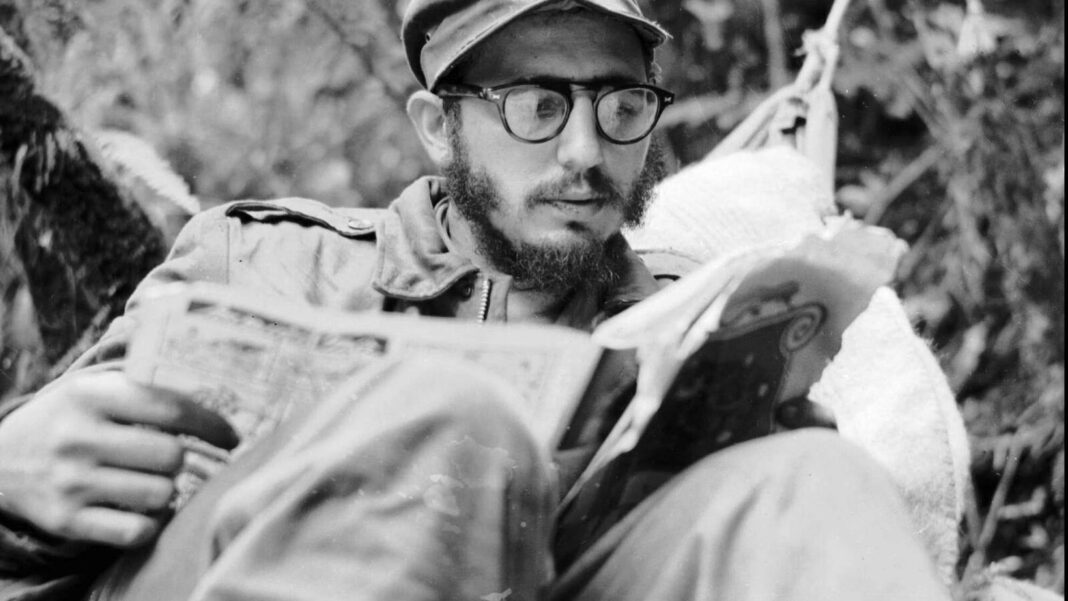

From a young lawyer challenging a dictatorship to the revolutionary leader who ruled Cuba for nearly five decades, Fidel Castro became one of the most controversial and influential figures of the 20th century. His story is one of revolution, resistance, political power, Cold War confrontation and an enduring debate over freedom and authoritarianism.
On August 13, 1926, a boy named Fidel Alejandro Castro Ruz was born in Birán, in eastern Cuba. Almost three decades later, he would launch a revolution that transformed Cuba and dramatically changed its relationship with the United States.The distance between Havana and Washington is only about 145 kilometers. Yet during much of Castro’s rule, those two places represented two opposing political worlds. Washington stood at the center of global capitalism, while Havana became one of the world’s most prominent centers of revolutionary socialism.
For nearly five decades, Fidel Castro stood between those two worlds.He survived the presidencies of 10 U.S. presidents, faced an American-backed invasion, endured decades of economic sanctions and became a central figure in the Cold War. He also built a political system that brought major advances in literacy, education and healthcare while severely restricting political opposition, independent media and civil liberties.That contradiction is at the heart of Fidel Castro’s legacy.
Fidel Castro at a Glance
| Fact | Information |
|---|---|
| Full name | Fidel Alejandro Castro Ruz |
| Born | August 13, 1926 |
| Birthplace | Birán, Cuba |
| Profession | Lawyer, revolutionary, politician |
| Revolutionary movement | 26th of July Movement |
| Cuban Prime Minister | 1959–1976 |
| Cuban President | 1976–2008 |
| Brother | Raúl Castro |
| Political ideology | Marxism-Leninism, Cuban socialism |
| Died | November 25, 2016 |
| Age at death | 90 |
A Privileged Childhood That Shaped a Revolutionary
Fidel was born into a relatively prosperous family. His father, Ángel Castro, was a Spanish immigrant who had initially worked for the United Fruit Company before becoming a successful landowner.Growing up in rural eastern Cuba, Fidel saw both wealth and poverty around him. His family was financially comfortable, but the countryside was marked by sharp social and economic inequality.He received his early education at Catholic and Jesuit schools before moving to Havana to study at the University of Havana.There, his life began to change.At university, Castro became increasingly interested in politics. Cuba was formally a republic, but political corruption, economic inequality and the influence of powerful interests had created deep frustration among many young Cubans.Fidel studied law and eventually became a lawyer.But he would not remain one for long.
From Lawyer to Political Activist
After graduating, Castro began working as a lawyer and became involved in opposition politics. He believed that Cuba’s political system needed fundamental reform.His political ambitions were initially directed toward constitutional and electoral politics rather than armed revolution.In 1952, however, Cuba’s political situation changed dramatically.General Fulgencio Batista seized power in a military coup and cancelled the scheduled elections. Castro considered the takeover a direct violation of Cuba’s constitutional order.For the young lawyer, this was a turning point.Instead of simply arguing political cases in court, he began looking for a way to overthrow Batista.His legal background remained important, however. Castro understood how to use political language, legal arguments and public speeches to build support.The lawyer was slowly becoming a revolutionary.
The Moncada Attack
On July 26, 1953, Castro and a group of young followers launched an attack on the Moncada Barracks in Santiago de Cuba.Their objective was to seize weapons and inspire a broader uprising against Batista.The operation failed.Government forces defeated the attackers, killing many of them. Fidel Castro and his brother Raúl were captured and imprisoned.For many revolutionaries, defeat at Moncada might have meant the end.For Castro, it became the beginning of his national political career.
“History Will Absolve Me”
During his trial, Castro delivered a lengthy defense speech.Instead of focusing only on his own actions, he used the courtroom as a political platform. He criticized Batista’s government and presented his vision for a different Cuba.The speech became known as “History Will Absolve Me.”Castro was sentenced to prison, but his words circulated beyond the courtroom and helped turn him into a recognizable opposition figure.In 1955, Batista granted amnesty to political prisoners. Castro was released.He left Cuba and went to Mexico.There, he began preparing for another attempt at revolution.
Meeting Che Guevara
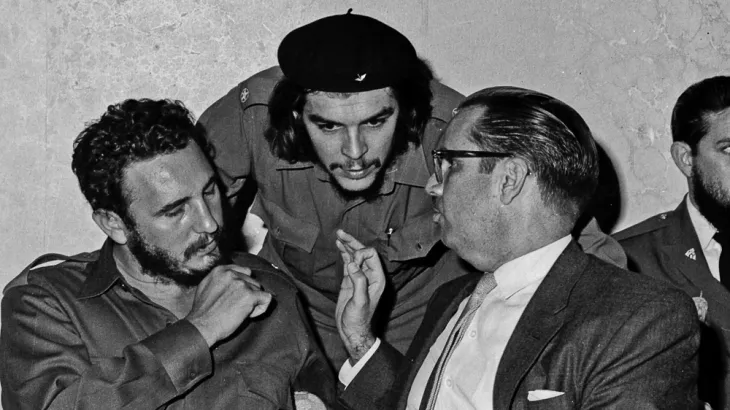
Mexico was also where Fidel Castro met an Argentine doctor and revolutionary named Ernesto “Che” Guevara.Che Guevara was fascinated by Castro’s plan to challenge Batista. The two men became revolutionary partners.Che brought revolutionary ideas, medical knowledge and military commitment to the movement. Castro brought leadership, organization and an ability to build political support.Together with Raúl Castro and other fighters, they prepared for an expedition to Cuba.Their vehicle was a small yacht called Granma.
The Granma Expedition
In November 1956, Castro and his followers sailed from Mexico toward Cuba aboard the Granma.They had hoped to land and quickly organize a major uprising.Instead, the expedition turned into a disaster.Government forces attacked the group soon after its arrival. Many fighters were killed or captured.Only a small number survived.Fidel, Raúl, Che Guevara and the remaining fighters retreated into the Sierra Maestra mountains.It was there that the revolution truly began to take shape.
Guerrilla War in the Sierra Maestra
The Sierra Maestra mountains provided Castro’s fighters with a natural refuge.From there, they launched guerrilla attacks against Batista’s forces.But military action was only part of Castro’s strategy.He also worked to win support among rural communities.The rebels presented themselves as opponents of Batista’s dictatorship and promised political and social change.International media coverage also helped Castro build his image.In 1957, American journalist Herbert Matthews interviewed Castro in the Sierra Maestra for The New York Times. The interview helped introduce Castro and his guerrilla movement to an international audience.Meanwhile, Batista’s government became increasingly unpopular.By 1958, the revolutionary movement had gained enough strength to challenge the government on a national scale.
The Revolution Triumphs
At the end of 1958, Batista’s position collapsed.On January 1, 1959, he fled Cuba.Castro’s forces entered Havana shortly afterward.On January 8, Castro arrived in the capital.He was only 32 years old.The young lawyer who had once challenged Batista in court had now become the leader of a successful revolution.But winning a revolution was only the beginning.The much harder question was what kind of country Castro intended to build.
From Revolution to Socialism
At first, Castro did not publicly present the revolution as a communist takeover.He spoke about restoring democracy and ending dictatorship.But his government soon began implementing sweeping economic and political changes.Large estates were broken up. Land was redistributed. Foreign-owned businesses and industries were nationalized.The government also expanded state control over the economy.Relations with the United States deteriorated rapidly.Washington became increasingly concerned about Cuba’s policies, particularly the nationalization of American-owned assets and Castro’s growing relationship with the Soviet Union.Within a short period, the former allies had become enemies.
The Bay of Pigs Invasion
The confrontation reached a dramatic point in April 1961.A force of approximately 1,400 Cuban exiles, trained and supported by the CIA, attempted to invade Cuba at the Bay of Pigs.The invasion failed within days.Castro’s forces defeated the invading force, and the episode became a major propaganda victory for the Cuban government.For Castro, it proved that his revolution could survive an attack supported by the United States.It also pushed Cuba even closer to the Soviet Union.Later that year, Castro formally declared that Cuba’s revolution was socialist.
The Cuban Missile Crisis
In October 1962, the confrontation became even more dangerous.The United States discovered Soviet nuclear missiles being installed in Cuba.U.S. President John F. Kennedy responded by imposing a naval blockade around the island.For 13 tense days, the world feared that the United States and the Soviet Union could enter a nuclear war.Eventually, Soviet leader Nikita Khrushchev agreed to remove the missiles from Cuba in exchange for arrangements involving U.S. missiles in Turkey and a U.S. commitment not to invade Cuba.The crisis ended peacefully.But Cuba had become one of the most important strategic locations of the Cold War.
Castro and the United States: Decades of Hostility
The relationship between Castro and the United States remained hostile for decades.Washington imposed a broad economic embargo on Cuba.Castro, meanwhile, repeatedly accused the United States of attempting to overthrow his government.American intelligence agencies and other groups were involved in various efforts to destabilize the Cuban government, including assassination plots against Castro. Some stories surrounding the number and details of these plots became part of the mythology surrounding Castro, but U.S. efforts to undermine his government are well documented.Castro survived.Again and again.He outlasted 10 American presidents.For supporters, this became evidence of his extraordinary political resilience.For opponents, it represented the survival of an authoritarian ruler who denied his own people political freedoms.
Education, Healthcare and the Literacy Campaign
One of Castro’s most significant achievements was the transformation of Cuba’s education system.In 1961, the government launched a massive literacy campaign. Thousands of young volunteers and teachers traveled into rural areas to teach people to read and write.The campaign dramatically increased literacy.Education became widely accessible, and the government expanded schools and universities.Healthcare was another major priority.Cuba developed a system emphasizing universal access and preventive medicine. Over time, the country became internationally known for its doctors and healthcare missions abroad.Cuban medical teams were sent to countries in Latin America, Africa and elsewhere.Supporters of Castro point to these achievements as evidence that the revolution improved the lives of ordinary Cubans.
But There Was Another Side
The same government that expanded education and healthcare also restricted political freedoms.Cuba became a one-party state.Independent political opposition was severely limited. Independent newspapers disappeared. Critics of the government faced imprisonment, surveillance or exile.The government established neighborhood-level Committees for the Defense of the Revolution, which helped monitor political activity and identify opposition.Religious institutions also faced restrictions, particularly during the earlier decades of the revolution.Political prisoners became a major source of international criticism.As a result, many Cubans left the country.This created one of the defining contradictions of Castro’s Cuba:The revolution expanded access to some social services while restricting political freedoms.That contradiction continues to shape the debate over Castro’s legacy.
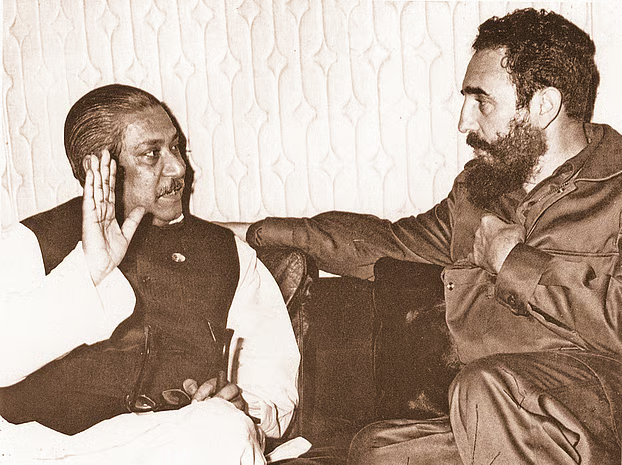
Fidel Castro and Bangabandhu Sheikh Mujibur Rahman
Fidel Castro and Bangabandhu Sheikh Mujibur Rahman first met in 1973 at the Non-Aligned Movement (NAM) summit in Algiers. Their meeting left a strong impression on Castro, who was reportedly deeply moved by Bangabandhu’s personality, courage and leadership. A widely quoted account says that after meeting him, Castro remarked, “I have not seen the Himalayas, but I have seen Sheikh Mujibur Rahman. In personality and courage, he is the Himalayas.” The remark has since become a memorable expression of Castro’s admiration for Bangabandhu. Although the two leaders did not share identical political ideologies, they had common ground in their opposition to colonialism and imperialism and in their support for the rights of oppressed peoples. After Bangladesh’s independence, Cuba under Castro maintained friendly relations with Bangladesh, and Castro remained sympathetic to Bangladesh’s liberation struggle. In 2013, Bangladesh honored him as a foreign friend of the Liberation War with the Muktiyuddho Sammanona, one of the country’s highest state honors for foreign supporters.
The Mariel Boatlift
One of the most dramatic examples of Cuban migration occurred in 1980.After tensions over emigration, the Cuban government allowed large numbers of people to leave through the port of Mariel.Approximately 125,000 Cubans eventually reached the United States in what became known as the Mariel boatlift.The event demonstrated the depth of dissatisfaction among some Cubans while also becoming a major political issue in the United States.It was another reminder that the Cuban Revolution had produced very different experiences for different sections of society.
Castro and Religion
Castro’s relationship with religion also changed over time.In the early decades of the revolution, religious institutions faced restrictions and many religious figures experienced pressure from the state.Relations gradually improved.A symbolic turning point came in 1998, when Pope John Paul II visited Cuba.The visit was historically significant. It showed that Castro’s government was willing to engage more openly with the Catholic Church and the wider international community.Religion remained an important part of Cuban society, even as the revolutionary state maintained its secular and socialist character.
Cuba Beyond Its Borders
Castro did not see the Cuban Revolution as something limited to one island.Cuba supported revolutionary and anti-colonial movements in parts of Africa and Latin America.Cuban forces played a significant military role in Angola during the Cold War.Cuban doctors, teachers and technical experts also worked in many developing countries.For supporters, Cuba’s internationalism demonstrated solidarity with nations struggling against colonialism and inequality.Critics, however, viewed Havana’s foreign interventions as an attempt to export revolution and expand Cuban influence.Once again, Castro’s foreign policy was interpreted in radically different ways.
The Fall of the Soviet Union and the “Special Period”
For decades, Cuba depended heavily on economic ties with the Soviet Union.Then, in 1991, the Soviet Union collapsed.The consequences for Cuba were devastating.The island suddenly lost its main trading partner, sources of subsidized energy and significant economic support.Cuba entered what became known as the Special Period.Food, fuel and other essential goods became difficult to obtain. The economy contracted sharply.Castro’s government was forced to introduce limited economic reforms.Private businesses were permitted in certain areas. Foreign investment was encouraged. Tourism became increasingly important.The government described these changes as temporary measures necessary to preserve socialism.Castro had survived another major crisis.
Why Did Fidel Castro Remain in Power for So Long?
One of the most remarkable aspects of Castro’s political career was its extraordinary longevity.He came to power in 1959 and remained Cuba’s dominant political figure for nearly five decades.Several factors helped explain this.He built a highly centralized political system. The revolutionary government controlled the state, military, media and major parts of the economy.He also cultivated a powerful political identity.For many supporters, Castro represented Cuban independence from foreign domination.His constant confrontation with the United States reinforced that image.Even when Cuba faced severe economic hardship, Castro portrayed his government as defending the country against an overwhelmingly powerful external enemy.His extraordinary ability to communicate with the public was another important factor.His speeches could last for hours.He was famous for speaking at enormous length, discussing history, economics, politics and international affairs.In 1960, his address to the United Nations lasted approximately 269 minutes, becoming one of the longest speeches ever delivered at the organization.
A Revolutionary Becomes a Head of State
Castro gradually transformed from guerrilla commander into head of state.In 1959, he became prime minister.In 1976, Cuba adopted a new constitution, and Castro became president of the Council of State and Council of Ministers.His revolutionary image remained, but his government had become a permanent state structure.This transformation raised a fundamental question:
What happens when a revolution becomes a government?
For Castro’s supporters, the answer was that revolutionary principles had to be protected through a strong state.For his critics, the answer was that the revolution had replaced one form of authoritarianism with another.
Passing Power to Raúl Castro
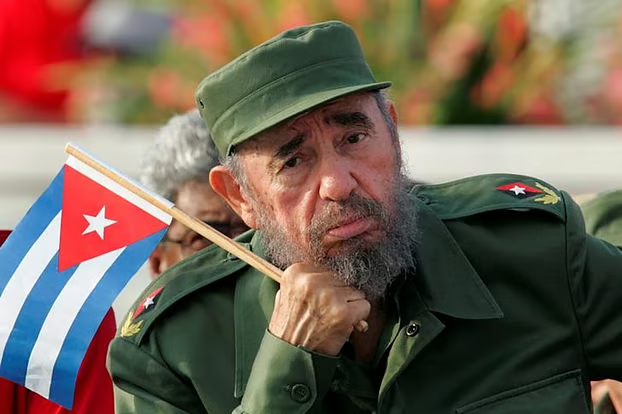
In 2006, Fidel Castro became seriously ill and temporarily transferred power to his younger brother, Raúl Castro.Two years later, in 2008, Fidel formally stepped down as president.Raúl succeeded him.But Fidel did not disappear from public life.He continued writing, commenting on political affairs and offering guidance to the Cuban leadership.Even after leaving office, his influence remained enormous.
The Historic Thaw with the United States
Perhaps one of the most remarkable developments near the end of Castro’s life was the improvement in relations between Cuba and the United States.On December 17, 2014, U.S. President Barack Obama and Cuban President Raúl Castro announced that the two countries would move toward restoring diplomatic relations.In 2015, diplomatic relations were formally restored.The United States reopened its embassy in Havana, and Cuba reopened its embassy in Washington.The Cold War-era hostility had begun to thaw.Fidel Castro was cautious about the rapprochement, but the change was nevertheless historically significant.After decades of confrontation, the two countries were finally beginning to talk to each other again.
The Final Years
Fidel Castro spent his final years largely away from formal political power.He continued to publish reflections and occasionally appeared in public.In April 2016, at the Communist Party Congress, he spoke about his age and mortality.He was nearly 90.Only a few months later, on November 25, 2016, Fidel Castro died.He was 90 years old.His death marked the end of one of the longest political careers of the modern era.
Fidel Castro: Hero or Dictator?
Few historical figures generate such sharply divided opinions.To his supporters, Castro was a revolutionary hero who freed Cuba from Batista’s dictatorship, resisted American pressure, expanded education and healthcare, supported anti-colonial struggles and defended Cuban sovereignty.To his opponents, he was an authoritarian ruler who eliminated political competition, censored the media, imprisoned dissidents and forced hundreds of thousands of Cubans into exile.Both sides point to real parts of his record.That is why reducing Castro to either a perfect revolutionary hero or a simple villain fails to explain his historical importance.He was both a revolutionary and a ruler.He fought against dictatorship and later built a political system that critics described as authoritarian.He challenged a superpower while depending heavily on another.He expanded social services while restricting political freedoms.He promoted Cuban independence while creating close ties with the Soviet Union.His legacy is therefore full of contradictions.
Fidel Castro’s Lasting Legacy
More than a century after his birth, Fidel Castro remains one of the most recognizable political figures in modern history.His revolution transformed Cuba.It changed the balance of power in the Caribbean.It became a symbol of resistance for revolutionaries across Latin America and beyond.It helped turn the Cold War into a global struggle with a nuclear flashpoint just off the coast of the United States.At the same time, Castro’s government left behind difficult questions about democracy, human rights, political freedom and the limits of revolutionary power.Perhaps that is why the historical debate over Fidel Castro remains unfinished.He proved that a small country could stand up to a superpower and pursue an independent political path.
But his story also raises another question:
When a revolution captures state power, can it preserve the ideals of liberation without creating new forms of control?
That question lies at the heart of Fidel Castro’s legacy.
The young lawyer who once stood before a courtroom challenging a dictator eventually became the leader of a revolution, the head of a socialist state and one of America’s most determined adversaries.Fidel Castro died in 2016.The revolution survived him.And the debate over what that revolution ultimately achieved—and what it cost—continues.
Fidel Castro Timeline
1926 — Fidel Castro is born in Birán, Cuba.
1945–1950 — Studies law at the University of Havana and becomes politically active.
1952 — Fulgencio Batista seizes power in a military coup.
1953 — Castro leads the failed attack on the Moncada Barracks.
1955 — Released from prison under an amnesty and leaves for Mexico.
1956 — Returns to Cuba aboard the Granma with a group of revolutionaries.
1956–1958 — Leads guerrilla warfare from the Sierra Maestra.
1959 — Batista flees Cuba; Castro’s revolution takes power.
1961 — Castro declares the Cuban Revolution socialist; the Bay of Pigs invasion fails.
1962 — Cuban Missile Crisis brings the world close to nuclear confrontation.
1976 — Castro becomes president of Cuba’s Council of State and Council of Ministers.
1980 — Mariel boatlift sends approximately 125,000 Cubans to the United States.
1991 — Collapse of the Soviet Union triggers Cuba’s “Special Period.”
1998 — Pope John Paul II visits Cuba.
2006 — Castro temporarily transfers power to Raúl Castro due to illness.
2008 — Fidel Castro formally steps down as president.
2014 — Cuba and the United States announce a historic rapprochement.
2015 — Washington and Havana formally restore diplomatic relations.
2016 — Fidel Castro dies at the age of 90.
Final Thought
Fidel Castro’s life began with a law degree and a belief that Cuba’s political system could be challenged through legal and political action.It ended with him remembered as one of the world’s most consequential revolutionaries.Between those two points lay prison, guerrilla warfare, revolution, socialism, Cold War confrontation, economic crisis, international intervention, political repression, social reforms and decades of resistance.
That journey—from lawyer to revolutionary, from revolutionary to ruler, and from ruler to historical symbol—is what makes Fidel Castro’s story impossible to ignore.