
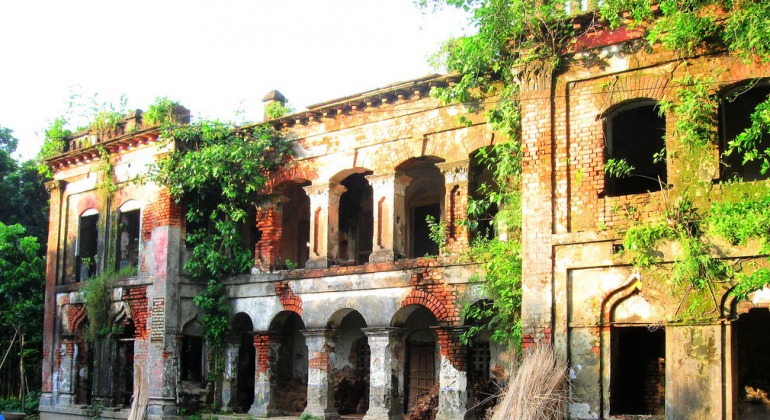

In the quiet village of Mujdia in Sreepur, Magura, stands an old two-storey house that carries the memory of one of Bengal’s remarkable poets and educators. Known locally as the house of Kazi Kader Newaz, the building is more than an ageing structure. It is closely connected with the later life of a poet whose writings inspired generations of Bengali readers and whose poem Shikkhagurur Morjada (“The Dignity of a Teacher”) became familiar to generations of schoolchildren.
Today, the house is recognised as a heritage attraction in Sreepur. Yet its weathered walls also tell a story of Partition, migration, education, literature and the changing history of Bengal.
Where Is Kazi Kader Newaz’s House?
Kazi Kader Newaz’s historic residence is located in Mujdia village, Sreepur Upazila, Magura, Bangladesh. According to the Sreepur Union government website, the house stands beside the main road of Mujdia, about one kilometre east of Sreepur Upazila headquarters.
The house is officially recognised as a tourist spot by the local administration. Its association with the poet makes it a place of interest not only for literary enthusiasts but also for visitors interested in Bangladesh’s cultural heritage.
The building is an old, palace-like two-storey structure. Although time and neglect have taken a considerable toll on it, the house still preserves an atmosphere associated with the final chapter of Newaz’s life.
How Did the Poet’s Family Come to Mujdia?
The story of the house is closely connected with the upheaval caused by the Partition of British India in 1947.
Kazi Kader Newaz was born in what is now West Bengal, while his ancestral home was in Mangalkot in Burdwan district. After Partition, he moved to what was then East Pakistan. Sources report that in 1948, his family acquired the Mujdia property through an exchange of property with a local Hindu landowning family.
This makes the house particularly interesting from a historical perspective. It was not the poet’s birthplace. Instead, it became connected with him because of the enormous political and social transformation that followed Partition.
The house therefore represents more than the personal history of one writer. It is also a physical reminder of the movement of families across Bengal during one of the most consequential periods in the region’s history.
From West Bengal to East Pakistan
Kazi Kader Newaz was born on 15 January 1909 at Talibpur in Murshidabad, where his maternal family lived. His ancestral home was in Mangalkot in present-day Burdwan district.
He grew up in an intellectually stimulating environment and developed an interest in literature from an early age. He passed the matriculation examination from Mathrun High English School in Burdwan in 1923. He subsequently studied at Behrampur College and completed a BA with Honours in English. He later studied English at Calcutta University and completed teacher training.
His education was important to his later career. Newaz was not simply a poet who wrote in his spare time. He was a professional educator whose literary identity developed alongside his long career in teaching.
After Partition, he came to East Pakistan and joined the teaching profession in Dhaka. The Sreepur Upazila government website records that he joined Nawabpur Government School and later became assistant headmaster before taking charge as headmaster of Dinajpur Zilla School.
He eventually retired from government school service in 1966.
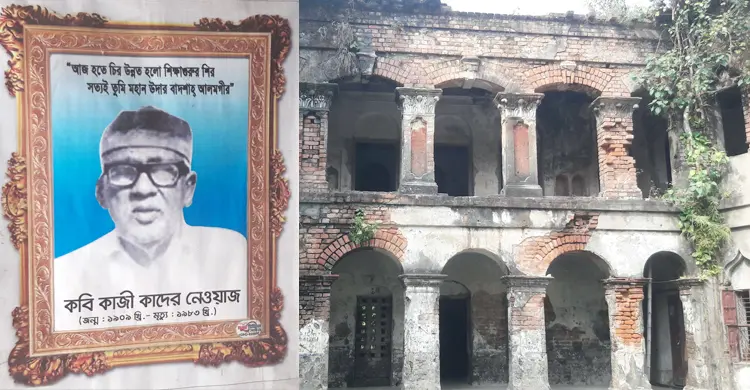
The House Became His Permanent Home
Retirement did not take Kazi Kader Newaz away from education or from the place that had become his home.
After retiring in 1966, he moved to Mujdia in Sreepur, Magura, and began living permanently in the house associated with his family.
Interestingly, his retirement from government service did not mean the end of his teaching career. Reports state that he subsequently served as headmaster of Mahesh Chandra Pilot Secondary School in Sreepur from 1966 to 1974.
This chapter of his life reveals something important about his personality: teaching was not merely a profession for him. It remained a significant part of his life even after his formal retirement.
The Mujdia house therefore became both a family residence and a place associated with his literary and educational activities.
A Poet Who Was Also a Teacher
Kazi Kader Newaz occupies a distinctive position in Bengali literature because of the combination of his literary work and his career as an educator.
He wrote poetry, children’s literature, stories and other forms of writing. According to Banglapedia, his principal literary interest was poetry, and his subjects included love, nature and patriotism.
He was also influenced by Rabindranath Tagore, but developed a style of his own. His writing often combined rhythm, accessible language and moral or emotional themes, making many of his works especially suitable for younger readers.
His literary contributions appeared in a number of periodicals, including Bikash, Shishushathi, Bharatbarsha, Basumati, Shuktara, Pathshala, Ramdhanu, Shishmahal, Mouchak, Probashi and Saugat.
The Poet Behind “The Dignity of a Teacher”
For many Bangladeshi readers, Kazi Kader Newaz is particularly memorable because of “Shikkhagurur Morjada” (The Dignity of a Teacher).
The poem presents the teacher as a figure deserving respect and highlights the importance of learning and knowledge. Its emphasis on the relationship between teacher and student helped make it particularly meaningful in school education.
For generations of Bangladeshi students, encountering the poem in school was often an introduction to the name Kazi Kader Newaz.
His children’s writings similarly combined literary enjoyment with values such as respect, responsibility, compassion and love for others.
His Major Literary Works
Kazi Kader Newaz published several books during his lifetime. Among the works associated with him are:
- Maral (1936)
- Dadur Baithak (1947)
- Nil Kumudi (1960)
- Duti Pakhi Duti Tara (1966)
- Manidvip
- Utala Sandhya
- Kaler Hawa
- Maruchandrika
Banglapedia identifies Maral, Dadur Baithak, Nil Kumudi and Duti Pakhi Duti Tara among his published works and also lists several other works associated with his literary career.
His writings covered different literary forms, but poetry remained central to his creative identity.
His Recognition and Awards
Newaz’s contribution to Bengali literature was recognised during his lifetime.
He received the Bangla Academy Award, as well as the President’s Award and Madar Baksh Award.
His literary reputation extended beyond his books. His identity as a teacher, poet and children’s writer helped him maintain a special place in Bengali cultural memory.
Kazi Kader Newaz and the Liberation War
The Mujdia chapter of his life also connects him with the history of Bangladesh’s Liberation War.
According to the Sreepur Upazila government’s account, Kazi Kader Newaz extended his wholehearted support to the freedom fighters during the 1971 Liberation War.
This aspect of his life adds another dimension to the history of the house. The building was not merely a private residence during the final decades of his life; it belonged to a period when the political identity of the land around it was undergoing a historic transformation.
What Does the House Look Like Today?
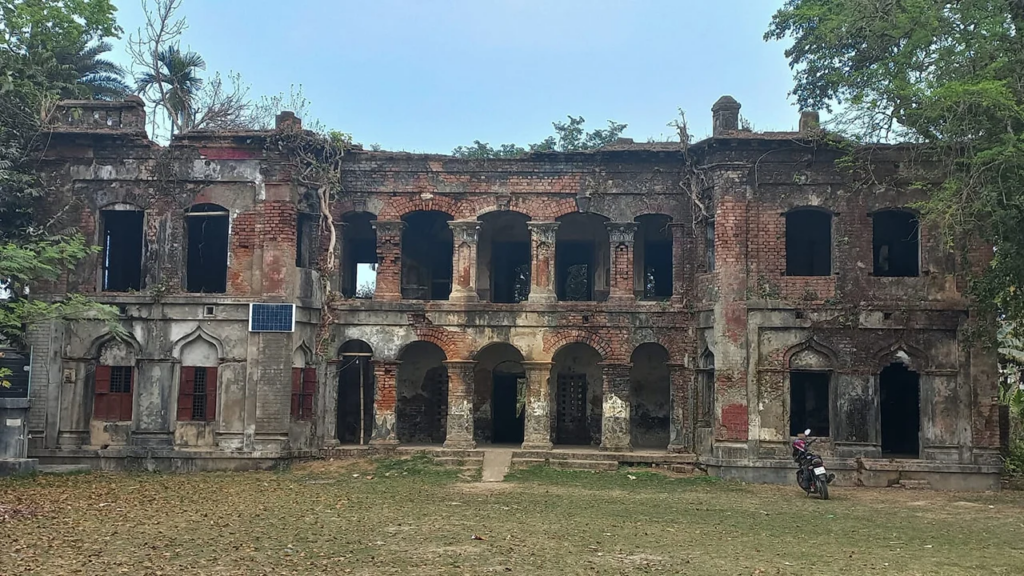
The house was once described as a grand, palace-like two-storey residence. Today, however, its condition is a cause for concern.
Reports in recent years have described the building as deteriorating because of prolonged neglect. Parts of the plaster and brickwork have fallen away, while doors and windows have reportedly disappeared over time.
The condition of the building illustrates a familiar problem in Bangladesh: many structures associated with important writers, artists and historical figures survive physically but receive limited conservation.
The house of Kazi Kader Newaz is therefore both a heritage site and a warning. If historical buildings are not properly maintained, eventually it becomes difficult to preserve not only the structure but also the stories associated with it.
A Library in the Poet’s House
There has also been an effort to keep the poet’s memory alive through literary activities.
A report notes that, since 2013, one room on the ground floor of the old residence has been used as a temporary office for the Kazi Kader Newaz Memorial Library.
Such initiatives are important because heritage preservation is not only about repairing walls. A literary memorial becomes meaningful when young people can learn about the person whose life and work are being remembered.
A functioning library, reading room or small museum could potentially transform the house into a much more significant cultural destination for students and literature lovers.
The Poet’s Final Years
After retiring from government service in 1966, Newaz spent his later years in Mujdia. He continued his connection with education and remained involved in literary activities.
He died on 3 January 1983. Banglapedia records his death in Jessore.
His death marked the end of the life of a writer whose career had crossed several historical eras—from British India and Partition to East Pakistan and the emergence of Bangladesh.
The house in Mujdia remains one of the strongest physical reminders of his later years.
Why Is This House Important?
At first glance, the house may appear to be simply an old building in a rural part of Magura. But its significance becomes clearer when its different layers of history are considered.
First, it is connected with a major Bengali poet. Kazi Kader Newaz’s writings remain part of the literary memory of generations of readers.
Second, it represents the history of Partition. His family’s connection with Mujdia came after the enormous demographic and political changes of 1947.
Third, it represents the history of education. Newaz spent much of his professional life teaching and serving as a headmaster.
Fourth, it is connected with Bangladesh’s Liberation War. Local government sources record his support for freedom fighters in 1971.
Finally, it is a piece of endangered cultural heritage. Its deteriorating condition raises questions about how Bangladesh preserves places associated with its writers and intellectuals.
Visiting Kazi Kader Newaz’s House
The house is located in Mujdia village, Sreepur, Magura, approximately one kilometre east of Sreepur Upazila headquarters. The local government describes the site as a tourist attraction.
Visitors travelling from Magura can reach Sreepur and then continue towards Mujdia. Local transport can be used for the final part of the journey.
Because the building is old and reportedly in a fragile condition, visitors should treat the site as a heritage structure rather than an ordinary tourist attraction. Respecting the property and avoiding damage to the remaining structure are essential.
A House That Deserves to Be Remembered
There is something deeply symbolic about Kazi Kader Newaz’s house in Mujdia.
The poet was born in present-day West Bengal but eventually made Bangladesh his home. His ancestral roots were in one part of Bengal, his professional life took him through different cities, and his later years were spent in a village in Magura.
His life therefore reflects the complicated history of Bengal itself.
The house preserves the memory of that journey.
Its walls have witnessed the final decades of a poet’s life. Its history is connected with Partition, education, literature and the Liberation War. Yet the building is now slowly losing the physical form through which future generations might encounter that history.
For today’s teenagers, the story of Kazi Kader Newaz offers an important lesson: heritage is not only about famous monuments or grand palaces. Sometimes a modest, ageing house can preserve the story of an entire generation.
Kazi Kader Newaz’s Mujdia residence deserves to be seen not simply as an old poet’s house, but as a literary and historical landmark of Bangladesh.
Preserving it would mean preserving a tangible link to a poet who devoted his life to both literature and education—and whose words once travelled into the classrooms and childhood memories of countless Bengali readers.
Neglected and left without proper care for years, the historic house in Magura—the last surviving landmark associated with one of the most celebrated figures in Bengali literature, the metrical poet Kazi Kader Newaz—is now standing on the verge of destruction.
If proper initiatives are taken to preserve the house with adequate patronage and institutional support, future generations will have the opportunity to learn about the life, literary excellence, humanistic vision, political consciousness and patriotism of this immensely popular Bengali poet.
About 15 kilometres north of Magura town lies the headquarters of Sreepur Upazila. From there, a winding, tree-shaded road runs for about one kilometre along the bank of the Kumar River before reaching the village of Mujdia. Beside the paved village road lies the family graveyard where Kazi Kader Newaz, the creator of timeless and widely loved poems such as Shikkhagurur Morjada (“The Dignity of a Teacher”), Ma (“Mother”) and Harano Topi (“The Lost Cap”), rests in eternal sleep.
About 100 metres away, on the left side of the road leading towards Kajli Bazar, the poet’s historic residence still stands as a proud witness to a glorious past. Its crumbling plaster, however, reveals the extent of neglect the house has suffered.
Built on approximately 99 decimals of land, the two-storey residence is damp throughout. Constructed with bricks, timber, lime and traditional mortar, the building has numerous cracks in almost every corner of its roof. Tiles have fallen away from several places, while the frames of all the doors and windows have disappeared. Only the skeletal structure of the house remains standing, silently bearing witness to the passage of time.
Even after the poet’s death on 3 January 1983, members of his family continued to live in the house until 2002. Most of them, however, now live outside the district, in places such as Dhaka and Khulna. There have also been allegations that a local group has been attempting to take control of the property, which covers a substantial area of land.
The Life of Kazi Kader Newaz
The celebrated Bengali poet Kazi Kader Newaz was born on 15 January 1909 at his maternal grandparents’ home in Talibpur village of Murshidabad district. His ancestral home was in Mangalkot village of the then undivided Bengal’s Burdwan district.
His father was Kazi Allah Newaz and his mother was Fatemu Nessa. In 1918, he enrolled at Mathrun English School in Burdwan. He passed his BA examination from Behrampur in 1929 and later earned a master’s degree in English literature.
Newaz began his professional career in 1933 as a school sub-inspector. He later served for many years as an English teacher at Calcutta Alia Madrasa.
Following the Partition of India in 1947, he moved to what was then East Pakistan, now Bangladesh. During this period, his family acquired the house and a substantial amount of land through a property exchange with a Hindu family headed by Dakshina Ranjan Joardar.
After coming to East Pakistan, the poet initially joined Nawab Kumar Institution in Dhaka’s Nawabpur area. In 1951, he joined Dinajpur Government High School as its headmaster.
He retired from the school in 1966 and returned to Magura. He then began living permanently in his family home in Mujdia village of Sreepur Upazila. During this period, he also took charge as headmaster of Sreepur Mahesh Chandra Pilot High School.
His Literary Journey
Kazi Kader Newaz began writing poetry at a very young age. According to accounts of his literary career, his first poem, Swadesh Priti (“Love of the Homeland”), was published in the magazine Bikash in 1921, encouraged by his teacher Dwija Babu.
In 1923, another poem titled Ghumparaniya Gaan (“A Lullaby”) was published in the monthly children’s magazine Shishu Sathi. Following its publication, his reputation began to spread among literary circles.
His poem Ma (“Mother”), published in the same magazine, reflected his deep love and devotion towards his mother. The opening lines describe “mother” as a very small word, yet one whose sweetness, according to the poet, has no equal in the three worlds.
His first poetry collection, Maral, was published from Kolkata in 1934. Another collection, Nil Kumudi, was published from Dinajpur in 1960.
Among his published novels are Utala Sandhya, published in 1947, and Duti Pakhi Duti Tire, published in 1973.
During his lifetime, Newaz saw his poems become part of the school curriculum for students of different grades across the country. His poem Harano Topi (“The Lost Cap”) was also included in the curriculum of the University of Calcutta.
There is an amusing story associated with the poem. During an examination, the question paper contained an excerpt from his own poem and asked students to explain its meaning. The poet himself reportedly had to pass the examination by writing the summary of his own poem.
The poem Harano Topi became widely popular for its humorous and engaging treatment of an apparently simple subject—the loss of a favourite cap.
A Poet Who Deserves to Be Remembered
Prominent Magura poet and columnist Sagar Zaman says that it is a matter of great pride for the region that the footsteps of such a gifted poet were once firmly planted there. Yet, he observes, Kazi Kader Newaz has now become almost a forgotten name.
According to rhymester and journalist Abu Saleh, Newaz demonstrated his talent in almost every branch of literature. He reportedly published his first poem in the magazine Moslem Bharat at the age of only 14 in 1923.
After the publication of Harano Topi, appreciation for his work spread throughout literary circles across India. According to Abu Saleh, Rabindranath Tagore also praised Kazi Kader Newaz for the poem.
The historic residence associated with such a distinguished figure of Bengali literature is therefore more than just an old building. It is a part of the region’s literary heritage and a physical link to the life of a poet whose writings influenced generations of readers.
Preserving the house is consequently not merely a matter of protecting an ageing structure. It is about protecting a part of Bengal’s literary history.
A Family Ready to Help Preserve the House
Kazi Kader Newaz had no children of his own.
His nephew Kazi Majed Newaz, son of the poet’s brother Kazi Malek Newaz and Director (Programme) of Jagorani Chakra Foundation, says the family is willing to cooperate if a genuine initiative is taken to preserve the house.
He has stated that if the government’s Department of Archaeology wants to acquire the property for preservation, the family would certainly extend its cooperation.
The willingness of the family to support such an initiative creates an opportunity for the historic residence to be rescued before it is too late.
The house of Kazi Kader Newaz is not simply a decaying building in a village of Magura. It is a place connected with the life of a poet, teacher and literary figure whose works became part of the cultural and educational memory of Bengal.
Its preservation would give future generations an opportunity to walk through a tangible piece of literary history—and to discover once again the life and legacy of Kazi Kader Newaz.