
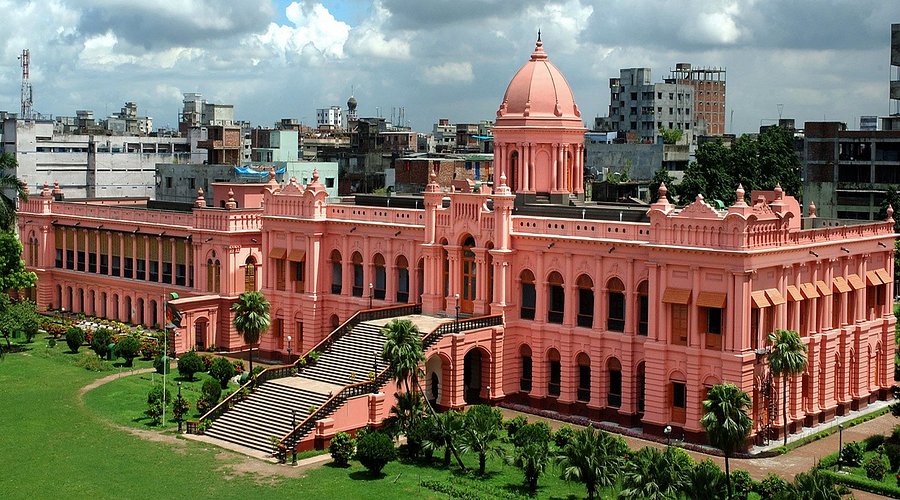

Standing proudly beside the Buriganga River in the heart of Old Dhaka, Ahsan Manzil is one of Bangladesh’s most recognizable historical landmarks. With its distinctive pink façade, grand dome, sweeping staircase and elegant riverfront setting, the palace is often called the “Pink Palace” of Dhaka.
But Ahsan Manzil is much more than a beautiful old building.
For much of the 19th and early 20th centuries, it was the centre of political, social and cultural life surrounding the Nawab Family of Dhaka. Important political discussions took place here, distinguished British officials visited the palace, and the activities of the Dhaka Nawabs were closely connected with the political development of Muslim society in Bengal.
The palace also witnessed the rise of Nawab Sir Khwaja Salimullah, one of the most influential Muslim political figures of the early 20th century. Ahsan Manzil is particularly significant because the political activities surrounding the Dhaka Nawab family contributed to the emergence of the All-India Muslim League.
Today, the palace is preserved as the Ahsan Manzil Museum, allowing visitors to explore the lifestyle, architecture and history of one of the most powerful aristocratic families in colonial Bengal.
Quick Facts About Ahsan Manzil
| Fact | Details |
|---|---|
| Name | Ahsan Manzil |
| Popular Name | Pink Palace |
| Location | Kumartoli, Old Dhaka, Bangladesh |
| River | Buriganga |
| Associated Family | Nawab Family of Dhaka |
| Major Builder | Nawab Khwaja Abdul Ghani |
| Construction of Present Palace | 1859–1872 |
| Named After | Khwaja Ahsanullah |
| Architectural Character | Indo-European / Indo-British |
| Major Damage | 1888 tornado and 1897 earthquake |
| Government Acquisition | 1985 |
| Museum Opened | 20 September 1992 |
| Present Function | Historical museum |
The present palace was constructed between 1859 and 1872 under Nawab Khwaja Abdul Ghani and was named after his son, Khwaja Ahsanullah. The building was later restored and transformed into a museum under the Bangladesh National Museum.
Where Is Ahsan Manzil?
Ahsan Manzil is located in Kumartoli in Old Dhaka, directly beside the Buriganga River.
Its riverside location was an important part of its original identity. During the 19th century, the Buriganga was one of the principal transportation routes of Dhaka, and important aristocratic residences and commercial establishments developed along its banks.
The palace’s grand southern staircase once provided a dramatic approach from the riverfront. The relationship between the building, garden and river was an important part of the visual character of the complex.
Today, the surrounding area is much more densely developed than it was during the Nawab period. Yet the palace continues to dominate the riverside landscape of Old Dhaka.
The Story Before Ahsan Manzil
The history of Ahsan Manzil actually begins before the palace itself was constructed.
During the Mughal period, the site was associated with the garden house of Sheikh Enayetullah, a zamindar of the Jalalpur area. Later, his son Sheikh Matiullah sold the property to French traders.
The French established a trading centre on the site, creating a connection between the location and the commercial world of colonial-era Dhaka.
In 1830, Khwaja Alimullah purchased the French trading establishment at Kumartoli and converted it into his residence. This building later became the nucleus around which the famous Ahsan Manzil complex developed.
This is an important part of the palace’s history because Ahsan Manzil was not created on an empty site. Instead, the later Nawab palace evolved from an earlier residence that had already passed through Mughal, French and local aristocratic phases.
Khwaja Alimullah and the Beginning of the Nawab Family
Khwaja Alimullah is regarded as the founder of the Nawab Family of Dhaka.
He was a successful businessman and landowner who accumulated substantial property in and around Dhaka and other parts of Bengal. His purchase of the French trading house in 1830 gave the family an important residence beside the Buriganga.
After Alimullah’s death in 1854, his son Khwaja Abdul Ghani emerged as one of the most influential zamindars in East Bengal.
Abdul Ghani expanded the family’s wealth and influence and played an important role in the development of Dhaka.
It was during his time that the palace took the form that would eventually become famous as Ahsan Manzil.
Construction of the Present Ahsan Manzil
The construction of the present palace began in 1859 and was completed in 1872.
Nawab Abdul Ghani engaged the European construction and engineering firm Martin & Company to prepare the master plan for the residence. The resulting architecture reflected the influence of European styles while retaining elements suited to the climate and traditions of Bengal.
Abdul Ghani named the palace Ahsan Manzil after his beloved son, Khwaja Ahsanullah.
At the time, the newly constructed eastern palace was known as the Rang Mahal, while the older western section was known as the Andar Mahal.
This distinction is important because the Ahsan Manzil complex was not originally a single building constructed at one time. It developed through different phases of construction and reconstruction.
Why Is Ahsan Manzil Called the Pink Palace?
The most recognizable feature of Ahsan Manzil is its striking pink exterior.
Because of its distinctive colour, the palace became popularly known as the Pink Palace.
The pink façade, combined with the large dome and monumental staircase, gives the building an appearance unlike most other historic structures in Dhaka.
The architecture reflects the 19th-century tendency of wealthy landowners and aristocratic families in Bengal to incorporate European architectural ideas into their residences.
The result at Ahsan Manzil is not purely European and not purely traditional Bengali or Mughal.
Instead, it represents a fascinating Indo-European architectural synthesis.
The Architecture of Ahsan Manzil
Ahsan Manzil was constructed on a raised platform and consists of a two-storey palace with a symmetrical plan.
The building is approximately 125.4 metres long and 28.75 metres wide. The ground floor is about five metres high, while the first floor reaches approximately 5.8 metres in height.
The palace has large verandas on both floors, supported by arches. Its monumental southern approach, grand staircase and central dome create a strong visual axis facing the river.
The building is divided internally into two major wings on either side of the central dome.
This symmetry is one of the defining characteristics of the palace.
The Famous Dome
The dome is perhaps the single most recognizable architectural feature of Ahsan Manzil.
The structure beneath the dome begins with a square room. Brickwork was used to transform the square into a rounded form, followed by an octagonal transition near the roof. This octagonal structure becomes the drum of the dome.
From there, the eight sides gradually rise toward the top, producing the distinctive lotus-bud-like form of the dome.
The dome reaches approximately 27.13 metres above ground level.
When viewed from the Buriganga, the dome creates the iconic silhouette that has become inseparable from the identity of Old Dhaka.
Rang Mahal and Andar Mahal
The palace historically consisted of two principal sections.
The Rang Mahal, the eastern section, was the principal new palace constructed under Nawab Abdul Ghani.
The Andar Mahal, or inner section, incorporated the older part of the complex.
The two sections had different functions and architectural histories.
The Rang Mahal contained the grander public and ceremonial spaces, while the Andar Mahal was associated more closely with the residential life of the household.
The Ahsan Manzil Museum’s historical documentation notes that the western Andar Mahal was originally connected with the older French construction on the site.
The Grand Staircase
One of the most impressive features of Ahsan Manzil is the broad staircase on the southern side.
The staircase descends from the southern portico toward the garden and historically provided an imposing approach to the palace from the riverside.
Visitors today can easily appreciate why the riverfront position was so important to the palace’s design.
Imagine arriving at the Nawab’s residence by boat on the Buriganga and approaching a massive staircase leading toward a monumental pink palace crowned by a large dome.
The setting was designed to communicate wealth, status and authority.
The Durbar Hall
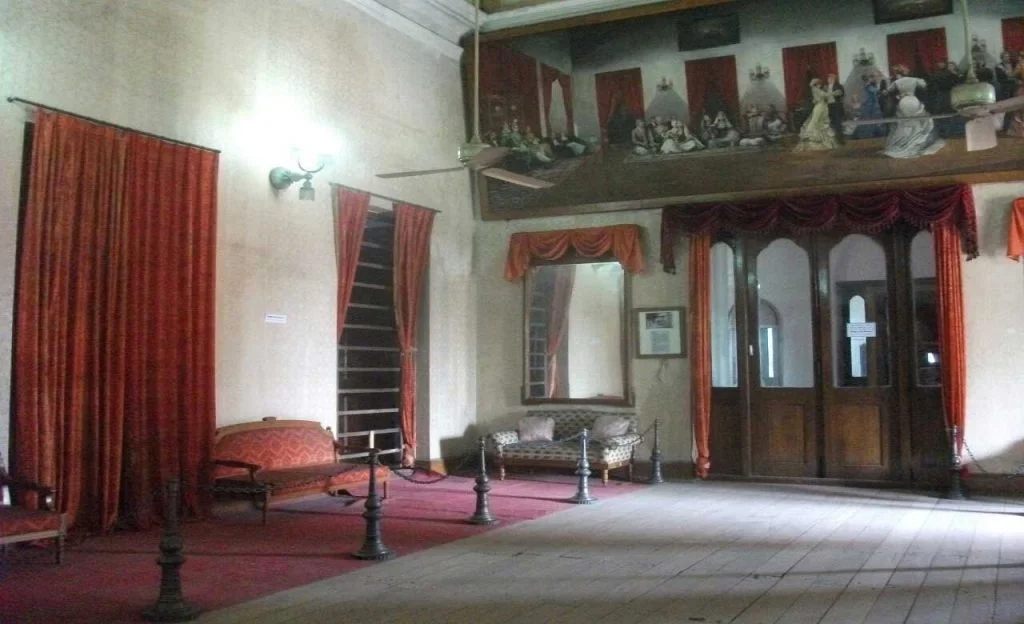
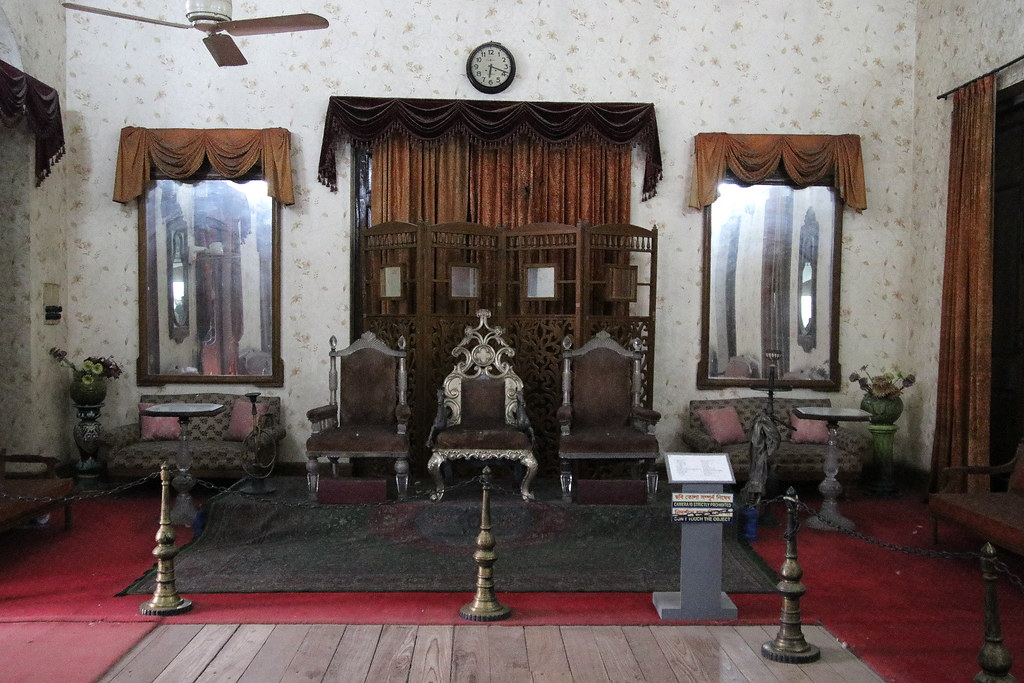
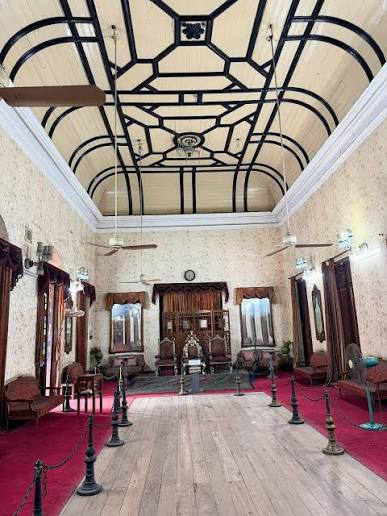
The Durbar Hall was one of the most important rooms in Ahsan Manzil.
It was used for formal gatherings and ceremonial occasions and reflected the social and political importance of the Nawab family.
The room’s scale and decoration demonstrate that Ahsan Manzil was not simply a private family residence.
It was also a place where officials, dignitaries, political figures and members of elite society could gather.
The palace’s political role is one reason why its history extends far beyond architecture.
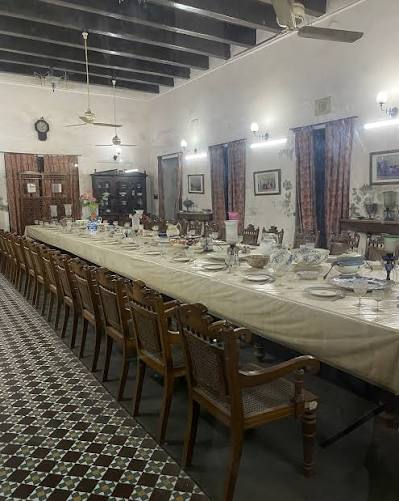
The Dining Hall
A large dining hall was located on the ground floor.
The dining and Durbar halls were decorated with coloured ceramic tiles, including white, green and yellow designs.
Such spaces provide an insight into the lifestyle of the Nawab family and the formal social culture of the 19th-century aristocracy.
Grand meals, official receptions and social gatherings were part of the life of a household that maintained close connections with both local elites and British colonial officials.
The Jalsaghar
Another important room was the Jalsaghar, or music and entertainment hall.
It was located on the western side of the first floor and was associated with the cultural life of the palace.
The Nawab family maintained a reputation for patronage of music, literature and the arts.
Khwaja Abdul Ghani, in particular, was known for supporting poets, singers and cultural activities.
The Jalsaghar therefore represents an important dimension of Ahsan Manzil that is sometimes overlooked when the palace is discussed simply as a political building.
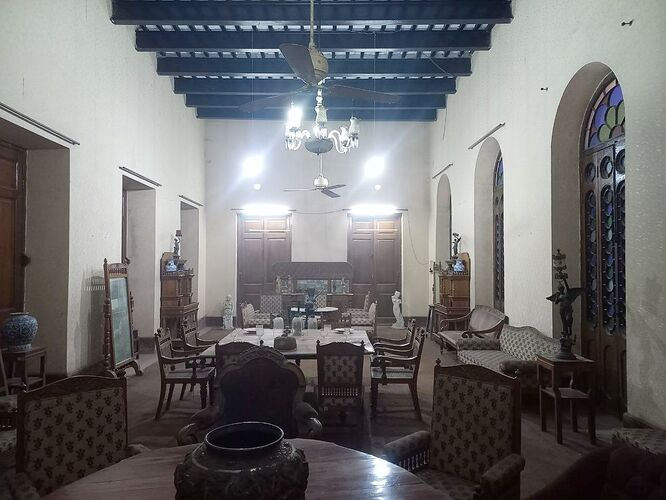
The Drawing Room and Library
The first floor also contained a large drawing room, library and card room.
These spaces reflected the changing lifestyle of the Bengali aristocracy during British rule.
The Nawab family interacted extensively with British officials and other influential communities, and European cultural influences became increasingly visible in elite domestic life.
Ahsan Manzil’s architecture and interior arrangement provide a physical record of this cultural transition.
The Billiard Room
The palace also had a billiard room.
Billiards was a popular recreational activity among the colonial-era elite, and its presence at Ahsan Manzil illustrates the combination of local aristocratic traditions and European-influenced social practices.
Together with the drawing room, card room, library and Jalsaghar, the billiard room demonstrates that the palace functioned as a sophisticated social centre.
The Strong Room
One of the most intriguing rooms in the palace was the strong room.
The Nawabs were extremely wealthy landowners, and valuable possessions had to be stored securely.
The famous strong room was located in the western half of the ground floor and was used for keeping valuables belonging to the Nawab family.
Today, the room contributes to the visitor’s understanding of the wealth and economic power once associated with the Dhaka Nawab Estate.
The Tornado of 1888
Ahsan Manzil suffered a major disaster on 7 April 1888, when a powerful tornado struck Dhaka.
The Andar Mahal was particularly badly damaged.
The older western section was largely destroyed, after which it was rebuilt. During the reconstruction, the famous dome was erected over the palace. Bricks of good quality were brought from Raniganj for the repair and rebuilding work.
This means that the Ahsan Manzil seen today is partly the product of 19th-century reconstruction rather than simply the untouched palace completed in 1872.
The Earthquake of 1897
A second major disaster came with the 1897 earthquake.
The palace suffered significant damage, but Nawab Khwaja Ahsanullah undertook repairs.
The earthquake and subsequent reconstruction are important because they demonstrate how historic buildings can evolve through repeated cycles of damage and restoration.
Ahsan Manzil’s present appearance therefore reflects several historical periods rather than one single moment in time.
Nawab Abdul Ghani and the Development of Dhaka
Nawab Khwaja Abdul Ghani was much more than the builder of Ahsan Manzil.
He was one of the most influential landowners in East Bengal and was active in charitable, cultural and civic activities.
He created or supported gardens and parks, including Shahbagh Garden and Dilkusha Garden, and contributed to the development of Dhaka’s urban environment.
He also supported poets, singers and other cultural figures.
His activities demonstrate the broader influence that wealthy zamindars could have on the social and cultural development of 19th-century cities.
Ahsan Manzil and British Officials
The palace became an important location for interactions between the Dhaka Nawabs and the British colonial administration.
Several prominent British officials visited Ahsan Manzil.
In 1874, Lord Northbrook, the Governor-General of India, attended an evening function at the palace during his visit to Dhaka.
In 1888, Lord Dufferin also accepted the hospitality of the Nawab family.
In 1904, Lord Curzon stayed at Ahsan Manzil on 18 and 19 February during his visit to East Bengal, at a time when the proposed Partition of Bengal was generating political debate.
These visits demonstrate the political importance of the palace during the colonial era.
The Rise of Khwaja Ahsanullah
The palace was named after Khwaja Ahsanullah, the son of Abdul Ghani.
Born in Dhaka in 1846, Ahsanullah became responsible for managing the family estate at a relatively young age.
He was interested in literature and music and was known for supporting writers and poets.
He also played a role in civic affairs in Dhaka.
The palace named after him became the symbolic centre of the family during a period when the Nawabs were among the most powerful Muslim aristocrats in Bengal.
Ahsan Manzil and Nawab Salimullah
Perhaps no figure is more closely associated with the political history of Ahsan Manzil than Nawab Khwaja Salimullah.
The son of Ahsanullah, Salimullah became one of the leading Muslim political figures of Bengal.
His political activities were centred largely around Ahsan Manzil.
At a time when political identity, representation and the future of India’s communities were being debated intensely, the palace became a meeting place for political discussions.
Ahsan Manzil consequently became connected with one of the most important political developments in South Asian history.
Ahsan Manzil and the Birth of the All-India Muslim League
Ahsan Manzil is historically significant because it is associated with the formation of the All-India Muslim League.
The Dhaka Nawab family, particularly Nawab Salimullah, played an important role in the political movement that led to the establishment of the organization.
The Muslim League was formally founded at a meeting in Dhaka in 1906, and Ahsan Manzil is widely associated with the political discussions and preparations surrounding this development.
Banglapedia describes Ahsan Manzil as the “cradle” of the All India Muslim League because of its central role in the political activities of the Dhaka Nawab family.
This gives the palace significance far beyond Bangladesh’s architectural history.
Its story is connected with the wider political history of British India and the emergence of Muslim political organization in South Asia.
The Decline of the Dhaka Nawab Family
The power and wealth of the Dhaka Nawab family did not last forever.
After the death of Ahsanullah in 1901, his son Salimullah inherited responsibility for the estate.
However, Salimullah’s political activities and extravagant lifestyle contributed to financial difficulties.
The estate eventually came under the management of the Court of Wards in 1907.
Salimullah died in 1915, and the family’s financial and administrative problems continued.
The decline of the Nawab Estate eventually had a profound impact on Ahsan Manzil itself.
The End of the Nawab Estate
A decisive change came after the partition of British India in 1947.
The political and economic circumstances of East Bengal changed rapidly.
Then, under the East Bengal State Acquisition and Tenancy Act, the Dhaka Nawab Estate was acquired by the government in 1952.
Without the enormous income generated by the zamindari estate, maintaining a huge palace like Ahsan Manzil became extremely difficult.
The successors of the Nawab family could no longer maintain the palace as they had before.
From Palace to Ruin
After the decline of the Nawab Estate, Ahsan Manzil entered a long period of neglect.
Parts of the palace were rented out, and unauthorized occupants gradually moved into the complex.
Over time, the once-grand residence deteriorated badly.
The surrounding area became increasingly crowded, and parts of the palace complex were transformed into extremely poor living conditions.
One of Dhaka’s greatest architectural treasures was therefore in danger of disappearing.
The Government Decides to Save Ahsan Manzil
The historical importance of Ahsan Manzil eventually led the government to intervene.
In 1974, the owners proposed selling the palace by auction.
The government cancelled the auction proposal and decided that the historic building should instead be preserved as a museum and tourist attraction.
The Ahsan Manzil Museum’s official history records that an order was issued on 2 November 1974 to establish a museum and tourist centre after proper conservation of the palace.
This decision ultimately saved Ahsan Manzil from further destruction.
Government Acquisition in 1985
The decisive conservation process began in the 1980s.
On 11 April 1985, the government acquired Ahsan Manzil and part of its surrounding compound for the establishment of a memorial museum.
The acquired area covered approximately 5.65 acres.
Conservation work began in 1986, with the aim of preserving the original structure while reconstructing the historic environment as far as possible.
The Bangladesh National Museum became the executive authority for the project, while the Public Works Department was responsible for reconstruction and beautification.
Ahsan Manzil Becomes a Museum
After years of conservation and restoration, Ahsan Manzil was officially opened as a museum on 20 September 1992.
The museum became a branch of the Bangladesh National Museum.
Today, the palace serves two purposes at once.
It is a preserved architectural monument, and it is also a museum documenting the history and lifestyle of the Dhaka Nawab family.
The transformation from neglected palace to museum is itself an important chapter in Bangladesh’s heritage conservation history.
What Can You See Inside Ahsan Manzil?
A visit to the Ahsan Manzil Museum provides an opportunity to explore the world of the Dhaka Nawabs.
The museum displays objects connected with the palace and the Nawab family, including furniture, household items, photographs, portraits, documents and other historical materials.
The galleries help visitors understand not only the architecture of the palace but also the lifestyle of the people who lived and worked there.
The official museum also provides a virtual tour and information about its historical collections.
Ahsan Manzil’s Importance in Dhaka’s History
Ahsan Manzil represents several different layers of Dhaka’s history.
It began on a site associated with the Mughal period.
It later became a French trading location.
It was transformed into the residence of the emerging Dhaka Nawab family.
It became a centre of aristocratic culture during British rule.
It witnessed interactions between Indian elites and British colonial officials.
It became associated with major political developments in Muslim India.
It later declined into neglect.
Finally, it was restored as a museum in independent Bangladesh.
Few buildings in Dhaka embody so many different chapters of the city’s history in one place.
Ahsan Manzil and the Buriganga
The Buriganga is more than a scenic background to Ahsan Manzil.
The river was central to the palace’s identity.
For centuries, rivers were the highways of Bengal. Boats transported people, goods and officials, connecting Dhaka with other parts of the region.
The Nawab family’s palace was therefore positioned in a location that was both prestigious and practical.
The grand river-facing façade was also a statement of status.
Even today, seeing Ahsan Manzil from the riverfront helps visitors understand why the location was so carefully chosen.
Ahsan Manzil as an Architectural Symbol
Ahsan Manzil is an excellent example of the architectural changes that took place in Bengal during the 19th century.
Traditional Mughal and Indo-Islamic architectural ideas existed alongside European influences introduced during British colonial rule.
Wealthy local elites adopted some of these European features in their residences, producing a hybrid architectural vocabulary.
Ahsan Manzil represents this transition particularly clearly.
Its arches, verandas, dome, symmetrical planning and monumental staircase combine with European-influenced construction and interior arrangements.
It is therefore an important monument for understanding not only the Nawab family but also the architectural history of colonial Bengal.
Restoration and Its International Recognition
The conservation of Ahsan Manzil became an important achievement in Bangladesh’s architectural preservation efforts.
Banglapedia notes that the Department of Architecture undertook restoration work on the palace and that the architects involved received the ARCASIA Gold Medal in 1991 for the conservation project.
This recognition highlights the significance of the restoration work.
Preserving an old palace is not simply a matter of repairing walls and repainting façades. Conservation requires an understanding of historic materials, architectural proportions, structural conditions and the cultural significance of the building.
Why Ahsan Manzil Matters Today
For modern Bangladesh, Ahsan Manzil serves as a physical link between the present and the country’s colonial-era past.
It tells the story of Dhaka’s aristocracy, the transformation of Bengal under British rule, the rise of Muslim political consciousness and the changing social structure of the region.
It also reminds visitors that historical monuments are not merely beautiful buildings.
They are places where people lived, debated, celebrated, made political decisions and experienced dramatic changes.
The palace’s walls therefore represent a history much larger than the building itself.
Ahsan Manzil vs. Lalbagh Fort
Visitors often compare Ahsan Manzil with Lalbagh Fort because both are major historic attractions in Old Dhaka.
But they represent very different periods and political worlds.
Lalbagh Fort is primarily a 17th-century Mughal palace-fort complex associated with Prince Muhammad Azam and Shaista Khan.
Ahsan Manzil, by contrast, is a 19th-century aristocratic palace associated with the Dhaka Nawabs and British colonial Bengal.
Lalbagh Fort represents Mughal imperial power.
Ahsan Manzil represents the rise of a powerful local aristocratic family during the colonial period.
Visiting both provides a remarkable overview of several centuries of Dhaka’s architectural and political history.
Frequently Asked Questions About Ahsan Manzil
Why is Ahsan Manzil called the Pink Palace?
Ahsan Manzil is popularly known as the Pink Palace because of the distinctive pink colour of its exterior.
Who built Ahsan Manzil?
The present palace was built by Nawab Khwaja Abdul Ghani. Construction began in 1859 and was completed in 1872.
Who was Ahsan Manzil named after?
The palace was named after Khwaja Ahsanullah, the son of Nawab Abdul Ghani.
Where is Ahsan Manzil located?
It is located in Kumartoli, Old Dhaka, beside the Buriganga River.
What was on the site before Ahsan Manzil?
The site had an earlier garden house associated with Sheikh Enayetullah and later became a French trading establishment. Khwaja Alimullah purchased the French property in 1830 and converted it into his residence.
When was Ahsan Manzil built?
Construction of the present palace began in 1859 and was completed in 1872.
What happened to Ahsan Manzil in 1888?
A powerful tornado struck Dhaka on 7 April 1888, badly damaging the palace, particularly the Andar Mahal. The damaged section was rebuilt and the famous dome was added during the reconstruction.
Was Ahsan Manzil damaged by an earthquake?
Yes. The palace was damaged by the 1897 earthquake and was subsequently repaired by Nawab Ahsanullah.
What is the connection between Ahsan Manzil and the Muslim League?
The political activities of the Dhaka Nawab family, particularly Nawab Salimullah, were closely connected with the political developments that led to the formation of the All-India Muslim League in 1906. Ahsan Manzil is therefore often described as the cradle of the organization.
When did Ahsan Manzil become a museum?
The government acquired the palace in 1985, conservation work began in 1986, and the museum was officially inaugurated on 20 September 1992.
Who manages Ahsan Manzil Museum?
Ahsan Manzil Museum is a branch museum of the Bangladesh National Museum.
Can visitors explore the original rooms of the palace?
Yes. The museum allows visitors to experience many of the palace’s preserved rooms and architectural spaces while also viewing historical objects and exhibits associated with the Nawab family.
The Legacy of Ahsan Manzil
Ahsan Manzil has survived an extraordinary journey.
It began as part of a historic riverside site, passed through a French commercial phase, became the residence of the powerful Nawab Family of Dhaka, survived a tornado and earthquake, witnessed major political events, suffered decades of neglect and finally returned to public life as a museum.
Its pink walls and magnificent dome are now among the most familiar images of Old Dhaka.
But the real significance of Ahsan Manzil lies beyond its appearance.
It tells the story of a changing Bengal.
It tells the story of how a wealthy local family rose to prominence under colonial rule, how aristocratic culture adapted to European influence, how Dhaka became a centre of political activity and how the city’s elite participated in the wider political transformation of South Asia.
Today, the palace no longer belongs to a Nawab family.
It belongs, in a sense, to the history of Bangladesh.
Every room, staircase, veranda and architectural detail provides another piece of that history. And standing beside the Buriganga after more than a century and a half, Ahsan Manzil remains one of the clearest reminders that the story of Dhaka cannot be understood without understanding the people and institutions that shaped its past.
The Pink Palace is therefore not simply one of Dhaka’s most beautiful buildings. It is a living chapter of the city’s political, social, architectural and cultural history.