
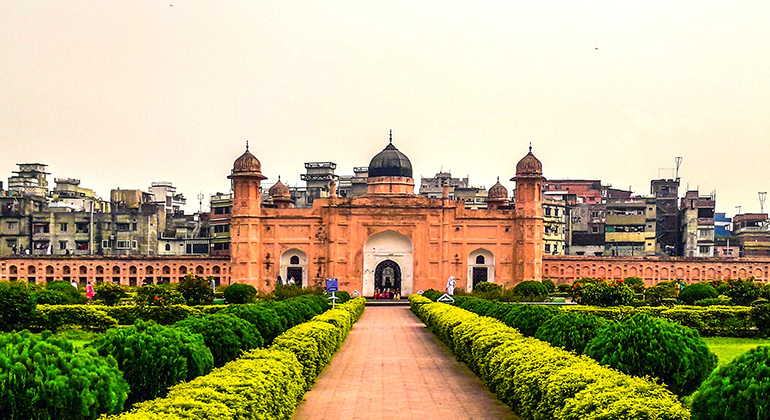

Lalbagh Fort, one of the most iconic historical monuments in Bangladesh, stands in the heart of Old Dhaka as a remarkable reminder of the city’s Mughal past. Surrounded today by the dense urban landscape of Dhaka, the unfinished 17th-century fort still preserves an atmosphere of another era—when Dhaka was an important provincial capital of the Mughal Empire.
Originally known as Fort Aurangabad, the monument was begun in 1678 by Prince Muhammad Azam Shah, son of Mughal Emperor Aurangzeb. The project was intended to become an impressive Mughal complex, but it was never completed. The death of Iran Dukht Pari Bibi, the daughter of Mughal governor Shaista Khan, became closely associated with the fort’s unfinished history.
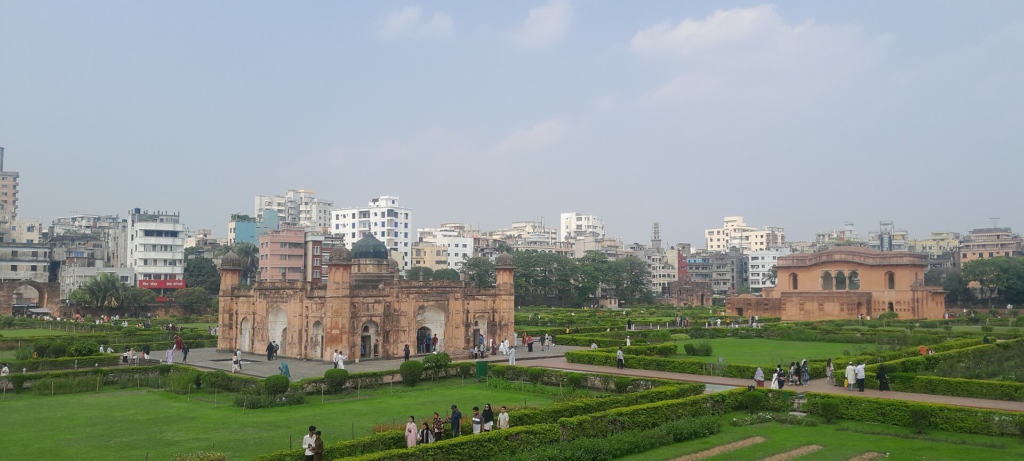
Today, Lalbagh Fort is much more than an old fort. Its mosque, tomb, audience hall, hammam, gardens, gateways and defensive structures provide valuable clues about Mughal architecture, administration and life in Dhaka.
Quick Facts About Lalbagh Fort
| Fact | Details |
|---|---|
| Name | Lalbagh Fort |
| Original Name | Fort Aurangabad |
| Location | Lalbagh, Old Dhaka, Bangladesh |
| Construction Began | 1678 CE |
| Founder | Prince Muhammad Azam Shah |
| Mughal Emperor | Aurangzeb |
| Major Associated Ruler | Shaista Khan |
| Most Famous Tomb | Tomb of Pari Bibi |
| Architectural Style | Mughal |
| Status | Incomplete fort complex |
| Present Custodian | Department of Archaeology, Bangladesh |
The Department of Archaeology lists Lalbagh Fort, its mosque, audience hall and hammam, gateway and Tomb of Pari Bibi among Bangladesh’s protected archaeological sites.
Where Is Lalbagh Fort?
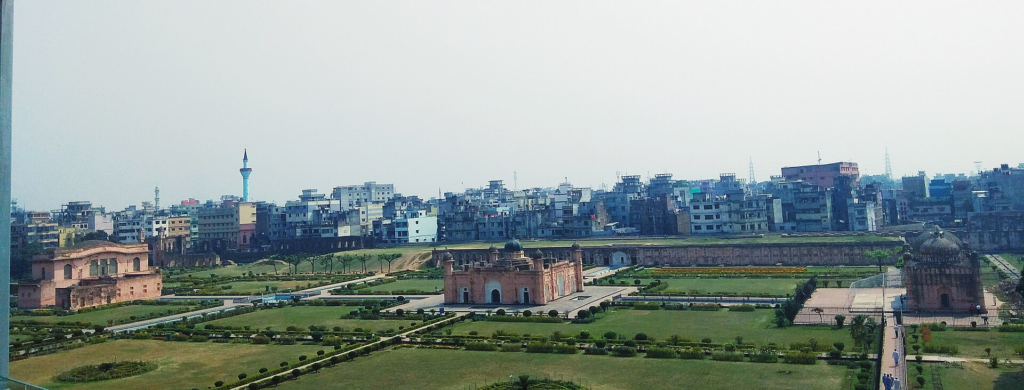
Lalbagh Fort is located in Lalbagh in Old Dhaka, in the southwestern part of the historic city. The fort was originally situated much closer to the Buriganga River than it is today. Over the centuries, the river changed its course, leaving the monument farther from the present riverbank.
Historical evidence suggests that the fort once had a much stronger visual and geographical relationship with the Buriganga. A historical painting from the early 19th century indicates that more than half of the fort’s southern and southwestern sides were close to the river.
This changing relationship with the river is important because Mughal Dhaka developed largely around waterways. Rivers were essential for transportation, trade, communication and defence.
The Beginning of Lalbagh Fort
The story of Lalbagh Fort begins in 1678, during the Mughal period.
Prince Muhammad Azam Shah, the third son of Emperor Aurangzeb, was serving as the Mughal Subahdar, or provincial governor, of Bengal. During his relatively short period in Bengal, he initiated the construction of an ambitious fort complex in Dhaka.
The original name of the project was Qila Aurangabad, meaning the Fort of Aurangabad.
The fort was not simply intended to be a military structure. It was conceived as a large Mughal complex combining administrative, residential, religious and defensive functions.
However, Muhammad Azam’s time in Bengal was short. He remained there for approximately 15 months before his father, Emperor Aurangzeb, recalled him to deal with the Maratha conflict. As a result, the ambitious project was left unfinished.
Shaista Khan and the Unfinished Fort
After Muhammad Azam left Bengal, Shaista Khan became the Mughal Subahdar of Bengal.
Shaista Khan was one of the most important Mughal governors in the history of Dhaka. He governed Bengal for a long period and played a major role in the development of the city.
Although he remained in Dhaka until 1688, he did not complete the Lalbagh Fort complex.
The reasons for leaving the fort unfinished have been discussed in historical accounts. The most famous explanation is connected with the death of his daughter, Iran Dukht, better known as Pari Bibi, in 1684.
Her death became a turning point in the story of Lalbagh Fort.
According to the historical tradition, Shaista Khan regarded the fort as an unfortunate place after the death of his daughter and abandoned plans to complete the complex. The UNESCO World Heritage Centre’s tentative-list documentation also identifies Pari Bibi’s death in 1684 as an important reason associated with the fort’s unfinished state.
It is important, however, to distinguish between documented history and later popular legends surrounding the fort.
Who Was Pari Bibi?
Pari Bibi, whose name is often translated as “Lady Fairy,” was the daughter of Shaista Khan.
She is one of the most famous figures associated with Lalbagh Fort because her tomb occupies a central position within the complex.
Historical accounts identify her as Iran Dukht. She was associated with Prince Muhammad Azam, and her death in 1684 became an important event in the fort’s history.
Her tomb is not merely a burial structure. It is one of the most architecturally significant parts of the fort.
Over time, the story of Pari Bibi has also become surrounded by romantic and mysterious legends. Some popular accounts portray the fort as a monument connected with an unfinished royal relationship. While these stories contribute to the monument’s cultural appeal, they should not be confused with firmly established historical facts.
Why Was Lalbagh Fort Never Completed?
The unfinished nature of Lalbagh Fort is one of its most fascinating characteristics.
Several historical circumstances came together:
- Muhammad Azam’s short stay in Bengal interrupted the initial construction.
- He was recalled by Emperor Aurangzeb before the project could be completed.
- Shaista Khan subsequently became governor but did not finish the entire complex.
- The death of Pari Bibi in 1684 became closely associated with the decision to stop construction.
The result is a monument that offers a rare opportunity to see an incomplete Mughal architectural project.
Rather than being a weakness, its unfinished condition has become one of Lalbagh Fort’s greatest historical attractions.
The Architecture of Lalbagh Fort
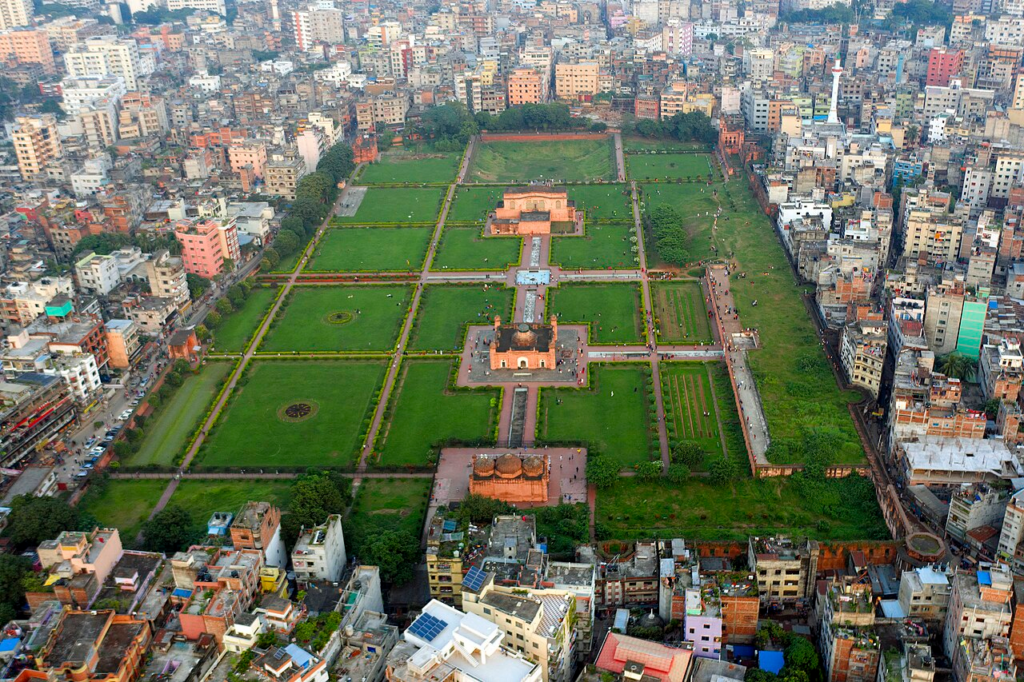
At first glance, Lalbagh Fort appears to be a traditional Mughal fort. But a closer look reveals that it was designed as a multi-functional palace-fort complex.
For many years, people commonly described the monument as consisting mainly of three structures:
- The mosque
- The Tomb of Pari Bibi
- The Diwan-i-Aam and hammam
Archaeological investigations, however, have revealed evidence of additional structures and functional areas within the complex. These included utility buildings, administrative spaces, residential areas, stables, gardens, water features and defensive elements.
This suggests that Lalbagh Fort was considerably more complex than its most recognizable buildings might suggest.
1. The Tomb of Pari Bibi
The Tomb of Pari Bibi is arguably the most famous structure inside Lalbagh Fort.
Located between the mosque and the Diwan-i-Aam, the tomb occupies a visually prominent position in the central part of the complex.
Its design reflects the refined architectural traditions of the Mughal period. The building uses a combination of decorative materials and carefully arranged architectural elements, creating a more intimate and ornamental appearance than the defensive walls surrounding it.
The tomb has become inseparable from the identity of Lalbagh Fort.
For visitors, it is often the first structure that communicates the emotional side of the fort’s history: behind the monumental architecture lies the story of a woman whose death became one of the defining events in the history of the unfinished complex.
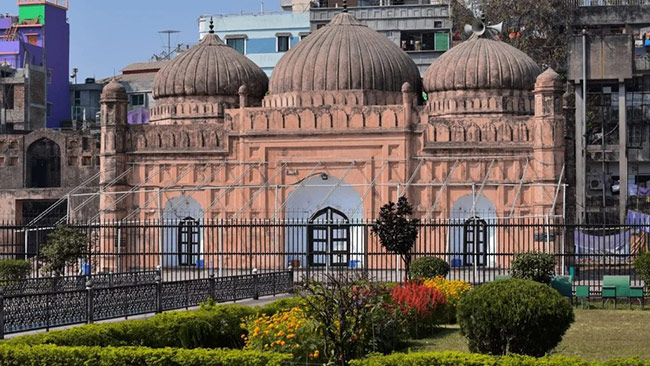
2. The Lalbagh Fort Mosque
The mosque is another major surviving structure.
The Mughal period was famous for its distinctive mosque architecture, and the Lalbagh Fort mosque represents this tradition in Dhaka.
Its design includes multiple domes and characteristic Mughal architectural elements. The mosque was integrated into the larger fort complex rather than being constructed as an isolated religious building.
Its presence demonstrates that the fort was intended to function as a living Mughal establishment, where administrative, residential and religious activities could exist together.
The mosque remains one of the most recognizable elements of the monument.
The Department of Archaeology separately identifies the Lalbagh Fort Mosque as a protected archaeological component.
3. Diwan-i-Aam
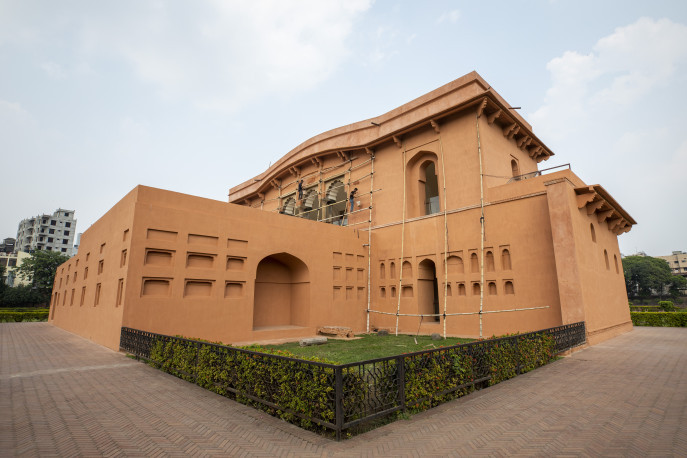
The Diwan-i-Aam, or Hall of Public Audience, was associated with the administrative and ceremonial functions of the Mughal government.
In Mughal architecture, a Diwan-i-Aam was a place where rulers or governors could meet officials, hear petitions and conduct public or administrative affairs.
At Lalbagh Fort, the Diwan-i-Aam forms part of the central architectural composition of the complex.
The building is particularly important because it helps us understand that Lalbagh Fort was not simply designed to protect its occupants from attack. It was also intended to serve as a centre of government and aristocratic life.
4. Hammam and Bathing Complex
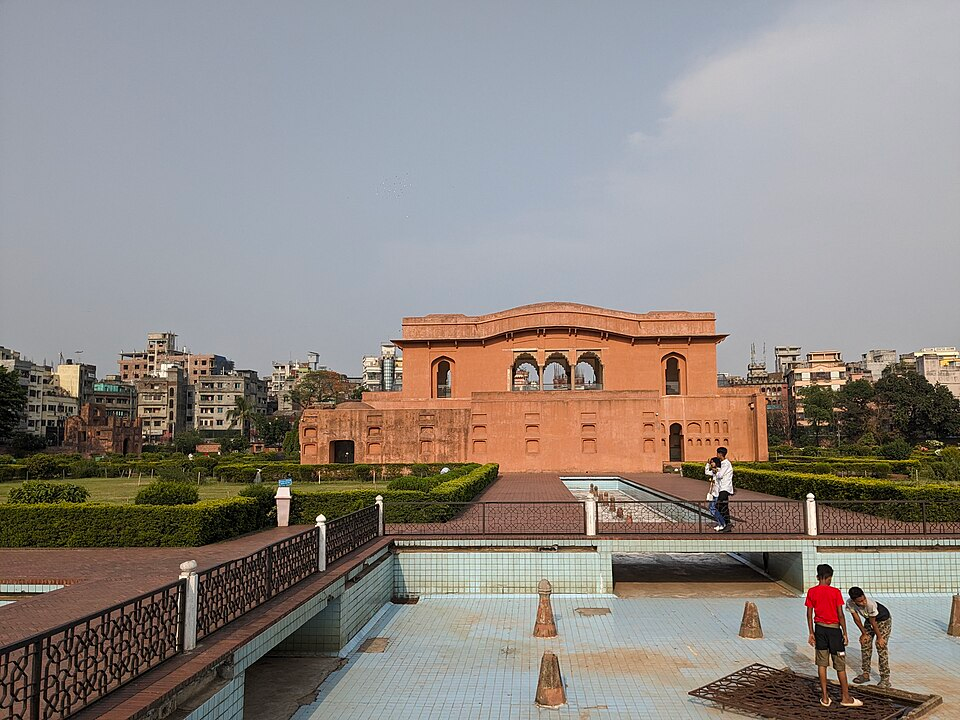
One of the most interesting surviving features is the hammam, or bath complex, associated with the Diwan-i-Aam.
Hammams were an important feature of Mughal elite architecture. They were not simply places for washing. A properly designed hammam could include different chambers and systems for supplying and controlling water.
The presence of a hammam at Lalbagh Fort illustrates the sophisticated lifestyle of the Mughal ruling class.
The Department of Archaeology officially lists the Audience/Hall and Hammam of Lalbagh Fort as a protected archaeological structure.
5. Fortification Walls and Bastions
The complex was surrounded by defensive walls and included several bastions.
These structures demonstrate the military dimension of the fort.
The southern fortification is particularly important. Historical descriptions identify several bastions along the southern wall and additional defensive structures on the western side. Some of the bastions were substantial two-storey structures.
Yet Lalbagh Fort should not be imagined as a purely military fortress like a massive battlefield stronghold.
Its architecture combines defence with administration, residence, religion, gardens and royal lifestyle.
That combination is characteristic of Mughal palace-fort complexes.
6. Gates and Entrances
The fort once had important gateways that controlled movement into the complex.
The surviving and historically documented gateways provide insight into how visitors, officials and residents would have entered the fortified compound.
The southern gateway is especially notable for its monumental appearance.
The Department of Archaeology also separately lists a gateway at the southeastern corner of Lalbagh Fort among its protected sites.
7. Gardens, Water and the Mughal Landscape
Mughal architecture cannot be understood simply by looking at buildings.
Gardens and water were equally important.
The Lalbagh complex incorporated landscaped spaces, water channels, fountains and reservoirs. Archaeological descriptions also indicate the presence of a roof garden and water-management features.
This reflects the wider Mughal preference for combining architecture with carefully planned landscapes.
The gardens provided more than beauty. They helped create a sense of order, privacy and royal refinement.
In the middle of densely populated Old Dhaka, the greenery of Lalbagh Fort therefore offers a striking contrast with the surrounding city.
Lalbagh Fort and the Buriganga River
The relationship between Lalbagh Fort and the Buriganga River is an important part of its history.
When the fort was built, the river was much closer to the complex than it is today. Waterways were central to the Mughal administration of Bengal, and Dhaka’s location on the river network made it an important political and commercial centre.
Over the centuries, changes in the course of the Buriganga altered the landscape around the fort.
This means that today’s Lalbagh Fort does not look exactly as it would have looked in the late 17th century.
The modern visitor sees the monument within a densely populated urban environment, while the original Mughal complex existed within a very different landscape.
From Aurangabad Fort to Lalbagh Fort
The monument was originally known as Fort Aurangabad or Qila Aurangabad.
The name “Lalbagh Fort” became established later.
According to UNESCO’s tentative-list documentation, the area became known as Lalbagh in the 19th century, with the name replacing Aurangabad.
The name Lalbagh is generally associated with the surrounding locality and is often understood as meaning “Red Garden.”
The name eventually became so closely associated with the monument that the old Fort Aurangabad is now universally recognized as Lalbagh Fort.
Lalbagh Fort During the British Period
After the decline of Mughal political power in Bengal, Dhaka underwent major political and administrative changes.
The fort itself remained an important historical structure, although it was no longer the active centre of Mughal provincial administration for which it had originally been designed.
Over time, interest in preserving historic monuments increased.
According to UNESCO’s documentation, an institution known as the Dhaka Committee began preservation efforts in 1844, and the monument subsequently became known as Lalbagh Fort.
The fort later came under the jurisdiction of the Department of Archaeology in 1910, marking an important stage in its modern conservation history.
Archaeological Importance
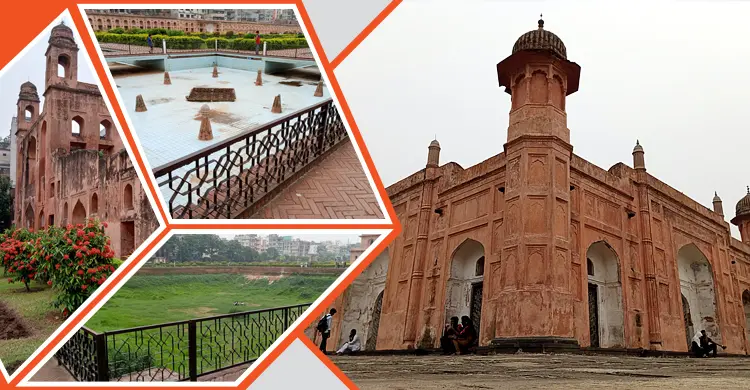
Lalbagh Fort is important not only because it is beautiful but because it provides physical evidence of Mughal Dhaka.
Its buildings allow historians and archaeologists to study:
- Mughal administrative architecture
- Military planning
- Palace design
- Religious architecture
- Water management
- Garden planning
- Elite residential life
- Construction techniques
- The historical development of Dhaka
Archaeological investigations have also changed our understanding of the fort.
For a long time, the three best-known structures dominated descriptions of the site. Later archaeological research identified evidence of additional buildings and functional areas, demonstrating that the original complex was more extensive than previously understood.
Why Is Lalbagh Fort Called an “Incomplete Fort”?
The word “incomplete” is central to almost every discussion of Lalbagh Fort.
But it is important to understand what that means.
The fort was never completed according to the original Mughal plan. Some planned structures and parts of the defensive system were left unfinished or altered over time.
Therefore, Lalbagh Fort is not simply a ruined fort.
It is better understood as an unfinished Mughal palace-fort complex whose surviving buildings represent only part of a much larger original plan.
Its incompleteness allows modern historians to examine the stages of Mughal construction and imagine how the complex might have developed had the project reached completion.
Myths and Legends of Lalbagh Fort
Few historical monuments in Bangladesh have generated as many stories as Lalbagh Fort.
The most famous is the belief that Shaista Khan stopped construction because the death of his daughter Pari Bibi convinced him that the fort was unlucky.
Another popular tradition associates the fort with secret passages and hidden routes.
Stories about underground tunnels have circulated for generations, adding to the mysterious reputation of the monument.
However, visitors should be careful when separating archaeological evidence from folklore.
Lalbagh Fort is already fascinating without the need to exaggerate its history. Its documented story—an ambitious Mughal project started by a future emperor, interrupted by imperial politics, associated with the death of Pari Bibi and ultimately left unfinished—is remarkable enough.
Lalbagh Fort and Mughal Dhaka
To understand Lalbagh Fort, it is useful to understand the importance of Dhaka during the Mughal period.
Dhaka became a major Mughal administrative centre in Bengal. Its position within the river network made it strategically important for governance, trade and communication.
The city developed a rich architectural heritage during this period.
Several important Mughal monuments remain in Old Dhaka, including mosques, caravanserais, tombs and palace-related structures.
Lalbagh Fort represents one of the most ambitious surviving examples of that architectural tradition.
It also reflects the social structure of Mughal government: the fort brought together administration, elite residence, religious practice, ceremonial activities, gardens and defence within one planned complex.
Why Lalbagh Fort Matters to Bangladesh
Lalbagh Fort is one of the most recognizable symbols of Dhaka’s historical identity.
For Bangladesh, its importance goes beyond tourism.
It represents a period when Dhaka was evolving into a major political and administrative centre. The monument connects modern Bangladesh with the architectural and cultural history of the Mughal period.
Its survival also demonstrates why historic buildings need protection.
Modern Dhaka is changing rapidly. Roads, buildings, businesses and residential areas continue to transform the city. In the middle of this constantly changing urban environment, Lalbagh Fort preserves a physical connection with a city that existed more than three centuries ago.
What Can Visitors See at Lalbagh Fort?
A visit to Lalbagh Fort can include several distinct experiences.
1. The Main Historic Structures
Visitors can explore the principal surviving Mughal buildings, including the mosque, Pari Bibi’s tomb and the Diwan-i-Aam-hammam complex.
2. The Fort Walls
The defensive walls and bastions help visitors understand the military planning of the original complex.
3. Gardens and Open Spaces
The greenery creates a peaceful contrast with the busy streets of Old Dhaka.
4. Mughal Architectural Details
Arches, domes, decorative elements, masonry and spatial arrangements reveal the architectural character of 17th-century Mughal Bengal.
5. The Historical Atmosphere
Perhaps the greatest attraction is simply being inside a place that has witnessed more than 300 years of Dhaka’s history.
Best Way to Experience Lalbagh Fort
A rushed visit may allow you to see the buildings, but a slower visit makes the monument much more meaningful.
Instead of looking only at the famous tomb and mosque, try to understand the site as a complete Mughal complex.
Look at:
- How the buildings are positioned in relation to one another
- The defensive walls
- The gardens
- Water features
- The relationship between administrative and religious structures
- The architectural symmetry
- The location of the fort within modern Old Dhaka
It is also worth remembering that the modern landscape is very different from the landscape of the 17th century.
Is Lalbagh Fort a UNESCO World Heritage Site?
Lalbagh Fort is not currently inscribed on the UNESCO World Heritage List.
However, it appears as part of Bangladesh’s Tentative List under the broader nomination context of Mughal forts on fluvial terrains in Dhaka. UNESCO’s documentation identifies Lalbagh Fort as an important Mughal heritage property.
This distinction matters: being on a Tentative List is not the same as being a formally designated World Heritage Site.
Frequently Asked Questions About Lalbagh Fort
Who built Lalbagh Fort?
Construction was started in 1678 by Prince Muhammad Azam Shah, the son of Mughal Emperor Aurangzeb.
What was Lalbagh Fort originally called?
It was originally known as Fort Aurangabad or Qila Aurangabad.
When was Lalbagh Fort built?
Construction began in 1678 CE, during Muhammad Azam’s tenure in Bengal.
Why is Lalbagh Fort unfinished?
Muhammad Azam was recalled by Emperor Aurangzeb before construction was completed. Shaista Khan later became governor but did not complete the project. The death of his daughter Pari Bibi in 1684 became closely associated with the decision to stop construction.
Who was Pari Bibi?
Pari Bibi, also identified as Iran Dukht, was the daughter of Shaista Khan. Her tomb is one of the principal monuments inside Lalbagh Fort.
What are the main buildings inside Lalbagh Fort?
The best-known structures are the Tomb of Pari Bibi, the mosque, and the Diwan-i-Aam with its hammam. Archaeological research has identified additional structures and functional areas within the complex.
Where is Lalbagh Fort located?
It is located in Lalbagh, Old Dhaka, Bangladesh.
Is Lalbagh Fort a palace or a fort?
It is best described as an unfinished Mughal palace-fort complex. It combined defensive, administrative, residential and religious functions.
Is Lalbagh Fort still near the Buriganga River?
The fort was historically much closer to the Buriganga, but the river has changed its course and is now farther away from the monument.
Is Lalbagh Fort protected?
Yes. The Department of Archaeology of Bangladesh lists Lalbagh Fort and several of its components among protected archaeological sites.
Lalbagh Fort: A Monument to an Unfinished Dream
Lalbagh Fort is fascinating precisely because it was never completed.
Had Muhammad Azam remained in Bengal longer, or had Shaista Khan decided to finish the project, the monument might have looked very different. More buildings might have been added, the defensive system might have been completed, and the relationship between the palace, gardens and river might have been transformed.
Instead, history left Dhaka with an unfinished masterpiece.
Its incomplete walls tell the story of imperial politics. Its mosque reflects the religious life of the Mughal elite. Its Diwan-i-Aam recalls the administrative world of the provincial government. Its hammam reveals aspects of aristocratic life. Its gardens reflect Mughal ideas of beauty and order. And the Tomb of Pari Bibi preserves the memory of a woman whose death became inseparable from the fate of the fort.
More than three centuries after construction began, Lalbagh Fort remains one of the most important historical landmarks in Bangladesh.
It is not merely a monument to the Mughal Empire.
It is a monument to Old Dhaka itself—a city shaped by rivers, rulers, traders, architects and generations of ordinary people.
And perhaps the most powerful lesson of Lalbagh Fort is that an unfinished building can sometimes tell a more compelling story than a completed one.
Its incomplete state allows every generation to imagine the Dhaka that might have been, while preserving the Dhaka that once was.