
 every year — one of the world’s most prestigious robotics competitions.)
For decades, humanity has dreamed of one day building a civilization on Mars. Across the world, scientists and engineers are working to turn that dream into reality. To inspire the next generation of innovators, the Mars Society in the United States organizes the University Rover Challenge (URC) every year — one of the world’s most prestigious robotics competitions.
This year, among teams from some of the world’s leading universities, a group of students from Bangladesh stunned everyone.
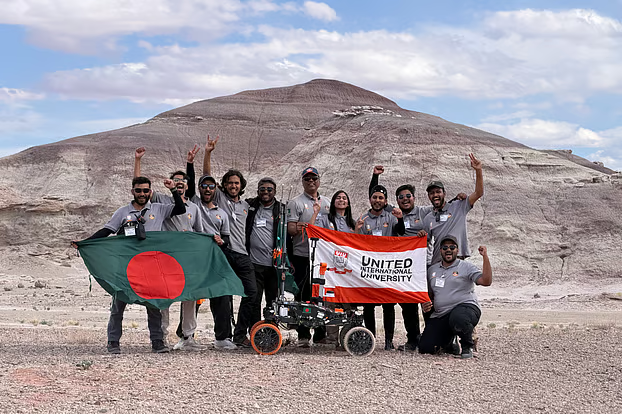
Competing at the Mars Desert Research Station (MDRS) in Hanksville, Utah, the United International University (UIU) Mars Rover Team secured third place globally at the 2026 URC finals. The competition, held from May 27 to May 30, featured 38 teams from 15 countries.
For the Bangladeshi students, however, the achievement meant much more than a trophy.
It was the culmination of years of persistence, countless sleepless nights, and a dream that once seemed impossibly distant.
The team’s journey began modestly in 2021 during the COVID-19 pandemic. Their workspace was a tiny room on campus furnished with only a few chairs and tables. Shops were closed, equipment was difficult to find, and the team lacked sophisticated laboratories, expensive machinery, and major funding.
What they did have was ambition.
Slowly, step by step, the project evolved. The university administration began supporting the students, and the results improved every year. In their first appearance at URC in 2022, the UIU team finished 13th in the world. They climbed to ninth place in 2023, fifth in 2024, sixth in 2025, and finally third this year.
Back in 2022, when the students first arrived at the Mars Desert Research Station, they were mesmerized by the rovers built by universities like Michigan and Monash. The machines looked so advanced that they seemed ready to be deployed directly to Mars.
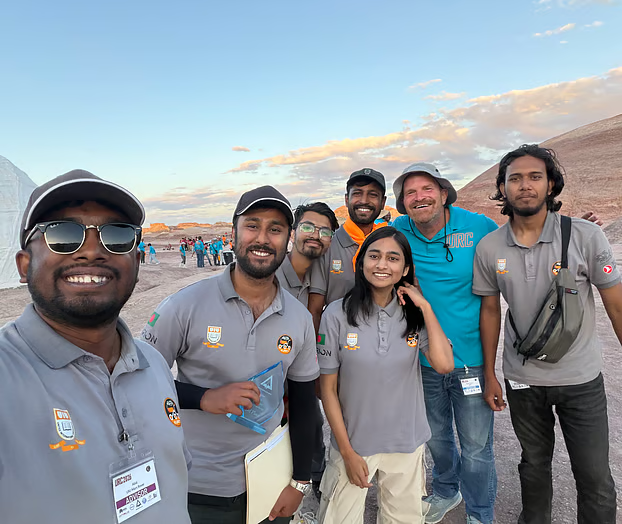
The Bangladeshi students approached those teams with curiosity, asking endless questions about simulation systems, mechanical design, and software architecture.
Quietly, they made a promise to themselves: one day, they would build a rover capable of competing at the same level.
This year, the roles had reversed.
After the award ceremony, members of the University of Michigan team approached the UIU students during a barbecue gathering. This time, it was the Americans asking questions.
“How did you do the simulation?”
“How did you design the wheels?”
“We tried something similar, but it didn’t work.”
Some even took photographs of UIU’s rover system for reference.
For the Bangladeshi team, it was a surreal moment.
This year’s rover was named Orion, a Greek word meaning “new dawn” or “new beginning.” The name reflected a bold decision made by the team before the competition.
Although their previous rover system had brought considerable success, the students realized they needed something faster, smarter, and more mission-oriented to compete at the highest level. So they made a risky choice: they completely abandoned their existing software and hardware architecture and rebuilt everything from scratch.
“Our old system was good,” said team leader Saif Al Sad. “But if we truly wanted to move forward, we needed the courage to leave our comfort zone. Rebuilding everything was risky, but we believed that transformation required bold decisions.”
That courage would soon be tested in dramatic fashion.
The most critical challenge arrived moments before the autonomous navigation mission — one of the competition’s toughest stages. The rover must independently navigate the desert terrain, avoid obstacles, identify targets, and make decisions entirely on its own without human control.
Just before the mission began, the UIU team discovered that their IMU (Internal Measurement Unit), the sensor responsible for determining the rover’s position and orientation, had stopped functioning. The rough 70-mile journey from the hotel to the field had likely damaged the device.
Panic spread instantly.
The students had only 40 minutes before the mission deadline. Replacing the IMU and reprogramming the system consumed 15 precious minutes, leaving them just 25 minutes to complete everything.
Then Orion began its mission.
The rover moved through the harsh desert terrain, avoiding obstacles and identifying targets one after another. Team members watched anxiously as the clock continued counting down.
With only four seconds remaining before time expired, Orion successfully identified the final target.
The audience erupted in surprise. Even the judges were astonished by how efficiently the rover had completed the mission under such pressure.
Out of seven targets, Orion successfully reached six and earned the highest score of 84 points in the autonomous category, winning the “Best Autonomous System” award.
“When the results were announced, we all jumped with excitement,” recalled senior lead Md. Mushfiqur Rahman. “Years of sacrifice, hard work, and waiting suddenly felt worthwhile in that one moment.”
The UIU Mars Rover Team consisted of 32 members this year. Alongside Saif Al Sad and Mushfiqur Rahman, the leadership team included co-team lead Sheikh Sakib Hossain. The students were guided by mentors and faculty members including Professor Hasan Sarwar, Professor Suman Ahmed, and lecturer Md. Abid Hossain.
UIU was not alone in representing Bangladesh. Three other Bangladeshi universities also reached the main competition stage this year: BRAC University’s “BRACU Mongoltori,” Military Institute of Science and Technology’s “MIST Mongolbarta,” and Aviation and Aerospace University of Bangladesh’s “Rover 71.”
Yet among all Asian teams, only UIU managed to secure a place in the global top three.
Still, the students are not fully satisfied.
Behind their success are nights spent inside laboratories during exam periods, festivals sacrificed for debugging sessions, and endless cycles of failure and improvement. For them, third place is not the destination — only another milestone.
“We gave our best,” said team mentor Abid Hossain. “But we do not want to stop here. Our goal is simple: we want to become world champions.”
From a tiny campus room during lockdown to the deserts of Utah, the journey of the UIU Mars Rover Team stands as a powerful reminder that innovation is not defined by resources alone.
Sometimes, all it takes is a dream bold enough to survive failure — and a team determined enough to chase it to another planet.