
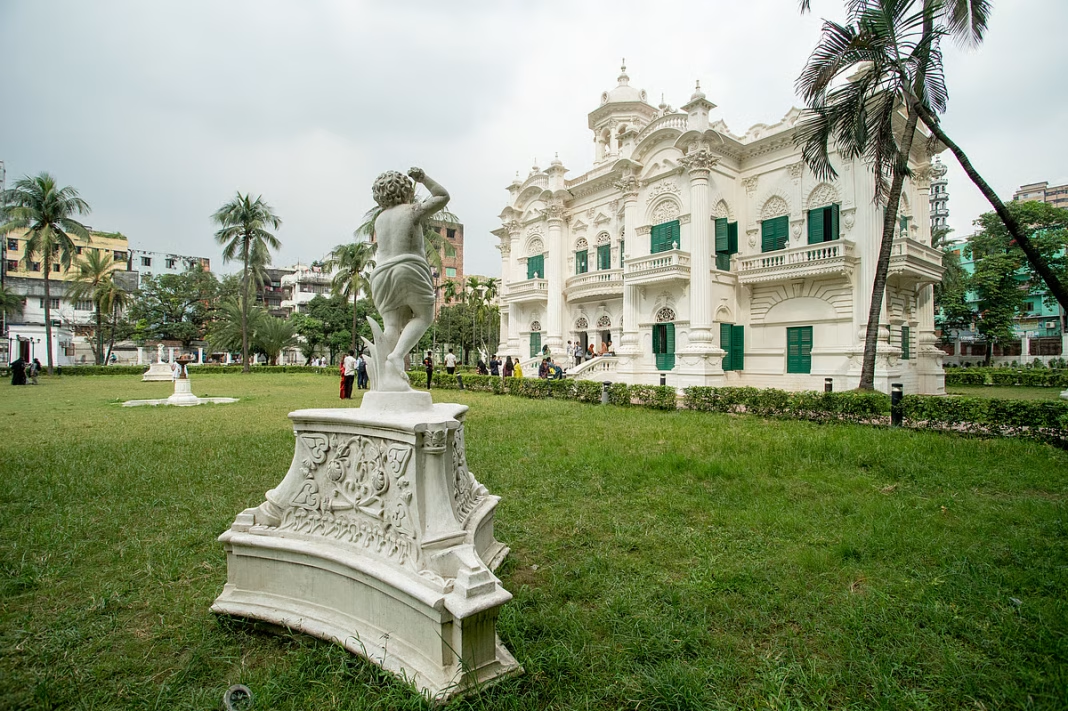

In the heart of Old Dhaka, surrounded today by the dense streets and busy urban life of Tikatuli, stands an elegant mansion that seems to belong to another era. Known as Rose Garden Palace, this historic estate is one of Bangladesh’s most fascinating examples of colonial-era architecture and one of the country’s most important political heritage sites.
Located on K. M. Das Lane in Tikatuli, the palace was originally created not as a political headquarters, but as a luxurious setting for entertainment, music and social gatherings. Its creator, zamindar Hrishikesh Das, reportedly wanted to establish a garden that could rival the famous Baldha Garden, then a major social and cultural centre of Dhaka.
Over the decades, however, Rose Garden acquired a significance far beyond its original purpose. It became a residence, a venue for political meetings, a film location and, most importantly, the place where the East Pakistan Awami Muslim League was founded on 23 June 1949. That event eventually connected the mansion with one of the most important political movements in the history of Bangladesh.
Today, Rose Garden Palace represents several layers of Dhaka’s past—its aristocratic culture, architecture, entertainment, politics and changing urban identity.
Where Is Rose Garden Palace?
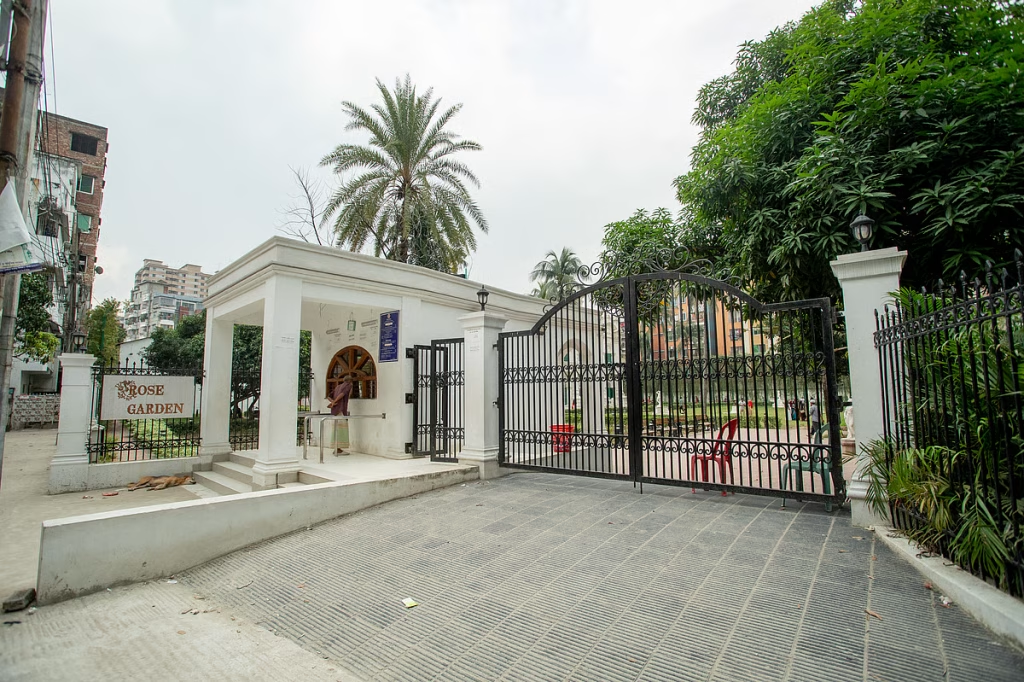
Rose Garden Palace is situated at K. M. Das Lane in Tikatuli, Old Dhaka, close to the Motijheel area and not far from Baldha Garden.
The location is significant because Tikatuli was historically part of the older urban fabric of Dhaka, where mansions, gardens, ponds, religious buildings and residences of wealthy families once stood alongside one another.
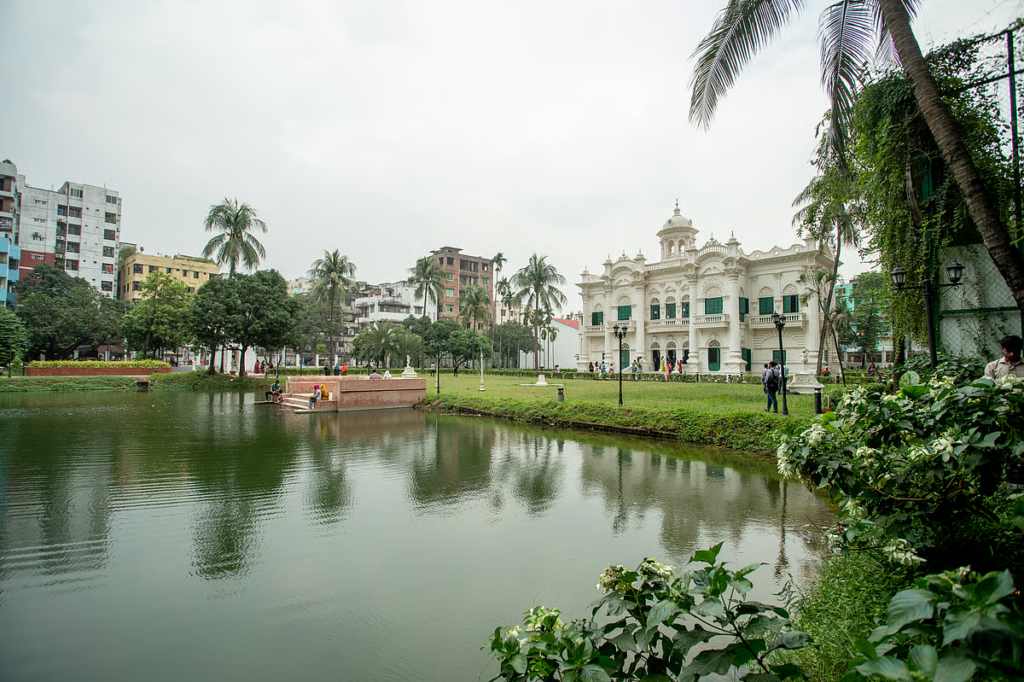
Unlike many heritage buildings that are difficult to identify from the surrounding streets, Rose Garden is distinctive because of its large façade, elaborate architectural details and the garden compound surrounding it.
Who Built Rose Garden Palace?
The mansion was built by Hrishikesh Das, a Hindu zamindar of Dhaka.
Sources differ on the exact historical dating of the building. Some government tourism material describes it as a 19th-century mansion, while Banglapedia records that Rose Garden was established in the early 1930s, and recent historical reporting identifies 1931 as the year of construction. The 1931 date is also widely associated with the present mansion and estate.
The estate reportedly covered a large area—around 22 bighas according to recent reporting—with a magnificent rose garden, a pond and the main two-storey mansion at its centre.
The name “Rose Garden” came naturally from the large collection of roses cultivated on the property.
The Story Behind the Name
One of the most interesting stories associated with Rose Garden concerns the social life of wealthy Dhaka residents.
During the late 19th and early 20th centuries, Baldha Garden was an important venue for cultural gatherings and musical soirées, known locally as jalsas. Wealthy and influential people of Dhaka regularly attended such events.
According to the traditional account, Hrishikesh Das attended one of these gatherings but was reportedly insulted because of his social background. The incident allegedly motivated him to create a garden of his own—one that would be grand enough to rival Baldha Garden.
He therefore established his own garden and arranged musical and social gatherings there. The magnificent mansion became the centrepiece of the estate.
Whether every detail of this story can be independently verified or not, it has become an enduring part of the popular history of Rose Garden.
A Palace Built for Entertainment
Interestingly, Rose Garden was not originally conceived simply as a family residence.
The estate was designed as a place for entertainment, cultural performances and social gatherings. The garden, pond and elegant pavilion-like mansion were intended to create an impressive setting for guests.
This original purpose helps explain the building’s unusual combination of residential and ceremonial spaces.
The mansion was designed to impress visitors from the moment they entered the grounds. Its grand façade, large garden, fountains, statues, balconies and decorative interiors created an atmosphere more commonly associated with European country estates than with the densely populated Dhaka of today.
However, maintaining such an extravagant lifestyle reportedly placed financial pressure on Hrishikesh Das. Eventually, he became bankrupt and was forced to sell the property.
Kazi Abdur Rashid and the Name “Rashid Manzil”
In 1936, the estate was purchased by Khan Bahadur Kazi Abdur Rashid, an entrepreneur and zamindar.
After acquiring the property, he renamed the mansion Rashid Manzil. He moved into the estate with his family in 1937.
Although the official name became Rashid Manzil for a period, the older name “Rose Garden” remained popular among local people and eventually continued to dominate public memory.
Under its new ownership, the building continued to function as an important residence and social space.
The property subsequently became associated with Kazi Abdur Rashid’s family, including his sons. Its ownership history later became complicated, involving transfers and legal disputes before the government eventually acquired it.
The Architecture of Rose Garden Palace
Architecture is one of the main reasons Rose Garden Palace remains so fascinating.
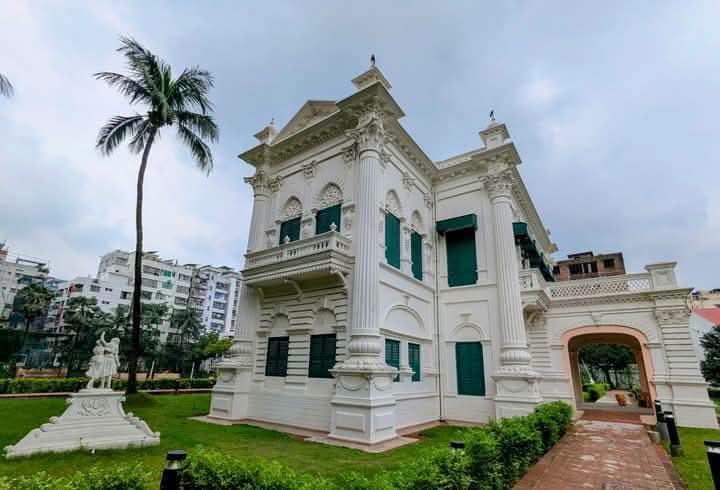
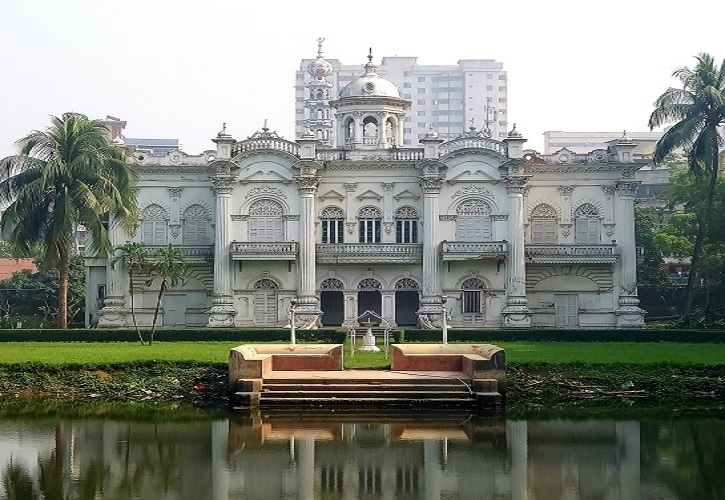
The building reflects strong European and Greek architectural influences, particularly in its use of classical columns, symmetry, arches and ornamental details. Banglapedia describes the mansion as approximately 45 feet high and covering nearly 7,000 square feet.
The western façade is especially impressive.
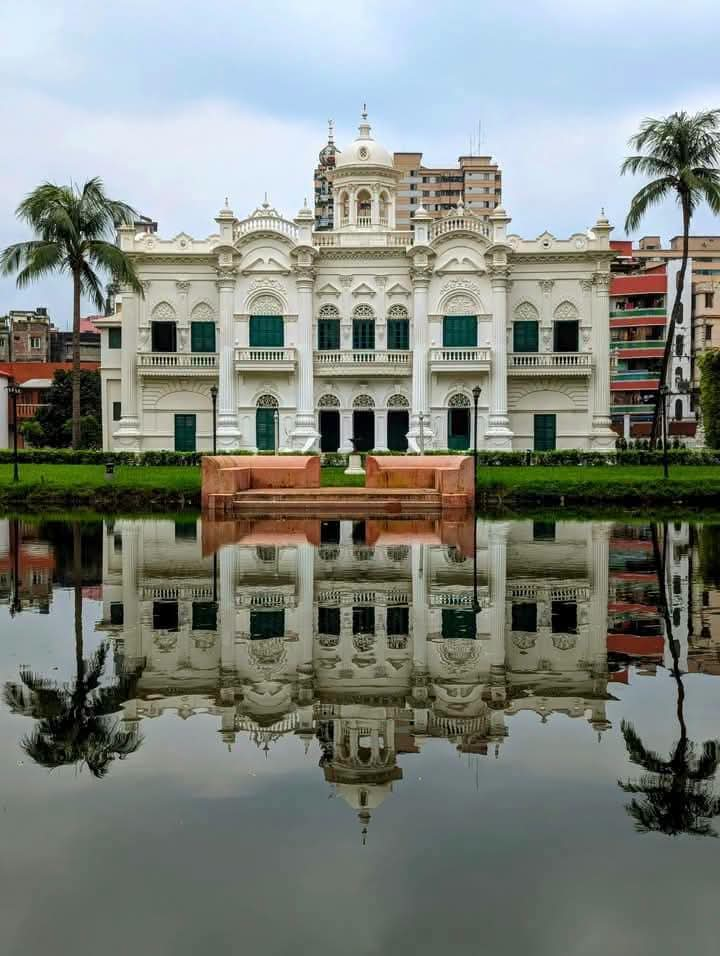
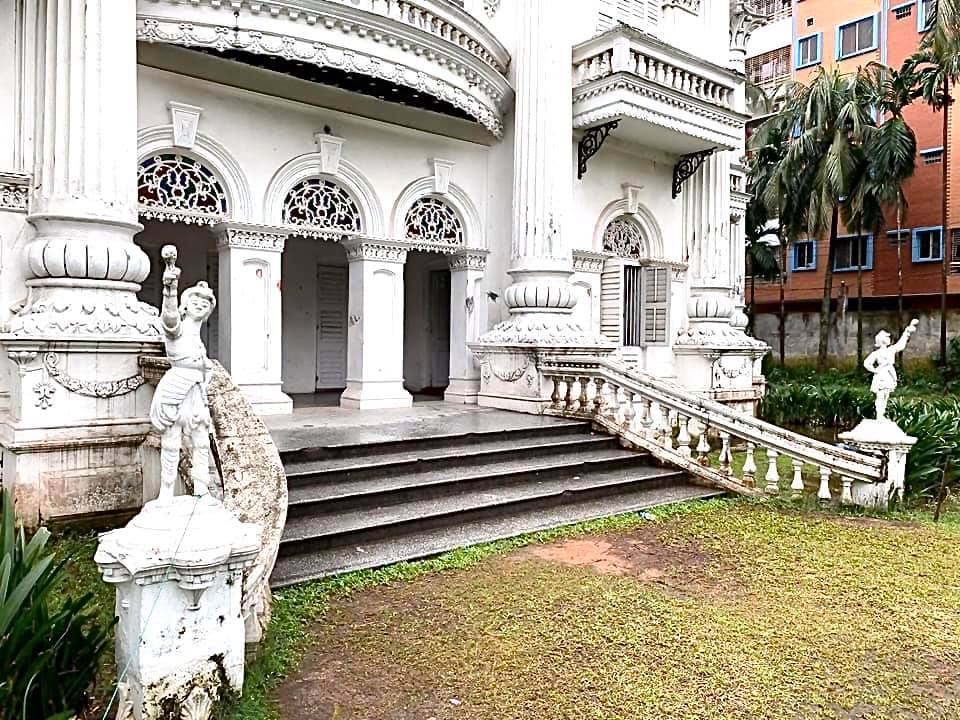
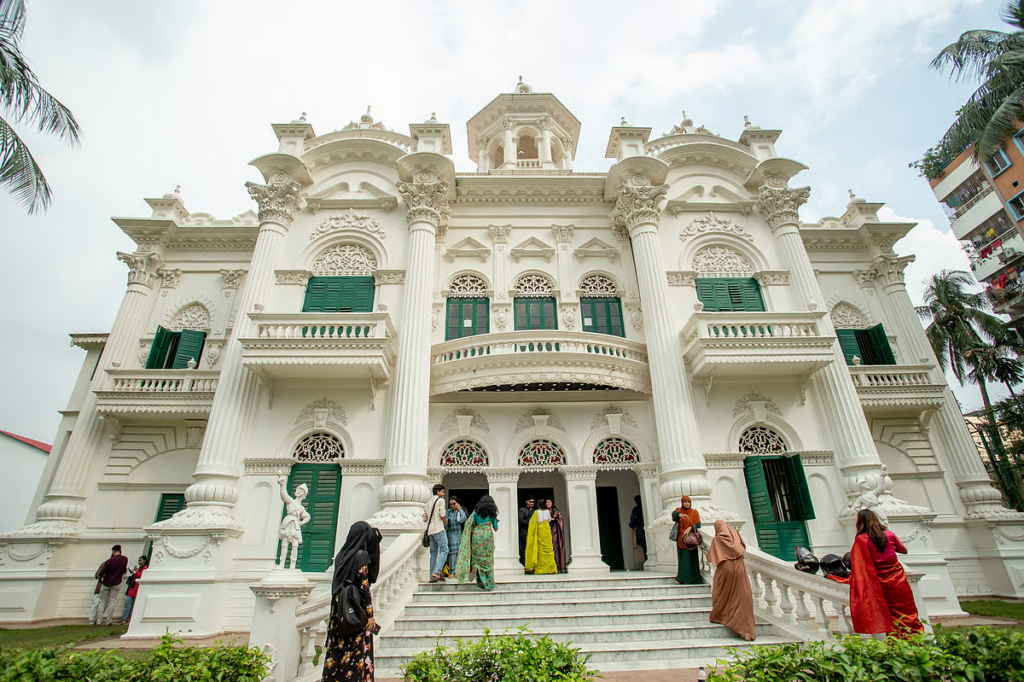
The front is symmetrically divided into several sections and features tall, fluted columns with elaborate capitals. The central portion contains a grand entrance approached by steps from the garden.
Above the central entrance is a distinctive balcony, while the upper portion is crowned by a lantern-like dome supported by columns and pointed arches.
The combination of columns, arches, balconies and the central dome gives the mansion an appearance that is distinctly different from traditional Bengali palace architecture.
Decorative Details
The beauty of Rose Garden is not limited to its exterior.
The doors, windows and other openings contain intricate decorative designs incorporating geometric patterns, foliage and animal motifs. These decorations were executed using materials including wood, coloured glass and iron.
The building also contains decorative balconies supported by cast-iron brackets, allowing residents and guests to enjoy views of the garden.
Inside, one of the most remarkable spaces is the large ballroom on the upper floor.
The ballroom has a marble floor, while its ceiling features floral decoration made with green mirrors. A beautifully designed spiral staircase leads towards the roof, with geometric ornamentation incorporated into its railing.
These details demonstrate the level of craftsmanship that went into the mansion at a time when Dhaka’s wealthy families often commissioned buildings that combined local construction traditions with European architectural ideas.
The Garden, Pond and Statues
The mansion was only one part of the original Rose Garden estate.
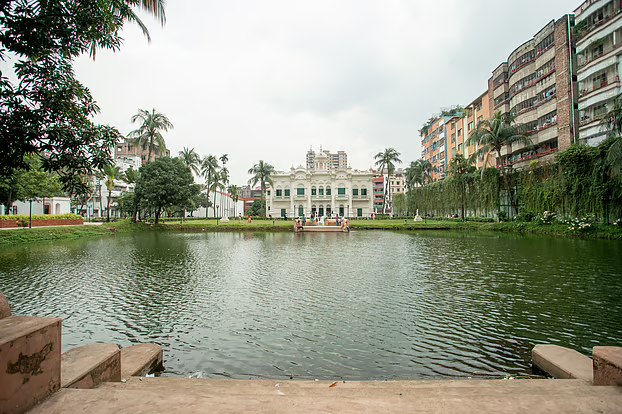
The surrounding grounds included a large garden filled with different varieties of roses. There was also a pond, often referred to as Rose Garden Pond, which formed another important element of the landscape.
The garden was decorated with fountains and statues, contributing to the estate’s character as a place for entertainment and leisure.
The relationship between the mansion and its garden was central to the original design. Rather than standing alone, the palace was intended to be experienced as part of a carefully arranged landscape.
Rose Garden and the Birth of the Awami League
The most important chapter in Rose Garden’s history began after the Partition of British India in 1947.
At the time, East Bengal was part of Pakistan and was known as East Pakistan after 1955. Political tensions were growing, and many Bengali political leaders and activists were seeking a new political platform.
On 23 June 1949, a historic meeting was held at Rose Garden in Dhaka.
At that meeting, the East Pakistan Awami Muslim League was established. Maulana Abdul Hamid Khan Bhashani was elected president, while Shamsul Hoque became the general secretary. Ataur Rahman Khan chaired the meeting, according to historical accounts.
The organization later became known as the Awami League after dropping “Muslim” from its name in the early 1950s.
The party would eventually become a major force in the political history of East Pakistan and later Bangladesh.
For this reason, Rose Garden is often described as the birthplace of the Awami League.
Its significance therefore goes far beyond architecture. The mansion is directly connected to a political organization that played a central role in the political developments leading to the independence of Bangladesh in 1971.
A Meeting Place for Political Leaders
Rose Garden’s political significance did not begin and end with the 1949 meeting.
According to Banglapedia, the estate hosted numerous important political meetings, particularly after the Partition of India. Many prominent leaders of Bengal visited the property, while the mansion also continued to host social gatherings.
This mixture of political and social history makes Rose Garden unusual among Dhaka’s historic mansions.
A building originally created for music, entertainment and aristocratic gatherings eventually became associated with the political transformation of an entire region.
Rose Garden and the Film Industry
Rose Garden also has an interesting connection with the history of cinema in Bangladesh.
In 1966, Kazi Abdur Raquib, the second son of Kazi Abdur Rashid, rented the estate to Bengal Studios and Motion Pictures.
The mansion’s palace-like architecture made it an attractive location for films, particularly productions involving stories of kings, zamindars and aristocratic families.
According to Banglapedia, Harano Din was the first film produced at the studio. Through cinema, millions of people who had never visited the estate were able to see the grandeur of Rose Garden on screen.
Thus, Rose Garden became part of not only political history but also the cultural history of Bangladesh’s film industry.
From Private Estate to Protected Heritage
As Dhaka expanded rapidly, historic mansions and gardens came under increasing pressure from urban development.
Recognizing the architectural and historical importance of Rose Garden, the Department of Archaeology included the building on its protection list in 1989.
This marked an important step toward preserving the property as part of Bangladesh’s national heritage.
Despite changes in ownership and periods of uncertainty, the mansion survived as one of Old Dhaka’s most recognizable historic structures.
The Government Acquired Rose Garden
A major turning point came in 2018, when the Government of Bangladesh purchased the Rose Garden property for approximately Tk 331.7 crore.
The purchase was announced on 9 August 2018, and the government subsequently expressed plans to develop the site as a museum.
The acquisition was intended to ensure the long-term preservation of a property considered important to the country’s architectural, cultural and political heritage.
In 2025, however, the Anti-Corruption Commission began investigating allegations of irregularities and financial inconsistencies surrounding the government’s 2018 purchase. The investigation concerns the procurement process and does not change the property’s historical significance.
Why Rose Garden Palace Matters
Rose Garden Palace is important because several different histories meet within its walls.
Architectural history: Its classical European and Greek-inspired design makes it one of Old Dhaka’s most distinctive historic mansions.
Social history: It reflects the lifestyle of wealthy Dhaka families and the culture of musical soirées and elite gatherings.
Political history: The mansion hosted the founding meeting of the East Pakistan Awami Muslim League in 1949.
Film history: Its grounds became associated with Bangladesh’s early film production and provided a dramatic setting for period films.
Heritage history: Its protection by the Department of Archaeology and later government acquisition demonstrate the growing recognition of the importance of preserving historic Dhaka.
Rose Garden Palace Today
Today, Rose Garden stands as a reminder of a very different Dhaka—a city of gardens, ponds, mansions and grand residences that existed before rapid urbanization transformed the capital.
The surrounding neighbourhood has changed dramatically, but the mansion still preserves many elements of its original architectural character.
For visitors interested in history and architecture, Rose Garden offers something different from more familiar landmarks such as Ahsan Manzil or Lalbagh Fort. Its story is not simply about a beautiful old building. It is about how a private garden became a social venue, how a mansion became a political meeting place, how a historic property became a film location and how all of these layers eventually turned it into a national heritage landmark.
A Symbol of Old Dhaka
Few buildings in Bangladesh can tell so many different stories at once.
Rose Garden Palace began with the ambition of a zamindar who wanted to create an extraordinary garden. It witnessed the social life of wealthy Dhaka, passed through different families, became known as Rashid Manzil, hosted political meetings, witnessed the birth of an important political organization, entered the world of cinema and ultimately became a protected national heritage property.
Its columns, arches, balconies, decorative glass, ballroom and garden may attract visitors first. But behind that beauty lies a much deeper story.
Rose Garden Palace is not merely an old mansion in Tikatuli. It is a physical record of Dhaka’s transformation—and a place where architecture, culture, politics and memory come together.
Quick Facts About Rose Garden Palace
| Feature | Details |
|---|---|
| Name | Rose Garden Palace |
| Former name | Rashid Manzil |
| Location | K. M. Das Lane, Tikatuli, Old Dhaka |
| Original builder | Hrishikesh Das |
| Construction | Commonly dated to 1931 / early 1930s |
| Architectural character | European and Greek-inspired |
| Main building size | Nearly 7,000 sq ft |
| Height | About 45 feet |
| Historic political event | Founding meeting of East Pakistan Awami Muslim League, 23 June 1949 |
| Protected by Archaeology Department | 1989 |
| Acquired by Bangladesh Government | 2018 |
| Purchase price | About Tk 331.7 crore |
| Film connection | Bengal Studios and Motion Pictures |
| Notable film associated with the studio | Harano Din |
Frequently Asked Questions
Where is Rose Garden Palace located?
Rose Garden Palace is located on K. M. Das Lane in Tikatuli, Old Dhaka, Bangladesh.
Who built Rose Garden Palace?
The mansion was built by Dhaka zamindar Hrishikesh Das.
When was Rose Garden Palace built?
The building is commonly dated to 1931 or the early 1930s, although some sources describe it more broadly as a 19th-century mansion. Banglapedia and recent historical reporting support the early-1930s dating for the present structure.
Why is Rose Garden Palace famous?
It is famous for its distinctive architecture, its historic rose garden and, most importantly, because the East Pakistan Awami Muslim League was founded there on 23 June 1949.
What was Rose Garden Palace called later?
After Khan Bahadur Kazi Abdur Rashid purchased the property in 1936, he renamed it Rashid Manzil. However, the name Rose Garden remained popular.
What architectural style does Rose Garden Palace have?
The building displays strong European and Greek classical influences, including Corinthian-style columns, arches, balconies and a central lantern dome.
Was Rose Garden used for filmmaking?
Yes. In 1966, the estate was leased to Bengal Studios and Motion Pictures and was used in film production. Harano Din was produced there.
When did the government acquire Rose Garden Palace?
The Government of Bangladesh purchased the property in 2018 for approximately Tk 331.7 crore.
Is Rose Garden Palace a protected heritage building?
Yes. The Department of Archaeology placed the building on its protection list in 1989.
Why should Rose Garden Palace be preserved?
Because it represents several important chapters of Bangladesh’s history at once—architecture, aristocratic culture, social life, cinema and the country’s political development.