
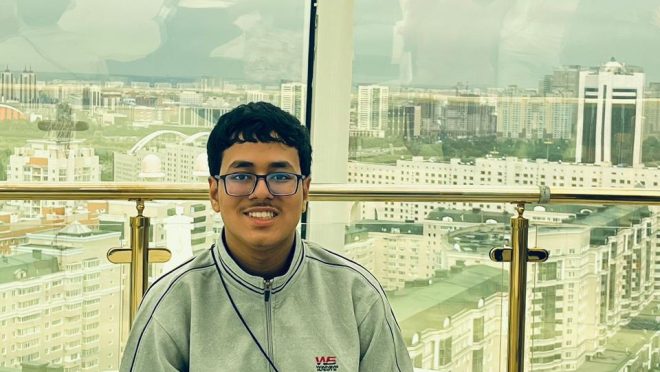

At just 18, Fayez Ahmad has already travelled a remarkable distance—from learning chess at the age of four in Rajshahi to earning admission to the Massachusetts Institute of Technology, one of the world’s most prestigious universities. But his story is not simply about getting into MIT. It is a story of curiosity, persistence, family support, Olympiads, self-learning and a determination to make opportunities more accessible for others.
For most Bangladeshi students, the end of HSC examinations marks the beginning of the next chapter of academic life. For Fayez Ahmad, however, the next chapter had already been written.
A student of Notre Dame College and a member of the HSC 2026 batch, Fayez received confirmation of his admission to the Massachusetts Institute of Technology (MIT) even before completing his HSC examinations. With his exams finishing in July and MIT classes scheduled to begin in September, he now finds himself standing between two very different stages of his life.
Yet, remarkably, the MIT admission is not where his story begins.
It began much earlier—with a chessboard, three older siblings and a childhood where curiosity was encouraged rather than controlled.
A Childhood Built Around Curiosity
Born in Rajshahi in 2008, Fayez grew up with his parents and three older siblings. According to him, learning was never something that had to be forced upon him. Instead, much of it came naturally from watching and following his siblings.
One of his earliest interests was chess.
He learned the game when he was only four years old, with the help of his siblings. What might have remained a childhood pastime gradually became his first experience of competitive learning.
That early environment would prove important in shaping the way he approached education later in life.
Fayez believes his family has been the greatest source of strength throughout his journey. In a country where extracurricular activities are sometimes viewed as distractions from academic studies, his parents took a different approach.
“In Bangladesh, many parents discourage extracurricular activities out of concern for academics, but my parents never limited me in that way. Their support made my journey possible.”
That freedom allowed Fayez to explore.
And he explored widely.
From Chess Tournaments to Olympiads
Fayez’s competitive journey began surprisingly early.
In Class 1, he participated in a national chess tournament. By Class 3, he had moved into Olympiads and became a regional champion.
Then came another important addition to his interests.
In Class 6, Fayez began debating—a field he continues to pursue today.
Chess, debate and Olympiads may appear to be separate activities, but together they helped develop something that would become central to his personality: the habit of thinking beyond the classroom.
The decisive change came in 2021.
While in Class 8, Fayez began participating in national camps in Biology and Physics, as well as the Junior Science Olympiad. What had previously been a collection of interests was gradually turning into a more focused journey.
Science became more than a subject.
It became a direction.
The Olympiad Years
For Fayez, Olympiads were not merely competitions where students tried to win medals. They became an environment where he could challenge himself, learn independently and meet students who shared similar interests.His journey eventually reached the international stage.In 2023, Fayez won a bronze medal at the International Biology Olympiad (IBO).That achievement became a major turning point.Until then, MIT had existed largely as a dream. The IBO medal made the dream feel more tangible—and encouraged Fayez to start thinking seriously about what it would take to reach a university like MIT.But instead of depending entirely on traditional coaching or a predetermined path, he continued to rely heavily on self-study.That approach would become a recurring theme in his journey.
Turning Personal Challenges into an Opportunity for Others
One of the most interesting chapters of Fayez’s story began not with an award, but with a problem.While preparing for Olympiads, he experienced firsthand how difficult it could be for students to find quality preparation resources. Rather than keeping those resources for himself, he decided to build something that could help others.In 2025, Fayez founded OlyPara, a nonprofit platform whose members come from 13 countries.The idea was simple but ambitious: make high-quality Olympiad preparation resources more accessible to students regardless of their financial circumstances or geographical location.Through the platform, students can search for questions by topic, practise full-length tests, create customised exams and read articles written by previous Olympiad medalists.
Explaining the motivation behind OlyPara, Fayez said:
“I built a website where students can search topic-wise questions, practise full-length tests, create customised exams, and read articles written by past Olympiad medallists.”
For Fayez, the purpose goes beyond creating another educational website.The broader goal is to reduce the resource gap that he himself encountered.He wanted students who might not have access to expensive coaching or specialised resources to still have a meaningful opportunity to prepare.That decision—to turn a personal challenge into a resource for others—became one of the defining aspects of his journey.
Research Beyond the Classroom
Fayez’s activities also extended into scientific research.He was selected as the only high school intern in the GSA Bioinformatics Internship. Later, he presented his research at the BSM International Conference 2025, again as the only high school presenter.These experiences gave him an opportunity to move beyond textbook learning and engage with scientific work in a more practical setting.By this point, his profile was no longer defined by a single achievement.It represented years of accumulated interests and experiences—Olympiads, debate, research, nonprofit work and independent learning.And that combination would eventually become important when he applied to MIT.
When MIT Became More Than a Dream
MIT had always been part of Fayez’s aspirations.But after his 2023 IBO bronze medal, the ambition became much more concrete.He knew that getting into a university like MIT would require more than simply performing well academically.So he began preparing.Not through a conventional coaching-heavy route, but largely through independent study.For the SAT, Fayez scored 1550, including 790 in Mathematics and 760 in Reading and Writing.He also achieved a 140 on the Duolingo English Test, a score roughly comparable to an IELTS score of around 7.5.His preparation was methodical.
For the SAT, he primarily used Bluebook, along with Khan Academy and several preparation books, including Princeton Review Digital SAT Premium Prep, The Critical Reader: The Complete Guide to SAT Reading by Erica L. Meltzer, and SAT Vocabulary: A New Approach, also by Meltzer.Interestingly, he did not consider separate preparation for the Duolingo English Test particularly necessary.
“I do not think separate preparation is very necessary if someone already has a strong foundation in English.”
His approach reflected something that had appeared repeatedly throughout his journey: build the foundation first, then remain consistent.
Building the MIT Application
Fayez began preparing his MIT application in late October 2025.The process required him to look back at years of work and organise his achievements into a coherent application.He contacted his teachers for recommendation letters and began working through the various components of the application.His advice to students planning to apply to highly competitive universities is straightforward: start early.He recommends beginning the process at least two months before the deadline.Fayez also acknowledged the support of Auctus Admissions, which assisted him with application strategy, essays and interview preparation.After months of preparation, he submitted his application on the deadline.Then came the wait.And eventually, the interview.
The MIT Interview
For many students, an interview with MIT might sound intimidating.Fayez’s experience, however, was somewhat different.He described the interview as informal and conversational rather than a rigid examination.The discussion focused extensively on his research, nonprofit work and extracurricular activities.That experience also reflected something important about his application.His story was not built around a single test score.The SAT score mattered. His Olympiad achievements mattered. His academic record mattered.But so did the things he had built and the questions he had pursued outside the classroom.And then came the news.MIT had accepted him.
The Unusual HSC-MIT Situation
There is an unusual element to Fayez’s journey that has attracted considerable attention in Bangladesh.He received his MIT admission before completing his HSC examinations.For many people, this created confusion: how could a student be admitted to an American university before finishing the higher secondary examination?Fayez describes the experience as “surreal,” but also points out that this timing is not unusual in the US university admissions system.
“Getting accepted before HSC is actually the standard timeline for US admissions. Even if I had gotten in after HSC, my reaction would have been exactly the same.”
He also clarified that, in most cases, completing a high school diploma or equivalent qualification is required. However, universities such as MIT have previously made exceptions where the credential is not completed before classes begin.With his HSC examinations now completed in July, that chapter is effectively coming to an end.His US student visa was also granted only a few days ago.The next destination is Cambridge, Massachusetts.
What Makes an Applicant Stand Out?
Fayez’s journey offers an interesting perspective on one of the most frequently asked questions among students dreaming of top universities:
What does it actually take to get admitted?
His answer does not focus solely on grades.
“Academics are important, but many applicants already have strong academic records. What differentiates applicants is their extracurricular involvement.”
For Fayez, extracurricular activities were not something added to his profile shortly before university applications.They had been part of his life for years.Chess came first.Then Olympiads.Then debate.Then scientific research.Then OlyPara.Each experience grew out of the previous one, creating a journey that was both broad and connected.That consistency may be more important than simply collecting certificates.
More Than an MIT Admission
It would be easy to tell Fayez Ahmad’s story simply as that of a Bangladeshi student who got into MIT.But that would leave out perhaps the most meaningful part.His journey is also about what happens when curiosity is allowed to grow.A four-year-old learns chess because his siblings introduce him to it.A young student enters competitions.A Class 3 student discovers Olympiads.A Class 6 student begins debating.A Class 8 student starts exploring science more seriously.An Olympiad medal turns a distant university dream into a concrete goal.And later, a student who struggled to find resources decides to build those resources for others.That progression matters.Because Fayez did not simply accumulate achievements.He gradually built an ecosystem around his interests.And perhaps that is the most valuable lesson in his story.
Fayez’s Advice to the Next Generation
Before ending our conversation, Fayez offered advice to students who dream of following a similar path.His message is not to chase prestigious names blindly.Instead, he encourages students to explore.
“Explore different extracurricular activities and try to find something you are genuinely passionate about.”
He believes starting early can help, but it is never too late to begin.He also encourages students to use online resources intelligently and to contact people who have already achieved what they aspire to achieve.Most importantly, he emphasises consistency.Failure, he says, is inevitable.The important thing is to understand why something went wrong, learn from the experience and continue moving forward.And perhaps his most powerful message is about talent itself.Students do not reach the world’s best universities simply because they were born geniuses.They get there by working hard, learning from setbacks and gradually building meaningful achievements.
“The key is to analyse your mistakes, learn from them, and keep moving forward.”
A New Chapter Begins
In September, Fayez Ahmad will leave behind the familiar classrooms of Notre Dame College and begin a new chapter at MIT.The transition will be enormous.From Rajshahi to Dhaka, from a childhood chessboard to international science competitions, and now from Bangladesh to one of the world’s most renowned universities, his journey has already crossed several remarkable milestones.But MIT is not the destination of his story.It is simply the next chapter.The more interesting question is what he will do with the opportunities that come next.If his journey so far is any indication, Fayez is unlikely to remain satisfied with simply reaching a new place.He will probably keep asking questions, keep exploring, keep building—and, if OlyPara is any indication, keep looking for ways to make the path easier for those who come after him.For a student who started playing chess at four, the next move may be his most interesting one yet.