

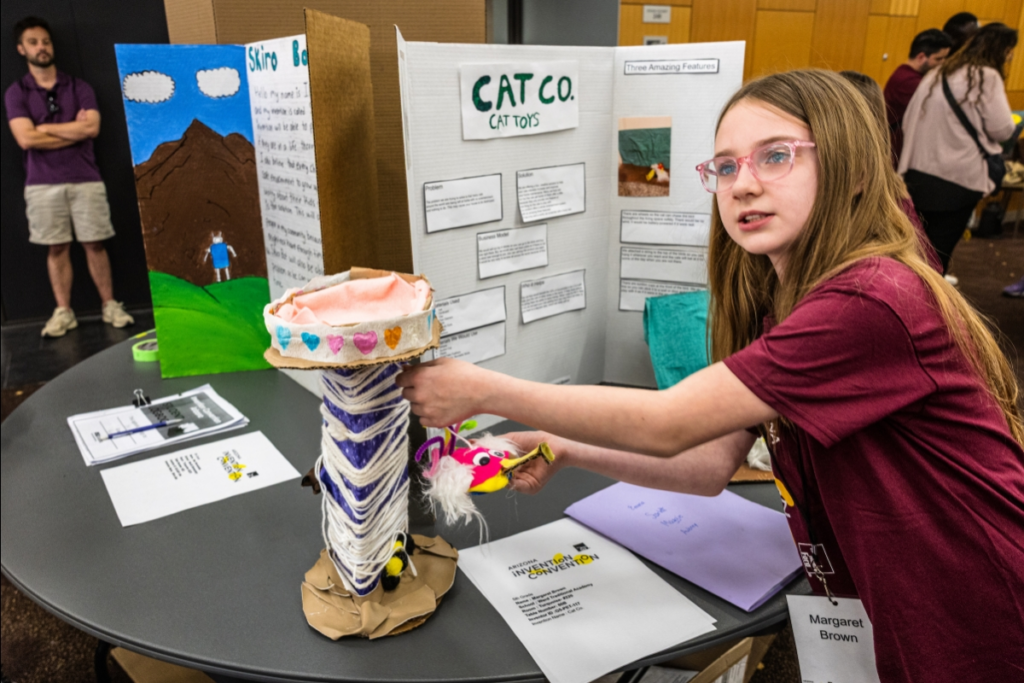
For many children, a lonely cat might seem like a small problem. For fifth grader Margaret Brown, it became the inspiration for an invention.
Margaret, a student at Ward Traditional Academy in Tempe, teamed up with classmates to create Cat Company Cat Toys — interactive toys designed to keep cats entertained while their owners are away from home.
“I thought it was a really good idea because one time we came back from camping and our cats had somehow turned on the water,” Margaret explained. “That showed us they can get into trouble when they’re left alone.”
Her invention was one of hundreds showcased at the 2026 Invention Convention Arizona, held Saturday at Arizona State University’s Tempe campus. More than 263 young inventors participated in the statewide competition, presenting creative solutions to real-world problems ranging from pet care and medicine safety to household messes.
This year, over 5,700 K–12 students from across Arizona took part in the program, which is supported by the J. Orin Edson Entrepreneurship + Innovation Institute at ASU. After competing in five regional events, top students advanced to the state competition, with winners earning the chance to compete at the national convention in June.
At its core, Invention Convention is designed to teach students the fundamentals of entrepreneurship and innovation. Participants identify a problem, brainstorm solutions, research existing ideas, build prototypes, test them, revise their designs, and ultimately market their inventions.
For Margaret, testing her invention was simple — her two cats eagerly volunteered.
“The moment we put the toys down, the cats immediately started playing with them,” she said with a laugh. “We actually had to move them out of the room so they wouldn’t destroy the toys before the competition.”
The program uses a free curriculum developed by The Henry Ford Museum of American Innovation. Students can participate during school hours, through after-school clubs, youth organizations like Scouting, or independently with support from parents.
According to Jeanine Ryan-Frandsen, program manager for youth entrepreneurship at the Edson Institute, the goal is to give students hands-on experience with innovation while introducing them to ASU’s entrepreneurial ecosystem.
“It mirrors the kind of experience students later have in college pitch competitions and startup programs,” she said. “We want them to understand that an idea can evolve into something bigger — maybe even a real business.”
She emphasized that the process itself matters just as much as the final product.
“This is all about critical thinking and iteration,” Ryan-Frandsen explained. “Students test ideas, discover what doesn’t work, redesign their prototypes, and improve them again and again. That’s the essence of STEM design thinking.”
As students grow older, the projects become increasingly sophisticated, often involving market analysis, patent research, and consultations with professionals.
Animals, in particular, proved to be a major source of inspiration for many participants.
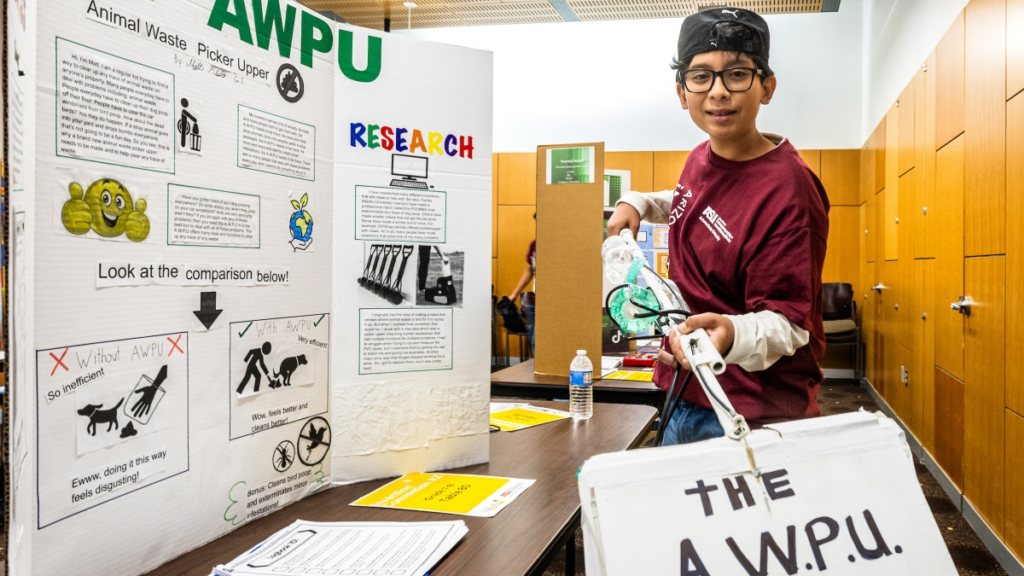
Seventh grader Matt Pulido from Madison Meadows Middle School in Phoenix won his division with the Animal Waste Picker Upper, a multi-purpose cleaning device designed to safely remove pet waste.
“I noticed there were a lot of stray animals in my neighborhood, and they often left messes in our yard,” he said.
While researching the issue, Matt learned that handling pet waste with plastic bags could expose people to harmful bacteria such as salmonella and E. coli. His invention combines several tools into one system, including a scooper, scrubber, alcohol dispenser, and cleaning solution.
“It’s basically a bunch of mini inventions combined into one,” he explained proudly.
Another pet-inspired innovation came from fifth grader Cecily Hart of Broadmor Elementary School in Tempe, who created Pet Perfection, a rolling support bed for animals with mobility problems.
“It’s kind of like a wheelchair for pets,” Cecily said. “You can push it like a stroller, and it has silk side cushions because silk helps animals with sores and aches.”
For younger students, research often begins at home.
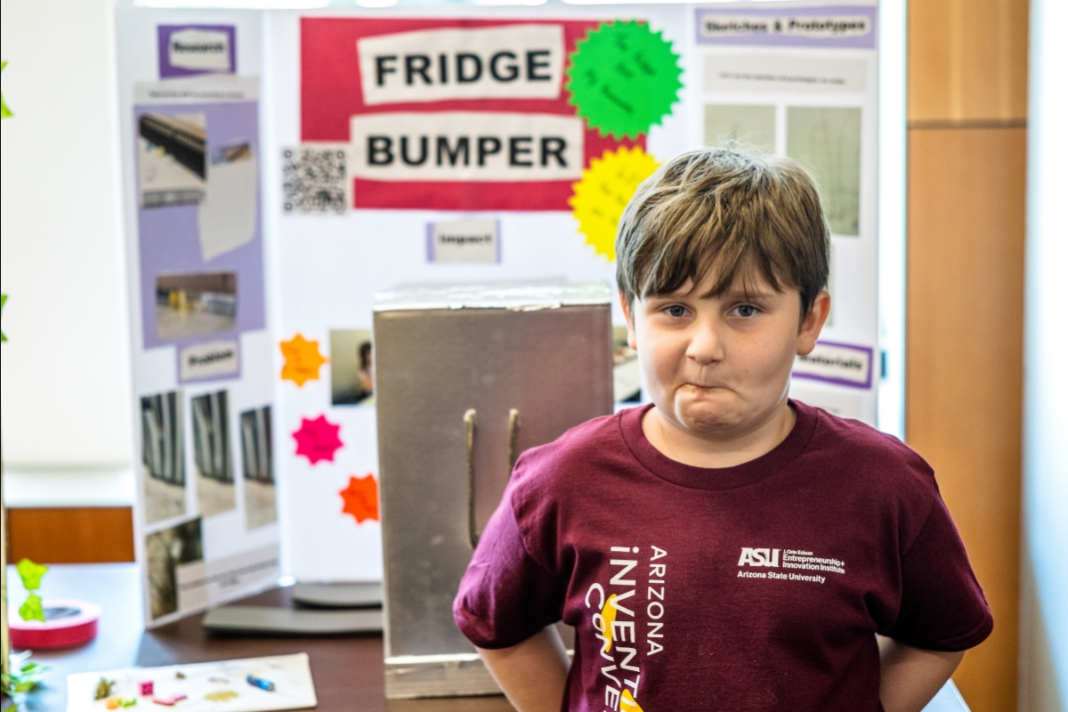
Second grader Caden Maxfield and his classmates at Fuller Elementary School kept losing toys underneath their refrigerator, inspiring them to invent the Fridge Bumper — a magnetic barrier that blocks the gap beneath the appliance.
When the students asked their families to pull out their refrigerators to investigate, they discovered far more than missing toys.
“There was dust, mold, pet fur, cereal spills, sticky juice — and even a hanger,” Caden said.
For older participants, however, the research process becomes far more advanced.
High school students Vyshal Sreenivas and Iraj Shroff developed a Smart Medicine Dispensing System after witnessing the dangers of medication misuse firsthand. One of their friends nearly overdosed on opioid medication, while a family member struggled to remember taking daily pills.
The two students — friends since childhood — consulted lawyers and a pain management specialist while developing their invention. Their device is a locked medicine dispenser that alerts users when it is time to take medication.
Sreenivas estimated that the product could be sold for around $50 with a monthly app subscription fee of $5, making it significantly cheaper than many existing systems on the market.
“Most current devices cost over a thousand dollars and are very bulky,” he said. “Our product not only helps prevent medication non-adherence, but could also reduce the billions spent on hospitalizations related to missed medication.”
A major component of the competition is feedback from judges, many of whom are university students and professionals.
One of Saturday’s judges, ASU engineering junior Charlotte Moenich, said she was amazed by the creativity and technical skill displayed by the participants.
“Some of these prototypes are honestly out of this world,” she said. “The creativity is flowing through everything they build.”
For her, the competition offers a glimpse into the future.
“It’s inspiring to see what this new generation wants to improve in the world,” she added. “They’re already thinking like real innovators.”