


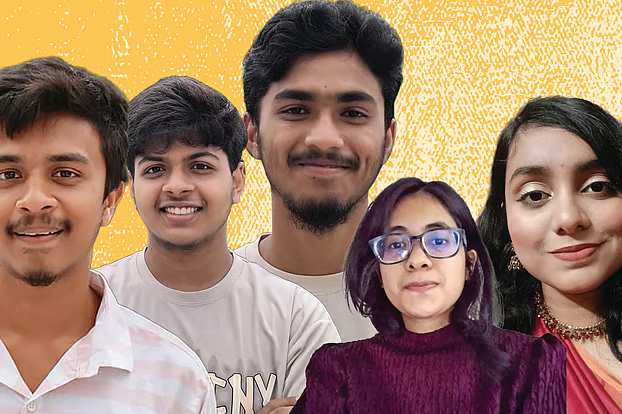
Five Bangladeshi college students have achieved what many could only dream of. With limited resources, no advanced laboratories, and in some cases not even a personal computer, they carried out theoretical research in particle physics and emerged as winners in one of the world’s most prestigious international science competitions organized by CERN.
The team, named Polaris after the North Star, consists of Salman Alam, Abdul Rahim, and S M Tausif from Chowmuhani Government Saleh Ahmed College; Nazia Titim from Rangpur Collectorate School and College; and Nazifa Tasnim from Birshreshtha Noor Mohammad Public College in Dhaka. Guiding them throughout their journey was their mentor, Md. Nishad Ahmed, a student of Noakhali Science and Technology University.
Their remarkable success came through CERN’s global competition, Beamline for Schools, where high school and college students from around the world submit proposals for experiments related to particle physics. This year’s competition featured around 4,500 participants from 89 countries, with 712 project proposals submitted. Polaris stood out among them and secured a place among the winning teams.
What makes their achievement extraordinary is not just the award itself, but the story behind it.
The journey began when Salman Alam discovered the competition through YouTube. Excited by the opportunity, he searched online for teammates through a Facebook group related to the program. After failing to join any existing team, he decided to build one himself. Along with two friends from his college, he formed Polaris — a name inspired by the guiding North Star and connected symbolically to their research material, polysiloxane.
Soon, they approached their private tutor Nishad Ahmed for guidance. Despite being a university student himself, Nishad enthusiastically supported the team. Later, through the same Facebook group, Nazia Titim and Nazifa Tasnim joined the project.
For Titim, the experience was personally transformative. An introvert by nature, she described the collaborative journey as something deeply meaningful and special.
The team focused on improving scintillators — materials used in radiotherapy equipment that emit light under radiation exposure. Current radiotherapy systems largely depend on plastic scintillators based on polyvinyl toluene, which gradually degrade under high radiation and temperature. This increases maintenance costs and reduces efficiency over time.
To address this challenge, Polaris proposed a new scintillator material based on polysiloxane. Although the material does not yet exist in practical form, the students theoretically demonstrated its feasibility. If successfully developed, the innovation could significantly reduce costs in the radiotherapy industry and improve the durability of medical equipment.
Their research, however, was carried out under severe technological limitations.
Salman did not own a computer and completed much of his work using a basic smartphone. His parents initially believed he was simply wasting time on his phone rather than studying. Tausif faced similar struggles. Many complex calculations had to be done manually with pen and paper.
Even their mentor Nishad struggled with insufficient computing power. After installing software necessary for computational physics simulations, his laptop repeatedly crashed. At one point, during his university examinations, the device remained unusable for over two weeks.
Eventually, the Department of Computer Science and Telecommunication Engineering at Noakhali Science and Technology University stepped in to support the team by granting them access to laboratory facilities.
Now, the young researchers are preparing for a once-in-a-lifetime opportunity. In August, they are expected to travel to Germany’s ELSA Research Center, where they will spend 14 days testing their proposal using advanced particle beamline technology. The organizers will bear all official expenses.
Yet uncertainty remains.
Four members of Polaris are currently preparing for their higher secondary examinations. While the written exams are expected to finish before the Germany trip, the dates for practical examinations remain undecided. The students have already contacted their colleges requesting an earlier schedule, but so far they have received little assurance.
There is another dream they hope to fulfill — visiting CERN’s main laboratory in Geneva, Switzerland. However, the additional travel costs are beyond the financial capacity of most team members. Australian-based Bangladeshi PhD researcher Salauddin Pathan has been trying to help them secure sponsorship, but no support has yet been confirmed.
Still, despite financial hardship, limited technology, and academic pressure, the story of Polaris shines as a powerful example of determination, curiosity, and the limitless potential of young minds.
From handwritten calculations and smartphone screens to international recognition at CERN, these five Bangladeshi students have already proven that talent can rise from anywhere — even from the most modest circumstances.