
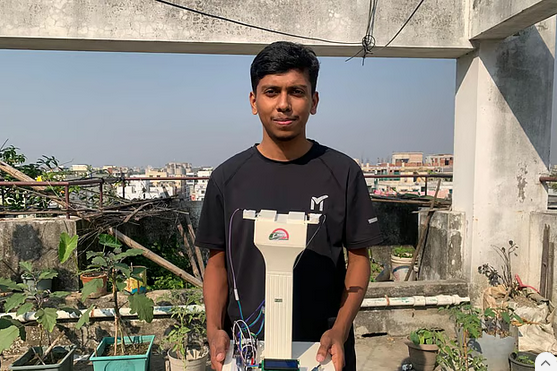
Concerns over public safety have intensified after a pedestrian died when a metro rail bearing pad fell onto the road in Farmgate, Dhaka. In response, a new technology has been developed by Iran Sardar, a student at Daffodil International University, to detect potential risks in metro rail structures in advance.
The Farmgate Metro Accident
On October 26, around 12:20 PM, a bearing pad fell from Metro Rail’s 433rd pillar in the Farmgate area, striking a pedestrian, Abul Kalam Azad (35), who died on the spot. Earlier, on September 18, 2024, a bearing pad fell from the 430th pillar in the same area. Although there were no casualties at that time, metro operations were halted for nearly 11 hours.
Understanding the Problem
Bearing pads play a critical role in keeping metro viaduct structures stable. Over time, or due to excessive vibrations, these pads can become displaced. After the recent accidents, the metro authorities installed CCTV cameras at the pillars, but no automated detection system exists yet.
The Metro Rail Bearing Pad Safety Technology
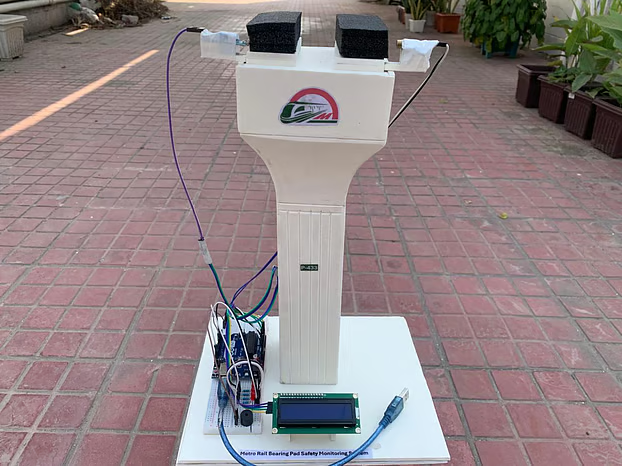
In this context, Iran Sardar, a student in the Computing and Information Systems (CIS) department at Daffodil International University, has developed a technology called the “Metro Rail Bearing Pad Safety Monitoring System.” Interested in robotics and IoT, Sardar explained that his system uses sensors installed on the bearing pads to provide real-time monitoring.
“Any vibration or structural deviation will be detected instantly by the sensors,” said Sardar. “The monitor will show which pillar’s pad has moved. Simultaneously, an alarm will sound and a warning will be sent to the control room. This system will allow preventive action before accidents occur.” He added that with government support, the technology could be fully implemented in the metro system, enhancing safety for both metro operations and pedestrians.
How the System Works
Each bearing pad will have a dedicated sensor. Even minor movements will trigger a signal sent to the control unit, displaying the pillar number and issuing an alert. A red signal and alarm will activate immediately, and notifications can also be sent via SMS or phone calls. The control room can monitor the bearing pads in real-time, ensuring instant action if any displacement occurs.
Iran Sardar’s Journey and Achievements
Iran Sardar is the youngest son of farmer Ibrahim Sardar and homemaker Momtaz Begum from Gaila village, Agailjhara Upazila, Barishal. He completed his SSC from Government Gaila Model Secondary School in 2021 and HSC from Mahilara Degree College in 2023. Currently, he is studying in the CIS department at Daffodil International University in Dhaka.
Sardar developed an interest in robotics after seeing the first robot, Sophia, in 2017. Later, in 2022, he won second place at the Digital Innovation Fair in Barishal Division with his robot “Korona Sebok.” He has also created robots for fire prevention named “Riba” and “Agni,” which have gained nationwide attention.
His future plans include elevating Bangladesh’s robotics sector to the global stage and researching how local technologies can solve the country’s technological challenges.
This young inventor’s project is just one example. Behind him are thousands of others—students, mechanics, small-scale researchers—working silently in garages, village homes, and university basements.
A Lesson for the World: Talent Exists Everywhere
The story also carries a larger message: every nation has hidden talents, waiting to be discovered. But without proper guidance, mentorship, and institutional support, many brilliant ideas die before they grow.
Countries like Bangladesh prove that if young people can innovate under so many constraints, imagine what they could create with opportunities, training, and encouragement.
Governments Must Support Innovators — Not Ignore Them
Across developing nations, talented inventors often struggle because:
- funding is scarce,
- research opportunities are limited,
- patents are expensive,
- and institutions rarely nurture young thinkers.
If governments invest in talent—through grants, innovation hubs, technology labs, and business mentorship—small inventions can grow into industries. These industries can create jobs, strengthen national identity, and boost the economy.
The Bangladeshi innovator’s device may seem simple, but it has already achieved something powerful: it has inspired millions and reminded the world that creativity is universal.
A Future Built on Innovation
Whether in Bangladesh, or anywhere else, visionary ideas are seeds. They may begin quietly, in a small workshop or a village shed, but with the right support, they can grow into national pride.
Governments, institutions, and communities must learn from these stories. Supporting innovators is not a luxury—it is an investment in the future.