
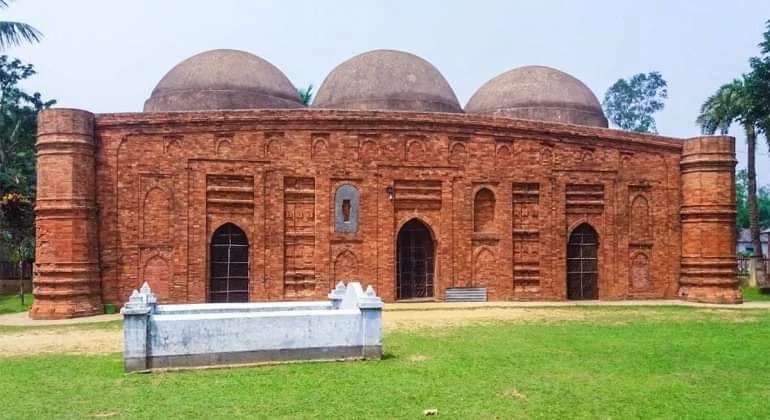

Hidden away in the quiet landscape of Sherpur, Bangladesh, stands a remarkable monument that has survived centuries of political change, social transformation, and the relentless passage of time. Kherua Mosque is one of the finest surviving examples of early Sultanate-era mosque architecture in Bengal.
Built in the late sixteenth century, the mosque represents a fascinating period in Bengal’s history when regional architectural traditions were developing their own distinctive identity. With its curved cornice, terracotta decoration, brick construction, and compact yet elegant design, Kherua Mosque offers a glimpse into the artistic and cultural world of medieval Bengal.
For visitors interested in history, architecture, and Bangladesh’s cultural heritage, Kherua Mosque is much more than an old religious building. It is a living reminder of a sophisticated architectural tradition that continues to shape the visual identity of Bengal.
Where Is Kherua Mosque?
Kherua Mosque is located in Kherua village of Sherpur Upazila in Bogura District, Bangladesh.
The mosque stands away from the country’s major tourist circuits, which has helped preserve some of its quiet historical character. Unlike famous monuments that attract large crowds, Kherua Mosque remains relatively peaceful, allowing visitors to appreciate its architecture without the overwhelming atmosphere of a busy urban attraction.
Its rural surroundings also create an interesting contrast with the monument itself.
The mosque was built centuries ago, yet the landscape around it still retains something of the atmosphere of rural Bengal.
A Mosque from the Sultanate Tradition
Kherua Mosque was constructed in 1582 CE, during the later period of Bengal’s independent Sultanate architectural tradition.
An inscription associated with the mosque provides important information about its construction. According to historical records, it was built during the reign of Sultan Bayazid Shah, with the mosque associated with Nawab Mirza Khan, an important figure of the period.
The date is particularly significant.
By the late sixteenth century, Bengal had already developed a distinctive architectural vocabulary. Local builders were no longer simply copying architectural forms from other parts of the Islamic world. Instead, they were adapting Islamic architecture to Bengal’s climate, building materials, craftsmanship, and long-established local traditions.
Kherua Mosque reflects this process beautifully.
The Architecture of Kherua Mosque
At first glance, Kherua Mosque may appear relatively simple compared with some larger historic mosques. But its architectural beauty lies precisely in its proportions and details.
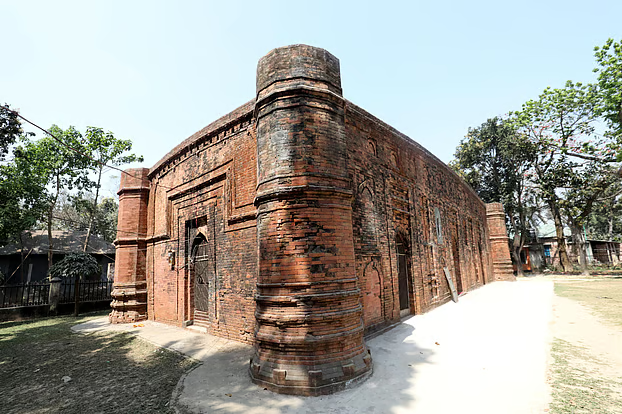
The mosque is built primarily of brick, a material that became fundamental to Bengal’s historic architecture.
Because natural building stone was relatively scarce in Bengal, brick became one of the principal materials used by local builders. Skilled craftsmen learned to use brick not merely for structural purposes but also as a medium for intricate decoration.
Kherua Mosque demonstrates this tradition.
Its walls are decorated with ornamental details, while the overall structure follows the characteristic forms of Bengal’s Sultanate mosques.
The Three-Domed Design
One of the most notable features of Kherua Mosque is its three-domed roof.
The three-domed arrangement became an important feature of mosque architecture in Bengal. The domes provide the building with a distinctive silhouette while also covering the prayer hall beneath.
The mosque’s relatively compact scale gives it a sense of intimacy.
Instead of monumental size, the architects relied on carefully balanced proportions, arches, domes, and decorative details to create visual harmony.
This approach is characteristic of much of Bengal’s historic mosque architecture.
Curved Cornice: A Signature of Bengal
One of the most recognizable characteristics of traditional Bengali mosque architecture is the curved cornice.
Unlike the straight horizontal rooflines commonly seen in many other Islamic architectural traditions, historic Bengal buildings often feature gently curved cornices.
This architectural form is believed to have been influenced by the traditional Bengali hut, whose curved roof helped shed heavy monsoon rain.
Kherua Mosque displays this characteristic curved cornice.
It is an excellent example of how Islamic architectural traditions were adapted to the local environment and cultural context of Bengal.
Terracotta and Decorative Details
Bengal’s historic brick architecture is closely associated with terracotta ornamentation.
Because brick was the primary construction material, craftsmen developed sophisticated methods of decorating buildings through carved or moulded terracotta elements.
Kherua Mosque contains decorative features that reflect this artistic tradition.
Floral patterns, geometric designs, recessed panels, and ornamental brickwork contribute to the mosque’s visual character.
These details are not merely decorative.
They represent the craftsmanship of artisans who worked with limited materials to create buildings of considerable artistic sophistication.
Three Arched Entrances
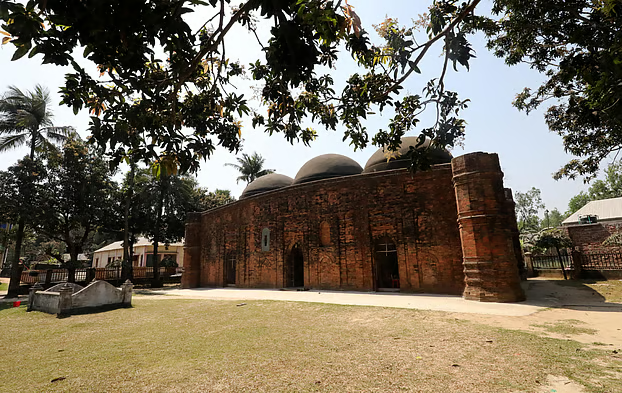
The eastern façade of the mosque features three arched entrances, which lead into the prayer hall.
The central entrance is emphasized architecturally, creating a balanced composition across the façade.
The arches also contribute to the mosque’s structural character while creating a visually pleasing rhythm.
When viewed from the front, the repeated arches, brickwork, and domes combine to create a simple but elegant façade.
Interior of the Mosque
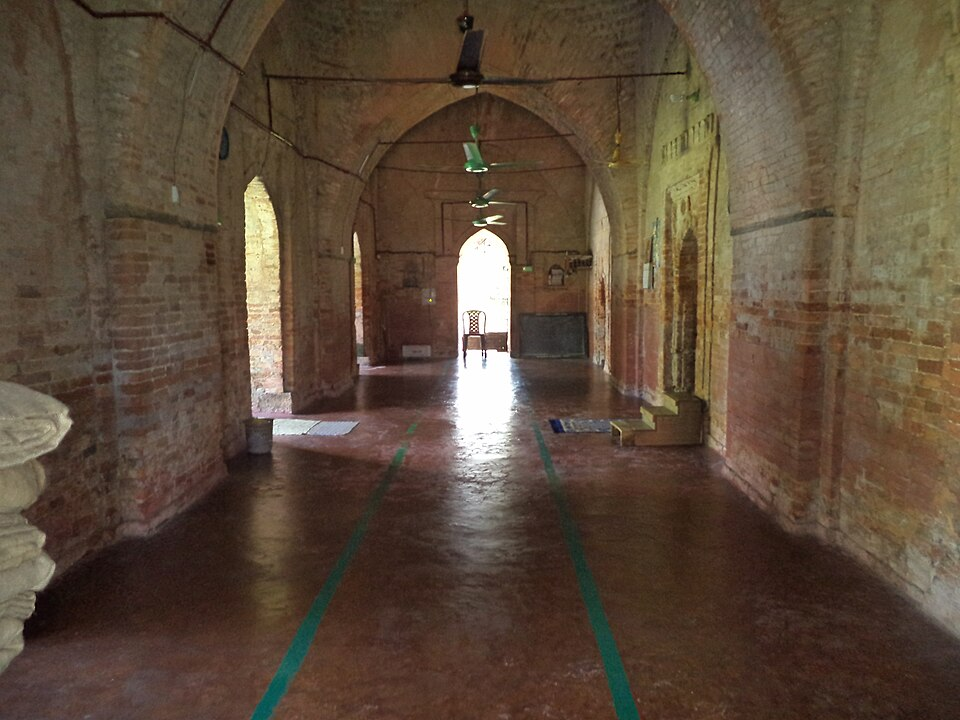
Inside, the mosque is relatively compact.
The prayer hall is divided into sections corresponding to the three domes above. Internal arches and supporting elements create the structural framework necessary to carry the weight of the domes.
The interior is considerably less elaborate than some later Mughal or colonial-era monuments.
Yet this simplicity is part of its charm.
The architecture emphasizes proportion, symmetry, functionality, and craftsmanship rather than excessive ornamentation.
A Window into Medieval Bengal
Kherua Mosque is valuable not only because of its architecture but also because of the historical period it represents.
The late sixteenth century was a time of significant political transition in Bengal.
Regional powers, Afghan rulers, and the expanding Mughal Empire were all part of the complex political landscape of the period.
Architecture from this era provides physical evidence of the society that existed during these transformations.
Kherua Mosque survived these changes.
Its walls have witnessed centuries of history that are almost impossible to imagine from the peaceful surroundings of the present day.
Why Brick Architecture Matters
To understand Kherua Mosque properly, it is important to understand Bengal’s relationship with brick.
The geography of Bengal influenced its architecture.
The region’s rivers, fertile plains, and abundant clay made brick a practical building material. At the same time, the monsoon climate required architects to develop structures capable of dealing with heavy rainfall.
This resulted in an architectural tradition that was distinctly local.
Kherua Mosque demonstrates how geography, climate, available materials, and cultural traditions can combine to create a unique architectural identity.
It is therefore not simply an Islamic monument.
It is an example of Bengal’s own architectural language.
Kherua Mosque and the Evolution of Mosque Architecture
The architectural development of mosques in Bengal did not happen overnight.
Early Islamic structures incorporated ideas brought from other parts of the Muslim world. Over time, local craftsmen adapted those ideas to regional conditions.
The result was a distinctive Bengali mosque style.
Features such as:
- Brick construction
- Curved cornices
- Multiple domes
- Terracotta decoration
- Compact prayer halls
- Elaborately framed arches
became associated with the region’s mosque architecture.
Kherua Mosque represents an important stage in this evolution.
A Survivor Through the Centuries
One of the most remarkable aspects of Kherua Mosque is simply its survival.
More than four centuries have passed since its construction.
During that time, Bengal experienced political upheaval, colonial rule, economic transformation, wars, changes in land ownership, and rapid modernization.
Many historic structures disappeared during this process.
Kherua Mosque survived.
Its continued existence gives historians, architects, students, photographers, and visitors an opportunity to study an authentic example of Bengal’s historic architecture.
The Importance of Heritage Conservation
Historic monuments require continuous care.
Brick structures are particularly vulnerable to moisture, vegetation growth, weathering, inappropriate repairs, and environmental changes.
For a monument like Kherua Mosque, conservation must therefore be approached carefully.
Modern repair materials and techniques can sometimes unintentionally damage historic structures if they are incompatible with the original construction methods.
Preserving a monument is not simply about repairing visible damage.
It is about protecting its original materials, architectural details, historical context, and authenticity.
Why Young People Should Visit Kherua Mosque
For young people, history can sometimes feel like something confined to textbooks.
Kherua Mosque offers a different experience.
Standing in front of a structure built in 1582 can make history feel tangible.
The bricks, arches, domes, and decorative patterns were created by people who lived hundreds of years ago. Their work has survived long after their names were forgotten.
That is one of the most powerful lessons heritage sites can offer.
They remind us that civilizations are remembered not only through written records but also through the buildings they leave behind.
Kherua Mosque as a Tourism Destination
Bangladesh has no shortage of historic monuments, but many remain relatively unknown outside their local communities.
Kherua Mosque has considerable potential as a cultural tourism destination.
Visitors interested in:
- History
- Islamic architecture
- Photography
- Archaeology
- Heritage tourism
- Bengali culture
can find something meaningful here.
The mosque can also form part of a broader historical tour of northern Bangladesh, where numerous archaeological and architectural sites reflect different periods of the country’s past.
A Quiet Monument with a Powerful Story
Perhaps the greatest attraction of Kherua Mosque is its quietness.
It does not need monumental scale to impress visitors.
Its story is contained within its brick walls.
A mosque built more than four centuries ago continues to stand in a country that has changed dramatically around it. Generations have come and gone, political boundaries have shifted, and cities have transformed.
Yet the mosque remains.
That endurance gives Kherua Mosque a special place in Bangladesh’s cultural landscape.
Final Thoughts
Kherua Mosque is a remarkable surviving chapter of Bengal’s architectural history.
Built in 1582, the mosque demonstrates the distinctive architectural language that emerged in Bengal through the adaptation of Islamic forms to local materials, climate, craftsmanship, and cultural traditions.
Its three domes, curved cornice, brick construction, arched entrances, and decorative details make it an important example of Sultanate-era architecture.
But its significance goes beyond architecture.
Kherua Mosque is a reminder of the people who built medieval Bengal, the craftsmen who transformed ordinary bricks into works of art, and the generations who preserved this remarkable structure.
In an increasingly modern Bangladesh, monuments like Kherua Mosque remind us that progress does not require forgetting the past.
Sometimes, the best way to understand where we are going is to pause beside the buildings that have been standing for centuries—and listen to what they have to say.
Frequently Asked Questions
When was Kherua Mosque built?
Kherua Mosque was built in 1582 CE, during the late Sultanate period of Bengal.
Where is Kherua Mosque located?
The mosque is located in Kherua village in Sherpur Upazila, Bogura District, Bangladesh.
What architectural style does Kherua Mosque represent?
Kherua Mosque represents the distinctive Bengal Sultanate architectural tradition, characterized by brick construction, curved cornices, multiple domes, arches, and decorative elements.
How many domes does Kherua Mosque have?
The mosque has three domes covering its main prayer hall.
Why is Kherua Mosque important?
It is an important surviving example of late Sultanate-period mosque architecture and demonstrates how Islamic architectural forms were adapted to Bengal’s local environment and building traditions.
What makes the mosque’s architecture distinctive?
Its three-domed design, curved cornice, brick construction, arched entrances, and ornamental details are among its most notable characteristics.
Why should Kherua Mosque be preserved?
Kherua Mosque is an important part of Bangladesh’s architectural and cultural heritage. Preserving it ensures that future generations can study and experience an authentic monument from medieval Bengal.