



What were you doing at 15? Maybe preparing for school exams. But what Laurent Simons from Belgium accomplished at that age will make your jaw drop.
This 15-year-old is being called “Belgium’s Little Einstein.” Recently, he defended his PhD thesis at the University of Antwerp—in Quantum Physics! He is probably now the youngest person in the world to earn a doctorate in this highly complex branch of physics.
Laurent’s learning speed is far from ordinary—it’s like a supersonic jet. He enrolled in primary school at the age of 4 and completed it by age 6!
By the time most of us were struggling with 7th or 8th-grade math at age 12, Laurent had already earned a master’s degree, conducting research on boson particles and black holes. How was this possible?
At 15, most teenagers are worrying about exams or learning to drive. Belgian researcher Laurent Simons has already defended a PhD in quantum physics at the University of Antwerp, with a thesis on “Bose polarons in superfluids and supersolids.”
Within weeks he moved to Munich to start a second PhD in medical science focused on artificial intelligence, where his long-term ambition is, in his own words, “creating superhumans” and defeating aging.
It sounds like the plot of a sci-fi series. Yet the academic record is real, formally documented and supervised through conventional university channels. The bigger question is what happens if projects like his actually work on a large scale, in a world already struggling with climate change, resource use, and inequality.
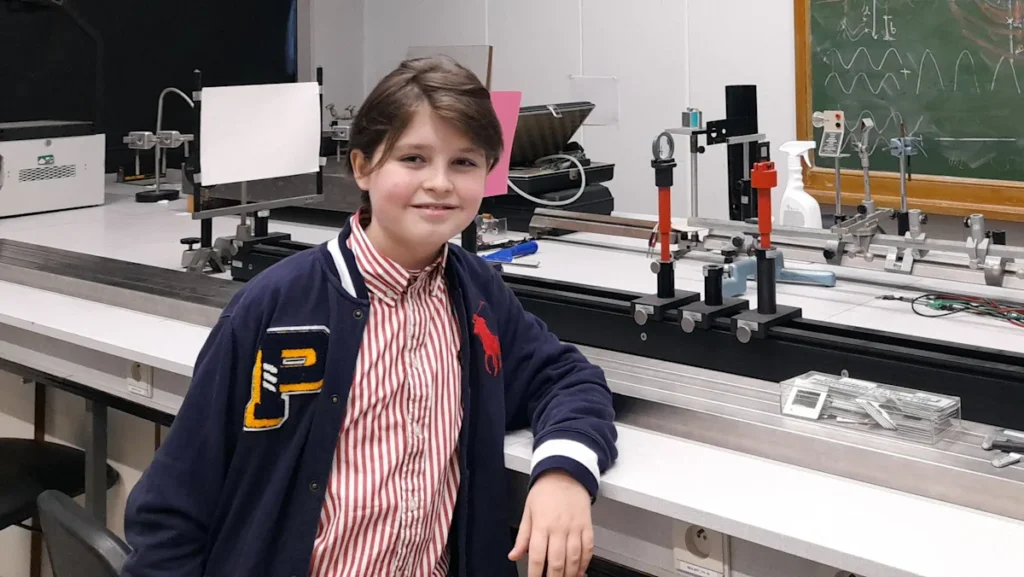
From frozen atoms to living cells
Simons’ physics PhD explored how single impurity particles behave inside Bose Einstein condensates, an exotic state of matter where atoms are cooled so much that they act like one giant quantum wave. This type of work helps scientists understand many body quantum systems, which can inform future quantum computers and ultra precise sensors.
Along the way he interned at the Max Planck Institute for Quantum Optics and completed bachelor and master degrees in physics at unusual speed, finishing secondary school at eight and a university degree before most teenagers start high school.
Now his daily work looks very different. In Munich he is part of a biomedical research lab that uses advanced computing and AI for “in silico bioengineering” to model tissues and disease on computers and to design new therapies. Public information points to algorithms, simulations, and data sets rather than experiments on human volunteers at this stage.
So there is no army of enhanced people hiding in a basement lab. Not yet. What we see is a teenager stepping straight into one of the hottest and most controversial frontiers in science.
Laurent has a photographic memory, meaning he can remember anything he sees or reads almost like a picture. His IQ is 145! Only about 0.1% of people in the world have such extraordinary talent.
You might think all this studying is just for records? Not at all. Behind it lies a story of emotion and determination. At age 11, Laurent lost his grandparents. That grief instilled in him an unusual determination.
His goal now is even bigger than a PhD—“immortality.” Not magic, but through medical science, he aims to extend human lifespan. Even if true immortality is impossible, he wants to help humans live longer. So after mastering physics, his next destination is medical science.
News of Laurent’s incredible talent has attracted major tech giants from the United States and China, offering him lucrative positions. But Laurent’s parents have turned down all offers.
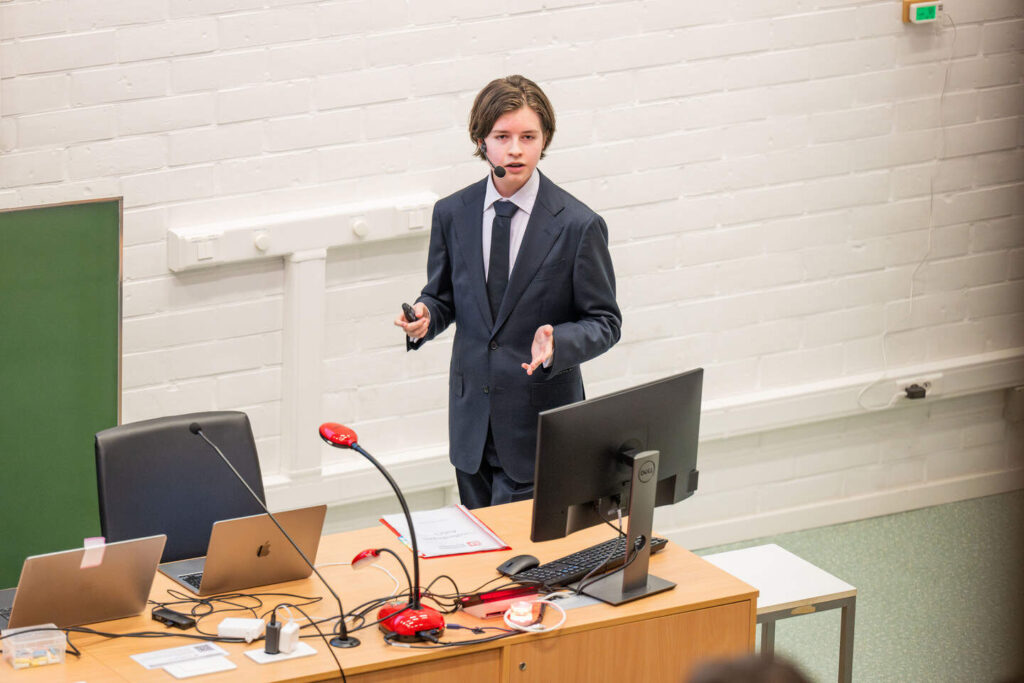
His father said, “Laurent carries two identities—one as a scientist, and one as a normal child. We don’t want him to lose his childhood locked in a laboratory.”
Of course, Laurent is not the youngest person in history to earn a doctorate. In 1814, Carl Witte earned a PhD at just 13. But in the modern era, completing a PhD in a field as challenging as quantum physics at 15 is truly astonishing!
At an age when most teenagers are busy with school studies and playing, 15-year-old Laurent Simons has earned a PhD in Quantum Physics from the University of Antwerp in Belgium. Not only did he achieve a PhD, but this young Belgian has also begun a complex research project aimed at extending human lifespan. Laurent’s extraordinary talent was noticed in his childhood. After finishing high school at the age of 8, he earned a bachelor’s degree in physics by the age of 12. He later completed a master’s degree and conducted research on boson particles and black holes.
According to researchers, Laurent has an IQ of at least 145. He possesses a photographic memory, allowing him to remember anything he sees or reads almost like a picture. His PhD thesis focused on boson polarons, primarily observing particle behavior at ultra-low temperatures. His research was influenced by the work of the legendary Indian scientist Satyendra Nath Bose. Laurent demonstrated how a single particle can alter its own behavior and that of its surrounding environment while moving through the quantum sea of other particles.
Laurent did not stop after earning his PhD. He has now begun research in Munich, Germany, aiming to earn another PhD in medical science and artificial intelligence. Laurent has stated that his ultimate goal is to create “superhumans.” By combining physics and AI, it may become possible to halt the human aging process, which is currently impossible. Artificial intelligence will also assist in rapidly identifying early symptoms of diseases and in developing new medicines by analyzing vast amounts of data.
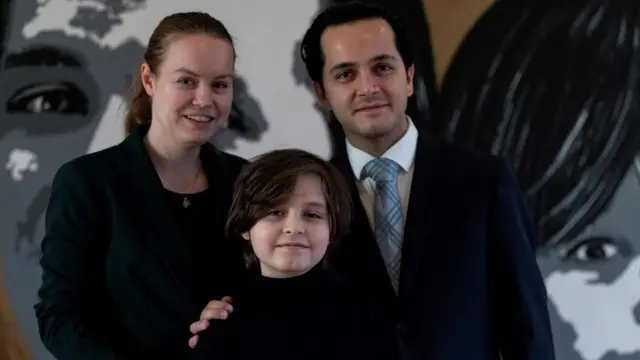
Immediately after earning his PhD in quantum physics, several major technology companies in the United States and China offered Laurent jobs with salaries in the millions. However, Laurent’s father, Alexander, and mother, Lydia, turned down these offers. They did not want him to be confined to a laboratory and lose his childhood. Laurent himself believes that intelligence only truly fulfills its purpose when used for noble goals.
For context, Carl Witte earned a PhD at the age of 13 in 1814. Although Laurent is not the youngest person in history to earn a doctorate, completing a PhD in a complex field like modern quantum physics at just 15 makes him one of the most influential young scientists in the world.
A Belgian child prodigy who had hoped to graduate from university in the Netherlands this month has dropped out.
The parents of Laurent Simons, nine, wanted him to graduate before his birthday on 26 December so he could be the first university graduate under 10.
But Eindhoven University told them there were still too many exams Laurent needed to take before then.
His parents refused an offer of a mid-2020 graduation date, and immediately removed him from the course.
Laurent was supposed to complete the three-year electrical engineering degree in just 10 months so he could meet his birthday deadline.
Alexander Simons, Laurent’s father, told Dutch media the university had criticised him for frequently courting media coverage of his son.
“If a child can play football well, we all think the media attention is great. My son has a different talent. Why should he not be proud of that?” he told Dutch newspaper De Volkskrant.
Laurent Simons’ Instagram account also posted a screenshot of an email the university had sent them last month about potential December graduation dates, with a caption saying: “Liar liar pants on fire!!!”
- Belgian boy off to university aged 8
- The three year old with an IQ of 171
- Mother intervenes in Child Genius final
In a statement, Eindhoven’s University of Technology said it would not be feasible for Laurent to complete the course before turning 10, while also developing “insight, creativity and critical analysis”. If he were to rush the course, the statement said, his academic development would suffer.
The university also cautioned against placing “excessive pressure on this nine-year-old student” who, it said, had “unprecedented talent”.