
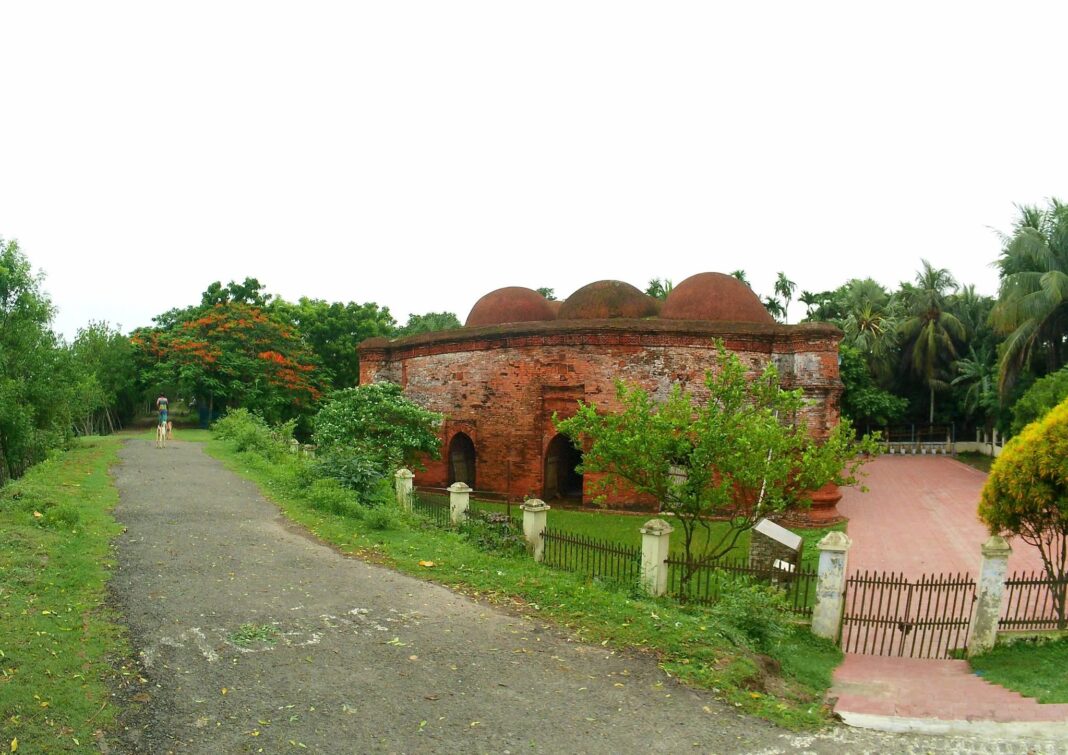

Nestled in the quiet village of Masjidkur in Amadi Union of Koyra Upazila, Khulna, stands one of Bangladesh’s lesser-known yet historically significant Islamic monuments—the Masjidkur Mosque. Hidden for centuries beneath layers of earth and vegetation, this remarkable fifteenth-century mosque represents the architectural brilliance of the Bengal Sultanate and the enduring legacy of the legendary Muslim saint and administrator, Khan Jahan Ali.
Although it does not receive the same international recognition as the Sixty Dome Mosque in nearby Bagerhat, Masjidkur Mosque possesses immense archaeological, historical, and architectural value. Today, it is a protected monument under the Department of Archaeology of Bangladesh, serving both as an active place of worship and an important cultural heritage site.
Quick Facts
Official Name: Masjidkur Mosque
Bengali Name: মসজিদকুঁড় মসজিদ
Location: Masjidkur Village, Amadi Union, Koyra Upazila, Khulna District, Bangladesh
Construction Period: Approximately 1450–1490 CE
Builder: Traditionally attributed to Bura Khan (Borhan Khan) and Fateh Khan, disciples of Khan Jahan Ali
Architectural Style: Bengal Sultanate Architecture
Structure: Nine-domed square mosque
Protected By: Department of Archaeology, Bangladesh
Current Status: Active mosque and archaeological monument
A Legacy Connected to Khan Jahan Ali
The story of Masjidkur Mosque begins with the remarkable expansion of Islamic settlements into the southern delta of Bengal during the fifteenth century.
The celebrated Muslim saint, administrator, and builder Khan Jahan Ali played a transformative role in developing the southwestern region of Bengal. While he is most famous for constructing the UNESCO World Heritage monuments of Bagerhat, historical traditions suggest that some of his trusted followers expanded settlements even farther south toward present-day Koyra.
Among these followers were Borhan Khan, popularly known as Bura Khan, and his son Fateh Khan. Historical accounts indicate that they governed the Amadi region between approximately 1450 and 1490 and established the mosque as both a religious center and a symbol of Islamic administration in the area.
Why Is It Called “Masjidkur”?
The mosque’s name has a fascinating origin.
Unlike many historic mosques that have retained their original names, this monument earned its identity through rediscovery.
For centuries, the mosque lay buried beneath soil, vegetation, and forest growth. After the Partition of India, local people rediscovered the structure during excavation. Since the mosque was literally dug out from the ground, it became known as “Masjidkur,” with “kur” referring to digging or excavation in local usage.
Over time, the surrounding settlement itself adopted the mosque’s name, making the monument the identity of the entire village.
Architecture: A Classic Example of Bengal Sultanate Design
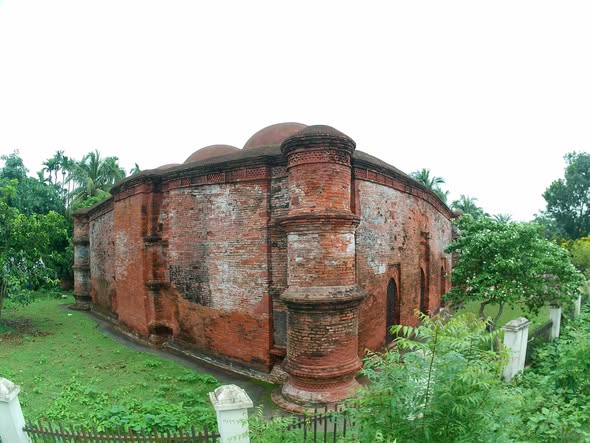
Masjidkur Mosque reflects many defining characteristics of fifteenth-century Bengal Sultanate architecture.
The mosque is perfectly square in plan.
- External dimensions: 16.76 metres on each side
- Internal dimensions: 12.19 metres on each side
- Wall thickness: Approximately 7 feet (over 2 metres)
Its massive brick walls were designed not only for structural stability but also to maintain a naturally cool interior throughout the year.
One of the mosque’s most impressive features is its nine-domed roof, supported internally by four stone pillars arranged in a square. These pillars divide the prayer hall into nine equal bays, each originally crowned with a dome—a design popular during the Sultanate period in Bengal.
Nine Domes That Define Its Identity
The mosque originally consisted of:
- Nine hemispherical domes
- Four interior stone columns
- Twelve supporting arches
- Thick brick walls
- Corner towers
The nine-dome arrangement was both structurally efficient and aesthetically elegant, allowing the roof load to be distributed evenly while creating a spacious prayer hall.
This architectural style can also be seen in several other mosques built under the influence of Khan Jahan Ali across southern Bengal.
Nine Entrance Arches
The mosque is notable for its symmetrical entrances.
Except for the western qibla wall, every side contains three arched doorways, making a total of nine entrances.
This design allows excellent ventilation and natural lighting—an important consideration in the humid climate of southern Bangladesh.
The western wall houses beautifully designed mihrabs, indicating the direction of Makkah.
A Naturally Cool Interior
Visitors frequently remark on the mosque’s surprisingly cool interior, even during the hottest summer months.
The reason lies in its medieval engineering:
- Exceptionally thick walls
- High brick domes
- Large arched openings
- Cross ventilation
- Heat-resistant traditional construction materials
These passive cooling techniques enabled worshippers to pray comfortably centuries before modern air-conditioning existed. Local worshippers continue to experience this unique feature today.
Rediscovered After Centuries
One of the most fascinating chapters in the mosque’s history is its rediscovery.
Following centuries of neglect, much of the building became buried under layers of earth and vegetation.
Unlike many historical monuments that remained continuously visible, Masjidkur Mosque virtually disappeared from sight until excavations revealed its hidden structure.
Interestingly, no foundation inscription was found during the excavation. As a result, historians rely on architectural analysis and historical traditions to estimate its construction period and builders.

Present Condition and Conservation Challenges
Today, the mosque remains under the protection of the Department of Archaeology of Bangladesh.
Although conservation work has been carried out periodically, heritage experts and local residents have expressed concern over the gradual deterioration of the structure.
Recent observations have identified:
- Peeling plaster
- Surface cracks
- Fading decorative elements
- Weather-related damage
Limited restoration has been undertaken to keep the mosque functional for daily prayers, but experts argue that comprehensive conservation is necessary to preserve this important monument for future generations.
Tourism Potential
Located near the Sundarbans, Masjidkur Mosque has significant potential as a cultural tourism destination.
Visitors can combine a trip to the mosque with exploration of:
- Rural Khulna
- The Kapotaksha River
- Traditional villages
- Nearby Sundarbans attractions
Its peaceful surroundings, medieval architecture, and historical significance make it an ideal destination for history enthusiasts, photographers, architecture students, and cultural travelers.
How to Reach
Location:
Masjidkur Village
Amadi Union
Koyra Upazila
Khulna District, Bangladesh
From Khulna city, visitors generally travel by road to Koyra and then continue toward Amadi Union before reaching Masjidkur village. The mosque stands close to the Kapotaksha River in a serene rural landscape.
Why Masjidkur Mosque Matters
Masjidkur Mosque is far more than an old brick building.
It is a surviving witness to the spread of Islam into the southern Bengal delta, the visionary leadership of Khan Jahan Ali and his followers, and the remarkable engineering skills of fifteenth-century Bengal.
Its rediscovery from beneath the earth adds a unique chapter to Bangladesh’s archaeological history, while its continuing use as a mosque demonstrates the enduring connection between heritage and living faith.
With proper conservation, improved visitor facilities, and greater public awareness, Masjidkur Mosque has the potential to become one of the most admired heritage destinations in southwestern Bangladesh.
Nearly six centuries after its construction, this quiet monument still stands—its nine domes, thick walls, and timeless elegance continuing to tell the story of a remarkable era in Bengal’s history.
You may like to read: Sixty Dome Mosque: History Architecture and Beauty