



For many children growing up in Bangladesh, power cuts were an inconvenience. For Tonima Tasnim Ananna, they were magical.Long before she became an astrophysicist, before she studied at Cambridge and Yale, and before she was recognized by Scientific American as one of the young scientists whose work could shape the future of science, she was simply a curious little girl standing under the night sky in Dhaka’s Badda neighborhood.
In those days, the city looked very different. There were fewer high-rise buildings, and when electricity disappeared during load-shedding, the sky suddenly came alive. Thousands of stars emerged from the darkness. Sometimes she spotted floating sky lanterns. Neighbors gathered outside, children played, and the universe seemed much closer than it does today.Her mother often told stories about planets, stars, and galaxies. Those stories ignited a fascination that has never faded.Like many children, Tonima dreamed of becoming an astronaut.Life eventually took her in a different—but equally extraordinary—direction.Instead of traveling into space, she chose to uncover its deepest secrets.
Today, Dr. Tonima Tasnim is an astrophysicist at Wayne State University in the United States, where she studies one of the most mysterious objects in the universe: supermassive black holes.
A Bangladeshi Scientist Among the World’s Most Promising Minds
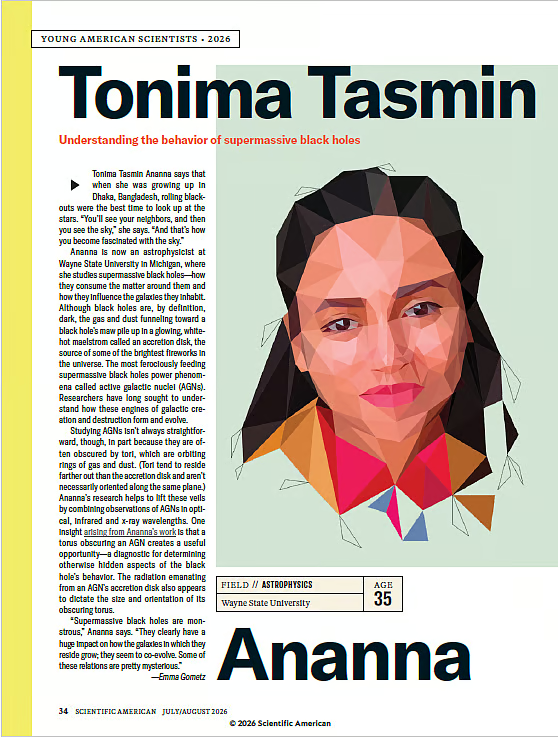
In 2026, one of the world’s oldest and most respected science magazines, Scientific American, published a special issue titled “The Future of Science.”Rather than celebrating famous Nobel Prize winners or veteran researchers, the magazine looked ahead.It selected 28 young scientists from different fields whose discoveries could transform our understanding of the world in the coming decades.Among them was a name that made Bangladesh proud:Tonima Tasnim.
For any scientist, appearing in Scientific American is a remarkable achievement. Being selected as one of the researchers expected to shape the future of science is even more extraordinary. It placed Tonima alongside some of the brightest emerging scientific minds on Earth.Yet for her, this recognition represents another milestone—not the destination. Her greatest passion remains understanding how the universe itself evolved.
Chasing the Biggest Mysteries in the Cosmos
If someone asked what the universe’s greatest unsolved mystery is, many astronomers would point toward black holes.Black holes are regions where gravity is so powerful that nothing—not even light—can escape.At the center of almost every large galaxy, including our own Milky Way, lies a supermassive black hole, containing millions or even billions of times the mass of our Sun.But one enormous question continues to puzzle scientists.How did these cosmic giants become so massive so quickly after the Big Bang?That question lies at the heart of Tonima Tasnim’s research.
Using advanced observations, computer simulations, and theoretical models, she investigates how supermassive black holes formed, how they grew over billions of years, and how they influence the galaxies surrounding them.Understanding black holes isn’t just about satisfying curiosity.These mysterious objects help determine how galaxies evolve, how stars are born, and perhaps even how the universe itself changes over time.Every new discovery brings humanity one step closer to understanding its cosmic origins.
From Dhaka to the World’s Best Universities
Tonima’s journey demonstrates that talent can flourish anywhere when paired with determination.She studied at Manarat International School and College in Dhaka before continuing her education abroad.Her academic journey took her through some of the world’s most respected institutions. She studied at Haverford College in the United States, continued her academic development through the University of Cambridge in the United Kingdom, and later earned her Ph.D. at Yale University, one of America’s most prestigious Ivy League universities.
At Yale, she worked under the supervision of Professor Claudia Megan Urry, a world-renowned astrophysicist and former President of the American Astronomical Society.For a young researcher, learning under one of the leading figures in modern astrophysics was both a privilege and an opportunity to contribute to cutting-edge research.Those years refined not only her scientific skills but also her ability to ask the kinds of questions that lead to groundbreaking discoveries.
Learning Beyond the Classroom
Tonima’s education was never limited to lectures and textbooks.She sought opportunities wherever science was pushing boundaries.She completed internships at organizations recognized around the world for scientific excellence, including NASA and CERN, the European laboratory famous for operating the Large Hadron Collider, the world’s largest particle accelerator.Although her primary research focuses on astrophysics rather than particle physics, these experiences exposed her to international collaborations, advanced technologies, and multidisciplinary scientific thinking.Modern science rarely happens in isolation.The biggest discoveries emerge when researchers from different countries and different disciplines work together. Tonima’s career reflects exactly that spirit.
Recognition That Came Early
Long before Scientific American celebrated her achievements, the international scientific community had already begun paying attention.In 2020, Science News selected her among its SN 10: Scientists to Watch, recognizing researchers who were making exceptional contributions early in their careers.Her work also gained remarkable attention within the astrophysics community.One of her research papers was recognized among the most downloaded and most widely read articles featured in The Astrophysical Journal’s annual review.Such recognition is significant because scientific influence is measured not only by awards but also by how often other researchers read,discuss, and build upon your work.In science, ideas matter most when they inspire further discovery.
A Scientist Who Loves Teaching
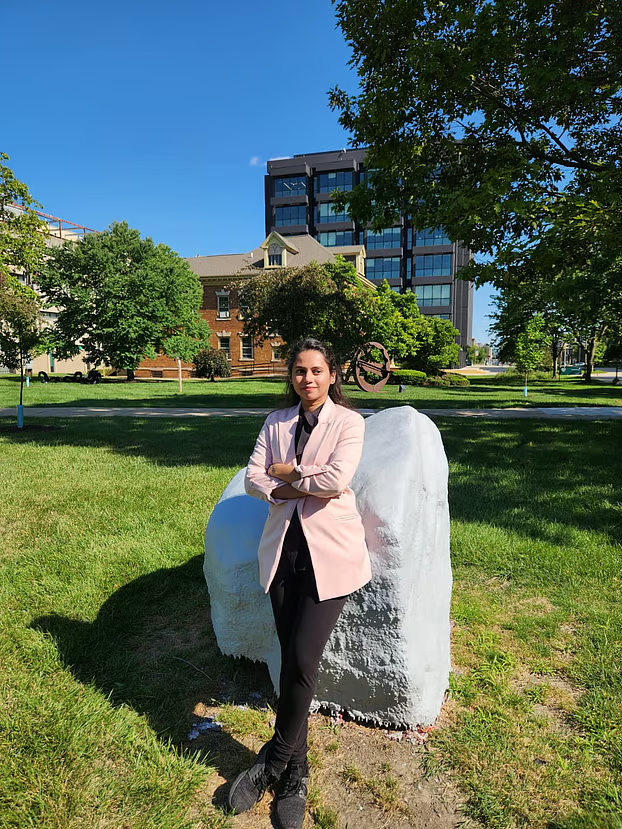
Although research is central to her career, Tonima doesn’t see herself only as a scientist.She is also an educator.At Wayne State University, she divides her time between research and teaching.When asked which she enjoys more, her answer is simple:Both.Research allows her to explore questions no one has answered before.Teaching allows her to share that excitement with students.She particularly enjoys environments where she can interact with people, exchange ideas, and encourage curiosity.That balance makes her career deeply fulfilling.After all, every great scientist was once inspired by a great teacher.
Giving Back to Bangladesh
Despite building an international academic career, Tonima has never forgotten where she came from.She actively supports Bangladeshi students interested in science.The first Ph.D. student she supervised was a Bangladeshi researcher—a meaningful milestone for someone who understands the challenges many young scientists face.She has also worked with WiSTEM (Women in Science, Technology, Engineering and Mathematics), helping encourage girls and young women from Bangladesh to pursue careers in STEM fields.Representation matters.When young students see someone from their own country conducting world-class research, impossible dreams begin to feel achievable.Tonima hopes to become that example for future generations.
The Girl Who Could Never Stop Reading
Scientific curiosity wasn’t Tonima’s only passion. She was also an enthusiastic reader. As a child, she devoured almost anything she could find.Comic books like Nonte Phonte and Chacha Chaudhary.Humorous magazines.The imaginative worlds of Sukumar Ray, Satyajit Ray, and Humayun Ahmed.Global fantasy classics such as Harry Potter and The Lord of the Rings.If she visited a relative’s house and discovered an interesting book, she would often finish reading it before leaving.Even today, reading remains part of her daily routine.She rarely goes to bed without spending time with a book.That lifelong reading habit helped nurture something every scientist needs:Imagination.Science begins not with answers but with questions.And questions often begin in the imagination.
Still Dreaming of Space
As a child, Tonima wanted to become an astronaut.Today she studies black holes instead.Does that mean she abandoned her childhood dream?Not at all.When asked whether she still hopes to travel into space someday, she smiles and says,“I haven’t given up hope yet.”That answer perfectly captures her personality.Optimistic.Curious.Always looking upward.
Why Her Story Matters
Tonima Tasnim’s story is not simply about academic excellence.It is about curiosity surviving into adulthood.It is about a girl who looked at stars during power cuts and decided to spend her life understanding them.It is about proving that a child growing up in Dhaka can contribute to humanity’s understanding of the universe.Most importantly, it reminds young readers that science is not reserved for people born in famous laboratories or wealthy countries.Great scientists are often ordinary children who never stop asking extraordinary questions.The stars that fascinated T0nima during those quiet nights over Dhaka are the same stars visible from every corner of Earth.The difference is that while many people simply admire them, a few dedicate their lives to understanding them.Tonima Tasnim is one of those few.And if Scientific American is right, her discoveries may help shape the future of science itself.
Suggested Related Articles
- Lamin Yamal: The Teenager Rewriting Football History
- Emma Watson Biography: From Hermione Granger to Global Role Model
- Gitanjali Rao: The Young Scientist Changing the World
- Boyan Slat: The Teen Who Decided to Clean the Oceans
- Taylor Wilson: The Nuclear Physicist Who Started as a Child
- Tom Holland: From a Young Dancer to Marvel’s Spider-Man
- How Gifted Children Learn Differently
- 10 Teenage Geniuses Who Changed the World Before Turning 20