


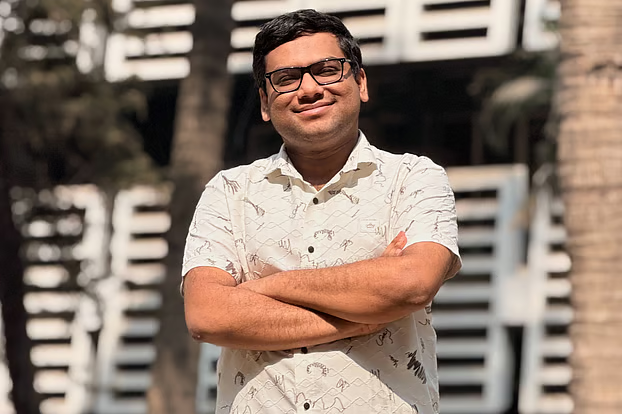
A PhD is considered the highest academic degree. Students usually prepare for a PhD after completing their undergraduate and master’s studies. However, it is also possible to begin the PhD journey even before finishing a master’s degree. In Bangladesh, many students are now starting their PhD right after completing their bachelor’s degree. This is the story of one such student.
It was the final semester rush at BUET. Classes, projects, thesis—everything combined to make it the most demanding phase of academic life for Abrar Rahman. Right in the middle of that hectic period came a piece of good news via email. Even before completing his undergraduate degree, he received a PhD offer from Cornell University in the United States. Later, the BUET Computer Science and Engineering student received fully funded PhD offers from six more universities.
From the time he enrolled at BUET, Abrar knew that students could apply directly to PhD programs in the United States during their fourth year of undergraduate studies. So his plan was long-term. He says, “From the very beginning, I decided that I would go straight into a PhD without doing a master’s. So I prepared myself accordingly from the first year. I knew that good grades alone would not be enough. I had to prove myself in research and produce work of international standard.”
Abrar’s research interests lie in machine learning and computational biology, both of which are deeply rooted in mathematics. His love for mathematics drew him to this path. He had been interested in math since childhood. Abrar says, “Mathematical analysis has always been my favorite. I used to study it with great interest from an early age. After getting admitted to BUET, I started reading about machine learning even before classes formally began. Toward the end of my first year, I got my first research opportunity. That’s when I realized this was the right place for me.”
His first research opportunity came through his elder brother. That experience led him to become actively involved in research from then on.
Abrar’s CGPA stands at 3.96 out of 4.00. However, it was not only his academic performance that set him apart—he also demonstrated strong research credentials. So far, this young researcher has published seven research papers. Abrar says, “It’s not just about increasing the number of publications; the quality of the work matters. I have always focused on methodological novelty. The real goal is to contribute something new to research. And for those who want to work in computer science or machine learning, having a strong mathematical foundation is absolutely essential.”
Abrar’s academic journey was further strengthened by his experience of working with professors from various universities abroad. From his third year, he began collaborating with international researchers. This later helped him secure strong recommendation letters. He explains, “To get into top universities, academic results, research, and recommendation letters—all are important. The competition is so intense now that even a small weakness in any area becomes noticeable. In my case, recommendations from foreign professors were very helpful.”
Beyond these factors, Abrar believes that performing well in interviews also plays a crucial role. In the case of the University of California, Berkeley, he had to go through five rounds of interviews. He says, “The application process is time-consuming, but the most important stage is the interview. Without a deep understanding of your own research, it’s difficult to succeed there.”