


Three hours. No phones, no internet, no laptops, and no outside help.
Inside a closed room, a team of university students is handed a 20-page business case based on a real-world corporate crisis. Their task: analyze the situation, identify the core problems, develop a realistic strategy, and present their solution before an international panel of judges.
This is the intense reality of the HSBC/HKU Asia Pacific Business Case Competition — widely regarded as one of the world’s largest and most prestigious undergraduate business competitions.
And this year, a team from Bangladesh stood proudly among the best.
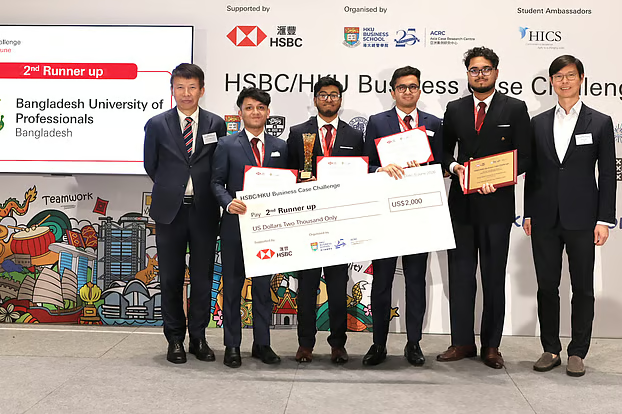
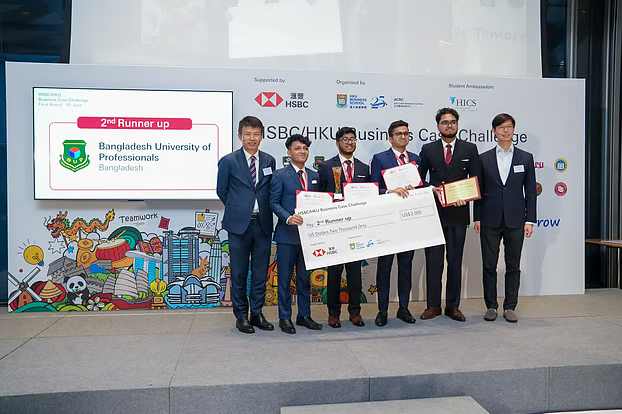
Competing against top universities from 20 countries, four students from Bangladesh University of Professionals (BUP) secured third place in the global round of the competition held in Hong Kong. Alongside the international recognition, they also won a prize of 2,000 US dollars.
Their team name? Team Six Seven.
At first glance, the name sounds unserious — and that is exactly the point.
The phrase “Six Seven,” two random numbers that recently became a viral meme among Generation Alpha on social media, was chosen purely for fun. “Most business cases are very serious and intense,” said team member Sakhawat Selim. “We wanted something that would make things a little lighter.”
Behind the playful name, however, stood months of discipline, preparation, and extraordinary teamwork.
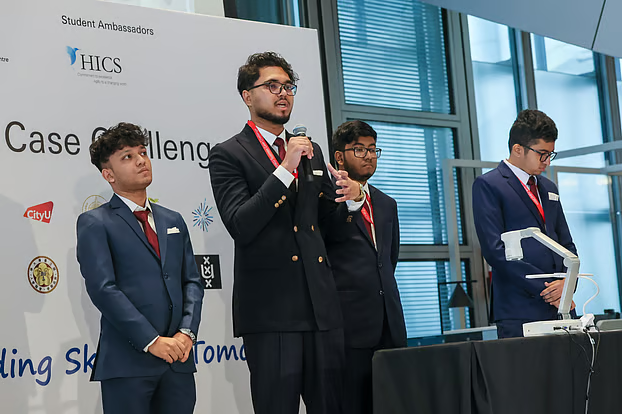
The team consists of Mohammad Ridwan Sakib, Mohammad Faiyad, Sakhawat Selim, and Navid Abrar — all fourth-year students from BUP’s Department of Business Administration. Their mentor from HSBC was Israt Jahan.
The four friends first met during their freshman year at university. Over time, they became close friends and regular teammates in different competitions. Earlier this year, another team involving Faiyad and Sakhawat also became national champions in the CFA Institute Research Challenge.
For Ridwan, forming the team felt natural.
“We are extremely close friends,” he said. “We thought participating together would be fun. In many ways, we were lucky that BUP brought us together.”
Their chemistry became one of their biggest strengths.
Each member developed a specialized role during competitions. Navid focused on analyzing the business situation and identifying the key problems. Ridwan worked on strategic planning. Sakhawat handled the financial aspects, while Faiyad evaluated implementation feasibility.
Still, they insist the process was always collaborative.
“Our team is structured in a way that if even one person is removed, we lose half of our capability,” Ridwan explained. “You can call it teamwork or friendship — either way, that bond is our biggest strength.”
Their journey to Hong Kong began on June 1 under HSBC’s sponsorship and supervision. During the four-day global competition, teams from around the world were divided into groups and faced multiple competitive rounds before the final stage, where only four teams remained. The University of Sydney from Australia eventually became the champion.
But Team Six Seven’s experience in Hong Kong was far from glamorous.
The students spent nearly every day preparing for rounds, leaving little opportunity to explore the city. To make matters more difficult, Navid suffered from severe food poisoning during the competition.
“After the first round, I became seriously sick,” Navid recalled. “Before one of the rounds, I was literally vomiting. I was scared to eat anything. I took medicine and kept working.”
Despite the illness, he believes his performance did not suffer — largely because of the support of his teammates.
Preparation for the competition itself was another battle.
To compete internationally, the team had to study global economics, geopolitics, corporate strategy, and market trends. They regularly followed publications such as Bloomberg, The Wall Street Journal, and The Economist.
However, accessing those resources came at a significant financial cost.
“Other universities had institutional subscriptions,” said Faiyad. “We often had to rely on free YouTube videos from Bloomberg Originals instead of getting daily updates through subscriptions.”
Beyond financial limitations, the team believes Bangladeshi universities also lack a stronger “case competition culture.”
Ridwan emphasized the need for dedicated “Case Clubs” in universities — organizations that train students in solving business cases and preparing structured solutions.
“When we became runners-up in the national round, we already understood the gap,” he said. “International universities have established case clubs where students are trained professionally. Our universities need that too.”
Despite those challenges, Team Six Seven managed to reach the global stage and compete among the world’s best.
Their story is more than just a competition result. It is a story of friendship, resilience, preparation, and the growing potential of Bangladeshi students in global business leadership.
From a meme-inspired team name to an international podium in Hong Kong, Team Six Seven proved that behind every joke can exist serious talent — and behind every limitation, extraordinary ambition.