
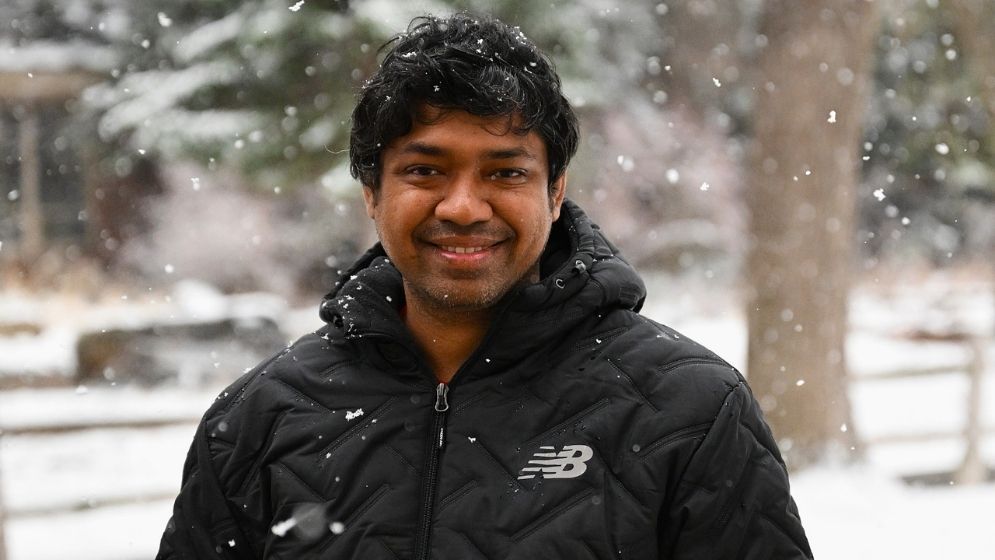

For many children growing up beside a river, the water is simply part of the landscape. For Mosabber Hossain, however, the Teesta was something more powerful. It was a source of life, but also a reminder of how quickly nature could change people’s lives.Mosabber Hossain, a Bangladeshi journalist, is a winner of the Thomson Foundation’s South Asia Inquirer Awards for Investigative Journalism, and Fellow of the Global Investigative Journalism Network and of Investigative Reporters and Editors. He was also a trained in the Investigating Environment and Climate Change Reporting training conducted by Linnaeus University, Sweden and MRDI Bangladesh.
Growing up in the Teesta riverine area of Hatibandha in Lalmonirhat, northern Bangladesh, he witnessed the effects of floods and river erosion from an early age. Homes disappeared, land was lost and families were repeatedly forced to confront an uncertain future.Years later, those experiences would influence the kind of stories he chose to tell.
Today, Hossain is an environmental journalist and graduate student in the United States. He is pursuing a fully funded master’s-level program in Environmental Science and Natural Resource Journalism at the University of Montana, while also working as a fellow with the Pulitzer Prize-winning nonprofit newsroom Inside Climate News.
His reporting focuses on some of the most consequential environmental issues of our time—from climate change and wildfires to water resources, mining and environmental justice.But his journey to the American West did not begin in a modern newsroom or a university laboratory.It began beside a river in northern Bangladesh.
A Childhood Shaped by the Teesta
The Teesta is one of the major rivers of northern Bangladesh. Its waters support agriculture and communities across the region, but the river is also notorious for flooding, erosion and changing river courses.For people living along its banks, climate and environmental changes are not abstract concepts discussed only in scientific reports.They are part of everyday life.
A 2026 profile of Hossain published by Daily Sun describes how growing up near the Teesta exposed him to the destruction caused by river erosion and the loss of homes and livelihoods. Those experiences helped shape his understanding of environmental issues and eventually influenced his career as a journalist.The experience left him with an important question: How can the stories of people living on the frontlines of environmental change be made visible to the wider world?Journalism became his answer.

Choosing Journalism as a Way to Tell People’s Stories
Hossain studied Social Work at Jagannath University before beginning his professional career in journalism.His academic background is significant because social work placed him close to questions of poverty, inequality, community welfare and people’s everyday struggles.Journalism gave him another way to explore those questions.Rather than limiting himself to conventional news reporting, he gradually became particularly interested in stories involving ordinary people whose lives were being transformed by environmental and economic pressures.
His years at Prothom Alo helped establish him as a journalist working on environmental, climate and public-interest stories.He reported on subjects including river erosion, water shortages, floods, agriculture and the effects of climate change on vulnerable communities.For a journalist from a riverine district, these were not distant subjects.They were stories he understood from experience.
Turning Local Stories into Bigger Questions
One of the defining characteristics of Hossain’s journalism is the way he connects individual experiences to larger environmental questions.A farmer losing agricultural land to erosion is not merely an isolated personal tragedy.It can be connected to river dynamics, changing weather patterns, land-use pressures, water management and climate vulnerability.A community facing water shortages may be dealing with questions involving groundwater, agriculture, infrastructure and environmental policy.This approach helped Hossain move beyond simply reporting what happened.He increasingly focused on why it happened, who was affected and what larger systems were responsible.That is at the heart of investigative and environmental journalism.
From Bangladesh to the International Media
Hossain’s reporting eventually reached audiences far beyond Bangladesh.Several of his climate-related stories were published through Reuters/Thomson Reuters Foundation, with some subsequently appearing on international platforms.His reporting has also been featured by the World Economic Forum, giving his work a wider international audience.One example was his reporting on farmers in northern Bangladesh turning toward maize as a response to changing agricultural and economic circumstances. The story illustrated how climate, food security and farmers’ livelihoods can become closely connected.For Hossain, international journalism did not mean abandoning the stories of his home region.Instead, it provided a larger platform for those stories.The people living beside Bangladesh’s rivers, farms and wetlands could now become part of conversations taking place far beyond the country’s borders.
Recognition for Investigative Journalism
Hossain’s work has also received professional recognition.Among his distinctions is the South Asian Inquirer Investigative Journalism Award, presented by the Thomson Foundation.The award recognized his contribution to investigative journalism and became an important milestone in his professional career.Such recognition is significant because investigative journalism requires much more than writing skill.It demands research, document analysis, verification, persistence and the ability to follow complicated stories wherever the evidence leads.Environmental investigations can be particularly challenging because they often involve powerful institutions, economic interests, government policies and communities with limited resources.
Entering the World of Climate Journalism
As climate change became an increasingly important part of global journalism, Hossain’s previous reporting experience gave him a natural connection to the field.He had already spent years observing how environmental changes affected people in Bangladesh.Now he was developing the skills to investigate those issues through a broader scientific and journalistic lens.That eventually led him to the United States.
In 2025, Hossain began studying at the University of Montana’s Environmental Science and Natural Resource Journalism program.The program is particularly suited to journalists who want to understand environmental issues not only through reporting but also through scientific research and natural-resource studies.For Hossain, it represented an opportunity to combine the two sides of his professional identity:the journalist who tells stories and the researcher who seeks to understand the science behind them.

A Fully Funded Opportunity in the United States
Hossain’s graduate study in Montana is fully funded through a scholarship and teaching assistantship.For an international journalist, this is more than simply an opportunity to study abroad.It represents a transition into a more specialized form of environmental journalism.Climate reporting increasingly requires journalists to understand scientific evidence, climate models, natural-resource systems, environmental economics and policy.A journalist covering wildfires, for example, may need to understand the interaction between temperature, drought, vegetation, land management and human development.A reporter investigating water shortages may need to examine hydrology, agriculture, groundwater use, climate trends and government policy.The University of Montana program provides an environment in which journalism and environmental science can be studied together.
Reporting from the American West
While studying in Montana, Hossain has also continued working as a journalist.He is a fellow with Inside Climate News, an independent nonprofit newsroom dedicated to climate and environmental reporting.The organization has been recognized with a Pulitzer Prize, and its reporting reaches a global audience.Hossain’s work there focuses on environmental issues in the American West, including climate change, wildfires, mining, water resources and environmental justice.
The geographical setting is dramatically different from the Teesta basin.But the underlying questions are surprisingly familiar.Who controls natural resources?Who bears the cost of environmental change?How do communities adapt?What happens when economic interests collide with environmental protection?And how does climate change affect people differently depending on where they live and what resources they possess?These are questions that connect Bangladesh with Montana, even though the landscapes are thousands of miles apart.
From the Teesta to the American West
There is an interesting symmetry in Hossain’s career.He grew up beside one of Bangladesh’s great rivers.Today, he studies and reports on rivers, water and natural resources in the American West.The challenges are not identical, but the underlying relationship between people and the environment remains central.In Bangladesh, river erosion can destroy farmland and homes.In the American West, drought and water scarcity can threaten agriculture, ecosystems and growing communities.In both places, environmental journalism has an important role: making complex environmental changes understandable through the experiences of real people.
Selected for the NYU Stern Climate Economics Journalism Fellowship
Hossain’s professional journey took another significant step in 2026 when he was selected for the NYU Stern Climate Economics Journalism Fellowship.According to NYU Stern, he is part of the 2026 cohort of fellows selected for the program.The fellowship brings journalists into closer contact with the economic dimensions of climate change.That is particularly important because climate change is not only an environmental or scientific issue.It is also an economic one.
The transition to clean energy affects industries and workers. Extreme weather affects insurance markets and public finances. Water scarcity affects agriculture and food prices. Climate policy influences investment and infrastructure.Understanding these connections allows journalists to explain climate change in ways that go beyond temperatures, emissions and extreme weather events.
Why Climate Economics Matters
A climate story can begin with a flood but end with an economic question.Who pays for rebuilding?A drought can become a food-security story.A wildfire can become an insurance crisis.A new mine can become a debate about jobs, economic growth, water pollution and Indigenous or local communities.The economic consequences of environmental decisions can therefore be enormous.For a journalist, understanding those connections is essential to producing deeper reporting.Hossain’s selection for the NYU Stern fellowship adds another dimension to his development as a climate journalist.He is no longer simply reporting environmental stories.He is building expertise in the science, natural resources and economics that underpin them.
His Journalism Has Roots in Social Work
Hossain’s academic background in Social Work may seem unusual for an environmental journalist.
In reality, it can be an advantage.
Environmental change rarely affects everyone equally.
A major flood does not necessarily have the same consequences for a wealthy landowner and a family living on an erosion-prone riverbank.
A drought can affect farmers differently depending on access to irrigation.
Air pollution can disproportionately affect communities located near industrial facilities.
These are questions of environmental justice.
A social-work perspective encourages attention to people, communities and inequality—issues that are increasingly central to climate journalism.
Hossain’s professional development therefore brings together three seemingly different disciplines:
social work, journalism and environmental science.
Together, they provide a framework for understanding not just what is happening to the environment, but what those changes mean for people.
The Importance of Environmental Journalism
Climate change is often discussed using enormous numbers: degrees of warming, tonnes of carbon emissions, sea-level rise and billions of dollars in economic losses.
Those numbers are important.
But people rarely experience climate change as a statistic.
They experience it as a flooded home.
A failed harvest.
A disappearing riverbank.
A shortage of drinking water.
A wildfire approaching their community.
A changing livelihood.
This is where journalism matters.
Good environmental journalism connects scientific evidence with human experience.
It makes complicated research accessible without oversimplifying it.
And it gives communities affected by environmental change an opportunity to be heard.
That has been a recurring theme throughout Hossain’s career.
A Career Built Around Public-Interest Stories
From his reporting in Bangladesh to his work in the United States, Hossain’s journalism has remained closely connected to public-interest issues.
His stories have often focused on communities facing environmental or economic pressures.
That focus is particularly important in developing countries such as Bangladesh, where millions of people live in areas highly exposed to floods, cyclones, river erosion and other climate-related hazards.
But his work also demonstrates that environmental journalism is not limited to developing countries.
The American West faces its own environmental challenges.
Wildfires, water shortages, drought, mining and land-use conflicts have become major issues affecting communities across the region.
By reporting on them, Hossain is expanding his understanding of environmental change from the riverbanks of Bangladesh to the broader global climate conversation.
The Value of Staying Connected to His Roots
Despite living and studying in the United States, Hossain’s connection to Bangladesh remains visible in his work.
The Teesta continues to provide an important part of the context through which he understands environmental change.
That connection gives his journalism something that cannot easily be learned from textbooks.
He knows what it means when a river changes its course.
He knows that environmental statistics represent real families.
And he knows that climate change is not simply a future threat.
For many people in Bangladesh, it has already been part of their lives for decades.
A Different Kind of Success Story
Hossain’s journey is worth highlighting because it is different from the conventional story of success.
He did not begin with a privileged connection to an international newsroom or an elite research institution.
He began in a riverine community in northern Bangladesh.
His career developed through journalism, reporting and investigative work.
Then his experience led him into specialized environmental journalism, first in Bangladesh and later on an international stage.
Today, he is studying environmental science and natural-resource journalism in the United States while reporting on climate issues and participating in an elite climate-economics fellowship.
His story shows that international careers do not always begin with international ambitions.
Sometimes they begin with paying close attention to what is happening in one’s own backyard.
What His Journey Means for Young Journalists
For young people interested in journalism, Hossain’s career offers several lessons.
Find a subject you genuinely care about
His interest in environmental issues was not manufactured for a career opportunity. It was connected to his childhood experiences.
Develop expertise
Modern journalism increasingly rewards reporters who understand a subject deeply.
Climate journalism requires knowledge of science, economics, policy and data—not just writing ability.
Report beyond the obvious
A flood is news.
But understanding why certain communities suffer more than others, how policies influence vulnerability and what happens afterward can turn a news report into a deeper investigation.
Keep learning
Hossain’s move from journalism into graduate study demonstrates that journalists can return to education and develop entirely new areas of expertise.
Think globally without losing local perspective
His international career has not required him to forget where he came from.
Instead, his experience in Bangladesh has become part of what makes his perspective valuable.
From a Riverbank to a Global Conversation
The Teesta is still flowing through northern Bangladesh.
Communities along its banks continue to live with the uncertainty that comes with living beside a powerful and constantly changing river.
For Mosabber Hossain, however, the river became more than part of his childhood landscape.
It became a lens through which he learned to understand the relationship between people and nature.
That perspective eventually led him into journalism.
Journalism took him from local reporting to international media.
And international journalism opened the door to a new chapter in environmental research in the United States.
Today, his work spans two continents and connects two very different landscapes.
Yet the central question remains the same:
How do environmental changes reshape people’s lives—and who is telling their stories?
Hossain has spent much of his career trying to answer that question.
His journey from the banks of the Teesta to the climate journalism classrooms and newsrooms of the American West is a reminder that a person’s roots do not have to limit their ambitions.
Sometimes, they become the very foundation upon which those ambitions are built.
Timeline of Mosabber Hossain’s Journey
| Period | Milestone |
|---|---|
| Childhood | Grows up near the Teesta River in Hatibandha, Lalmonirhat, witnessing floods and river erosion. |
| University years | Studies Social Work at Jagannath University and develops an interest in journalism and public-interest issues. |
| Journalism career | Works at Prothom Alo, reporting on environmental, social and public-interest issues. |
| International reporting | His environmental and climate stories appear through Reuters/Thomson Reuters Foundation and other international platforms. |
| 2014 | Receives the South Asian Inquirer Investigative Journalism Award. |
| 2025 | Begins graduate study in Environmental Science and Natural Resource Journalism at the University of Montana with full funding. |
| 2025–26 | Works as a fellow with Inside Climate News, reporting on environmental issues in the American West. |
| 2026 | Selected for the NYU Stern Climate Economics Journalism Fellowship. |
| Present | Continues combining graduate study with international environmental and climate journalism. |
Frequently Asked Questions
Who is Mosabber Hossain?
Mosabber Hossain is a Bangladeshi environmental and climate journalist currently studying Environmental Science and Natural Resource Journalism at the University of Montana. He is also a fellow with Inside Climate News.
Where is Mosabber Hossain from?
He is from the Hatibandha area of Lalmonirhat in northern Bangladesh, near the Teesta River. His childhood experiences with river erosion and flooding influenced his interest in environmental issues.
What does Mosabber Hossain study in the United States?
He studies Environmental Science and Natural Resource Journalism at the University of Montana.
Is Mosabber Hossain’s graduate study fully funded?
Yes. He has publicly stated that his University of Montana graduate study is supported through full funding, including a scholarship and teaching assistantship.
Where does Mosabber Hossain work?
He works as a fellow with Inside Climate News, where he reports on environmental and climate-related issues in the American West.
What subjects does he report on?
His reporting interests include climate change, wildfires, mining, water resources, environmental justice and other environmental issues.
Has Mosabber Hossain received journalism awards?
Yes. Among his recognitions is the South Asian Inquirer Investigative Journalism Award presented by the Thomson Foundation.
What is the NYU Stern Climate Economics Journalism Fellowship?
It is a fellowship designed to help journalists deepen their understanding of the economic dimensions of climate change. Hossain was selected as part of the 2026 cohort.
A River That Became a Beginning
For some people, childhood memories remain memories.
For Mosabber Hossain, they became questions.
Why does a river destroy one family’s home while leaving another untouched?
Why do some communities recover from environmental disasters while others struggle for years?
How does climate change alter livelihoods?
And who tells the stories of the people living through those changes?
His journalism has been, in many ways, an attempt to answer those questions.
The boy who grew up beside the Teesta has become a journalist reporting on climate change from the American West—and a researcher learning to understand the science and economics behind the environmental stories he tells.
The river shaped his story.
Journalism gave him a voice.
And now, that voice is reaching a global audience.
Source: Inside Climate News, The Daily Sun