
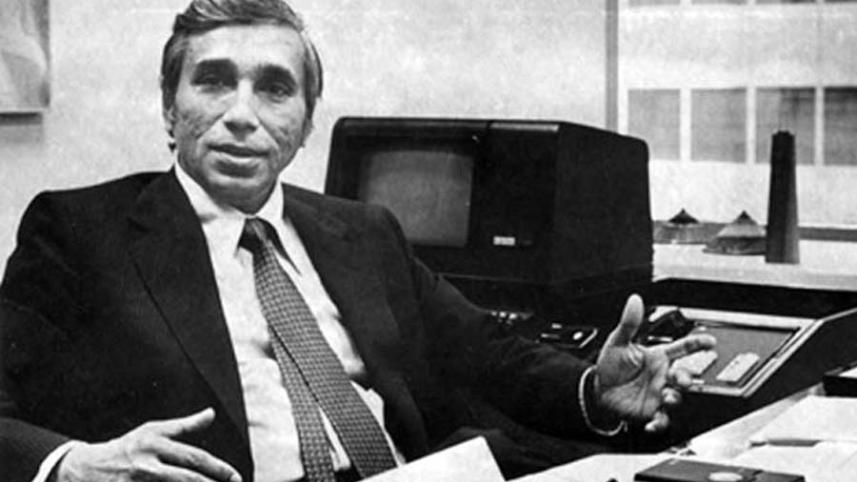

Look up at a modern skyscraper.The higher the building rises, the more extraordinary it seems. Hundreds of metres above the ground, thousands of tonnes of steel and concrete are exposed to something that cannot be seen: wind. For centuries, people learned how to build wider, stronger and more massive structures. But the skyscraper created a different problem. The taller a building became, the more important it was to control the forces pushing against it from the side. A structure could be strong enough to carry its own weight and still face enormous engineering challenges from wind.By the middle of the twentieth century, engineers were searching for better answers.One of the people who transformed that search was a young engineer born in Dhaka in 1929.
His name was Fazlur Rahman Khan. He would eventually become one of the most influential structural engineers of the twentieth century—a man whose ideas helped make the modern skyscraper economically and structurally practical. His work helped shape Chicago’s John Hancock Center and Sears Tower, now known as Willis Tower, and his structural concepts continue to influence tall-building design decades after his death. The Council on Tall Buildings and Urban Habitat later described Khan as one of the engineers whose work helped redefine the skyscraper.
But Khan’s story is much bigger than two famous towers.
He was a mathematician who loved practical problems, an engineer fascinated by architecture, an early advocate of using computers in structural design, a Bangladeshi who became an American citizen, and an internationally respected professional who remained deeply connected to his homeland.During Bangladesh’s Liberation War in 1971, he also used his position and network in the United States to support the cause of Bangladesh.
His life therefore tells several stories at once:
the story of a boy from Bengal, the story of an immigrant engineer, the story of a technological revolution, and the story of a Bangladeshi whose ideas reached the world’s tallest buildings.
A Boy from Dhaka
Fazlur Rahman Khan was born on 3 April 1929 in Dhaka, then part of British India. Today, the city is the capital of Bangladesh.Although he was born in Dhaka, his family had roots in Bhandarikandi, in present-day Shibchar of Madaripur. His father, Khan Bahadur Abdur Rahman Khan, was an educationist and senior government education official. He had begun his career as a mathematics teacher and textbook writer and eventually served as Bengal’s Director of Public Instruction. After retiring from government service, he became the first principal of Jagannath College in Dhaka.That background mattered.
Fazlur Rahman Khan did not grow up in a family where education was simply encouraged; he grew up around a father whose professional life was deeply connected with teaching, mathematics and education.The young Fazlur was particularly comfortable with mathematics and practical problems. Later recollections of his life describe him as someone who enjoyed understanding how things worked rather than merely memorising formulas.That combination would eventually become one of his greatest strengths.He could think like a mathematician.But he wanted his mathematics to do something in the real world.That distinction would become crucial.
From Bengal to Engineering
Khan’s education took place during a period when the Indian subcontinent itself was changing rapidly.He attended school in Dhaka and eventually pursued civil engineering. Sources differ somewhat in their descriptions of the exact sequence of his early education, but they agree on the central fact: he emerged as an exceptionally talented civil engineering student and completed his bachelor’s degree at Ahsanullah Engineering College, the institution that later became part of today’s Bangladesh University of Engineering and Technology (BUET).
At Ahsanullah Engineering College, he stood out academically.He completed his Bachelor of Civil Engineering degree in 1950, graduating with outstanding results. BUET’s Department of Civil Engineering records that he later served as a lecturer at the institution before leaving for the United States for advanced study.There was, however, an important turning point ahead.Khan had already demonstrated that he could excel academically in South Asia. The next question was what he would do with that ability.The answer came in the form of scholarships.

Three Degrees in Three Years
In 1952, Fazlur Rahman Khan travelled to the United States for graduate study at the University of Illinois at Urbana-Champaign.He had received scholarship support that included a Fulbright scholarship and government assistance.What happened next was extraordinary.
In only three years, Khan earned:
- a master’s degree in Structural Engineering;
- a master’s degree in Theoretical and Applied Mechanics; and
- a PhD in Structural Engineering.
The University of Illinois records his degrees as an MS in Structural Engineering in 1952, an MS in Theoretical and Applied Mechanics in 1955, and a PhD in Structural Engineering in 1955.His doctoral research was highly technical, focusing on relationships among different design criteria for rectangular prestressed-concrete beams.To a general reader, that subject might sound far removed from skyscrapers.In retrospect, however, it reveals something important about Khan’s approach to engineering.
He was interested in finding relationships between theory, materials, forces and efficient design.That habit of looking for the underlying system would later become the foundation of his skyscraper revolution.And there was another thing happening.America was about to become the place where Khan would turn his mathematical and engineering ability into ideas that would change the world’s cities.
Chicago: The City That Changed His Life
After completing his doctorate, Khan joined the Chicago-based architectural and engineering firm Skidmore, Owings & Merrill (SOM) in 1955.Chicago was an extraordinary place for an engineer interested in tall buildings.The city had helped give birth to the skyscraper in the late nineteenth century. By the middle of the twentieth century, however, building ever higher was no longer simply a matter of adding more floors.The engineering problem was becoming increasingly severe.A tall building must carry its own weight.
But as it grows taller, wind becomes a dominant structural problem.Imagine holding a thin ruler upright.Push it gently from the side. Now imagine making that ruler hundreds of metres tall.The taller it becomes, the more important its ability to resist sideways movement becomes.That was the problem Khan wanted to solve.And he approached it differently from many engineers before him.Instead of thinking primarily about a skyscraper as a collection of vertical columns supporting floors, Khan began thinking about the building’s entire outer structure as a kind of tube.This simple conceptual shift would change skyscraper engineering.
The Idea That Changed the Skyscraper
Before Khan’s innovations, very tall buildings often depended heavily on large internal structural frames. As buildings became taller, however, increasingly large amounts of structural material could be required simply to resist lateral forces. That could make very tall buildings expensive and inefficient. Khan’s insight was that the exterior of a building could participate much more actively in resisting those forces. The building could behave structurally more like a tube. The idea sounds simple today. It was revolutionary at the time.
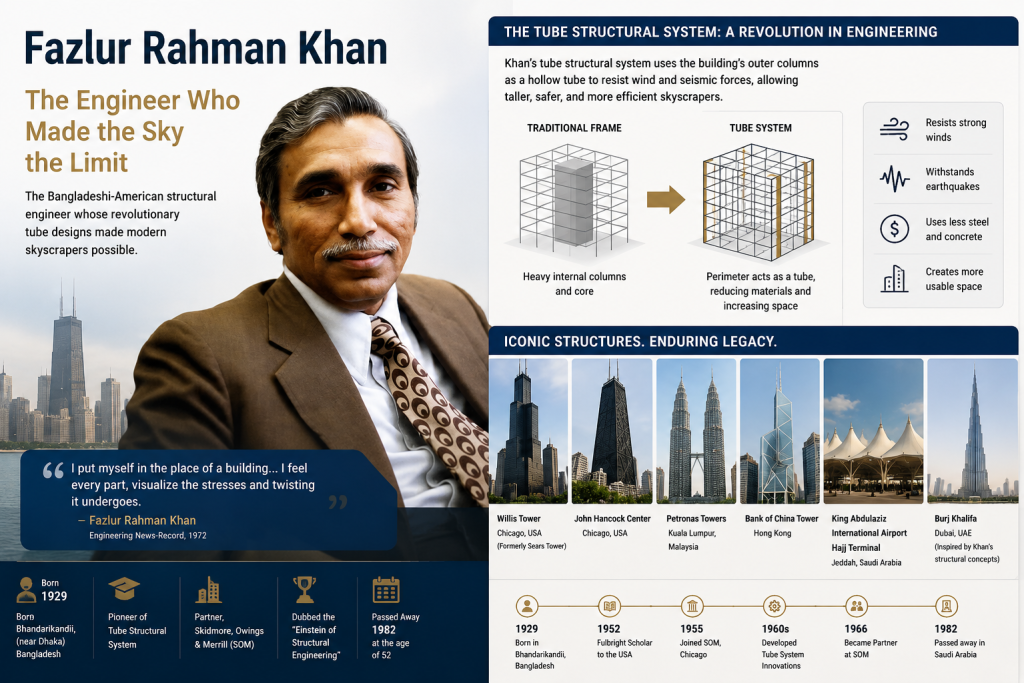
Khan developed a family of structural systems that became known collectively with the term tubular structures. These included the framed tube, trussed tube and bundled tube systems. His innovations allowed engineers and architects to construct taller buildings with greater structural efficiency and more usable interior space. BUET describes the tubular structural system he developed in the 1960s as a breakthrough that made super-tall buildings more feasible and economical. This is why Khan is so often remembered as the “father of tubular designs.”
But the phrase can obscure just how radical his contribution was. He did not simply invent one formula. He developed a way of thinking about tall buildings. Different heights and different building types required different structural systems. Khan’s work helped establish the idea that engineers should select the most efficient structural system according to the building’s height and requirements. A later CTBUH analysis describes this systems-based approach as one of his greatest contributions to twentieth-century high-rise technology.
In other words, Khan was not asking only:
“How can we make this building stand?”
He was asking:
“What is the smartest structural system for this building?”
That question changed everything.
Dewitt-Chestnut: The Experiment Before the Revolution
One of the important steps in Khan’s development of tubular design came before his most famous towers. For the DeWitt-Chestnut apartment building in Chicago, Khan developed a structural system in which closely spaced columns around the building’s perimeter worked together like a thin-walled tube. The result was significant. The exterior structure could take much of the wind-related loading, allowing greater freedom inside the building. SOM describes the project as an important precursor to the system later used at the John Hancock Center. Khan had found a way to make the skin of a skyscraper part of its strength.
The Building with the Giant X
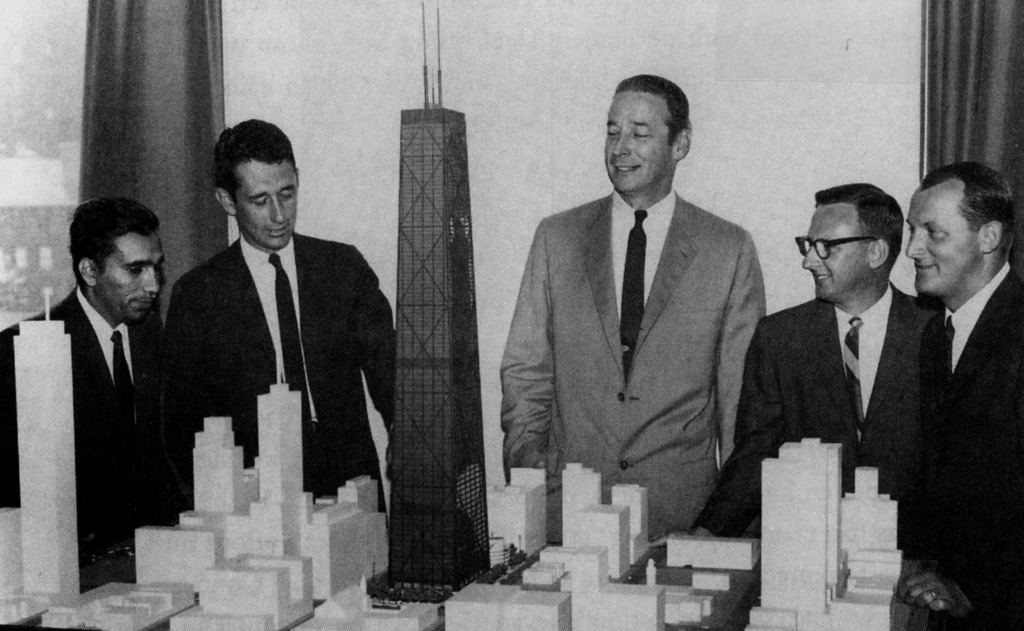
In Chicago, a new tower was being conceived that would eventually become one of the most recognizable skyscrapers in the world. It is now known as 875 North Michigan Avenue. For decades, however, most people knew it as the John Hancock Center. The building was the product of a remarkable partnership between architect Bruce Graham and structural engineer Fazlur Rahman Khan at SOM. SOM describes their collaboration as a defining example of the integration of architecture and structural engineering.
The project posed an unusual challenge. The developers wanted multiple functions in a single tower: offices, apartments, shops and other uses. One proposal involved separate towers for different functions. But that would consume too much of the available site and create problems involving privacy and daylight. The solution was to combine the functions in one very tall building. Khan’s structural idea made that possible. Instead of hiding the structural system inside the building, he and Graham allowed the structure to become part of the building’s visual identity. The tower’s famous diagonal braces form enormous X-shaped patterns across its dark exterior. Those X’s are not decoration.
They are structure.
The diagonal bracing forms a highly efficient external trussed tube, allowing the building to resist lateral forces while using structural material efficiently. SOM identifies the building as the first major application of its exterior diagonalized tube system. The tower reached an architectural height of approximately 1,128 feet (344 metres) and was completed in 1970.
The result was something rare in architecture:
Engineering became architecture.
The structure that made the building possible also became the thing that made the building beautiful. That was one of Khan’s great gifts. He did not believe engineering had to be hidden.
Then Came the Tower That Changed the World
The John Hancock Center demonstrated what Khan’s ideas could do. But his most famous structural breakthrough was still ahead. Chicago’s Sears, Roebuck & Co. wanted a headquarters large enough to bring together thousands of employees. The project would become the Sears Tower, now known as Willis Tower. And it would be enormous. At 1,450 feet (442 metres), the tower would become the world’s tallest building when completed in 1973. It remained the world’s tallest building until 1998. But how could anyone make such a huge building structurally efficient?
Khan’s answer was one of his most famous innovations:
The bundled tube.
Imagine several strong square tubes standing side by side. Now imagine connecting them into a single structural system. Instead of treating the skyscraper as one enormous slender frame, the building could behave as a group of interconnected tubes working together. That was the basic concept behind the Sears Tower’s structural system. SOM describes the tower as nine separate structural tubes that rise together and then step back at different heights, creating its distinctive form. The idea had another important advantage. The shape of the structure itself became the architecture. The building did not need an elaborate decorative skin to tell people how it worked. You could look at the tower and see the engineering. That was Khan’s philosophy at its most powerful.
He Was Not Just Designing Buildings—He Was Changing the Rules
It would be easy to look at the John Hancock Center and Willis Tower and conclude that Khan was simply an exceptionally talented engineer who helped design two famous skyscrapers. That would underestimate him. His real contribution was a new structural vocabulary for tall buildings. The tubular concept could be adapted. Different variations could be used depending on the building’s height, materials and function. The approach reduced the amount of structural material required compared with less efficient systems while maintaining the stiffness necessary for very tall buildings. The impact was enormous.
Modern skyscraper engineering would continue to develop beyond Khan’s specific systems, but his ideas became part of the foundation upon which later generations of supertall buildings were developed. SOM itself notes that Khan’s tube systems remain fundamental to modern supertall structural engineering. His influence therefore reaches far beyond Chicago. It reaches upward.
The Engineer Who Embraced Computers Before They Were Everywhere
There is another part of Khan’s story that deserves much more attention. He was not only innovating in structural engineering. He was also interested in computers. In the early 1960s, computers were nothing like the laptops and smartphones people know today. They were expensive, enormous machines that could seem like an extraordinary investment for an architecture and engineering firm. Khan encouraged SOM to embrace computer technology for structural analysis and design.
SOM records that, at Khan’s urging, the firm installed an IBM 1620 in 1963 and began exploring the use of computers in structural design. This was remarkably forward-looking. The engineer who was changing the physical structure of skyscrapers was also helping change the way engineers thought about and calculated those structures. That combination—structural intuition, mathematics and emerging computing technology—gave Khan an unusual advantage. He could imagine a structural system conceptually and increasingly use computers to explore and analyse it. The skyscraper was becoming not just a physical object. It was becoming a system that could be modelled, calculated and optimized.
Beyond the Skyscraper
Despite becoming famous for tall buildings, Khan did not limit himself to skyscrapers. His work extended into several different kinds of structures. One of the most remarkable was the Hajj Terminal at King Abdulaziz International Airport in Jeddah, Saudi Arabia.
The terminal was completed in 1981 and was designed by SOM with Fazlur Rahman Khan. The project used enormous fabric structures suspended from steel pylons, creating a roof inspired by tent forms associated with the region. The Aga Khan Trust for Culture lists Khan/SOM as the architect for the award-winning project.
The Hajj Terminal presented a completely different structural challenge from the John Hancock Center or Sears Tower. There was no need to build upward. Instead, the challenge was to create vast areas of shelter while maintaining openness and responding to the needs of millions of pilgrims passing through the airport. The result demonstrated another side of Khan’s imagination. He could work with steel and concrete. But he could also work with fabric, tension and space.
The project later received the Aga Khan Award for Architecture, and its structural and architectural qualities became internationally recognized. Khan’s career therefore cannot accurately be reduced to one sentence such as “the engineer who designed the Sears Tower.” He was a structural innovator whose work ranged from supertall towers to large-span structures and other specialized buildings. The Institution of Engineers, Bangladesh notes his work on projects including the Hajj Terminal, McMath-Pierce Solar Telescope and stadium structures.
The Bangladeshi Behind the American Skyline
There is something deeply striking about Khan’s biography. He was working in Chicago, helping shape buildings that would become symbols of American economic power and technological ambition. Yet his story began in Bengal. The world would come to know him as an American engineer. Bangladesh would remember him as one of its greatest sons. Both descriptions are true. Khan became a United States citizen in 1967, but he never simply erased the place from which he came. His professional identity became international. His personal story remained rooted in South Asia. And in 1971, that connection became especially important.
When Bangladesh Needed a Voice
When the Liberation War began in 1971, Bangladesh was thousands of kilometres away from Chicago. Khan, however, was not a passive observer. He became involved in efforts to mobilize support among Bangladeshis living in the United States and to generate support for the independence struggle. Sources from the Institution of Engineers, Bangladesh and other biographical accounts describe his efforts during the Liberation War, including mobilizing support among Bangladeshis in the United States.
This chapter of his life deserves special attention because it reveals something that the photographs of skyscrapers cannot show. The man who spent his professional life thinking about structures was also thinking about a nation. He had achieved extraordinary professional success in America. But when the country of his birth was fighting for independence, his expertise, reputation and network became tools he could use in another kind of struggle. His story was no longer only about steel and concrete. It was about belonging.
The Human Being Behind the Engineering
Khan’s professional achievements can make him seem almost larger than life. But people who knew him remembered something more human. He had the rare ability to discuss complicated engineering concepts in language that ordinary people could understand. A retrospective study of his life and work noted his ability to explain intricate structural problems simply, even to people without technical backgrounds. That quality is important. Great innovators are not necessarily the people who know the most complicated equations. Sometimes they are the people who can take a complicated problem and see its simplest underlying idea. Khan’s tubular structures were mathematically sophisticated. But the underlying intuition could be expressed simply: Make the whole building work together. That idea changed the skyline.
A Career That Ended Too Soon
By the late 1970s and early 1980s, Khan had become one of the most respected structural engineers in the world. He had risen through the ranks at SOM, becoming a full partner in 1970. The University of Illinois records his professional progression and describes his work as involving innovative structural systems for steel and concrete high-rise buildings. He also served as chairman of the Council on Tall Buildings and Urban Habitat from 1979 to 1982. But his career was cut tragically short. On 27 March 1982, just seven days before his 53rd birthday, Fazlur Rahman Khan died in Jeddah, Saudi Arabia, during a business trip in the Middle East. The National Academy of Engineering memorial described his sudden death as a major loss to the field of tall-building engineering.
He was only 52 years old. He had spent less than three decades in professional practice. Yet in that relatively short period, he had helped change one of the most technically demanding areas of modern construction. His buildings would continue to rise. His ideas would continue to spread. And his influence would outlive him by generations.
Why the World Still Remembers Fazlur Rahman Khan
The easiest way to understand Khan’s legacy is to look at the modern city. Skyscrapers today are everywhere. They rise in Dubai, Shanghai, Singapore, Kuala Lumpur, New York, Seoul, Hong Kong and dozens of other cities. Their structural systems have continued to evolve.
But the central question remains the same:
How do you make a very tall building strong, efficient, economical and usable?
Fazlur Rahman Khan helped change the answer. His innovations showed that the structure of a tall building could be integrated with its architecture rather than treated as something separate and hidden. His work demonstrated that structural efficiency could make extreme height more economically practical. And his systems became part of the technological foundation of the modern supertall. That is why SOM describes him as an engineer whose influence extended far beyond the individual buildings he worked on. His legacy is not simply a tower in Chicago.
It is an entire way of thinking.
A Name That Became Part of Chicago
Khan’s adopted city did not forget him. A sculpture honoring him was installed in the lobby of the Sears Tower, now Willis Tower. And in 1998, the City of Chicago named the intersection of Jackson and Franklin Streets, near the foot of the tower, “Fazlur R. Khan Way.” There is something poetic about that. At one end of his story stands a young boy from Dhaka. At the other stands one of the world’s great cities, giving a street corner the name of the engineer who helped change its skyline.
More Than the “Father of Tubular Designs”
The title “Father of Tubular Designs” is deserved. But it is not enough. Fazlur Rahman Khan was: a structural engineer who transformed skyscraper design; an innovator who embraced computer technology early; a collaborator who understood that engineering and architecture could reinforce each other; an educator and thinker who could make difficult ideas understandable; a Bangladeshi who became an important American professional; and a man who used his international position to support Bangladesh during its Liberation War. His greatest achievement may therefore not be any single building. It may be the fact that he changed the question engineers asked. Before Khan, the question was increasingly:
“How can we build this tall?”
After Khan, it became:
“What is the most efficient structural system for building this tall?”
That is a much more powerful question. And sometimes, changing the question is how you change the world.
Fazlur Rahman Khan — Quick Facts
| Fact | Detail |
| Full name | Fazlur Rahman Khan |
| Born | 3 April 1929 |
| Birthplace | Dhaka, British India |
| Family roots | Bhandarikandi, present-day Shibchar, Madaripur |
| Profession | Structural Engineer; Architect |
| Higher education | University of Illinois at Urbana-Champaign |
| Major employer | Skidmore, Owings & Merrill (SOM) |
| Famous structural innovations | Framed tube, trussed tube, bundled tube |
| Most famous buildings | John Hancock Center; Sears Tower/Willis Tower |
| Major non-skyscraper work | Hajj Terminal, Jeddah |
| U.S. citizenship | 1967 |
| CTBUH leadership | Chairman, 1979–1982 |
| Died | 27 March 1982 |
| Age at death | 52 |
| Major posthumous legacy | Fazlur Khan Lifetime Achievement Medal, Chicago’s Fazlur R. Khan Way |
The Story Is Not Over
The buildings are perhaps the easiest part of Fazlur Rahman Khan’s story to see. The harder—and more fascinating—part lies underneath them.
Why did he think differently?
How exactly did he develop the tubular concept? What happened inside the SOM offices when Khan and Bruce Graham began experimenting with the John Hancock Center? How did the Sears Tower’s bundled-tube idea emerge? Why did Khan believe architecture and engineering should not be separated? What was his relationship with Bangladesh after moving to America? What exactly did he do during the 1971 Liberation War? What did his colleagues say about him? What did he believe about the future of cities? And how did the ideas of a Bangladeshi engineer eventually influence skyscrapers that would rise decades after his death? Those questions take us beyond the famous photographs. And that is where the real story of Fazlur Rahman Khan begins.
The Man Behind the Mathematics
A photograph of Fazlur Rahman Khan can be slightly misleading. In many of the surviving photographs, he appears beside a model of a skyscraper, surrounded by architects and engineers, or seated behind a desk covered with drawings. It is easy to see only the engineer. But people who knew him remembered a much broader personality. Khan was deeply interested in music, literature, philosophy and the arts. He loved classical music, particularly Bach and Brahms, and enjoyed singing Rabindranath Tagore’s songs in Bengali with family and friends. Later tributes described him not simply as a structural engineer but as a philosopher, visionary, educator and humanist.
That combination helps explain something important about his professional work. Khan did not see a building as merely a machine for carrying loads. He believed that engineering could contribute to beauty. A structural system could be efficient and elegant at the same time. A column, a brace or a structural tube did not necessarily have to disappear behind an architectural façade. It could become part of the architecture itself. That philosophy became particularly visible in the John Hancock Center.
The Partnership That Changed Chicago
The story of Fazlur Rahman Khan cannot be told properly without Bruce Graham. Graham was an architect. Khan was a structural engineer. Their partnership at Skidmore, Owings & Merrill became one of the most important architect-engineer collaborations in twentieth-century American architecture. They were different kinds of thinkers. Graham was concerned with architectural form, space, urban presence and how people experienced a building. Khan was concerned with forces, materials, structural efficiency and the invisible mathematics that allowed the building to stand. But instead of treating those concerns as separate, they worked together. That collaboration was especially important because SOM operated differently from many conventional architecture practices. Architects and engineers worked within the same organization, allowing structural ideas to influence architectural design from the beginning.
The John Hancock Center became the great demonstration of what could happen when the two disciplines were genuinely integrated. Princeton University’s study of the project notes that the design team was led by Graham and Khan and initially included roughly 60 architects and engineers. This was not simply an architect handing a finished design to an engineer and asking:
“Can you make this stand?”
The structure was part of the design from the beginning.
The Problem That Nearly Killed the Idea
The John Hancock project presented a brutal engineering challenge. The developers wanted a huge mixed-use building containing offices and residences. The amount of floor space required was enormous. An early proposal considered separate towers: one for offices and another for apartments. But the project had a major problem. The site was constrained, and the economic realities of the development made a conventional approach difficult. More importantly, the height being considered created structural demands that traditional systems could not satisfy economically. Princeton’s research into the project records that the initial structural analysis showed that the required height would be economically unfeasible using conventional structural solutions. This was precisely the kind of problem Khan loved. Instead of asking how to make the conventional system stronger, he asked whether the building should use a completely different structural system. The answer became the trussed tube.
Why the Giant X’s Matter
Walk along Michigan Avenue in Chicago and look up at the tower. The first thing many people notice is the giant black X-pattern running across its exterior. For someone unfamiliar with engineering, those X’s might look like a stylistic decision. They are not. They are the building’s structural logic made visible. The diagonal braces connect the exterior structural frame so that the entire building can act much more effectively against lateral forces. Instead of asking the interior columns to do all the work, Khan moved much of the structural action toward the perimeter.
The result was a kind of structural tube strengthened with diagonal bracing. This became known as the trussed tube. The building was completed in 1969/1970, and its 100-story form became one of the most recognizable silhouettes in Chicago. Khan had achieved something more important than making a tall building stand. He had made the building’s strength visible.
A New Way of Thinking About Materials
There was another reason Khan’s work mattered. Tall buildings require enormous quantities of structural material. If an engineer simply adds more steel whenever a building becomes taller, the structure can eventually become so heavy and expensive that the project stops making economic sense. Khan’s approach was different. He wanted to understand where the material was actually needed. Then he wanted the structure to put that material to work as efficiently as possible. This was an engineer’s version of a simple principle:
Don’t make the structure stronger everywhere. Make it stronger where the forces demand it.
The tubular system allowed a building’s perimeter to become a major part of its lateral-force-resisting structure. The result was more structural efficiency. That efficiency was one of the reasons the modern skyscraper could become economically viable at heights that had previously been extraordinarily difficult to achieve. The National Academy of Engineering’s memorial described Khan’s bundled-tube system as a way of reducing the structural steel or concrete required for very large towers and thereby making them economically feasible. That is perhaps the best way to understand the scale of his contribution. Khan did not merely help buildings become taller. He helped make height economical.
Sears Tower: When the Tube Became a Bundle
If the John Hancock Center demonstrated the power of the trussed tube, the Sears Tower demonstrated what happened when Khan pushed the tubular concept further. The problem was now extraordinary. Sears, Roebuck & Co. wanted a headquarters that would contain an enormous amount of office space. The tower would need to be taller than anything previously built. The answer was not one giant tube. It was a collection of tubes working together. Khan developed the bundled tube concept. Imagine nine vertical structural tubes arranged together.
Each tube could behave structurally, but the tubes could also work together as one enormous system. This allowed the tower to achieve enormous height without requiring the same structural inefficiency that a conventional frame would have created.
The National Academy of Engineering described the bundled tube as Khan’s signature innovation and noted that it was first used in the Sears Tower. The tower’s architecture made the concept visible. Instead of rising as one perfectly uniform shaft, the building’s tubes terminate at different heights. That creates the familiar stepped profile of the tower. Once again, the structural system generated the architecture.
The Tallest Building in the World
When the Sears Tower was completed, it stood approximately 1,450 feet (442 metres) tall. For a time, it was the tallest building in the world. That distinction lasted for roughly a quarter of a century, until the Petronas Towers in Kuala Lumpur surpassed it in height in the late 1990s. But the numerical record is not the most important part of the story. The more important question is:
Why could such a tower exist at all?
The answer lies in the structural system. The Sears Tower showed the world that a building could be extraordinarily tall without simply becoming an enormous pile of structural material. It could be tall and efficient. That was the breakthrough.
Khan Was Already Thinking About the Future
Khan’s thinking was not limited to the buildings immediately in front of him. He was interested in what would happen to cities as populations grew. If millions more people were going to live and work in cities, urban land would become increasingly valuable. Building upward could become one solution. But simply building taller was not enough.
Tall buildings had to be:
- structurally efficient,
- economically practical,
- adaptable,
- architecturally meaningful,
- and comfortable for people.
Khan therefore viewed structural engineering as part of a larger urban problem. The skyscraper was not an isolated object. It was part of the future of the city. That is one reason his influence extended beyond individual projects.
The Engineer Who Became a Mentor
Khan’s influence was not transmitted only through buildings. It was also transmitted through people. His colleagues remembered him as someone who encouraged younger engineers and gave them responsibility.
The Oxford Research Encyclopedia’s biographical treatment of Khan specifically identifies “Fazlur Khan as a Colleague and a Collaborative Team Builder” and “Dr. Fazlur Khan as a Mentor” as important aspects of his career.
That is significant. A great engineer can leave behind a building. A great mentor can leave behind an entire generation. Khan helped create an environment in which structural engineers could think creatively rather than simply execute calculations handed down by others. He wanted engineers to participate in architectural thinking. That attitude helped elevate structural engineering from a supporting technical discipline into an important part of architectural creativity.
He Did Not Believe Engineers Should Hide
There was an old tendency in architecture to think of structure as something that should disappear. The architect created the visible building. The engineer made sure it did not collapse. Khan challenged that separation. His buildings suggested another possibility:
What if the structure itself became architecture?
The diagonal braces of the John Hancock Center are the obvious example. The bundled form of Sears Tower is another. In both cases, the structural system is inseparable from the visual identity of the building. This was not structural engineering competing with architecture. It was structural engineering creating architecture.
The Computer in the Office
Khan’s willingness to embrace technology was another indication of how far ahead he was thinking. In 1963, SOM installed an IBM 1620 after Khan encouraged the firm to explore computer-based structural analysis and design. Today, engineers routinely use sophisticated software to model enormous buildings. But in the early 1960s, this was still a relatively new idea.
Khan understood that computers could allow engineers to analyse increasingly complicated structures more efficiently. This did not replace engineering intuition. It enhanced it. His approach combined three things: physical intuition + mathematical understanding + computational analysis. That combination became increasingly important as buildings grew more complex. In this sense, Khan was not merely an innovator in structural systems. He was also an early participant in the digital transformation of engineering.
One Engineer, Many Structural Worlds
It is tempting to associate Khan exclusively with skyscrapers. But his portfolio tells a broader story. He worked on structures that were radically different from one another.There were towers. There were large-span roofs. There were stadium structures. There was the McMath-Pierce Solar Telescope. And there was the extraordinary Hajj Terminal in Jeddah. The Institution of Engineers, Bangladesh lists several of these projects among his important works. This diversity matters because it reveals something about his mind. He did not have one trick. He had a structural way of thinking. Whenever he encountered a new problem, he tried to understand the forces, materials, geometry and human requirements before deciding what the structure should be.
The Hajj Terminal: Engineering for Millions of Pilgrims
The Hajj Terminal was perhaps the clearest demonstration that Khan’s imagination went far beyond skyscrapers. The terminal at Jeddah was designed to accommodate enormous flows of pilgrims arriving for the Hajj. The project used enormous tensile-fabric roofs supported by steel pylons. The visual effect was striking. The repetitive tent-like forms created a vast sheltered landscape rather than a conventional enclosed airport building. The Aga Khan Trust for Culture recognizes the project as an award-winning work and credits SOM with the design. The terminal also connected Khan’s engineering with his interest in Islamic architecture. A skyscraper in Chicago and a pilgrimage terminal in Saudi Arabia might seem like completely different worlds. For Khan, they were both structural problems. How can materials create space? How can a structure respond to climate? How can engineering serve people? How can a building express something about the place where it stands? Those questions followed him throughout his career.
The Family Man
Behind the engineer was also a husband and father. Khan was married to Liselotte Khan, and they had a daughter, Yasmin Sabina Khan. Yasmin later became a structural engineer herself, following her father’s professional path. She has written and spoken about her father’s work, providing an unusually personal perspective on his life. Her account of the John Hancock Center notes that Khan initiated the trussed-tube structural system for the tower and assumed responsibility for its structural design and construction. This is one of the most interesting continuities in his story. The man who changed structural engineering did not simply leave behind buildings. He also left behind a daughter who entered the same profession and became an interpreter of his legacy. Through Yasmin’s writings, the public can see a different Fazlur Rahman Khan—not only the celebrated engineer, but also a father whose professional work was close enough to home that his daughter eventually entered the same field.
The Bengali Musician Inside the Engineer
There is another detail that makes Khan feel surprisingly human. He loved Bengali culture. According to later tributes, he enjoyed singing Tagore songs with family and friends and maintained an interest in classical music, particularly the works of Bach and Brahms. That combination is worth remembering. During the day, he could be thinking about lateral loads, structural tubes and computer calculations. Outside the office, he could be singing Bengali songs. It is a reminder that intellectual greatness rarely fits into one category. The engineer was also a Bengali. The structural theorist was also a music lover. The skyscraper innovator was also a father. And the internationally respected American professional remained emotionally connected to the land where he had grown up.
1971: When His Two Worlds Collided
In 1970, Khan became a full partner at SOM. At almost exactly the same moment, the political situation in East Pakistan was moving toward crisis. Then came 1971. For Khan, the Liberation War was not a distant international news story. It was about his homeland. By this time he was already well known among Bengalis living in the United States. When activists began organizing support for the people of East Pakistan, they contacted Khan in Chicago. He agreed to take a central role. According to archival material assembled around his life, Khan became founding president of two Chicago-based organizations:
Bangladesh Emergency Welfare Appeal (BEWA) and Bangla Desh Defense League (BDL).
The first focused on humanitarian assistance and fundraising. The second supported the emerging resistance and worked to lobby in Washington against continued U.S. support for the military government in West Pakistan. This was not a symbolic gesture. He was already carrying enormous professional responsibilities. In 1971, he was working on the 110-story Sears Tower while simultaneously taking on a major political and humanitarian commitment for Bangladesh. Imagine the contrast. By day, he was helping design what would become the world’s tallest building. Outside the office, he was trying to help a nation struggling to survive.
The Engineer and the Politics of Power
There is a deeper irony here. The Sears Tower represented American economic and technological power. Khan was one of the people making that power visible in the skyline. Yet the same man was using his influence to challenge the foreign-policy position of the U.S. government over the crisis in his homeland. He could have remained silent. His career was already flourishing. He was an immigrant who had achieved an extraordinary position in American professional life. But he chose to become publicly involved. That decision tells us something about his priorities. Professional success had not replaced his sense of responsibility toward Bangladesh.
Why His 1971 Role Matters
Khan’s contribution during the Liberation War is sometimes overshadowed by his skyscrapers. It should not be. The buildings explain what he achieved as an engineer. The events of 1971 help explain who he was as a person. He had the ability to remain above politics. Instead, he became involved. He used his professional standing, contacts and organizational ability to help raise money, support humanitarian efforts and advocate for Bangladesh. The archival record of the Bangladesh Emergency Welfare Appeal and Bangla Desh Defense League provides evidence of this involvement. This is one of the chapters that should be preserved carefully in any biography of Khan because it places him within the broader history of the Bangladeshi diaspora during 1971.
Recognition Came Early
Khan did not have to wait until after his death to become famous. His contemporaries already recognized what he was doing. In 1972, Engineering News-Record named him “Construction’s Man of the Year.” The publication highlighted his work on the John Hancock Building, Sears Tower and other major projects. The recognition was important because it demonstrated that his achievements were not being exaggerated retrospectively. People working in the construction industry at the time already understood that something significant was happening. He was not merely an engineer who later became famous because historians liked his buildings. He was recognized during his own career.
The Final Years
By the early 1980s, Khan was internationally established. He had received major professional honors. He had become a leader in organizations concerned with tall buildings. He was still working. He was still thinking. And he still had projects ahead of him. Then, unexpectedly, his life ended. On 27 March 1982, Khan died in Jeddah, Saudi Arabia, while on a business trip. He was only 52. The National Academy of Engineering’s memorial described his death as a sudden loss to the engineering profession and emphasized the extraordinary international importance of his work. Seven days later, he would have turned 53. He never got to see many of the buildings that later generations would construct using structural concepts descended from his work. He never saw the supertall era of Dubai. He never saw the modern skyline of Shanghai. He never saw today’s generation of skyscrapers rise hundreds of metres into the sky. But in a sense, part of him was already there.
The World Continued Building Upward
Khan died in 1982. The skyscraper did not stop. It accelerated. Architects and engineers around the world continued developing structural systems for taller and more complex buildings. Materials improved. Computers became vastly more powerful. Wind engineering became more sophisticated. Digital modelling transformed design. New structural systems emerged. But Khan’s basic contribution remained embedded in the profession: use the building’s geometry and perimeter intelligently; make the structure work as a whole; and seek efficiency rather than simply adding more material. That principle proved remarkably durable.
Why His Legacy Is Larger Than the Sears Tower
If someone asks: “What did Fazlur Rahman Khan design?” A short answer might mention the John Hancock Center and Sears Tower. But if someone asks: “What did Fazlur Rahman Khan change?” the answer is much bigger. He changed the relationship between: height and efficiency, structure and architecture, engineering and computers, architects and engineers, and ultimately, the skyscraper and the modern city. That is why the National Academy of Engineering described his contribution in terms of structural systems rather than simply individual buildings. His greatest creation was not one tower. It was a new structural language.
The Names That Followed
After his death, recognition continued. His work became part of engineering education around the world. Professional institutions established lectures, awards and memorials in his name. The Council on Tall Buildings and Urban Habitat created the Fazlur Khan Lifetime Achievement Medal, recognizing exceptional contributions to the design and construction of tall buildings. Chicago also preserved his memory through Fazlur R. Khan Way. His name appears in engineering institutions, academic programs, books and professional histories. And perhaps most significantly, his daughter Yasmin Sabina Khan became one of the people helping document and explain his work to later generations.
From Dhaka to the World’s Skyline
There is a simple way to describe Fazlur Rahman Khan’s journey. He began in Dhaka. He studied engineering in a period when the subcontinent itself was undergoing enormous political change. He travelled to America on scholarships. He earned three graduate degrees in three years. He moved to Chicago. He entered one of the world’s leading architectural and engineering firms. He began asking fundamental questions about tall buildings. He developed tubular structural systems. He helped create the John Hancock Center. He helped create the Sears Tower. He became an international authority on tall buildings. He used computers before computer-aided engineering became commonplace. He designed structures far beyond skyscrapers. He supported Bangladesh during the Liberation War. And before reaching the age of 53, he was gone. But the buildings remained. And more importantly, the ideas remained.
What Fazlur Rahman Khan Left Behind
The most powerful monuments to Fazlur Rahman Khan are not statues. They are cities. Look at Chicago. Look at the towers that rise from the ground and disappear into the sky. Look at the modern supertall buildings that dominate skylines across Asia and the Middle East. Their exact structural systems may differ. Their architects may be different. Their materials may be different. Their technology may be decades more advanced. But the intellectual revolution that made extreme height more structurally and economically practical owes an enormous debt to the work Khan pioneered. That is why his story belongs not only to Bangladesh. It belongs to the history of the modern city.
The Question That Remains
Perhaps the most interesting question about Fazlur Rahman Khan is not:
“How tall was the building he helped design?”
It is:
“How far can one person’s idea travel?”
A young man born in Dhaka developed an idea in Chicago. That idea became steel and concrete. The steel and concrete became towers. The towers changed skylines. The structural systems influenced generations of engineers. And generations later, a person standing beneath a skyscraper in a city on the other side of the world can look upward without ever knowing that one of the intellectual foundations beneath that skyline came from a Bangladeshi engineer. That is Fazlur Rahman Khan’s extraordinary legacy. He did not simply help the world build taller. He helped the world think differently about how tall buildings should stand.
Fazlur Rahman Khan: A Timeline
| Year | Milestone |
| 1929 | Born in Dhaka on 3 April |
| 1950/51 | Completed undergraduate engineering education in Dhaka |
| 1952 | Travelled to the United States for graduate study |
| 1952 | Earned first master’s degree at the University of Illinois |
| 1955 | Earned second master’s degree and PhD |
| 1955 | Joined Skidmore, Owings & Merrill in Chicago |
| 1960s | Developed and refined tubular structural systems |
| 1963 | SOM began using an IBM 1620 for computer-based structural work |
| 1970 | Became full partner at SOM |
| 1970 | John Hancock Center completed |
| 1971 | Played an active organizational role in support of Bangladesh’s Liberation War |
| 1972 | Named Engineering News-Record’s “Construction’s Man of the Year” |
| 1973 | Sears Tower completed and became world’s tallest building |
| 1979–82 | Chairman of the Council on Tall Buildings and Urban Habitat |
| 1981 | Hajj Terminal completed |
| 1982 | Died in Jeddah on 27 March |
| 1998 | Chicago dedicated “Fazlur R. Khan Way” |
| 1999 | Bangladesh awarded him the Independence Award posthumously |
The Fazlur Rahman Khan We Should Remember
There are many ways to remember him. As the Father of Tubular Designs. As the structural engineer behind the Sears Tower. As the engineer who helped make the John Hancock Center possible. As a pioneer in computer-assisted structural design. As a mentor. As a collaborator. As a Bengali who loved Tagore. As an American professional who never forgot Bangladesh. As one of the people who used his influence during the Liberation War. But perhaps the most fitting description is simpler.
Fazlur Rahman Khan was a man who understood that great structures begin with great ideas.
And one of his greatest ideas was that a building should not fight nature by simply becoming heavier. It should become smarter. That idea changed Chicago. Then it changed the skyscraper. And eventually, it changed the skyline of the world.
The Engineer Who Could Read Palms
There is a surprisingly playful story about Fazlur Rahman Khan. In the serious world of Chicago’s architecture and engineering establishment, Khan was known for equations, structural models and extraordinarily complicated engineering problems. But at social gatherings, he could be quite different. According to a recollection published about his life, Khan had a habit of entertaining guests at Chicago parties by reading their palms and telling fortunes. It was a skill he had learned as a boy in Dhaka. The image is almost impossible to resist.
Here was a man who could calculate how a 100-story building would respond to wind—and then, at a party, turn someone’s hand over and pretend to predict their future. It tells us something important about his personality. Khan was not the stereotypical engineer who lived entirely inside equations. His colleagues remembered him as easygoing, curious and sociable. His interests extended into music, poetry, philosophy and the arts. A later documentary about his life describes him as someone who loved people, music and poetry as much as science and engineering. That breadth of personality was not separate from his engineering. It was part of it.
“The Technical Man Must Not Be Lost in His Own Technology”
One of Khan’s most revealing ideas was his belief that an engineer needed a life beyond engineering. He warned against becoming trapped inside one’s own technology. His philosophy can be summarized by the idea that a technical person must still be able to appreciate life, art, drama, music and people. That is a remarkable statement from a structural engineer. And it explains why his buildings feel different from purely technical solutions. For Khan, engineering was not just about preventing collapse. It was about creating places for human beings. He wanted structural efficiency. But he also wanted elegance. He wanted economy. But he also wanted beauty. He wanted technology. But he did not want technology to overwhelm humanity.
Princeton University’s exhibition on Khan describes this philosophy particularly well: for him, elegance was not decoration; it was the expression of structure itself and the relationship between forces and form. That may be one of the most important ideas in understanding his work.
The Teacher
Before Khan became one of the world’s best-known structural engineers, he became a teacher. In 1961, architect and structural engineer Myron Goldsmith introduced Khan to the Illinois Institute of Technology. Goldsmith was teaching architecture students there and invited Khan to participate. Khan became an adjunct professor, teaching structures to architecture students and advising master’s students. This experience had an enormous effect on his career. Teaching forced Khan to explain complicated structural concepts to people who were not necessarily structural engineers.
That meant he could not simply rely on equations. He had to explain why a structure behaved the way it did. And something else happened. The classroom became a laboratory. Khan could explore structural ideas with students before they became real buildings. Some of the concepts that emerged through this academic work eventually found their way into actual construction projects. This is one reason his relationship with IIT was so important. He was not simply teaching students. He was thinking with them.
The Architect Who Changed the Engineer
Khan’s relationship with Myron Goldsmith was particularly significant. Goldsmith was unusual because he understood both architecture and engineering. He encouraged Khan to think about structural systems not simply as calculations but as architectural ideas. Khan’s later philosophy of structural elegance grew partly from this environment. And then there was Bruce Graham. Graham quickly recognized that Khan had something unusual. He had an intuitive understanding of how structures behaved.
According to Lehigh University’s account of their collaboration, Graham appreciated the rational and elegantly simple structural systems Khan proposed. Khan, in turn, valued Graham’s willingness to involve him early in the architectural process. This was crucial. Normally, an architect might first create a form and then ask an engineer to make it stand. Graham and Khan increasingly worked differently. The structural idea could come before the final architectural form. The engineer was no longer merely solving the architect’s problem. He was helping define the problem itself.
Bruce Graham Saw More Than an Engineer
The relationship between Khan and Graham eventually became one of professional admiration and personal friendship. Years later, Graham’s words about Khan revealed how deeply he valued him. Graham remembered not merely Khan’s intelligence and creativity, but his heart and humanity. That distinction matters. Many engineers can become respected for technical brilliance. But Khan appears to have had an unusual ability to create personal connections. His colleague could admire his equations. His students could admire his teaching. His daughter could admire him as a father. His friends could enjoy his music and humour. And Graham could see him as both an extraordinary professional and a deeply human person. That combination helps explain the emotional intensity of the tributes that followed his death.
The Day the John Hancock Center Was “Sinking”
One of the most dramatic episodes in Khan’s career occurred during the construction of the John Hancock Center. In March 1966, Khan received a telephone call. The message was alarming:
The building was sinking.
For an engineer responsible for the structure of a future 100-story skyscraper, this was not a minor problem. But the story did not end with a structural failure. The apparent problem involved the ground and foundation behaviour of the enormous building during construction. The situation generated concern and public attention, but Khan remained confident in the integrity of his design. A contemporary account of the episode emphasizes how unusual it was for such a young engineer to face a crisis of this scale and remain composed. There is an important lesson here. Engineering is not simply about designing something correctly. It is also about knowing how to respond when reality behaves differently from the assumptions made during design. Khan’s response demonstrated something that would become characteristic of his professional reputation: confidence without panic.
The 35-Year-Old Behind a 100-Story Tower
When Khan was developing the structural system for the John Hancock Center, he was still remarkably young. He was only about 35 years old when he submitted his plans for the tower. He had been at SOM for roughly a decade. That is astonishing when viewed from today’s perspective. Imagine being in your mid-thirties and being responsible for the structural concept of a building that would become one of the world’s most recognizable skyscrapers. Khan did not come from a family of famous American architects. He had not grown up surrounded by skyscrapers. In fact, before leaving South Asia, he had seen very few tall buildings. A documentary project about his life notes that when Khan left Dhaka in 1952, he had never seen anything comparable to the skyscrapers he would later pioneer. His imagination therefore did something remarkable. It travelled farther than his physical experience.
He Learned to “Think as the Structure Thinks”
One of the intellectual influences on Khan was the legendary structural engineer Hardy Cross.Cross had taught engineering at the University of Illinois.His teaching emphasized understanding how a structure actually behaves rather than simply manipulating formulas.One phrase associated with his teaching was: “Think as the structure thinks.” That philosophy resonated deeply with Khan. Rather than seeing a building as a rigid collection of beams and columns, he learned to imagine the forces moving through the structure. Where does the load go? Where does the wind push? Which members resist? Which parts of the structure are doing unnecessary work? How can the entire system cooperate? This way of thinking was central to Khan’s later innovations. His tubular systems were not simply mathematical inventions. They were the physical expression of understanding how a building behaves as a whole.
The Man Who Had Never Seen a Skyscraper—and Then Changed Them
There is a beautiful irony in Khan’s story. He came from a city whose skyline in his youth was nothing like modern Chicago. Yet he eventually became one of the people responsible for transforming the architecture of the skyscraper. This makes his story particularly powerful for young readers. Innovation does not always come from the person who grew up surrounded by the technology they eventually transform. Sometimes it comes from someone who encounters the problem with fresh eyes. Khan arrived in America and encountered a world of skyscrapers. Instead of simply accepting the way they were built, he asked: Could they be built differently? That question changed his life. And then it changed architecture.
The Family That Lived Inside the Engineer’s World
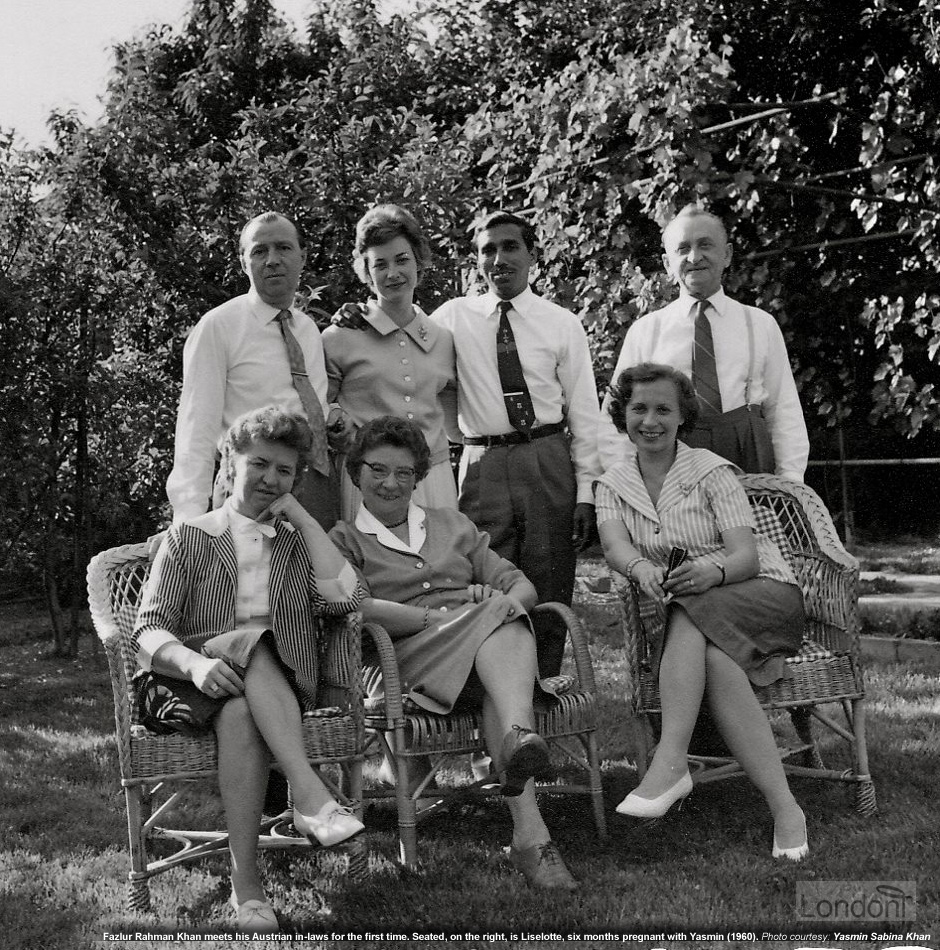
Khan married Liselotte, an Austrian-born woman, in 1959. Their only child, Yasmin Sabina Khan, was born in 1960. Their family life appears to have been warm and close. The family eventually lived in a Chicago high-rise apartment. There is an especially charming detail in Yasmin’s recollections: although her father spent his professional life designing enormous structures, at home he enjoyed ordinary activities such as mowing a lawn or painting—things that gave him a sense of freedom from his highly technical professional world. It is a small detail. But small details are often what make a historical figure feel real. The engineer who worked on skyscrapers could still enjoy doing ordinary household things.
A Daughter Who Followed Him
Yasmin Sabina Khan was only 22 when her father died. Yet she later followed his professional path and became a structural engineer herself. She also became one of the important people preserving his legacy. Her writings provide personal insights that cannot be obtained from engineering records alone. In describing her father, Yasmin emphasized that his technical ability was extraordinary—but that his human awareness and collaborative nature transformed his accomplishments and made his work more meaningful. This is an important distinction. Khan’s legacy was not simply:
“Here are the buildings he helped design.”
It was also:
“Here is the way he approached people, ideas and collaboration.”
That may be the part of his legacy most useful to the next generation.
The Bengali Family in Chicago
The Khan household retained a strong Bengali character. This becomes particularly visible in accounts of the family’s involvement with Bangladesh’s Liberation War. One memoir describing the Bengali community in Chicago during 1971 recalls visiting Khan’s home with his wife and finding the family deeply committed to Bangladesh. The visitors remembered Khan behaving “like a Bengali to the core” despite his international professional status. The account also recalls a worn copy of Rabindranath Tagore’s Gitabitan in the house. That image is powerful. A man whose professional life revolved around Chicago’s steel-and-concrete skyline still had Bengali songs and literature in his home. The skyscraper engineer had not become culturally detached from Bengal.
1971 Was Personal
By 1971, Khan had become a successful American professional. He had a prestigious position at SOM. He had international recognition. He had a family. He could have stayed out of politics. Instead, he became deeply involved in the Bangladesh cause. BUET records that he helped mobilize Bangladeshis in the United States, worked to build public opinion in favor of Bangladesh and helped establish the Bangladesh Emergency Welfare Appeal and Bangladesh Defense League in Chicago. His involvement was not merely emotional. He helped organize. He helped raise support. He helped connect people. And according to BUET’s account, he also worked to encourage Bangladeshi officials serving in foreign missions to break with the Pakistani administration and support the Mujibnagar government. This makes the 1971 chapter of his life much more consequential than a simple statement that “he supported Bangladesh.” He actively participated in the diaspora’s political and humanitarian mobilization.
The Extraordinary Contrast of 1971
There is perhaps no better year for understanding the extraordinary range of Khan’s life than 1971. On one side: the Sears Tower. A massive technological project that would become the world’s tallest building. On the other: Bangladesh. A country fighting a war for independence. Khan was involved in both worlds simultaneously. The engineer who was calculating how to make a skyscraper withstand enormous forces was also trying to help a nation withstand political and military pressure. It is one of the most remarkable contrasts in his biography.
The Engineer as Humanist
The more one studies Khan, the harder it becomes to describe him simply as an engineer. His colleagues called him a humanist. His daughter emphasized his human awareness. His professional philosophy connected engineering with art and people. His interests included music and poetry. His work connected architecture with structure. His political activities connected professional success with social responsibility. In other words, the various parts of his life were not isolated. They reinforced one another. His engineering was humanistic. His architecture was structural. His professional success gave him a platform for social action. And his Bengali identity remained part of his American life.
Why Young Engineers Remember Him
Khan’s story offers an important lesson for young people interested in science and technology. He did not become extraordinary simply because he was good at mathematics. He combined several abilities: curiosity, imagination, mathematical discipline, communication, collaboration, and an ability to see connections between apparently different fields. He could move between engineering and architecture. Between theory and practice. Between teaching and professional work. Between computers and physical structures. Between Chicago and Bangladesh. That ability to connect different worlds was one of his greatest strengths.
The Real Innovation Was Not a Tube
It is tempting to reduce Khan’s contribution to the phrase “tubular design.” But a tube was not the ultimate innovation. The deeper innovation was his method. He looked at the entire structure. He asked how forces travelled through it. He considered the economics of materials. He considered the building’s use. He considered architectural form. And then he tried to find the simplest structural system that could satisfy all of those requirements. That is why his ideas remained useful long after the specific buildings were completed. The individual systems could evolve. The method remained.
The Legacy of a 52-Year Life
Fazlur Rahman Khan died at 52. By ordinary standards, that is young. He had decades of possible research, teaching and design ahead of him. There were undoubtedly buildings he never designed and ideas he never had time to develop. Yet the body of work he left behind was enormous. His structural concepts became foundational to modern high-rise engineering. His buildings became architectural landmarks. His teaching influenced younger engineers. His collaboration with architects helped change the profession’s understanding of structure. His work with computers anticipated the digital transformation of engineering. And his daughter continued his professional legacy. His life was short. His influence was not.
What Made Fazlur Rahman Khan Different?
Perhaps the simplest answer is this: He refused to see engineering as a narrow profession. He saw engineering as a way of understanding the world. A building was physics. But it was also architecture. A structural system was mathematics. But it was also economics. A city was concrete and steel. But it was also people. A successful career was personal achievement. But it could also become a platform for helping others. And a life in America did not require forgetting Bangladesh. That is why Khan’s biography continues to feel relevant.
The Final Lesson
When a young person looks at the Sears Tower today, it is easy to see only the height. But Fazlur Rahman Khan would have wanted us to look deeper. Look at the structure. Look at the forces. Look at the geometry. Look at the efficiency. Look at the collaboration between architecture and engineering. And then look beyond the building. Behind every great structure is a human being who asked a question that others had not asked before. Khan’s question was not simply:
“How do we build higher?”
It was:
“How can we build higher, smarter, more efficiently and more beautifully?”
That question carried a young man from Dhaka into the heart of Chicago. And from Chicago, his ideas travelled into the skyline of the world.
Fazlur Rahman Khan in One Sentence
He was a Bangladeshi-born structural engineer who transformed the science of tall buildings by making structure more efficient, architecture more expressive and the skyscraper more achievable.
But perhaps there is a better sentence for the readers of Teenagers:
He was a boy from Bengal who looked at the world’s tallest buildings and decided they could stand differently.
And they did.
How Fazlur Rahman Khan Changed the Way Skyscrapers Stand
To understand Fazlur Rahman Khan’s genius, you do not need to become a structural engineer. You only need to imagine a straw. Hold a drinking straw upright between your fingers. Now push it gently from the side. The straw bends. But if you make the outside of the straw stronger while keeping its inside relatively open, something interesting happens: the whole object becomes much better at resisting the sideways force. That simple idea helps explain one of the most important revolutions in twentieth-century skyscraper engineering. Fazlur Rahman Khan realized that a tall building could be designed to behave in a similar way. Instead of thinking of a skyscraper as a collection of columns and beams carrying loads independently, he increasingly treated the perimeter of the building as a structural system working together. The building itself could become a tube. And that tube could resist the forces trying to push it sideways. This idea transformed the skyscraper.
Why Height Is Such a Difficult Problem
A building has to carry its own weight. That is obvious. Every floor, wall, piece of glass, machine, person and piece of furniture adds weight. The structural system must carry all of that downward to the foundations. But a skyscraper has another problem. Wind. The taller a building becomes, the more important wind-induced forces and movements become. A low-rise building can often tolerate the effects of wind with a relatively conventional structural frame. A very tall, slender tower cannot. Imagine standing beside a tall tree during a storm. The tree does not simply have to carry its own weight. It has to deal with forces pushing against its entire height. A skyscraper faces a similar challenge.
It must resist:
- gravity,
- wind,
- bending,
- twisting,
- vibration,
- and the cumulative effects of all those forces.
Before Khan’s tubular revolution, engineers had already developed sophisticated ways of dealing with these problems. But as buildings became taller, conventional systems could become increasingly inefficient. More steel or concrete might be required. That added weight. That added cost. And eventually, the structure itself could become an obstacle to achieving greater height. Khan wanted to change that equation.
The Old Way: Beams and Columns
Think of a conventional structural frame as a giant three-dimensional grid. Vertical columns carry gravity loads. Horizontal beams connect them. Together, they create the skeleton of the building. This works extremely well for ordinary buildings. But when the building becomes very tall, the frame has to resist enormous lateral forces. The problem is that not every part of a conventional frame is equally effective at resisting those forces. Some structural material is doing work that could potentially be done more efficiently by a better arrangement. Khan began looking at the building from a different perspective. Instead of asking:
“How can I strengthen all these individual beams and columns?”
he asked:
“Can I make the entire building behave as one structural object?”
That question led toward the tube.
The Framed Tube
The first major idea was the framed tube. The concept is easier to understand if you imagine the walls of a cardboard box. The box is hollow. But its four sides work together. If you push the box from one direction, the entire shell participates in resisting the force. Khan applied a similar principle to tall buildings. Closely spaced columns were placed around the perimeter and connected by deep spandrel beams. Together, they behaved like the walls of a tube. The building’s exterior was no longer merely an enclosure. It became an active structural system. This was a profound change. The interior could contain fewer structural columns. That meant more flexible floor space. The structure could also resist wind more efficiently. SOM describes Khan’s 1960s work on the DeWitt-Chestnut Apartments as a key early implementation of this concept: closely spaced perimeter columns behaved like a thin-walled tube, allowing fewer interior columns and greater flexibility inside.
DeWitt-Chestnut: The First Big Experiment
The DeWitt-Chestnut Apartments in Chicago became an important milestone. The building rose approximately 42 stories and was completed in the mid-1960s. Khan’s structural idea was straightforward but revolutionary: Move much of the structural action toward the outside. Instead of filling the interior with columns, make the perimeter do more of the work. This allowed the interior spaces to become much more flexible. And there was another benefit. The exterior structural system could respond much more effectively to wind. CTBUH research identifies DeWitt-Chestnut as the first major attempt to use the perimeter structural mass as an active element in a high-rise building’s response to wind. This was the beginning. But Khan was not finished. The framed tube could be improved.
From Tube to Trussed Tube
For extremely tall buildings, Khan wanted an even more efficient system. His next major step was to introduce diagonal bracing into the perimeter. Instead of having many closely spaced vertical columns do the work, large diagonal members could connect the exterior frame and create a much stiffer structural system. The result was the trussed tube, sometimes called the braced tube. And this was the system that made the John Hancock Center possible. The exterior X-braces became its most recognizable visual feature. But those giant X’s were doing serious engineering work. They were not decoration. They were the skeleton. SOM identifies the John Hancock Center as the first major use of the exterior diagonalized tube system, developed specifically for the building.