
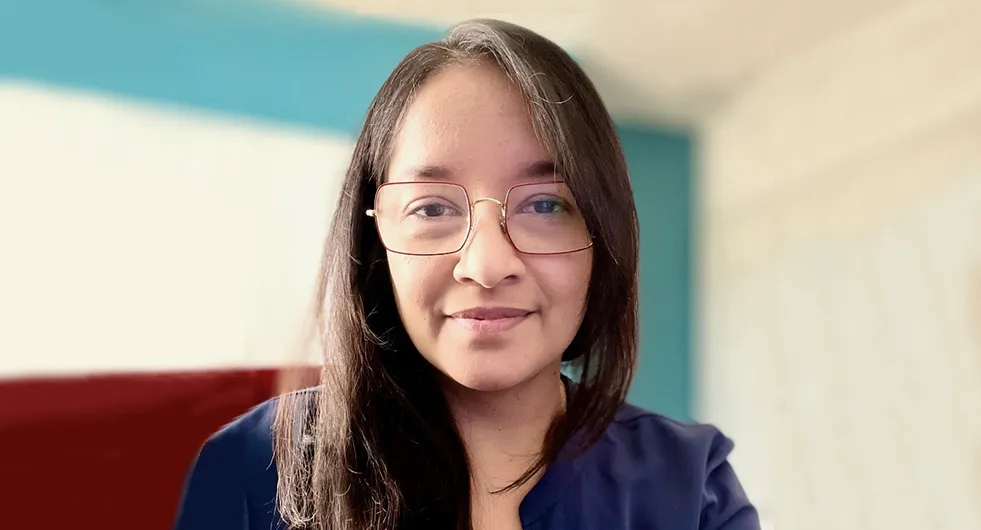

There are some lives that seem to follow a straight line. Rebecca Shafee’s life appears to have followed a very different path—one defined not by a single discipline, but by an enduring curiosity about difficult questions.
Long before she became a physicist, astrophysicist and neuroscientist, Rebecca Shafee was known in Bangladesh as an exceptionally articulate young debater. Decades later, she would be working at the intersection of neuroscience and human genetics at the U.S. National Institute of Mental Health (NIMH), studying questions about the relationship between genes, the human brain and mental health. Her journey—from Bangladesh to Caltech, from Harvard to black-hole research, and eventually from astrophysics to neuroscience—is an extraordinary example of how intellectual curiosity can cross the boundaries of academic disciplines.
Growing Up in Bangladesh
Rebecca Shafee was born and raised in Bangladesh. On her personal website, she describes herself as someone whose early education included both the Bangladeshi secondary education system and the University of London’s O and A Level examinations. She completed her S.S.C. and H.S.C. alongside the O/A-Level curriculum—an unusual academic path that reflects the breadth of her early education.
Before the scientific world knew her name, however, she became known to many Bangladeshis through another intellectual arena: television debate. As a school student in the 1990s, Shafee appeared in Bangladesh Television’s national school debate programmes. Her confidence, fluency and ability to construct arguments made a strong impression on viewers. Footage from those years resurfaced on social media many years later, reminding a new generation of Bangladeshis of the young debater who had once appeared on national television. But the debate stage was only the beginning.

From Debate to Physics
After completing her early education in Bangladesh, Shafee moved to the United States for higher education. In 2002, the California Institute of Technology’s commencement records listed Rebecca Shafee of Dhaka, Bangladesh, as a Physics graduate. Caltech would become the first major stage in an academic journey that eventually took her into some of the most challenging questions in modern science. Her own biography describes her undergraduate years in Pasadena, the home of Caltech, before she moved to Boston for doctoral study. The transition was significant. The teenager who had once debated questions in front of a television audience was now studying the fundamental laws governing the physical universe.
Harvard and the Mystery of Black Holes
After Caltech, Shafee went to Harvard University for doctoral study in physics. Her PhD research focused on one of the most fascinating objects in astrophysics: black holes. Harvard’s official records list her doctoral thesis as “Measuring Black Hole Spin.” The Astronomy Genealogy Project records her as receiving her PhD from Harvard in 2009, with Jeffrey E. McClintock and Ramesh Narayan as her advisors.
Her research addressed a fundamental question: how fast do black holes rotate? Black holes are not simply cosmic objects that swallow everything around them. Their mass, spin and interaction with surrounding matter are central to understanding some of the most extreme environments in the universe. Shafee’s work contributed to research on determining the spin of black holes from observations of their surrounding accretion disks.
One of her research papers, published with Jeffrey McClintock, Ramesh Narayan and other collaborators, examined the spin of the black hole in the X-ray binary system GRS 1915+105. The study concluded that the compact object was a rapidly rotating Kerr black hole and placed a lower limit of more than 0.98 on its dimensionless spin parameter.
Her doctoral work was sufficiently distinguished that Harvard’s Institute for Theory and Computation recognized Shafee in 2009 as one of the recipients of the Eric R. Keto Prize for the best thesis in theoretical astrophysics. The subject of that prize-winning thesis was, appropriately, Measuring Black Hole Spin.

A Remarkable Change of Direction
For many scientists, a PhD in astrophysics might mark the beginning of a lifelong career studying the cosmos. For Rebecca Shafee, it appears to have been a doorway into another scientific world. After completing her work in astrophysics, she moved toward neuroscience. This was not a minor change of subject. She moved from studying objects on astronomical scales to studying the most complex biological organ known: the human brain.
At Harvard’s Center for Brain Science, Shafee worked as a Swartz Fellow in Computational Neuroscience. According to her current NIMH profile, she worked in Randy Buckner’s group on understanding the myelination pattern of the human cerebral cortex. The research required a very different scientific vocabulary—one involving brain anatomy, genetics, computation and statistical analysis rather than black holes and relativistic astrophysics. Yet there was a connection. Both fields demand the ability to extract meaningful information from enormously complex systems.
From Neuroscience to Genetics
Shafee’s next major research chapter took her into statistical genetics. As a postdoctoral researcher at the Broad Institute of MIT and Harvard and Harvard Medical School, she worked on using statistical genetics to investigate the genetic basis of psychiatric disorders. Her research included work on schizophrenia and the relationship between genetic risk and cognitive traits. A 2018 paper in Translational Psychiatry, for example, lists Rebecca Shafee as an author and identifies her affiliations with the Department of Genetics at Harvard Medical School and the Stanley Center for Psychiatric Research at the Broad Institute of MIT and Harvard.
The research examined polygenic risk for schizophrenia and measured domains of cognition in people with psychosis and control groups. The direction of her career was now becoming clear. She was no longer asking only how the universe works. She was asking how genes influence the brain—and how biological differences may relate to human cognition and psychiatric conditions.
At the National Institute of Mental Health
Shafee’s current professional chapter is at the U.S. National Institute of Mental Health. The NIMH identifies Rebecca Shafee, PhD, as a Research Fellow in the Section on Developmental Neurogenomics. Her current research interests concern the relationship between the human genome and brain anatomy and function in both healthy individuals and people affected by disease. According to her NIMH profile, one of her current interests is investigating the genetic basis of sex differences in the human brain using statistical genetics.
This places her at the intersection of several fields:
- Neuroscience
- Human genetics
- Brain anatomy
- Computational biology
- Statistical genetics
- Psychiatric research
It is a long way from the television debate stage where many Bangladeshis first encountered her.

Studying the Architecture of the Human Brain
Shafee’s research has also appeared in major scientific publications. In 2024, she was among the authors of a Nature Communications paper titled “A sex-stratified analysis of the genetic architecture of human brain anatomy.” The research examined how genetic factors relate to anatomical characteristics of the human brain and how those relationships can differ between sexes. The paper lists Shafee’s affiliation with the Section on Developmental Neurogenomics, Human Genetics Branch, Intramural Research Program of the National Institute of Mental Health.
This is important because it provides a direct, contemporary record of her continuing scientific work rather than relying solely on biographies or social-media descriptions. Another recent research publication, “Genetic insights on the mechanisms of human cortical folding,” also lists Shafee as a contributor and identifies her affiliation with the same NIMH research section. Her work today therefore sits firmly within one of the most rapidly developing areas of modern science: understanding how genetics contributes to the structure and function of the human brain.

A Journey Across Scientific Boundaries
Rebecca Shafee’s career is unusual because it crosses boundaries that are normally separated into entirely different academic worlds. She studied physics at Caltech. She studied astrophysics at Harvard. She investigated black-hole spin. She moved into computational neuroscience. She then worked in statistical genetics and psychiatric research. Today, she studies the relationship between genetics and the human brain. The progression may look surprising, but there is an underlying continuity. Physics teaches a scientist to look for fundamental principles. Astrophysics applies those principles to the largest structures in nature. Neuroscience applies quantitative thinking to one of the most complex biological systems. Genetics provides another layer of explanation—one that reaches into the biological instructions underlying human development and variation. Shafee’s career demonstrates that scientific curiosity does not have to remain confined to one subject.
The Importance of Her Bangladeshi Roots
There is another dimension to Shafee’s story that makes it particularly meaningful to young Bangladeshis.She was born and raised in Bangladesh.Her Caltech record identifies her place as Dhaka.Her own website begins her biography by explicitly stating that she was born and brought up in Bangladesh.That makes her journey more than an academic success story.It is also a reminder that intellectual ambition can begin anywhere.
A student does not have to grow up in one of the world’s traditional scientific centres to develop the curiosity necessary to participate in global science.Shafee’s early life in Bangladesh preceded an academic career that eventually placed her at Caltech, Harvard, the Broad Institute, Harvard Medical School and the U.S. National Institutes of Health.
More Than a Story About Intelligence
It would be easy to describe Rebecca Shafee simply as a “genius.”But that would make her story less interesting, not more.What stands out is not merely academic achievement. It is the willingness to move into unfamiliar territory. A young debater became a physicist. A physicist became an astrophysicist. An astrophysicist studied black holes. A researcher of black holes moved into neuroscience. A neuroscientist moved deeper into genetics.And now she is investigating how genes and the brain interact. That pattern suggests something more valuable than raw intelligence: intellectual flexibility. The ability to learn a new language of knowledge. The willingness to become a beginner again. The courage to leave a familiar field and ask entirely new questions.
The Debate Stage and the Laboratory

There is a beautiful symmetry between the beginning and the present stage of Shafee’s career.Debate is about asking questions, examining evidence, challenging assumptions and constructing arguments.Science is also about questions, evidence and testing assumptions. The tools are different. The stakes are different. But the underlying intellectual habit is remarkably similar.Perhaps the young girl who learned to stand confidently before a television audience was already developing the qualities that would later help her navigate difficult scientific problems. The debate stage taught her to think. Science gave her a universe—and later a human brain—to think about.
A Message for the Next Generation
Rebecca Shafee’s journey offers an especially powerful message to young people who feel pressured to decide their entire future too early. You do not necessarily have to know at fifteen what you will be researching at thirty-five. You may begin with one passion and discover another. You may study one subject and eventually find that the skills you gained there help you understand something completely different. The important thing is to remain curious. Shafee’s story demonstrates that a career does not always need to be a straight road. Sometimes the most remarkable journeys are the ones that take unexpected turns.
From Dhaka to the Frontiers of Science
The young Rebecca Shafee who once appeared on Bangladesh Television could hardly have known where her intellectual journey would eventually lead. From Dhaka she travelled to Pasadena. From physics she travelled to astrophysics. From black holes she travelled to the human brain. And from neuroscience she moved into the intricate relationship between genetics, brain structure and human behavior.
Today, Rebecca Shafee is a researcher at the National Institute of Mental Health, working at the intersection of neuroscience and human genetics. Her story is therefore not simply about a gifted Bangladeshi student who achieved academic success abroad. It is a story about curiosity without borders.
The same mind that once stood before a television camera in Bangladesh eventually turned toward some of the biggest questions imaginable—from the rotation of black holes to the genetic architecture of the human brain. And perhaps that is the most remarkable lesson of Rebecca Shafee’s life:
The most important question is not always what you know. It is how willing you are to keep learning.
Imagine a woman some twenty years ago in Bangladesh. Chances are, the most successful women you could think of were highly ambitious and promising individuals progressing rapidly in their respective fields, but all these promises and ambitions came with a deadline. Most of these women could never keep pursuing their dreams as they kept reaching further and further into “womanhood”.
Being born into a social structure that hinges on the men being the torch bearers of the society and the women being nothing but their support systems, it is pretty obvious that a woman with dreams would not be anything more than a burden. For most women, it is imperative to start thinking about wedlock and motherhood immediately after graduation. Women usually give up on their hopes of being anything more, because the society leads them into believing that this marriage and this family-life gives them some form of security from the dark world outside.
Rebecca Shafee seemed to be echoing the same sentiments when she said in a BTV debate final speech representing Holy Cross College. “I am not overambitious, I don’t hold the rights to be so. I am but a simple girl, afraid of the world around me. And I am just fine.”
Now imagine a woman some twenty years ago, already being in the BTV debate finals.
Who is Rebecca Shafee? Recently a video of her final debate speech went viral on Facebook. She speaks of herself, a feeble and fragile being, to whom the system is all there is to believe in. Coming from a society that views women raising their voices to be problematic; in her world, she was the only speaker, and the rest of the world was her audience.
Glories abroad
What most people do not know is what she proceeded on to doing after this final. She set on a path to destroy all possible gender norms. In a world where women are taught to be submissive, this woman chose to cling on to her dreams and not give in to anything short of greatness.
She started off by getting a BS degree from the California Institute of Technology on Physics. She then proceeded on to doing her PhD from Harvard University on Astrophysics, during which she spent her time researching on the measurements of black hole spin. She is currently involved with Harvard Medical School and Broad Institute of MIT and Harvard as a Post-Doctoral Fellow in genetics.
Although Rebecca had her sights set on astrophysics for undergrad, she went on to pursuing further education on medical science for postdoctoral. She has worked on neuroscience for several years and is currently researching on the relationship between genetic variants and neuropsychiatric disorders.
She has won several awards for her dedication in various scientific fields, most of which my undergrad engineer brain is yet to grasp. She has worked as a Teaching Assistant for Caltech and is currently engaged with Harvard as a Teaching Fellow.
The Apt Role Model
With too many publications and recitations to be named within the span of this article, Rebecca is an idol for the thousands of girls without a voice in Bangladesh. She came from a country so heavily patriarchic and eastern, and ended up showing the world what women are capable of. Rebecca is an inspiration. She is visible proof that women are so much more than what the society expects them to be.
Apart from her academic life, she is also a mother of one.
The condition of women in this third-world country has not had any drastic improvement over the years. But today, women countrywide have someone to look up to, someone to relate to for their struggles. Now they have evidence that women aspiring for greatness are not just a cog in the system.
With Begum Ruqaiya having paved the way for education of women, Rebecca is perhaps the most effective option right now to take the helm. Rebecca is the mother of a new line of strong and independent women. Her courage accompanied by her willpower is what makes her the perfect role model for the new generation of Bangladeshi girls
Source: Official website of Rebecca Shafee, Linkdin