

We are living in an era where technology evolves faster than ever, and at the heart of the next big technological leap lies a concept that sounds straight out of science fiction: Quantum Technology. While traditional computers have powered our world for decades, they are slowly reaching their physical limits. Enter the quantum realm—a fascinating microscopic world that promises to redefine how we process information, solve global challenges, and understand the universe itself. But what exactly is this “quantum revolution,” and why should the next generation care? Let’s dive in and explore the foundational elements of quantum education.
What Does the Word ‘Quantum’ Mean?
The word ‘Quantum’ originates from Latin, meaning “how much” or “amount.” In the realm of physics, it refers to the smallest possible, indivisible unit of any physical property, such as energy or light.
What is Quantum Education?
Quantum education serves as an umbrella term that generally covers two distinct areas: learning the fundamental principles of quantum physics and understanding quantum computing. It is your gateway to exploring how the universe operates at its most microscopic level.
What is Quantum Computing?
Quantum computing is a revolutionary technology that utilizes the laws of quantum mechanics to process information. While daily technology relies on classical computing, quantum computers have the potential to solve optimization problems, simulate molecular structures, and drastically advance fields like chemistry, artificial intelligence, and medicine.
What are Quantum Computers?
A quantum computer is an advanced system that leverages quantum mechanics to solve highly complex problems—tasks that would take today’s most powerful classical supercomputers thousands of years to complete. It might sound like science fiction, but these machines actually exist!
However, to understand how they achieve this incredible speed, we need to look at what powers them. Regular computers rely on standard “bits,” but bits are far too limited for a system this advanced. Instead, quantum computers use something much more powerful: qubits.
What are Qubits?
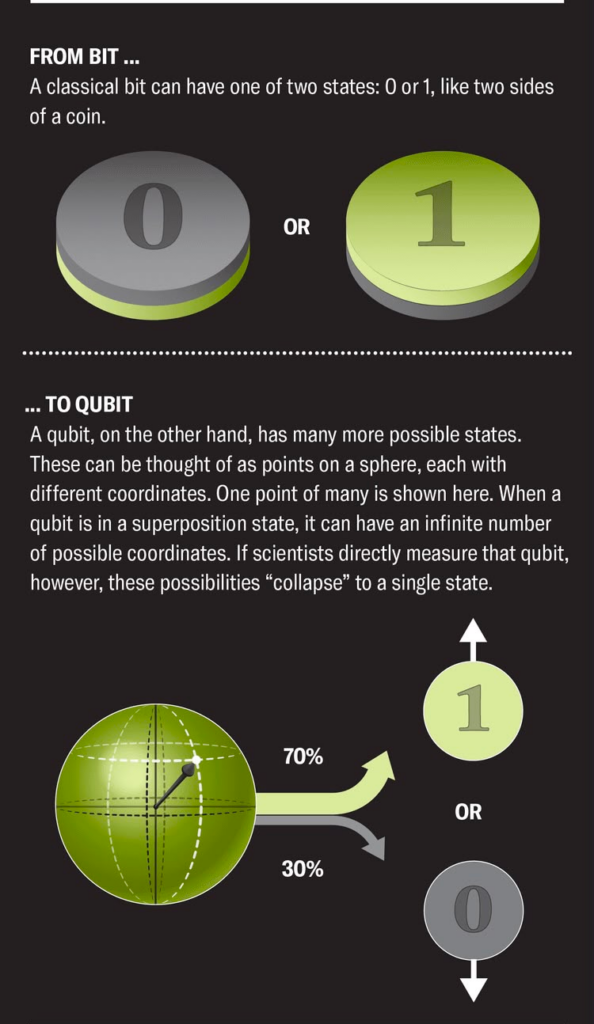
To understand qubits, let’s first look at classical bits:
- Classical Bits: A standard bit can only exist in one of two states: 0 or 1. They are highly stable at room temperature, which is why they successfully power our everyday laptops, TVs, and smartphones.
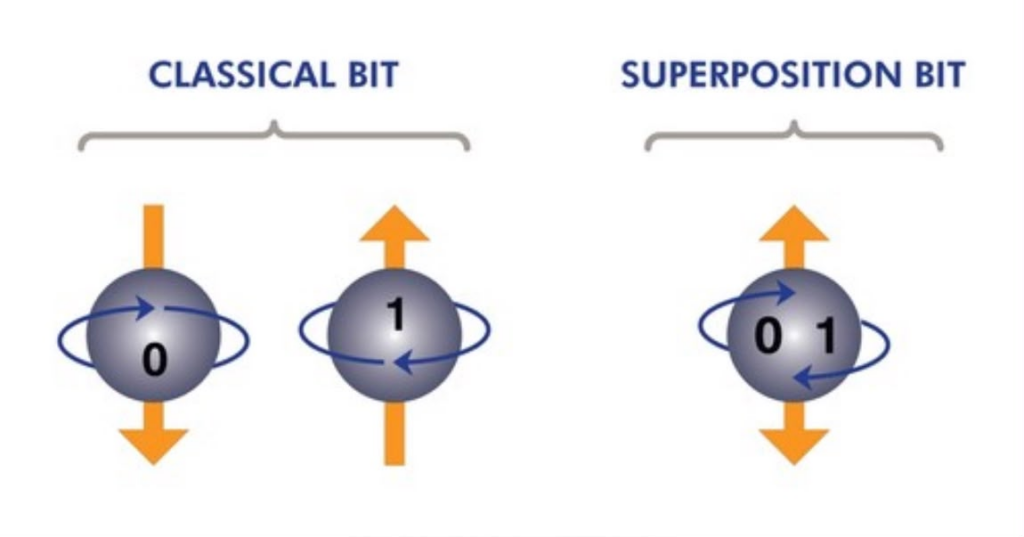
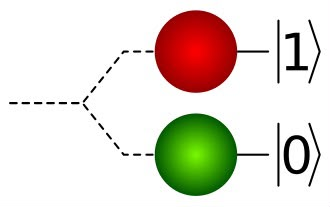
- Qubits (Quantum Bits): Think of a qubit as the cooler, more powerful sibling of the regular bit. Unlike a bit, a qubit can exist in a superposition of both 0 and 1 simultaneously. This allows a quantum computer to evaluate a vast number of possibilities all at once.

The Catch: While qubits are incredibly powerful, they are also extremely unstable. To function without errors, they require an environment cooled to near absolute zero (colder than deep space)!
What is Superposition? (The Story of Schrödinger’s Cat)
To understand how something can be two things at once (like a qubit being 0 and 1), scientists use the concept of Superposition. The easiest way to picture this is through the famous thought experiment known as Schrödinger’s Cat, proposed by physicist Erwin Schrödinger.
Imagine a cat sealed inside a box. Along with the cat, there is a tiny amount of a radioactive substance, a Geiger counter, a hammer, and a small vial of poison gas.
- If a single atom of the radioactive substance decays within one hour, the Geiger counter detects it, releases the hammer, breaks the vial, and the cat dies.
- If no atom decays, the vial remains intact, and the cat lives.
Because the box is completely sealed, an observer outside cannot know the outcome. Therefore, until the box is opened, the cat is scientifically considered to be in a quantum superposition—both alive and dead at the same time. Only the act of opening the box (observation) forces nature to choose one reality.
Similarly, a qubit stays in a superposition of multiple possibilities until the quantum computer finishes its calculation and presents the final answer.

What is Quantum Entanglement?
In quantum physics, entanglement occurs when two microscopic particles (such as photons or electrons) become deeply interconnected. Once entangled, the state of one particle instantly determines the state of the other—no matter how vast the distance between them.
To visualize this, imagine you have two magically linked coins. If you leave one on Earth and take the other to the Moon, flipping the coin on Earth and getting “Heads” means the coin on the Moon will instantly land on “Tails.” They remain perfectly correlated across the universe. While this coin analogy helps us understand the connection, the actual quantum behavior is infinitely weirder and faster than the speed of light!
Why Should We Invest in Quantum Education?
As we stand on the brink of a technological revolution, quantum education is no longer just for scientists. It is essential for everyone for several key reasons:
- Preparing for Future Technology: It builds critical high-tech skills, preparing the next generation for emerging industries like quantum computing, unbreakable cryptography, and advanced molecular engineering.
- Solving Impossible Global Challenges: With the computational power of quantum systems, future professionals can find solutions to complex problems—such as climate modeling, financial optimization, and disease eradication—that currently seem impossible for classical computers.
- Nurturing Innovative Minds: Quantum education trains young minds to think outside the box. By moving past traditional, linear learning methods, it encourages multi-dimensional problem-solving and fosters true innovation.
Future-Proof Careers: Exploring Quantum Jobs
While the quantum industry is rapidly evolving, several key career paths are already shaping the future of this technology:
- Quantum Hardware Engineers: These engineers design, build, and test the physical components of quantum computers, including qubits and control electronics. Their primary mission is to minimize environmental noise and improve “coherence times” (how long a qubit can hold information) through error-correcting layouts.
- Cryogenic Integration Specialists: Since qubits are highly unstable, these experts set up and maintain extreme cooling systems. They keep quantum processors running at temperatures colder than deep space to ensure system stability.
- Quantum Software Developers: They design algorithms and applications tailored for Quantum Processing Units (QPUs). By manipulating qubits through superposition and entanglement, they build programs using modern frameworks like Qiskit, Q#, Cirq, and PennyLane.
- Quantum Researchers and Scientists: These pioneers explore the behavior of matter and energy at the atomic and subatomic levels. Their research lays the foundation for revolutionary leaps in quantum computing, hyper-sensitive quantum sensing, and secure quantum networks.
How Do We Spread Quantum Education?
To prepare society for this quantum shift, we must integrate these concepts into our educational pipeline at every level:
- Primary Education: Introduce foundational concepts like probability, waves, and states through interactive games, hands-on experiments, and engaging storytelling.
- Secondary Education: Seamlessly integrate the basics of quantum mechanics into existing high school physics and computer science curricula.
- Higher Education: Launch interdisciplinary degree programs that bridge the gaps between physics, computer science, electrical engineering, and mathematics.
- Practical Training: Encourage students to use cloud-based platforms like the IBM Quantum Experience or open-source simulation tools to run real experiments on actual quantum processors remotely.
Written by: Mahira Elsa