
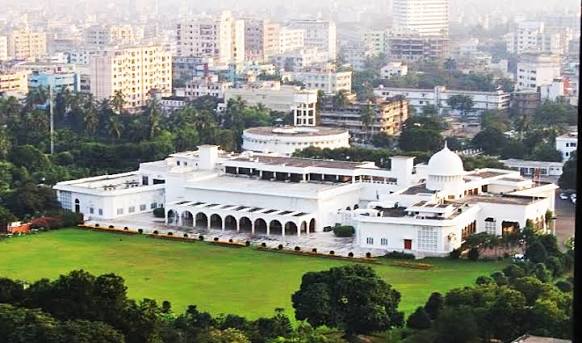

In the heart of Dhaka, surrounded by high walls and extensive greenery, stands a building that is far more than an official residence. It is Bangabhaban, the official residence and principal workplace of the President of Bangladesh.
For most people, the name immediately evokes images of state ceremonies, visiting heads of government, presidential meetings and national occasions. Yet behind its guarded gates lies a much older story—one that began long before Bangladesh existed as an independent country.
The history of Bangabhaban stretches back more than a century. Its story connects the Nawabs of Dhaka, the British Raj, the partition of Bengal, the creation of Pakistan, the political history of East Pakistan, the Liberation War and the emergence of Bangladesh. In other words, Bangabhaban is not merely a palace. It is a physical record of Bengal’s political transformation.
Bangabhaban at a Glance
| Fact | Details |
| Location | Bangabhaban Road, Dhaka |
| Present role | Official residence and workplace of the President of Bangladesh |
| Historic beginning | Early 20th century |
| Government House era | 1905–1947 |
| Governor House era | 1947–1971 |
| Present name | Bangabhaban |
| Name adopted | December 1971 / January 1972 |
| Major reconstruction | 1961–1964 |
| Main structure | Three-storeyed complex |
| Architectural character | Indo-Saracenic with Islamic and Bengali influences |
| Compound | About 50 acres |
| Main building plinth area | 9,962 sq ft, according to PWD database |
| Important spaces | Darbar Hall, State Dining Hall, Banquet Hall, Cabinet Room, Presidential Office and residential suites |
The Bangladesh government’s official Bangabhaban website describes the complex as a symbol of the nation’s dignity and glory and traces its institutional history to the creation of the Province of Eastern Bengal and Assam in 1905.
Before Bangabhaban: A Place Older Than the Palace
To understand Bangabhaban, one has to look beyond the present building. The land on which Bangabhaban stands has a history that predates British rule by centuries. According to Banglapedia, during the Sultanate period the area was associated with a Sufi saint known as Hazrat Shahjalal Dakhini. Historical tradition says that he and his disciples were killed and buried in the area, which subsequently became known as a mazar. The story then moves forward to the Mughal period.
The area was associated with Mirza Mukim, an official connected with Nawara Mahal during the rule of Subadar Mir Jumla. Banglapedia records traditions concerning large elevated mounds and a tank in the area. The tank became associated with the name Motijheel, literally “lake of pearls”, through a local legend involving Mirza Mukim’s daughter and her ornaments. Centuries later, the landscape came into the possession of the Nawab family of Dhaka.
The Nawabs and the Birth of Dilkusha Garden
One of the most important figures in the early history of the site was Nawab Khwaja Abdul Ghani, one of the most influential members of the Dhaka Nawab family. Abdul Ghani acquired land in the area and developed a garden-house known as Dilkusha Garden. The property was subsequently expanded, and parts of the estate had connections with Armenian zamindars, including a figure known as Manuk. This is significant because traces of that earlier landscape survived even after the colonial government transformed the site.
One such surviving structure is Manuk House, located within the Bangabhaban compound. Manuk House is generally associated with an Armenian zamindar named Manuk and represents a small but fascinating link between Bangabhaban and Dhaka’s Armenian heritage. Thus, before it became a government palace, the land was part of a much older cultural landscape shaped by saints, Mughal officials, the Nawabs of Dhaka and Armenian landholders.
1905: When Bengal Was Partitioned
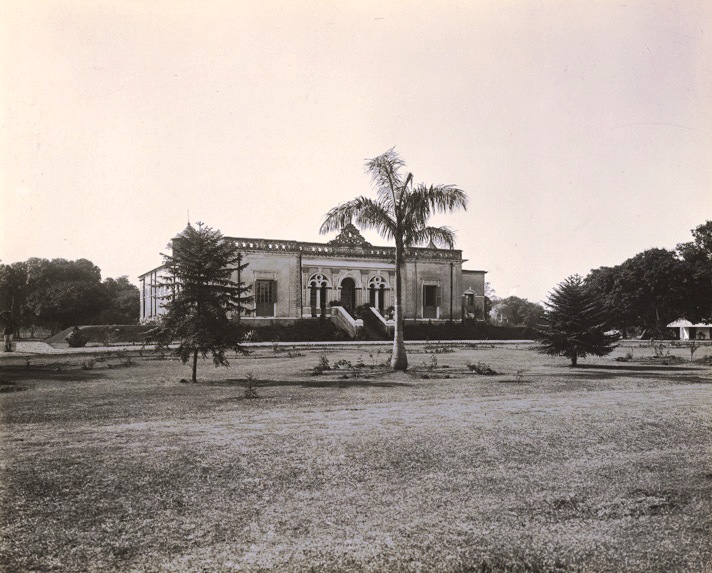
The modern history of Bangabhaban began during one of the most controversial episodes of British India’s history: the Partition of Bengal in 1905. Lord Curzon’s government divided Bengal and created the new province of Eastern Bengal and Assam. Dhaka was selected as the capital of the new province. A new administrative centre was therefore required. The government acquired part of the Dilkusha property and constructed a grand Government House intended for the province’s Lieutenant-Governor and for visiting senior colonial officials. The building soon became known as the Dilkusha Government House.
The first Lieutenant-Governor of Eastern Bengal and Assam was Sir Joseph Bampfylde Fuller. On 14 February 1906, Fuller began his official work at what is today the Darbar Hall of Bangabhaban. That date is particularly important. It marks the beginning of the building’s life as a major centre of government.
A Palace for Governors—and a Temporary Home for the Viceroy
The new Government House was not simply a provincial residence. The Viceroy of India also used the residence during visits to Eastern Bengal. According to Banglapedia, the Viceroy stayed there during his visits to the province until 1911. The building therefore became part of the highest levels of colonial administration. Its location was strategic. Dhaka was being transformed into the administrative capital of a new province, and the Government House stood at the centre of that transformation. The surrounding Dilkusha area itself became an important setting for official receptions and political gatherings. Historical records mention receptions involving senior colonial officials and members of Dhaka’s elite at Dilkusha Garden.
The Partition Was Reversed—but the House Survived
In December 1911, the British government announced the annulment of the Partition of Bengal. The administrative structure changed again. Dhaka lost its status as the capital of the divided Bengal province, but the Government House did not disappear. Instead, the property continued to serve important administrative functions. From the early 20th century until the end of British rule, the building remained associated with the highest level of provincial government. The official residence therefore outlived the political arrangement for which it had originally been created.
1947: From British Government House to Governor House
The next great transformation came with the Partition of British India in 1947. Pakistan was created, and East Bengal became a province of Pakistan. The former Government House was selected as the official residence and office of the provincial governor. Its name changed accordingly. It became known as the Governor House. When East Bengal was renamed East Pakistan in 1955, the building continued to serve as the residence and workplace of the governor. For nearly a quarter of a century, the Governor House was one of the principal political centres of East Pakistan.
The Storm That Changed Bangabhaban
One of the most dramatic episodes in the building’s physical history came in 1961. A devastating storm struck East Pakistan on 9 May and severely damaged the Governor House. The old structure required extensive reconstruction. Rather than simply repairing the damaged building, substantial reconstruction took place, producing the structure that forms the architectural basis of today’s Bangabhaban. The reconstruction was completed in 1964. This distinction is important. When people describe Bangabhaban as a “1905 building”, they are referring to the origins of the Government House on the site. The present main structure, however, owes much of its physical form to the 1961–1964 reconstruction. The Public Works Department’s building database records Bangabhaban’s establishment year as 1961, describes the main building as an RCC/brick masonry structure and lists a plinth area of 9,962 square feet with three floors.
What Happened to the Building During the Liberation War?
The Governor House entered the most consequential chapter of its history in 1971. The political crisis that had been building for years culminated in the Liberation War of Bangladesh. The building remained part of the administrative landscape of Dhaka during the conflict. After Pakistan’s surrender on 16 December 1971, the Governor House was taken over by the new Bangladesh authorities. The transition was more than administrative. The building that had represented colonial and Pakistani authority was about to become the house of the head of an independent Bangladesh.
Why Was It Renamed Bangabhaban?
The name Bangabhaban literally conveys the idea of the “House of Bengal”. Following the birth of Bangladesh, the former Governor House was given a new identity. A cabinet meeting held at the Governor House on 23 December 1971, presided over by Acting President Syed Nazrul Islam, took the decision to rename the building Bangabhaban. The name was therefore not simply a change of signboard. It represented a political transformation. The colonial Government House had become the Governor House of Pakistan. The Governor House had now become the Bangabhaban of Bangladesh.
The First President to Live in Bangabhaban
Bangabhaban became the official presidential residence of independent Bangladesh. Justice Abu Sayeed Chowdhury became the first constitutional President of Bangladesh to reside there after taking office in January 1972. The building consequently entered a completely new phase of its history. It was no longer the residence of a colonial governor or a provincial governor. It became the official home and workplace of the head of a sovereign state.
A Remarkable Constitutional Moment Inside Bangabhaban
Bangabhaban also witnessed one of the country’s earliest constitutional transitions. After returning to Bangladesh in January 1972, Sheikh Mujibur Rahman, who had been President of the provisional government while detained in Pakistan, moved from the presidency to the position of Prime Minister when Bangladesh adopted a parliamentary system. The transition was formally connected with Bangabhaban. Thus, the building became a setting for one of the earliest institutional transformations of the newly independent country.
Who Has Lived in Bangabhaban?
The list of people associated with Bangabhaban reads almost like a political history of Bangladesh. During the colonial period, it was occupied by senior British administrators, including the Lieutenant-Governor of Eastern Bengal and Assam and later governors of Bengal. After 1947, it became the residence of the governors of East Bengal and East Pakistan.
After independence, it became the official residence of Bangladesh’s presidents. Among the major Bangladeshi heads of state associated with Bangabhaban were:
- Abu Sayeed Chowdhury
- Mohammad Mohammadullah
- Sheikh Mujibur Rahman
- Khondaker Mostaq Ahmad
- Justice Abu Sadat Mohammad Sayem
- Ziaur Rahman
- Abdus Sattar
- A. F. M. Ahsanuddin Chowdhury
- Hussain Muhammad Ershad
- Shahabuddin Ahmed
- Abdur Rahman Biswas
- Badruddoza Chowdhury
- Iajuddin Ahmed
- Zillur Rahman
- Mohammad Abdul Hamid
- Mohammed Shahabuddin
The sequence reflects the extraordinary political changes Bangladesh experienced after independence, including parliamentary government, presidential government, military rule, caretaker government and the return to parliamentary democracy. Historical lists of Bangladesh’s heads of state confirm the succession of presidents who occupied the presidential office after independence.
Not Every President Used Bangabhaban in Exactly the Same Way
There is an important distinction between being President and “living” permanently inside the complex.
Bangabhaban serves simultaneously as:
- a residence;
- a presidential workplace;
- a ceremonial venue;
- a meeting complex;
- a state reception venue;
- a location for official dinners;
- a place where credentials and honours are presented;
- and a setting for meetings involving senior national and foreign officials.
Consequently, its role has always been larger than that of a private residence.
The Architecture of Bangabhaban
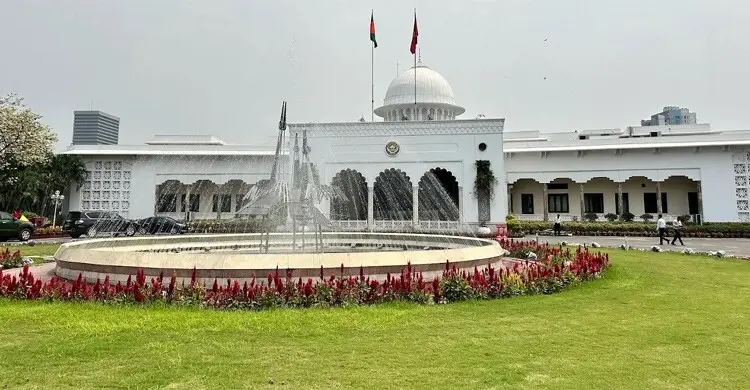
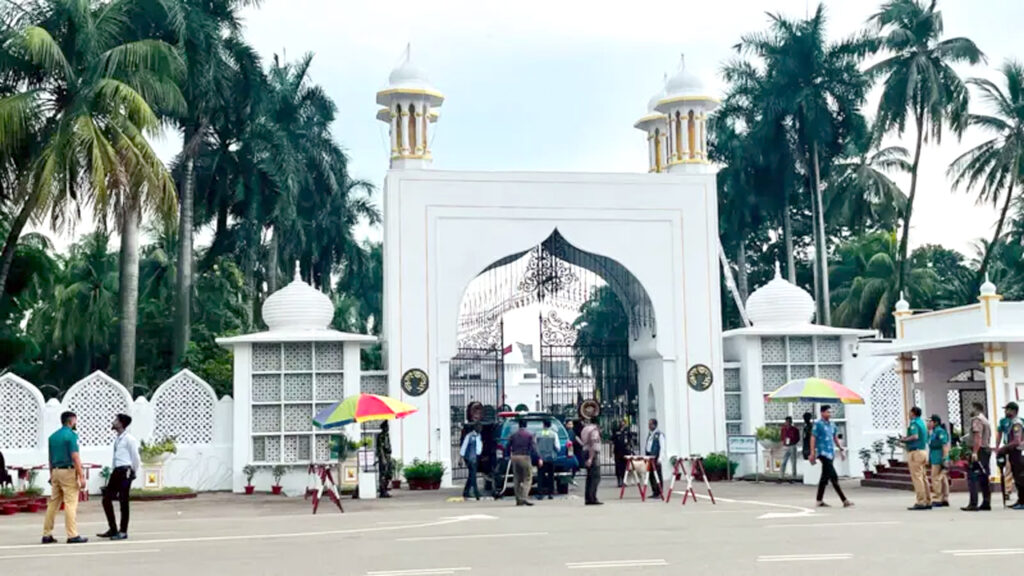
Bangabhaban’s architecture reflects the complicated history of the building. Its architectural character is commonly described as Indo-Saracenic, while the post-1961 reconstruction incorporated elements associated with Islamic and Bengali architectural traditions. This makes the building particularly interesting. It does not belong neatly to one architectural era. Its history can be read in layers. The colonial period contributed the Government House tradition. The Nawabi landscape survives through the garden setting and structures such as Manuk House. The 1960s reconstruction introduced a new architectural and structural language. Independent Bangladesh then transformed the complex into a national ceremonial space.
A Three-Storey Presidential Complex
The principal building is a three-storeyed palatial complex. According to the available architectural descriptions, the ground floor contains many of the principal official spaces, including the presidential office, offices of senior officials, audience rooms, a Cabinet Room, Banquet Hall, Darbar Hall, State Dining Hall, auditorium and lounge areas. The upper levels contain additional official and residential facilities. The President’s residential section is located toward the north-eastern portion of the complex and includes residential suites and bedrooms. The upper floor also contains suites intended for visiting foreign heads of state and government. This arrangement tells us something important about Bangabhaban. It was designed not simply for one person to sleep and work there, but as a self-contained state environment.
The Darbar Hall: The Heart of Ceremony
Among the most important spaces inside Bangabhaban is the Darbar Hall. The word “Darbar” immediately evokes the ceremonial traditions of South Asian courts. But its modern function is republican rather than royal. The hall is used for important state occasions, ceremonies and official events. It was also in this historic space that Sir Joseph Bampfylde Fuller began his official work in February 1906. More than a century later, the same space remains associated with the formal public face of the presidency. The Darbar Hall has also undergone repair, renovation and modernization work over the years. Public Works Department procurement records show renovation and interior-decoration work associated with the hall.
The State Dining Hall and Banquet Traditions
Bangabhaban is also a place where diplomacy takes a very tangible form. State dinners and formal banquets bring together political leaders, diplomats, visiting heads of state, government officials and other distinguished guests. The presence of a dedicated State Dining Hall and Banquet Hall reflects the building’s diplomatic function. In many countries, official residences of heads of state serve as stages for international diplomacy. Bangabhaban performs that role for Bangladesh.
A Presidential Office Inside the Residence
Unlike a conventional palace, Bangabhaban is also an administrative workplace. The presidential office and offices of senior civilian and military officials are located within the complex. This means that official meetings, ceremonial duties, diplomatic engagements and residential life are brought together within the same secure environment. The arrangement is characteristic of presidential residences around the world, although the architectural form is distinctly South Asian.
What Is Inside the Bangabhaban Compound?
The main palace is only one part of a much larger complex. The approximately 50-acre compound contains extensive greenery as well as a number of supporting buildings and facilities.
Publicly documented facilities and structures include:
- Presidential offices
- Residential areas
- Darbar Hall
- Banquet Hall
- State Dining Hall
- Cabinet Room
- Auditorium
- Reception facilities
- Mosque
- Post office
- Bank-related facilities
- Cafeteria
- Staff accommodation
- Security facilities
- Military Secretary’s bungalow
- Assistant Military Secretary’s bungalow
- Other service buildings
The Public Works Department database documents numerous individual structures within the compound, including the Military Secretary’s bungalow, Assistant Military Secretary’s bungalow, Toshkhana building, old post office, generator house, mosque and other facilities. This makes Bangabhaban less like a single palace and more like a small institutional campus built around a historic presidential residence.
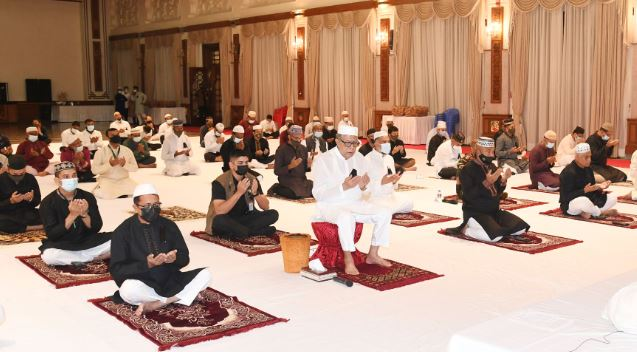
The Mosque Inside Bangabhaban
The compound contains a mosque with a distinctive three-domed form. Its presence reflects the layered architectural character of the complex, where formal state architecture exists alongside religious and residential facilities. The mosque is not simply an architectural accessory. It is part of the everyday infrastructure of the presidential compound.
The Gardens: A Legacy of Dilkusha
One of Bangabhaban’s most striking features is not the building itself. It is the greenery surrounding it. The palace stands inside an extensive compound with lawns, mature trees and landscaped areas. The gardens are historically connected to the old Dilkusha Garden of the Nawab period. This gives Bangabhaban an unusual quality in central Dhaka. Outside its walls lies one of South Asia’s busiest and most densely developed urban environments. Inside, the atmosphere can be markedly different—formal, spacious and heavily landscaped. The gardens therefore preserve something of the old character of Dilkusha even though the city around them has changed almost beyond recognition.
Manuk House: A Forgotten Piece of Dhaka’s Armenian History
Among the lesser-known historical elements of Bangabhaban is Manuk House. The structure is associated with the Armenian zamindar Manuk and survived within the larger estate that eventually became part of Bangabhaban. Its existence is important because it reminds us that the history of the site is not exclusively British or Bengali Muslim. Dhaka’s Armenian community also formed part of the city’s commercial and landed history. Manuk House is therefore a small architectural survivor carrying a much larger story about the multicultural history of old Dhaka.
How Much Did Bangabhaban Cost to Build?
This is one of the most frequently asked questions about historic government buildings. And here, caution is necessary. Unlike some major colonial buildings for which original construction accounts have survived or been digitized, a reliably documented original construction cost for the Bangabhaban complex has not been found in the accessible authoritative sources consulted for this research.
Some secondary websites repeat figures or make comparisons with other colonial palaces, but without a verifiable primary record those figures should not be presented as fact. There is another complication. The “Bangabhaban” we see today is not simply the 1905–06 building. The complex was substantially reconstructed after the devastating 1961 storm, with the reconstructed building completed in 1964. Therefore, at least three different financial questions could be asked:
- What did the original Government House cost in the early 20th century?
- What did the 1961–64 reconstruction cost?
- How much has been spent on subsequent renovation, modernization and new facilities?
These are not the same thing. For a responsible historical article, inventing a single “construction cost of Bangabhaban” would therefore be misleading.
But We Know What Later Projects Cost
Although the original construction cost remains difficult to establish from reliable online records, later projects have documented budgets. For example, a swimming pool was constructed in the residential block during the presidency of Mohammad Abdul Hamid. Contemporary reporting put the construction cost at Tk 123.5 million, or approximately Tk 12.35 crore. Public Works Department records also document later repair, renovation and modernization projects in different parts of the complex. These figures should not be confused with the cost of constructing the historic palace itself.
Bangabhaban as a Witness to Political History
Perhaps the most remarkable thing about Bangabhaban is the number of political systems it has survived.
Consider its transformations:
Colonial Government House
↓
Governor’s residence of Bengal
↓
Governor House of East Bengal
↓
Governor House of East Pakistan
↓
Bangabhaban of independent Bangladesh
↓
Presidential residence and workplace of the People’s Republic of Bangladesh
Few buildings in Dhaka can claim such a continuous connection with successive political orders.
The House of Governors
During the British and Pakistani periods, the building was associated with provincial governors and senior administrators. The first Lieutenant-Governor associated with the new Eastern Bengal and Assam Government House was Sir Joseph Bampfylde Fuller. Other governors and senior officials subsequently used the residence as the centre of provincial administration. The political importance of the building increased because the person living there was not merely occupying a grand residence. He represented the highest level of provincial authority.
The House of Presidents
After 1971, that role changed fundamentally. Bangabhaban became the presidential residence of a sovereign state. Presidents from different political backgrounds and periods of Bangladesh’s history have used the building. Among them were figures associated with parliamentary democracy, military-backed governments, transitional administrations and elected civilian governments. Bangabhaban consequently became a place where the political history of Bangladesh repeatedly crossed its threshold.
A Building That Survived Regime Changes
The history of many grand political buildings ends when the political regime that built them disappears. Bangabhaban is different. The British left. The Pakistani state disappeared from Dhaka. Bangladesh was born. Governments changed. Constitutions changed. Presidents changed. Yet the building remained. Its function changed with the state around it. That may be the greatest historical significance of Bangabhaban.
The 1990 Democratic Transition
Bangabhaban also played an important role during the political transition of 1990–91. After the fall of Hussain Muhammad Ershad, Chief Justice Shahabuddin Ahmed became Acting President. The presidential residence became one of the institutional centres of the transition toward parliamentary democracy. Shahabuddin Ahmed administered the oath of office to his Council of Advisers at Bangabhaban in December 1990. The following parliamentary election eventually resulted in the restoration of parliamentary government. Once again, Bangabhaban stood at the centre of a major constitutional transition.
Why Bangabhaban Matters to the History of Dhaka
Dhaka has changed dramatically since 1905. The landscape surrounding Dilkusha has been transformed by high-rise buildings, commercial districts, roads, financial institutions and a rapidly expanding population. But Bangabhaban preserves a fragment of the older city. It represents the period when Dhaka was being reshaped as an administrative capital. It also preserves the memory of the Nawabi landscape that existed before the Government House.
The result is unusual:
a colonial administrative building standing on a site with Nawabi, Mughal, Sufi and Armenian associations, now functioning as the presidential palace of an independent South Asian republic.
Bangabhaban and the Architecture of Power
Architecture is rarely neutral. A government house is designed to communicate authority. The scale of the compound, the formal entrance, the landscaped grounds, ceremonial halls and controlled access all contribute to that message. Yet Bangabhaban’s meaning has changed over time. For the British administration, it symbolized imperial authority. For Pakistan, it represented provincial governmental power. For Bangladesh, it represents the constitutional office of the President and the sovereignty of the republic. The walls remained. The meaning changed.
Why Ordinary People Rarely See Inside
Bangabhaban is not a conventional tourist palace. Unlike many historic residences that have been converted into museums, it remains an active presidential complex. It is therefore a highly controlled official environment. Public access is limited, and many interior areas are not open for casual visitors. This is why much of Bangabhaban’s interior remains unfamiliar even to people who have lived in Dhaka for decades. Photographs of its major ceremonial spaces exist, but the everyday life of the complex largely remains hidden behind its walls.
A Century of Renovation and Maintenance
A building that has been in continuous official use for more than a century cannot remain unchanged. Bangabhaban has undergone repeated repair, renovation and modernization. The Public Works Department continues to document individual buildings and facilities inside the compound. Recent procurement records, for example, show work related to the modernization and interior decoration of the Darbar Hall and repairs to presidential office areas. These interventions create an interesting heritage question:
How much of Bangabhaban is historic, and how much is modern?
The answer is not simple. The site is historic. The institution is historic. Some structures are historic survivors. But the principal building itself was substantially reconstructed in the 1960s and has been repeatedly renovated since then. Bangabhaban is therefore better understood as a living heritage complex, rather than a perfectly preserved museum building.
A Palace Without a King
Perhaps the most interesting way to understand Bangabhaban is to remember what it is not. It is not a royal palace. Bangladesh is a republic. The President is not a monarch. Yet the architectural language of a grand residence, ceremonial hall, formal gardens and state banquets inevitably creates an atmosphere reminiscent of palaces. This apparent contradiction is part of Bangabhaban’s fascination. It is a palace-like building serving a republican institution. Its ceremonies are not royal ceremonies. They are ceremonies of the state.
The Name “Bangabhaban”
The name itself carries symbolic weight. “Bangla” evokes Bengal. “Bhaban” means a house or building. So Bangabhaban can be understood as the House of Bengal. After the violence and upheaval of 1971, the new name provided a distinctly Bengali identity to a building that had previously carried colonial and Pakistani institutional names. The change from “Government House” to “Governor House” to “Bangabhaban” mirrors the political evolution of the territory itself.
A Living Historical Archive
There are archives made of paper. There are archives made of photographs. And then there are buildings. Bangabhaban belongs to the third category. Its rooms and grounds have witnessed events that cannot be fully reconstructed from documents alone. British administrators worked there. Governors received political leaders there. Pakistan’s provincial administration functioned there. The building survived the upheaval of 1971. Bangladesh’s first presidents worked and lived there. Foreign leaders have entered through its gates. State dinners have been held under its roof. Cabinet-level discussions and constitutional transitions have taken place within its walls. In that sense, Bangabhaban is a living historical archive.
Bangabhaban Today
Today, Bangabhaban remains one of the most important state properties in Bangladesh. The President’s official functions, meetings with dignitaries, state ceremonies and diplomatic engagements are conducted there. The complex continues to combine three roles: home, office and ceremonial centre. That combination is what distinguishes Bangabhaban from most other historic buildings in Dhaka. It is not frozen in the past. It continues to function.
The Untold Beauty of Bangabhaban
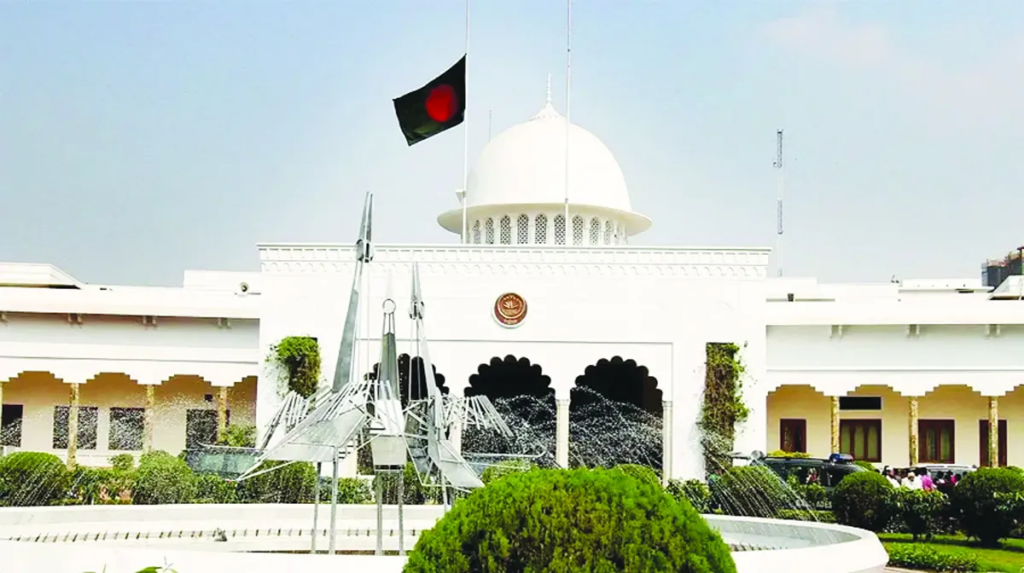
The beauty of Bangabhaban is not primarily about ornament. Its greatest visual strength comes from the relationship between architecture and landscape. A relatively compact central building sits within a vast compound of trees, lawns and supporting structures. The greenery creates a sense of separation from the surrounding metropolis. The formal architecture, broad open spaces and mature vegetation together produce an atmosphere rarely found in the centre of modern Dhaka. This is perhaps the legacy of Dilkusha Garden that remains most visible today.
From Dilkusha Garden to the Presidential Palace
The journey of this place can be imagined as a sequence of names:
A sacred site
→ A Mughal-era landscape
→ Nawabi Dilkusha Garden
→ Dilkusha Government House
→ Governor House
→ Bangabhaban
Each name represents a different chapter of Dhaka’s history. Each chapter left something behind. That is why the story of Bangabhaban cannot be reduced to the history of one building. It is the history of a place continuously reinvented by political power.
Ten Dates That Explain Bangabhaban
1905
The Partition of Bengal creates the Province of Eastern Bengal and Assam. The government acquires part of the Dilkusha estate for a Government House.
14 February 1906
Lieutenant-Governor Sir Joseph Bampfylde Fuller begins official work at the building’s Darbar Hall.
1911
The Partition of Bengal is annulled. The site continues to serve as an important government residence.
1947
British India is partitioned. East Bengal becomes part of Pakistan and the building becomes the Governor House.
1955
East Bengal is renamed East Pakistan.
1961
A devastating storm severely damages the building.
1964
Major reconstruction of the building is completed.
16 December 1971
Bangladesh achieves victory in the Liberation War.
23 December 1971
The decision is taken to rename the Governor House Bangabhaban.
January 1972
Abu Sayeed Chowdhury becomes the first constitutional President of Bangladesh to reside at Bangabhaban.
The Most Important Thing About Bangabhaban
If one had to explain the importance of Bangabhaban in a single sentence, it would be this: Bangabhaban is one of the very few buildings in Bangladesh whose physical history follows the political history of the country almost step by step. It was created because Bengal was partitioned. It survived the reversal of that partition. It became a Governor’s residence under Pakistan. It witnessed the birth of Bangladesh. It was renamed after independence. It became the home and workplace of Bangladesh’s presidents. And it continues to function more than a century after the Government House first opened its doors.
Final Thoughts: More Than a Presidential Residence
Visitors looking at Bangabhaban from outside may see a guarded government complex surrounded by walls. But history reveals something much richer. Beneath the modern identity of the presidential palace lie traces of an older Dhaka—the Dhaka of saints, Mughal officials, Nawabs and Armenian landholders. Then came the British, who transformed the landscape into a centre of colonial administration. Then Pakistan. Then the Liberation War. Then Bangladesh. The building changed its name, its occupants and its political meaning, but the place remained. That continuity makes Bangabhaban unique. It is simultaneously an architectural landmark, a political institution, a diplomatic venue, a presidential residence and a witness to more than a century of South Asian history. Its story is not finished. And perhaps that is the most fascinating thing about Bangabhaban. Unlike a museum, it does not merely preserve history. It continues to make it.
Frequently Asked Questions About Bangabhaban
What is Bangabhaban?
Bangabhaban is the official residence and principal workplace of the President of Bangladesh in Dhaka.
When was Bangabhaban built?
The origins of the present complex go back to the Government House established after the 1905 Partition of Bengal. However, the main building was substantially reconstructed after storm damage in 1961, with reconstruction completed in 1964.
What was Bangabhaban called before independence?
During the British period it was known as the Government House or Dilkusha Government House. After 1947, it became known as the Governor House.
Why is it called Bangabhaban?
After Bangladesh’s independence, the former Governor House was renamed Bangabhaban, a name meaning essentially the “House of Bengal”. The renaming decision was taken in December 1971.
Who was the first President to live in Bangabhaban?
Justice Abu Sayeed Chowdhury was the first constitutional President of Bangladesh to reside there after taking office in January 1972.
How large is Bangabhaban?
The Bangabhaban compound is commonly described as covering about 50 acres. The Public Works Department records the main building’s plinth area as 9,962 square feet and its height as three floors.
What architectural style is Bangabhaban?
The complex is generally described as Indo-Saracenic, with Islamic and Bengali architectural influences incorporated during its reconstruction.
Is Bangabhaban open to tourists?
Bangabhaban remains an active presidential complex rather than a conventional public museum. Access to the compound and its interiors is therefore restricted.
How much did it cost to build Bangabhaban?
A reliable original construction-cost figure was not found in the authoritative sources consulted for this article. Because the present building was substantially reconstructed in the 1960s and subsequently renovated, quoting a single figure without a primary source would be misleading.