
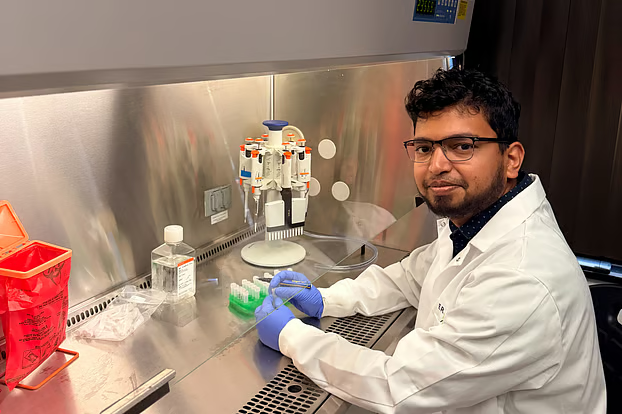

From the classrooms of the University of Dhaka to the laboratories of Purdue University and the biotechnology industry in the United States, Dr. Imrul Shahriar has built a career around one of the most challenging goals in modern medicine: discovering better ways to fight viral infections. His work has now reached an important milestone. An experimental influenza treatment developed by the research team he has been part of is being evaluated in a Phase 2 clinical study in Bangladesh, bringing an international drug-development program to the country where his own scientific journey began.
For Bangladesh, the story is notable not simply because a Bangladeshi scientist is working in the United States. It is notable because the research has moved beyond the laboratory and into the much more demanding process of clinical development.
The experimental treatment, EV25, is being developed by Eradivir, a clinical-stage biotechnology company based in West Lafayette, Indiana. On July 7, 2026, the company announced that the first influenza patient had been dosed in a Phase 2 study in Bangladesh. The randomized, double-blind study is being conducted in collaboration with the icddr,b, with the aim of evaluating the safety, tolerability, pharmacokinetics and efficacy of EV25 in adults with naturally occurring uncomplicated influenza.
For Shahriar, whose academic background is in chemistry, the milestone represents a remarkable progression—from studying molecules and their interactions to helping develop a potential treatment that is now being tested in people.
A Scientist Focused on Drug Discovery
Imrul Shahriar’s professional work sits at the intersection of chemistry, biology and medicine.He is currently listed by Eradivir as its Director of Discovery. The company says he earned his PhD in Chemistry from Purdue University, where his research focused on targeted antiviral and cancer immunotherapies under the supervision of the late Professor Philip S. Low.His work has particularly focused on developing targeted therapeutic strategies against influenza and other enveloped viruses.
That focus is important because viruses present a difficult therapeutic problem. They reproduce inside host cells, meaning that a treatment must be able to interfere with the infection while minimizing harm to the patient.Researchers therefore continue to search for approaches that can eliminate viruses more efficiently, work at different stages of infection and reduce the limitations of existing therapies.Shahriar’s research has explored one such approach.
The Science Behind EV25
The research that brought Shahriar and his colleagues international attention was published in Proceedings of the National Academy of Sciences (PNAS) in September 2024.The paper, titled “Targeted recruitment of immune effector cells for rapid eradication of influenza virus infections,” lists Imrul Shahriar as the first author. His affiliations included Purdue University and Eradivir.The research describes an approach designed to do more than simply attack the virus directly.The strategy involves using a molecule that can help recruit the body’s own immune system toward the site of viral infection.
In the experimental work described in the paper, the researchers developed a targeted immunotherapy based on a zanamivir-linked design. The idea was to use the viral targeting properties of zanamivir while simultaneously recruiting antibodies and immune effector mechanisms to help eliminate the virus.In laboratory and animal experiments, the approach produced substantially faster reductions in influenza viral levels than the researchers observed with several existing antiviral drugs.This is an important distinction.
The research did not establish that EV25 is already a proven treatment for influenza in humans. Rather, it provided preclinical evidence strong enough to justify further development and clinical testing.That distinction is essential whenever experimental medicines are discussed.
From Preclinical Research to Human Trials
Drug discovery is a long process.A promising molecule can spend years in laboratory research before researchers can determine whether it is safe and effective enough to test in humans.Preclinical studies are designed to answer fundamental questions about a candidate treatment, including its biological activity, safety and behavior in experimental models.If the results are sufficiently encouraging, researchers can proceed to clinical development.EV25 has now entered that stage.
An earlier integrated Phase I/IIa study evaluated EV25 in healthy volunteers and influenza challenge participants. European clinical-trial records identify the study as having evaluated safety, tolerability, pharmacokinetics and efficacy. That study was completed in May 2025.The next step is the Bangladesh study involving people with naturally occurring influenza.Eradivir announced that the first patient was dosed in July 2026 after completion of the study’s safety lead-in portion. According to the company, EV25 was well tolerated across the cohorts in that lead-in. The Phase 2 study is designed to compare different EV25 dose levels with placebo and oseltamivir and to evaluate patients presenting at different stages after the onset of symptoms.The results of this study will be important in determining how the treatment performs in real-world influenza infections.
Why Bangladesh Matters
Perhaps the most meaningful part of this story for Bangladesh is where the clinical research is taking place.The Phase 2 study is being conducted in collaboration with icddr,b, an international health research institute with extensive experience in influenza surveillance, infectious-disease research and clinical trials.This gives Bangladesh a role beyond being the country of origin of one of the researchers.It becomes part of the actual process of evaluating a new therapeutic candidate.Clinical trials require highly organized systems. Researchers need trained medical and laboratory personnel, carefully designed protocols, ethical oversight, patient monitoring and reliable data collection.The participation of an institution such as icddr,b demonstrates that Bangladesh can contribute to international clinical-development programs involving experimental medicines.For Shahriar, the connection is particularly meaningful.His academic journey began in Bangladesh, and his research has now returned to the country in the form of a clinical study involving a drug candidate he helped develop.
The Journey Began in Bangladesh
Before working in advanced drug-discovery research in the United States, Shahriar was a chemistry student at the University of Dhaka.Eradivir’s profile of him states that he earned a BS (Honors) in Chemistry from the University of Dhaka and later received the Ross Fellowship from Purdue University’s Graduate School for his doctoral studies.
His academic record at Dhaka University was already attracting attention. In 2017, he was among eight Chemistry Department students who received the Prof. Abdul Muktadir Memorial Scholarship for outstanding academic performance.But his university years were not limited to conventional academic work.He also became interested in innovation and social problem-solving.
From Chemistry to Social Innovation
During his university years, Shahriar and fellow students worked on innovative ideas aimed at addressing practical problems in Bangladesh.His involvement with the Hult Prize is part of that chapter of his journey. His public professional profile records that he was first runner-up in the Hult Prize competition at the University of Dhaka in 2017.
The experience is revealing because it shows that his interest in innovation existed before his career in drug discovery.Scientific research and entrepreneurship may appear to be separate worlds, but both require a similar mindset: identify a problem, understand its causes and develop a solution that can work beyond the laboratory or classroom.That mindset would later become central to his career in biotechnology.
The Purdue Chapter
After completing his undergraduate studies at Dhaka University, Shahriar moved to the United States for doctoral research at Purdue University.At Purdue, he joined the research environment of Professor Philip S. Low and became involved in the development of targeted antiviral and cancer immunotherapies.His research eventually focused heavily on influenza.One of his earlier scientific contributions appeared in work on neuraminidase-targeted imaging and therapeutic agents for influenza virus infections, published in Bioconjugate Chemistry in 2021. Shahriar was among the researchers listed in that study.
By 2023, his work on targeted immunotherapy for influenza was also being presented at scientific conferences, where preclinical experiments were being used to assess antiviral activity, safety and pharmacokinetics.The progression illustrates how scientific careers are often built.A major discovery rarely appears from nowhere. It usually grows from years of smaller experiments, failed approaches, improved designs, collaborations and accumulated knowledge.
The PNAS Breakthrough
The 2024 PNAS publication represented one of the most visible milestones in Shahriar’s research career.
The study reported that the researchers’ targeted approach could produce rapid clearance of influenza virus in experimental models. The researchers reported that their candidate, then described in the work as a zanamivir-targeted dual-hapten immunotherapy, produced much stronger antiviral effects than several standard treatments in their experimental models.
The work attracted attention beyond the scientific community.
Purdue-related communications highlighted the findings, and Shahriar later discussed the research in a BBC Science in Action interview concerning Eradivir’s influenza treatment. Purdue Innovates noted that the interview with Shahriar appeared in the BBC program in connection with the company’s influenza research.
The PNAS paper also underwent a minor correction in late 2024. The authors clarified terminology concerning the mechanisms of several antiviral drugs and corrected minor errors in chemical structures and wording. Importantly, the correction stated that these changes did not affect the paper’s conclusions.
What Makes the Approach Different?
Many antiviral drugs work by interfering with a particular step in the viral life cycle.EV25 represents a somewhat different strategy.Rather than relying solely on direct inhibition of viral replication, the approach is designed to recruit the body’s immune system to help eliminate infected cells and virus.In simplified terms, the treatment aims to make the immune response more targeted.The research team’s preclinical findings suggested that this could produce rapid reductions in viral levels, including in experimental models of later-stage infection.This is potentially important because people do not always seek medical attention immediately after becoming infected.However, whether the approach actually provides a meaningful clinical benefit in people is precisely what the clinical trials are designed to determine.That answer cannot be known until the human data are available.
What the Phase 2 Trial Will Tell Researchers
Phase 2 studies occupy an important position in drug development.At this stage, researchers have already obtained initial human safety information, but much more evidence is needed before a treatment can be considered for wider use.The Bangladesh study is designed to evaluate several important questions.
Researchers will examine:
- how well patients tolerate EV25;
- how the drug behaves in the body;
- whether it produces measurable antiviral effects;
- how different dose levels perform;
- how the treatment compares with placebo and oseltamivir;
- and whether treatment timing affects its performance.
The study is randomized and double-blind, meaning the trial is designed to reduce bias when comparing treatment groups. According to Eradivir, the study includes adults with uncomplicated naturally occurring influenza.These details matter because promising laboratory results do not automatically translate into successful medicines.Clinical research is where those scientific hypotheses are tested in people.

A Recognition in Antiviral Research
Shahriar’s work has continued to receive recognition within the scientific community.
At the 38th International Conference on Antiviral Research in 2025, he received the first prize in the young investigator category for his presentation, “Ligand-Targeted Immunotherapy for the Rapid Clearance of Influenza Virus Infections.”
The recognition reflects the broader scientific interest in the research program.It also illustrates how a young researcher can move from doctoral work to leadership responsibilities within a biotechnology company while continuing to contribute to peer-reviewed scientific research.
Beyond One Drug
Although EV25 is currently the most visible part of Shahriar’s work, his research interests extend beyond a single antiviral candidate.Eradivir describes his broader work as involving targeted antiviral and cancer immunotherapies. The company says that, as Director of Discovery, he is also helping expand its BAiT platform into oncology research.This reflects an important feature of modern drug discovery.A successful scientific platform can potentially be adapted to more than one disease.Instead of developing a single molecule for a single infection, researchers may try to build technologies that can be redirected toward different biological targets.Whether those approaches ultimately produce approved medicines is something that only future clinical development will establish.
A Different Kind of Bangladesh–US Scientific Connection
Shahriar’s career also illustrates the international nature of modern science.His education began in Bangladesh.His doctoral research took him to the United States.His scientific collaborations span academic and biotechnology environments.And now, part of the clinical evaluation of the experimental treatment is taking place in Bangladesh.The journey shows how scientific knowledge can move across borders.
For Bangladesh, this is particularly relevant because the country has a large pharmaceutical manufacturing sector but has historically been better known internationally for generic drug production than for discovering entirely new therapeutic candidates.The transition from manufacturing established medicines to developing novel drugs is considerably more difficult.It requires advanced research infrastructure, highly trained scientists, long-term funding, intellectual-property expertise, regulatory capacity and strong connections between universities, biotechnology companies and clinical research institutions.Scientists such as Shahriar represent one part of that emerging ecosystem.
The Dream of Drug Discovery in Bangladesh
Shahriar has also expressed an interest in contributing to the development of Bangladesh’s own drug-discovery capabilities.The broader ambition is significant: to see Bangladesh move beyond manufacturing medicines developed elsewhere and build greater capacity to discover and develop original therapeutic technologies.That transition cannot happen through individual achievement alone.
It requires universities capable of sustained research, laboratories equipped for modern molecular science, private investment, biotechnology companies willing to take scientific risks and clinical institutions capable of conducting internationally credible trials.The fact that a Bangladesh-linked researcher is now involved in a clinical development program being conducted partly in Bangladesh offers an example of what such international connections can make possible.
What Happens Next?
For now, EV25 remains an investigational treatment.
It has not been established as an approved cure for influenza, and the ongoing clinical research will determine whether the encouraging laboratory and earlier human findings translate into meaningful benefits for patients.That uncertainty is not a weakness of the story.It is what makes scientific research a process rather than a finished product.A discovery becomes a medicine only after it survives successive stages of testing.The current Phase 2 study is therefore another step—not the final destination.If the results are positive, further development and larger studies would still be required before any regulatory approval could be considered.
A Scientist at the Intersection of Three Worlds
Dr. Imrul Shahriar’s career can be viewed through three connected worlds.The first is Bangladesh, where his education and early interest in innovation began.The second is academic science, represented by the University of Dhaka and Purdue University, where he developed the research skills that shaped his career.The third is biotechnology and drug development, where laboratory discoveries must eventually be translated into treatments that can be tested in patients.His current work sits at the intersection of all three.That is perhaps the most compelling part of his story.
He is not simply a Bangladeshi scientist working abroad. His career demonstrates how research originating from a young student’s curiosity can eventually become part of an international effort to address a global health problem—and how that research can, in turn, return to Bangladesh through clinical science.
From a Chemistry Student to a Drug-Discovery Scientist

The journey from an undergraduate chemistry student to a scientist involved in clinical-stage antiviral development is long and demanding.It requires patience.Experiments fail. Hypotheses change. Molecules that look promising may turn out to be ineffective. Results must be independently examined, repeated and subjected to increasingly rigorous standards.Shahriar’s career reflects that reality.The PNAS publication was a milestone. The recognition at the International Conference on Antiviral Research was another. The movement of EV25 into clinical development represents another.But the most important chapter is still being written.The Phase 2 study in Bangladesh will provide evidence that laboratory research cannot provide on its own: how an experimental treatment performs in actual people with influenza.
Why His Story Matters
The significance of Dr. Imrul Shahriar’s story extends beyond one experimental drug.For young Bangladeshis interested in science, it demonstrates that a career in research can lead to the frontiers of global scientific discovery.For Bangladesh’s scientific community, it highlights the value of international academic collaboration.For the country’s pharmaceutical sector, it points toward the possibility of moving further into original drug discovery.And for global antiviral research, it represents another attempt to develop treatments that can tackle influenza in new ways.Whether EV25 ultimately becomes an approved medicine remains to be determined.But the journey that brought it from the laboratory to a Phase 2 clinical study is already an important scientific story.
Timeline of Dr. Imrul Shahriar’s Scientific Journey
| Period | Milestone |
|---|---|
| University years | Studies Chemistry at the University of Dhaka and becomes involved in research and innovation activities. |
| 2017 | Receives the Prof. Abdul Muktadir Memorial Scholarship for academic performance at Dhaka University. |
| 2017–18 | Represents the University of Dhaka in Hult Prize activities and is listed as first runner-up at the university competition. |
| Purdue University | Begins doctoral research in Chemistry with a Ross Fellowship. |
| 2021 | Contributes to research on neuraminidase-targeted therapeutic approaches for influenza. |
| 2023 | Presents research on ligand-targeted immunotherapy for influenza at the IDWeek-related scientific program. |
| September 2024 | Publishes the major influenza immunotherapy study in PNAS as first author. |
| 2025 | Wins first prize in the young investigator category at the International Conference on Antiviral Research. |
| 2026 | Eradivir lists him as Director of Discovery. |
| July 2026 | First patient is dosed in the Phase 2 EV25 influenza study in Bangladesh, conducted with icddr,b. |
Frequently Asked Questions
Who is Dr. Imrul Shahriar?
Dr. Imrul Shahriar is a Bangladeshi chemist and drug-discovery researcher working in the United States. He earned his PhD from Purdue University and is currently Director of Discovery at Eradivir. His research focuses on targeted antiviral and immunotherapy approaches.
What is Dr. Imrul Shahriar researching?
His research has focused on targeted antiviral and cancer immunotherapies, with significant work on experimental treatments for influenza.
What is EV25?
EV25 is an investigational antiviral treatment candidate being developed by Eradivir for influenza. Its approach is designed to recruit immune mechanisms to help clear viral infection. It remains under clinical investigation and is not an approved treatment.
Where is EV25 being tested?
A Phase 2 study involving adults with naturally occurring influenza is being conducted in Bangladesh in collaboration with icddr,b.
What is the role of icddr,b?
icddr,b is collaborating with Eradivir on the Bangladesh clinical study. The institute brings experience in influenza surveillance, infectious-disease research and clinical trials.
Has EV25 been proven to cure influenza?
No. EV25 is still an investigational treatment. Preclinical research and earlier clinical studies have provided evidence supporting further evaluation, but the ongoing clinical trials are needed to determine its safety and efficacy in patients.
Where was Dr. Imrul Shahriar educated?
He completed his undergraduate Chemistry degree at the University of Dhaka and later earned his PhD in Chemistry from Purdue University in the United States.
Why is his work important for Bangladesh?
His career illustrates how Bangladeshi scientific talent can contribute to international drug discovery while also creating opportunities for Bangladesh to participate in advanced clinical research. The EV25 Phase 2 study gives a Bangladeshi clinical research institution a direct role in evaluating an experimental antiviral treatment.
The Next Chapter
The most interesting part of Dr. Imrul Shahriar’s story may be the part that has not yet been written.The PNAS publication established an important scientific foundation. Further research moved the experimental approach toward clinical development. Now, with the first patient dosed in Bangladesh, EV25 has entered another critical stage.The coming clinical results will determine how far the research can go.
Whatever the final outcome, the journey already offers a powerful lesson for aspiring scientists: major discoveries rarely begin with a grand laboratory. They begin with curiosity, persistence and the willingness to spend years solving difficult problems.
For a young chemistry student in Bangladesh, that journey led to Purdue University, international antiviral research and a biotechnology company working toward a potential new treatment for influenza.And now, that scientific journey has come back home—into the laboratories and clinical research facilities of Bangladesh.
The experiment continues. The answer will come from the evidence.
Source: The Daily Prothom Alo, LinkdIn