
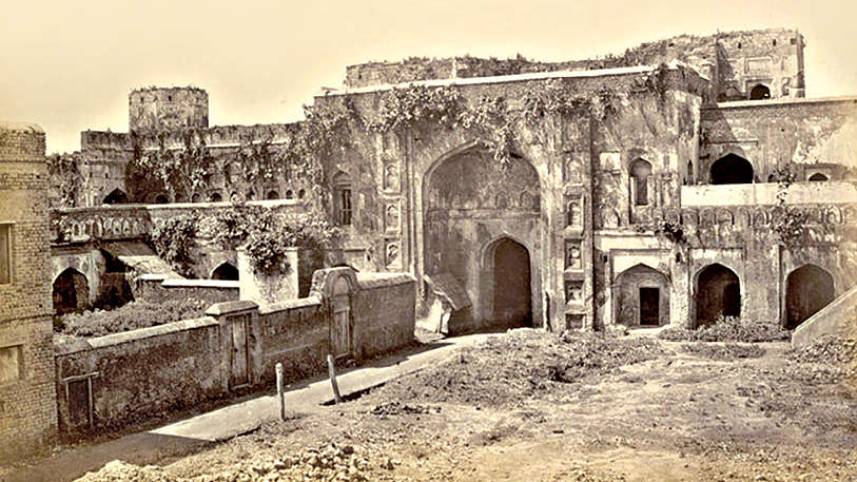

Near the bustling lanes of Chawkbazar in Old Dhaka stands the weathered remains of a monument that once represented the grandeur, ambition and commercial importance of Mughal Dhaka. Known as Bara Katra, this 17th-century structure was built beside the Buriganga River during the rule of Mughal prince Shah Shuja. Originally conceived as a grand residence but eventually endowed as a caravanserai for travelers and merchants, Bara Katra became an important part of the urban life of Mughal Dhaka.
Today, only a fraction of the original complex survives. Yet its monumental gateway and surviving architectural elements continue to offer a glimpse into a period when Dhaka was emerging as one of the most important cities of Bengal.Bara Katra is not merely an old building.It is a surviving chapter of Dhaka’s Mughal history.
What Does “Bara Katra” Mean?
The word Katra is associated with the Arabic and Persian tradition of the karwan sarai or caravanserai—a place where travelers could rest during long journeys.A traditional caravanserai generally consisted of a large enclosed courtyard surrounded by rooms and verandahs. Travelers could stay in the rooms, while horses, carts and other belongings could be kept in the courtyard.Such establishments were particularly important along major trade and travel routes. Depending on their size and importance, they could include facilities such as kitchens, dining areas, sanitation facilities, mosques and sometimes medical services.The word Bara means “large” or “greater.” The name therefore distinguishes it from Chhota Katra, or the “smaller Katra,” which was built later in Old Dhaka.Together, the two Katras represent an important category of Mughal urban architecture in Dhaka.
Dhaka Under the Mughals
To understand Bara Katra, it is necessary to understand the Dhaka in which it was built.The Mughals made Dhaka the provincial capital of Bengal in the early 17th century. The city developed rapidly around the Buriganga River, which served as an important route for transportation and commerce.By the middle of the 17th century, Dhaka was becoming an important administrative and commercial center. Merchants, officials, artisans, soldiers and travelers moved through the city, creating a growing need for infrastructure.
It was during this period that Shah Shuja, son of Emperor Shah Jahan and brother of the future emperor Aurangzeb, served as Subahdar of Bengal.Shah Shuja governed Bengal for much of the period from 1639 to 1660 and was a significant patron of architecture. Several important surviving Mughal monuments of Dhaka date from his period, including Bara Katra.
Who Built Bara Katra?
The story of Bara Katra is closely associated with Shah Shuja, but the actual construction was undertaken by his Diwan, Mir Abul Qasim.Banglapedia records that Abul Qasim built the spacious structure in 1645 on the bank of the Buriganga, south of present-day Chawkbazar.The monument contains two Persian inscriptions that provide important clues about its history.One inscription records the construction date as 1053 AH, corresponding to 1643–44 CE. Another inscription gives 1055 AH, or 1645–46 CE, and records that Shah Shuja entrusted the building to Mir Abul Qasim to function as a Katra.The difference between these dates is important. Rather than assuming that the entire complex appeared in a single year, the inscriptions suggest a construction and institutional history extending across several years.For a historical reference article, these inscriptions are more valuable than a single simplified construction date.
A Palace That Became a Caravanserai
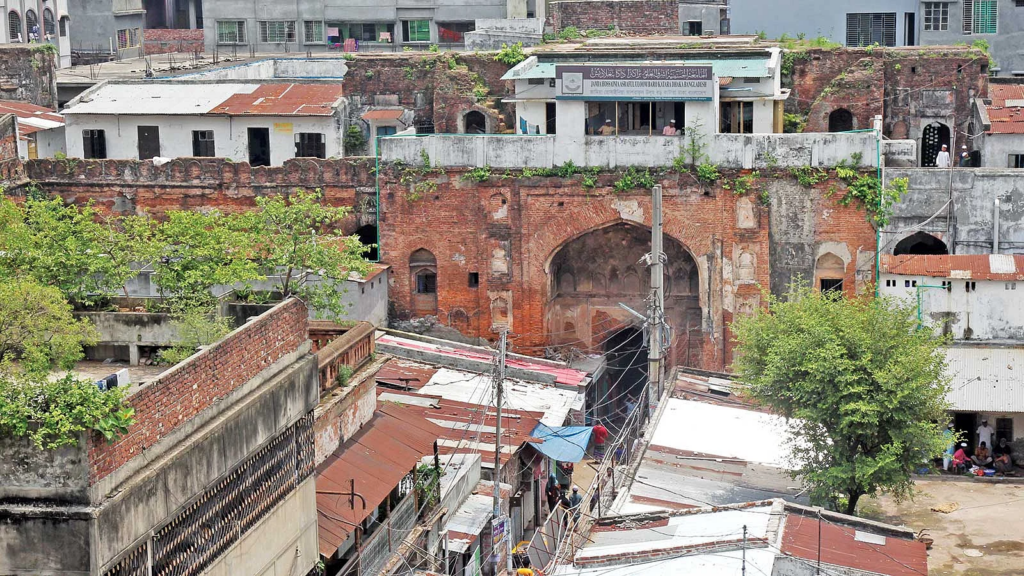
One of the most fascinating details about Bara Katra is that it was not originally intended simply as a roadside inn.According to historical accounts, the grand building was initially constructed as a residence for Shah Shuja. However, the prince preferred to live in Rajmahal, which was his capital during much of his later period as Subahdar.As a result, Bara Katra was instead dedicated for the use of traveling merchants. It became a Katra or caravanserai where travelers could stay.This change in purpose transformed the building from a potential princely residence into a public-facing commercial and social institution.In a city increasingly connected to regional and international trade networks, such a facility would have been extremely valuable.
A Monument Built Around a Courtyard
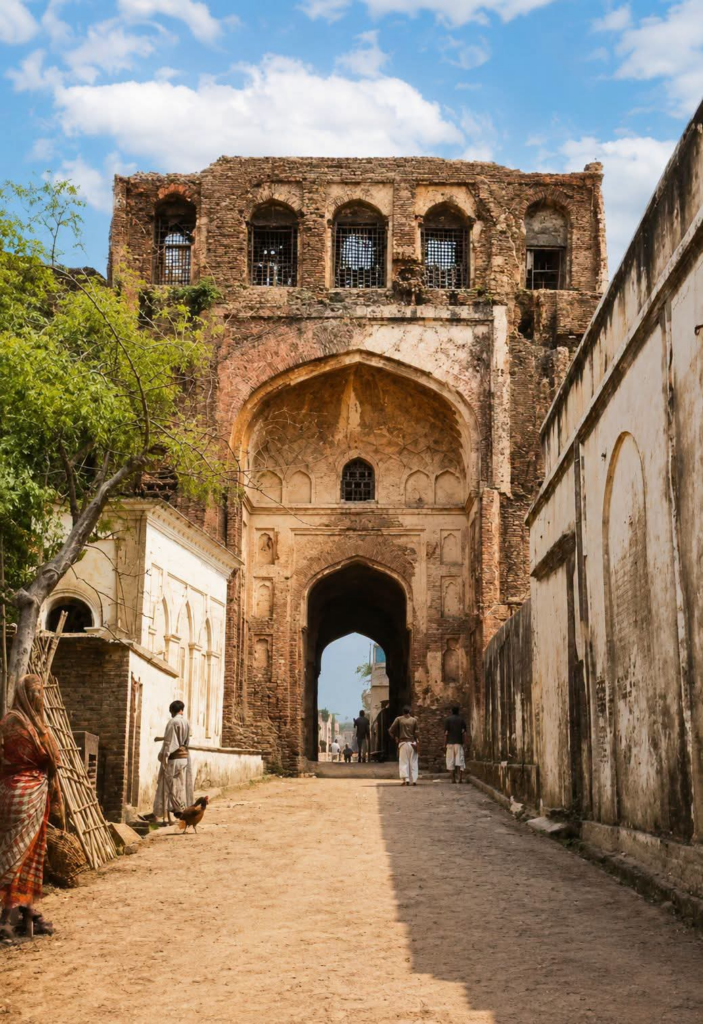
Bara Katra originally enclosed a large quadrangular courtyard.Historical descriptions indicate that there were 22 rooms on each of its four sides, forming an extensive rectangular complex. The southern and northern walls were approximately 67.97 metres long, while the eastern and western walls were around 70.10 metres long.Two principal gateways were built into the complex—one on the north and another on the south.The southern gateway was particularly monumental.It was designed as a three-storeyed entrance structure, with an octagonal central chamber and projecting octagonal towers. The remaining wings were largely two storeys high.This arrangement gave the building an imposing appearance while also reinforcing the enclosed character expected of a caravanserai.
The Monumental Southern Gateway
The surviving gateway is arguably the most recognizable feature of Bara Katra.The gateway rises prominently above the surrounding structure and projects toward the river side. Its architectural composition combines a large central entrance with decorative panels, arches and projecting towers.A tall alcove rises through the upper levels of the entrance, visually reducing the heaviness of the structure.The walls contain panels of different shapes, decorated with various types of arches, including four-centred, cusped, horseshoe and flat arches. Windows appear above the main alcove at the third-storey level.Passing through the main entrance once led visitors through a sequence of archways into an octagonal domed hall.Historical descriptions mention plaster decoration on the ceiling, including net-like patterns and foliage designs.These details demonstrate that the building was not designed merely as a functional resting place. It was also intended to communicate status and architectural grandeur.
A Fortified Caravanserai
Bara Katra followed the traditional architectural principles of the Central Asian caravanserai, but it was adapted to the Mughal architectural environment of Bengal.The complex was strongly enclosed and fortified, with projecting towers and controlled entrances.That defensive quality made practical sense.A caravanserai could accommodate merchants carrying valuable goods, travelers from distant regions and animals used for transportation. Security was therefore an important consideration.The result was an architectural form that combined hospitality, commerce, security and imperial prestige.
The River Was Part of the Story
Bara Katra was built beside the Buriganga, south of Chawkbazar.That location was not accidental.Before the modern transportation network existed, rivers were among the most important highways of Bengal. Dhaka’s relationship with the Buriganga was fundamental to the city’s growth.Goods and people could arrive by river, while merchants could access the commercial areas of the city.Bara Katra’s location therefore placed it within the economic geography of Mughal Dhaka.The riverfront setting also gave the monument a prominent position in the city’s landscape.
A Place for Merchants
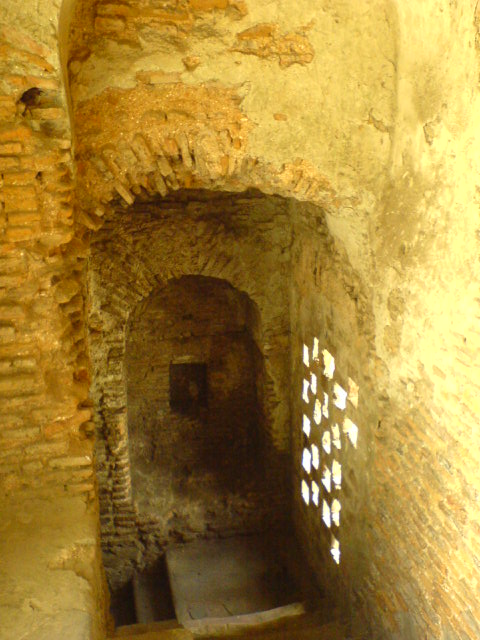
The Katra was intended to provide accommodation and facilities for visiting merchants.This tells us something important about Mughal Dhaka.The city was not simply an administrative capital. It was also a center of commerce, manufacturing and long-distance movement.Merchants arriving in Dhaka needed somewhere to stay, protect their goods and conduct business.A large caravanserai such as Bara Katra provided an organized environment for this activity.Its existence therefore reflects the economic vitality of the city during the Mughal period.
The Waqf Tradition
Bara Katra was also connected to the Islamic institution of waqf, through which property or income-generating assets could be dedicated to charitable or religious purposes.The second Persian inscription states that Shah Shuja gave the building to Mir Abul Qasim for use as a Katra, with an important condition concerning travelers and tenants. According to Banglapedia, the waqf arrangements specified that officials responsible for the endowment should not charge rent to deserving people staying there.
Historical accounts also state that 22 shops were endowed as waqf to help cover the operating expenses of Bara Katra.This arrangement reveals an important feature of the institution.Bara Katra was not simply a commercial property.Its income was connected to maintaining a facility that served travelers and merchants.In other words, the building combined commercial revenue with a form of public welfare.
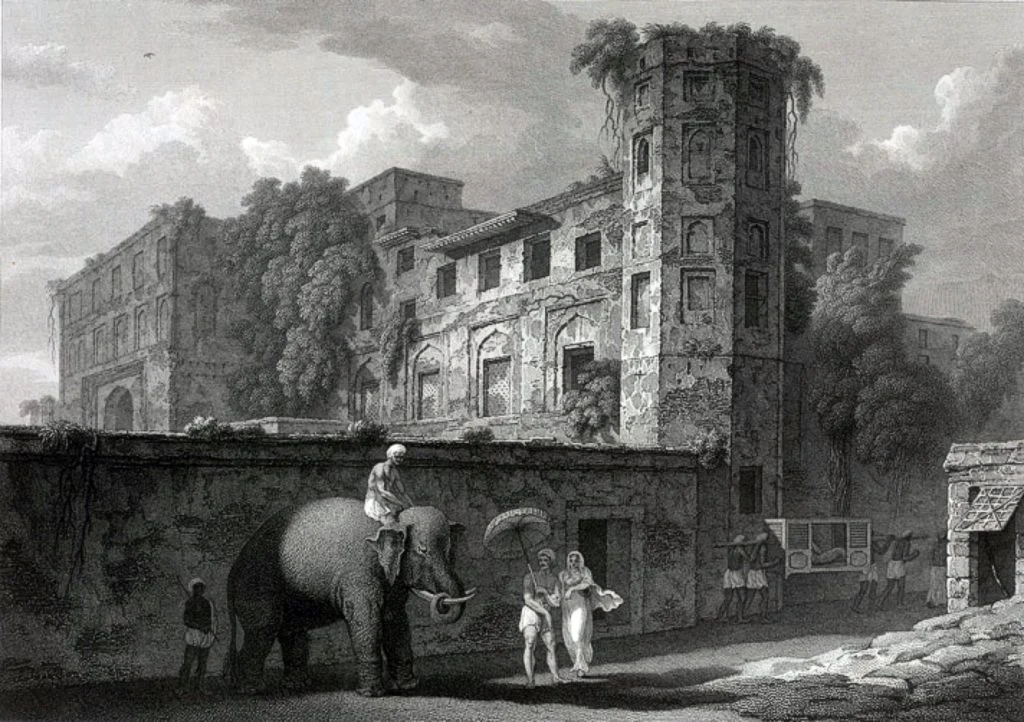
Bara Katra and the Growth of Chawkbazar
The location of Bara Katra is closely connected with the historic development of Chawkbazar.The area around the Buriganga became one of the important commercial zones of old Dhaka. Markets, river transport and merchant activity all contributed to its development.Bara Katra stood within this broader urban landscape.The relationship between the Katra and Chawkbazar illustrates how architecture, commerce and geography worked together in the development of the old city.Even today, the dense urban environment surrounding the monument offers a striking contrast to the relatively spacious Mughal complex that once occupied the area.
Bara Katra and the Mughal Architectural Tradition
Bara Katra belongs to the early phase of Mughal architectural development in Dhaka.Shah Shuja was an important patron of construction. Banglapedia identifies several surviving Mughal buildings in Dhaka dating from his period, including Bara Katra, the Idgah, Husaini Dalan and Churihatta Mosque.The architectural language of Bara Katra reflects the broader Mughal tradition while responding to local conditions.Its monumental gateway, arches, domed chamber, enclosed courtyard and octagonal towers are distinctly Mughal in character.At the same time, the use of brick and plaster reflects the material environment of Bengal, where stone was less readily available than in many northern parts of the Mughal Empire.
Bara Katra and Chhota Katra
Bara Katra is often discussed together with another historic Dhaka monument: Chhota Katra.Chhota Katra stands roughly 180 metres east of Bara Katra in the old city. It is smaller but follows a broadly similar courtyard-centered plan. It is generally believed to have been built during the rule of Shaista Khan, around 1664.The two structures illustrate how the caravanserai form became part of Dhaka’s architectural landscape.Bara Katra, however, predates Chhota Katra and belongs to the earlier architectural phase associated with Shah Shuja.The two buildings also help demonstrate the transformation of Mughal Dhaka over the course of the 17th century.
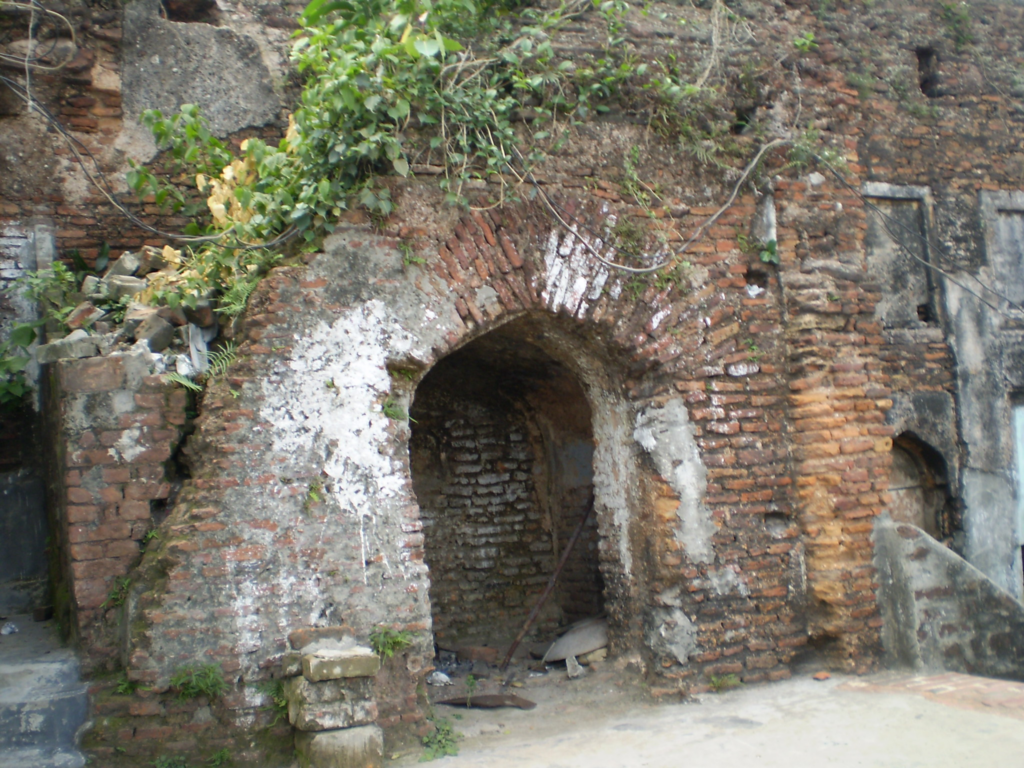
Bara Katra as a Government Residence
Bara Katra’s role did not remain limited to accommodating merchants.After the East India Company’s acquisition of the Diwani in 1765, the Mughal administrative system in Bengal underwent major changes.Historical accounts record that the Naib-Nazim of Dhaka eventually moved into Bara Katra after the earlier fort residence was occupied by Company officers.The building consequently acquired another chapter in its history—as a residence associated with the city’s governing elite.This illustrates how historic buildings often change functions as political circumstances change.A building originally intended as a princely residence, then transformed into a caravanserai, could later become associated with administrative authority.
The Monument Through the Colonial Era
Dhaka changed significantly under British rule.The city’s political center, commercial patterns and architecture gradually evolved. European influence became increasingly visible in parts of Dhaka, while older Mughal structures were adapted to new uses.Bara Katra survived these transformations, but not without consequences.Like many historic buildings in densely populated Old Dhaka, it gradually lost parts of its original architectural integrity.Additions, alterations and changing patterns of land use altered the character of the complex.
The Decline of the Original Complex
The Bara Katra visible today represents only a portion of the monumental structure that once existed.According to Banglapedia, more than half of the original Katra has already been destroyed, and the surviving building is in a dilapidated condition. The source also notes that alterations were made to the original structure and that construction of a modern multi-storey building had begun within the area.This loss is particularly significant because the original Bara Katra was much larger than the surviving fragment suggests.What remains today is therefore not simply an old building.It is a surviving fragment of a much larger Mughal urban complex.
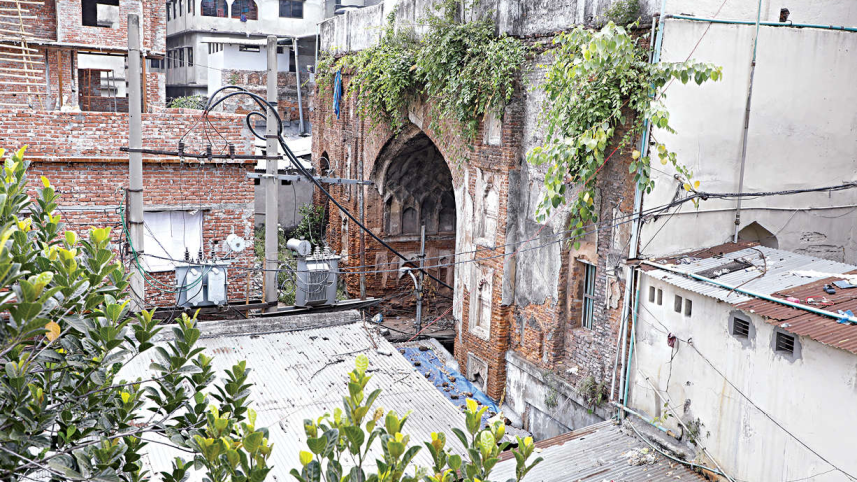
A Protected Archaeological Site
Despite its difficult condition, Bara Katra remains officially recognized as an archaeological site.The Department of Archaeology of Bangladesh includes Bara Katra in its list of protected archaeological sites in the Dhaka Division.This recognition is important because the monument is not merely a privately owned old structure. It is part of the country’s archaeological heritage.Yet legal protection and practical preservation are not always the same thing.The challenge is particularly difficult in Old Dhaka, where historic monuments exist within intensely developed neighborhoods and often have complicated ownership and land-use histories.
Why Preservation Is So Difficult
Preserving Bara Katra presents a complex challenge.The monument exists within a densely populated urban area. Its original surroundings have changed dramatically. Portions of the original complex have disappeared, while surviving portions have been modified.Banglapedia notes that attempts by the Department of Archaeology to take over the building encountered resistance from its owners.
This illustrates a broader problem facing heritage conservation in Bangladesh:
How can historic buildings be protected when heritage value, private ownership, urban development and the need for modern space all collide?
There is no simple answer.
But without effective conservation, the surviving portions of Bara Katra may continue to deteriorate, making it increasingly difficult for future generations to understand the monument as it once existed.
Why Bara Katra Matters
Bara Katra deserves attention for several reasons.
It is a major Mughal monument
The structure is among the most important surviving examples of Mughal architecture in Dhaka. Banglapedia describes it as perhaps the most magnificent Mughal edifice in Bangladesh, particularly because of its monumental central gateway.
It records the history of commerce
Its original function as a caravanserai connects it directly with the movement of merchants and travelers through Dhaka.
It reflects the Buriganga’s historic importance
Its riverfront location shows how closely the city’s economic life was tied to river transportation.
It preserves evidence of the waqf tradition
Its endowed shops and charitable conditions reveal how religious and social institutions could be connected with urban commercial property.
It tells the story of a changing city
Its transformation from a proposed princely residence to caravanserai and later government-associated residence reflects the political changes experienced by Dhaka.
It represents a conservation challenge
Its damaged condition demonstrates the difficulties of preserving historic architecture within a rapidly changing city.
Bara Katra Through Time: A Timeline
| Year / Period | Event |
|---|---|
| 1639 | Shah Shuja becomes Subahdar of Bengal and begins a period associated with significant construction in Dhaka. |
| 1643–44 | One Persian inscription records an important construction date for Bara Katra. |
| 1645 | Mir Abul Qasim, Shah Shuja’s Diwan, is associated with the construction of the spacious Bara Katra. |
| 1645–46 | A second Persian inscription records Shah Shuja’s endowment of the building as a Katra under Mir Abul Qasim. |
| 17th century | Bara Katra functions as a caravanserai for visiting merchants and travelers. |
| After 1765 | Following the Company’s acquisition of the Diwani, the building becomes associated with the residence of the Naib-Nazim of Dhaka. |
| 19th century onward | Dhaka’s urban transformation and subsequent alterations gradually change the character of the historic complex. |
| Modern period | Large portions of the original structure disappear and the surviving sections deteriorate. |
| Present | Bara Katra remains one of Dhaka’s most important Mughal monuments and is listed as a protected archaeological site by the Department of Archaeology. |
Frequently Asked Questions
What is Bara Katra?
Bara Katra is a 17th-century Mughal architectural monument in Old Dhaka, located south of Chawkbazar near the Buriganga River. It was originally conceived as a grand residence but was subsequently used as a caravanserai for traveling merchants.
When was Bara Katra built?
Persian inscriptions associated with the monument give dates corresponding to 1643–44 and 1645–46 CE. Banglapedia also identifies 1645 with the construction undertaken by Mir Abul Qasim, Shah Shuja’s Diwan.
Who built Bara Katra?
Mir Abul Qasim, the Diwan of Mughal prince and Bengal Subahdar Shah Shuja, is credited with constructing the Bara Katra.
Who was Shah Shuja?
Shah Shuja was the second son of Mughal Emperor Shah Jahan and served as Subahdar of Bengal for much of the period from 1639 to 1660. He was also a patron of architecture and several important early Mughal monuments in Dhaka date from his period.
Why was Bara Katra built?
It was initially intended as a residence for Shah Shuja. Since he preferred to reside in Rajmahal, the building was subsequently used as a Katra or caravanserai for visiting merchants and travelers.
What is a caravanserai?
A caravanserai was a roadside or urban establishment where travelers and merchants could rest. Traditionally, it consisted of rooms surrounding a courtyard, with space for animals and goods.
Where is Bara Katra located?
Bara Katra is located in Old Dhaka, south of Chawkbazar, near the Buriganga River.
Is Bara Katra protected?
Yes. The Department of Archaeology lists Bara Katra among the protected archaeological sites of the Dhaka Division.
Is the original Bara Katra still intact?
No. A substantial portion of the original complex has disappeared. Banglapedia states that more than half of the Katra has already been destroyed and that the surviving structure is in a dilapidated condition.
What is the difference between Bara Katra and Chhota Katra?
Bara Katra is the earlier and larger of the two historic Mughal Katras in Old Dhaka. Chhota Katra was built later, probably during Shaista Khan’s period around 1664, and is located roughly 180 metres east of Bara Katra.
The Forgotten Grandeur of Bara Katra
Standing amid the crowded streets of modern Old Dhaka, Bara Katra can be easy to overlook.Yet the surviving gateway represents something much larger than the fragment visible today.It recalls a time when the Buriganga was one of the city’s principal arteries, when merchants arrived in Dhaka by river, and when Mughal officials and travelers moved through a city that was becoming an important center of Bengal.
Its walls once enclosed a large courtyard. Its rooms sheltered travelers. Its shops helped finance the institution through waqf. Its monumental entrance announced the presence of Mughal power and architectural ambition.Over the centuries, its role changed. Political systems changed. Dhaka expanded. The riverfront changed. Much of the original building disappeared.But what remains still carries the memory of the city that built it.
Bara Katra therefore deserves to be understood not simply as an old monument in Old Dhaka, but as a historical document in brick and plaster—one that tells the story of Mughal architecture, river-based commerce, philanthropy, governance and the transformation of Dhaka itself.For a city whose historic landscape is disappearing rapidly, preserving such a monument is not only about saving an old building.
It is about preserving the physical evidence of how Dhaka became the city it is today.