



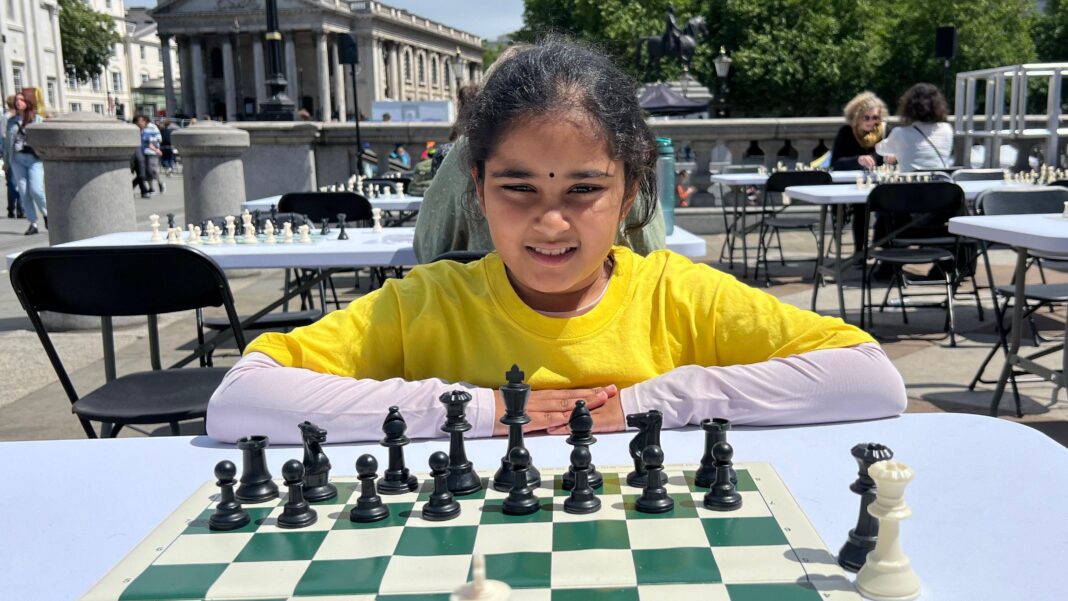
In the complex, 64-square universe of chess, prodigies occasionally emerge who defy every convention and age barrier. Today, that phenomenon is Bodhana Sivanandan. Growing up in an ordinary middle-class family in Harrow, northwest London, this schoolgirl has become the youngest Woman Grandmaster (WGM) and the youngest female International Master (IM) in chess history at just 11 years old.
She is still small enough that she has to sit on a car booster seat during tournaments just to get a clear view of the board across adult-sized tables. Yet, from that elevated perch, she has shattered decades-old world records previously held by legends like Kateryna Lagno and Judit Polgar.
Unbelievably, just six years ago, she didn’t even know what chess was.
Roots, Family, and Early Life
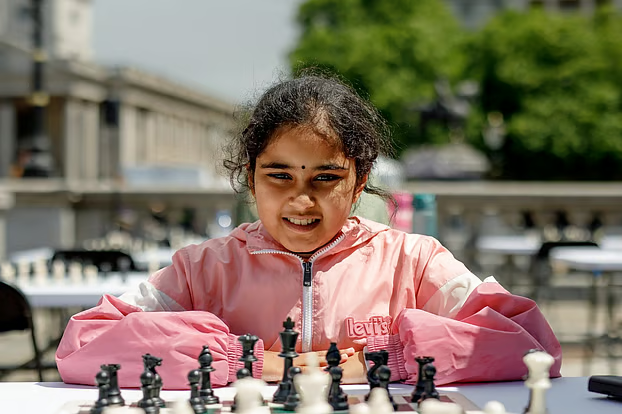
Bodhana Sivanandan traces her roots to Tiruchirappalli (Trichy) in the southern Indian state of Tamil Nadu. In 2007, her father, Sivanandan Velayutham, migrated to the United Kingdom in search of better opportunities. Bodhana was born in Harrow, northwest London, on March 7, 2015.
Interestingly, there is no history of chess talent anywhere in her family. Both her father and mother studied engineering, and her father works as an IT professional. Speaking to the BBC, Sivanandan joked about his daughter’s sudden brilliance: “I checked with all my relatives and across our family tree—nobody has ever shown any talent or interest in chess. I have no idea where she got it from.”
The Lockdown Bag and a Chance Discovery
Bodhana’s introduction to chess reads like a modern fairy tale. It was September 2020, in the middle of the COVID-19 lockdown, and Bodhana was just five years old.
A friend of her father, who had been studying in the UK, decided to move back to India permanently due to the pandemic. Before leaving, he left behind two bags filled with old books, toys, and unwanted household items at the Velayutham residence. As Sivanandan sorted through the bags to throw things away, five-year-old Bodhana’s eyes locked onto an old chessboard and a set of pieces tucked inside.
At the time, she had no idea it was a board game. Fascinated by the shapes of the pieces—especially the knight and the queen—she wanted to use them as dolls and toys. Her father intervened, explaining that playing with them roughly would ruin the set so no one could ever play the game properly. To show her how they actually worked, he played a few beginner tutorials on YouTube and downloaded the free version of Chess.com for her.
Her father assumed she would lose interest within a few days. Instead, without any formal coaching, Bodhana taught herself the game through YouTube videos and online matches. Within a year, at age six, she was already beating her father.
A Meteoric Rise: From Harrow to Samarkand
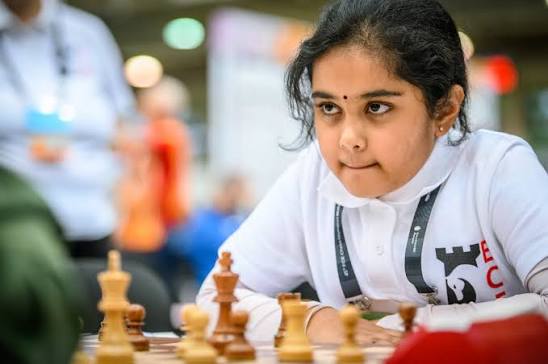
Since entering her first local tournament at the Harrow Chess Club in July 2021, Bodhana has never looked back. By age seven, she defeated six experienced club players in a simultaneous exhibition match with a 5–1 score. Her international record-breaking spree followed swiftly:
- 2022 (European School Championships): Just a year after her first tournament, she won all 24 of her games across classical, rapid, and blitz formats in the Under-7 category in Rhodes, Greece, sweeping three gold medals.
- 2023 (World Youth & European Blitz): She captured the “Triple Crown” at the World Youth Under-8 Championships by winning 33 consecutive games. Later that year, at the European Rapid and Blitz Championships in Croatia, the eight-year-old became the youngest player ever to remain undefeated against a Grandmaster in an international tournament.
- 2024 (England’s Youngest International): At just nine years old, she was selected to represent England at the 45th Chess Olympiad in Budapest, Hungary, making her the youngest person ever to represent England internationally in any sport.
- 2025 (Defeating a Grandmaster): In August, at the British Chess Championships in Liverpool, she defeated English Grandmaster Peter Wells. At 10 years and 5 months old, she became the youngest girl in history to beat a Grandmaster in a classical game.
- 2026 (The Year of Historic Records):
- July: At the Dole Open in France, she defeated French Grandmaster Marc’Andria Maurizzi (rated 2628), becoming the youngest girl ever to beat a player rated over 2600.
- August: She won the British Women’s Championship in Coventry, becoming the youngest champion in the tournament’s history.
- September (Youngest Woman Grandmaster): Playing on England’s top board across all 11 rounds at the 46th Chess Olympiad in Samarkand, Uzbekistan, Bodhana scored an impressive 8 points. By securing her third and final norm, she became the youngest Woman Grandmaster (WGM) in history at age 11, surpassing the previous record set by Kateryna Lagno at age 12.
- October (Youngest Female International Master): Having already earned two IM norms by the end of the Olympiad, she clinched her third IM norm the following month at the European Women’s Club Cup. At 11 years and 7 months old, she broke Judit Polgar’s 38-year-old record to qualify as the youngest female International Master (IM) in history.
Title Requirements and Bodhana’s Next Target
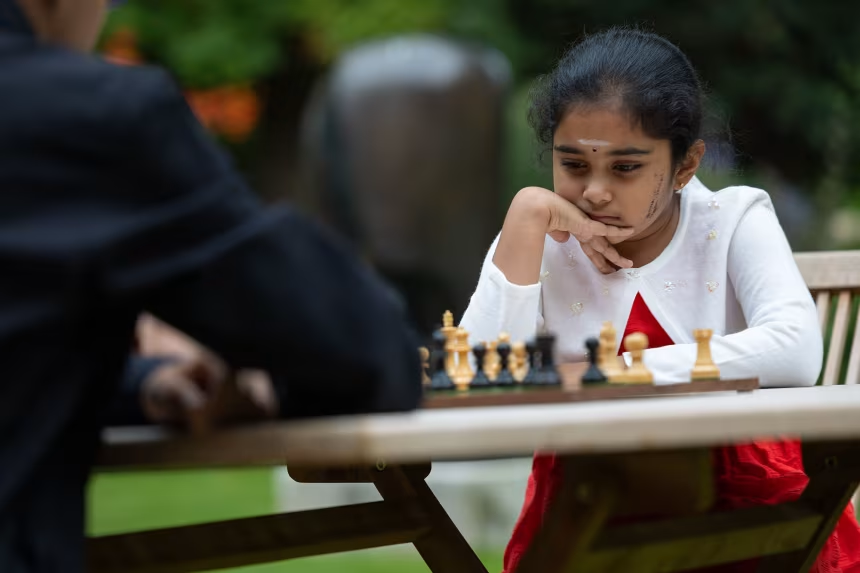
To appreciate the magnitude of Bodhana’s achievements, it helps to look at the official requirements set by the International Chess Federation (FIDE):
| Chess Title | Minimum Rating Required | Norms & Additional Criteria | Bodhana’s Status |
| Woman Grandmaster (WGM) | 2,300 | 3 WGM norms (Highest female-exclusive title; held for life) | Achieved at age 11 (World Record) |
| International Master (IM) | 2,400 | 3 IM norms | Qualified at 11 years, 7 months (World Record) |
| Grandmaster (GM) | 2,500 | 3 GM norms (Highest open title in chess) | Next Target |
According to her FIDE profile, Bodhana currently holds a classical rating of 2414, a rapid rating of 2259, and a blitz rating of 2344.
Among female players, the world record for becoming a full open Grandmaster (GM) belongs to China’s Hou Yifan, who achieved the feat in 2008 at age 14. With over two years to spare before turning 14, Bodhana is firmly on track to shatter that record as well.
From Booster Seats to Classrooms: Academics and Personal Life
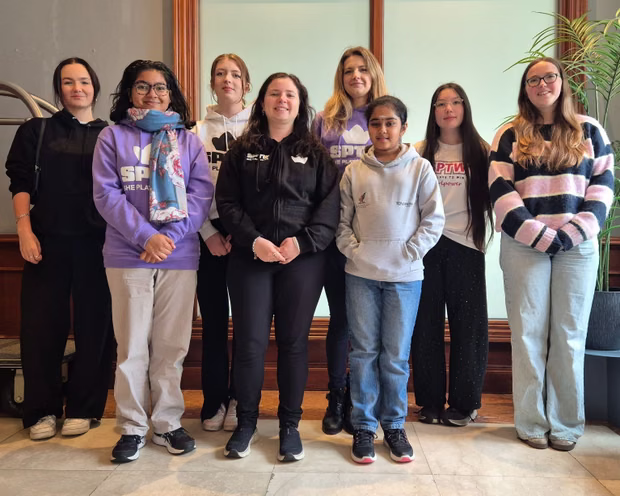
Despite toppling seasoned Grandmasters on the world stage, Bodhana’s daily life remains remarkably grounded. On the Tuesday morning immediately after returning from her historic Olympiad triumph in Samarkand in September 2026, she was back at her secondary school in London attending her Design and Technology class. She takes her academics seriously, catching up on two weeks of missed lessons by borrowing notes from her classmates whenever she returns from international tournaments.
Away from the chessboard, Bodhana enjoys reading books and playing both the piano and the violin. Remarkably, despite winning three smartphones as tournament prizes, she does not own a phone. Her father believes she is still too young for one. As a result, she remains completely untouched by social media buzz—missing out even on congratulatory posts from former UK Prime Minister Rishi Sunak (who hosted her at 10 Downing Street in 2023) and Chancellor Rachel Reeves.
Playing Style, Idols, and Future Ambitions
Trained by former World No. 4 Grandmaster Jon Speelman, Bodhana is known for a mature, composed style of play. She idolizes current World No. 1 Magnus Carlsen and 1920s World Champion José Raúl Capablanca, whose legendary endgame technique she deeply admires.
When asked by FIDE how she handles immense pressure on the world stage, Bodhana responded with disarming simplicity: “I didn’t really feel any pressure. I just tried to enjoy the game. Especially since this was my second Olympiad, it was great, and I really like my team. Honestly, I enjoyed the whole experience.”
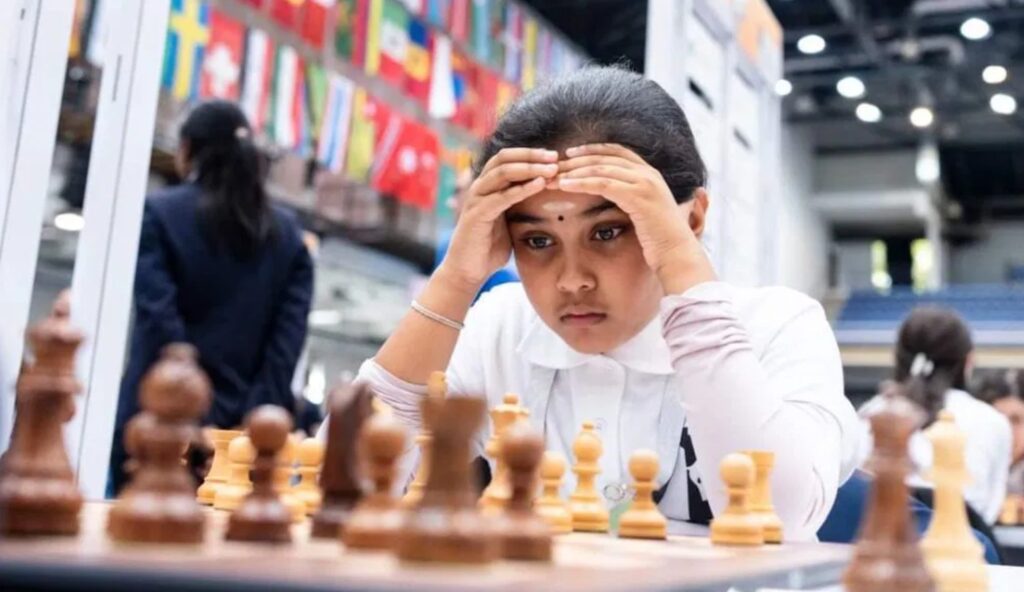
In a feature interview with The Guardian, she echoed a similar philosophy: “I don’t play to break records; I play because I love the game. When I sit at the board, I just focus on the game and forget everything else.”
She has also brushed aside outdated stereotypes, such as past remarks by former British Grandmaster Nigel Short suggesting men are naturally better wired for chess. “Men might be ahead in ratings right now,” Bodhana stated confidently, “but if women work just as hard, they can reach the exact same heights.”
Following her historic Olympiad run, Bodhana made her intentions clear: “I am thrilled to achieve this milestone, but I don’t want to stop here. I want to keep moving forward and keep making new history.”
From a discarded lockdown toy to a global chess icon sitting on a booster seat, Bodhana Sivanandan has already conquered the record books—and her journey has only just begun.