


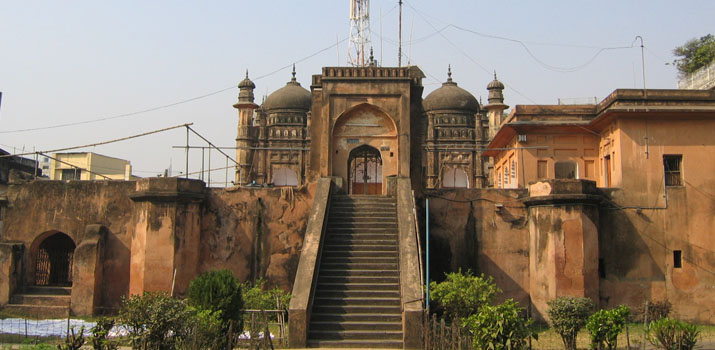
In the heart of Old Dhaka, surrounded by the energy and density of one of Bangladesh’s oldest urban neighbourhoods, stands a remarkable reminder of the city’s Mughal past. Khan Mohammad Mridha Mosque may not be as famous internationally as Lalbagh Fort, but its distinctive architecture and centuries-old history make it one of Dhaka’s most fascinating heritage monuments.
Built in the early eighteenth century, the mosque represents a distinctive form of Bengali Mughal architecture. Its three domes, raised platform, vaulted chambers, arched entrances and elegant brickwork tell the story of a time when Dhaka was an important centre of Mughal administration, commerce and culture.
Today, the mosque continues to serve as a place of worship while also standing as a protected archaeological monument—a rare combination that connects the city’s living present with its historic past.
Where Is Khan Mohammad Mridha Mosque?
Khan Mohammad Mridha Mosque is located in the Atish Khana area of Old Dhaka, less than half a kilometre west of the famous Lalbagh Fort.
Its location makes it part of one of Dhaka’s most historically significant neighbourhoods.
Lalbagh Fort, historic mosques, old residences, narrow streets and centuries-old urban settlements together form a remarkable cultural landscape. Within this environment, Khan Mohammad Mridha Mosque stands on a raised platform, making it particularly noticeable despite the dense surroundings.
The mosque’s elevated position is one of the first things visitors notice.
A Mosque Built More Than Three Centuries Ago
Historical inscriptions indicate that the mosque was constructed in 1704–05 CE. The construction took place during the Mughal period, when Farrukhsiyar was associated with the administration of Dhaka.
The mosque is traditionally associated with Khan Mohammad Mridha, while historical accounts also connect its construction with the order of Qazi Ibadullah, the chief Qazi of Dhaka.
Two Persian inscriptions—one above the central entrance arch and another above the central mihrab—provide important historical evidence about the mosque’s construction.
These inscriptions are especially valuable because they allow historians to connect the surviving structure with a specific period of Dhaka’s history.
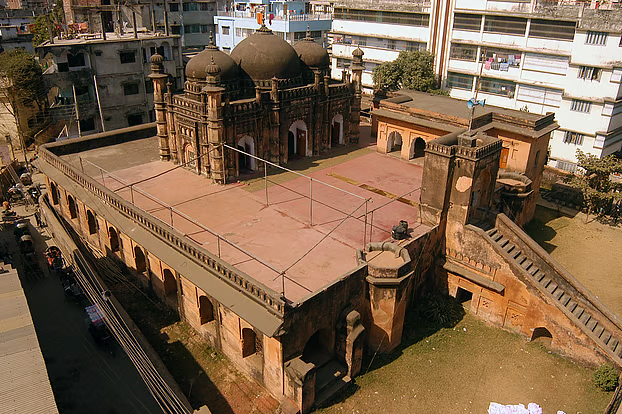
The Unusual Raised Platform
Perhaps the most striking architectural feature of Khan Mohammad Mridha Mosque is that the mosque does not simply sit at ground level.
Instead, it stands on a large raised platform approximately 5.18 metres, or about 17 feet, above the surrounding ground.
The platform measures approximately 38.10 metres from north to south and 28.96 metres from east to west.
This elevated design gives the mosque a commanding presence.
But the platform was not merely decorative.
Beneath it are vaulted rooms arranged around much of the structure. These spaces, often described as tahkhana, created a functional area beneath the elevated mosque.
The result is an architectural composition that combines religious, educational and residential functions in a remarkably compact complex.
A Classic Bengali Platform Mosque
Architectural historians identify Khan Mohammad Mridha Mosque as a notable example of the Bengali platform mosque.
The basic concept is simple: a relatively compact mosque with three domes is placed on top of a much larger rectangular platform.
This arrangement became an interesting feature of mosque architecture in Bengal.
Rather than relying only on height, size or monumental façades, the architects created visual prominence by elevating the entire mosque.
From ground level, the stairs lead visitors upward toward the prayer hall, creating a gradual transition from the surrounding neighbourhood into the religious space above.
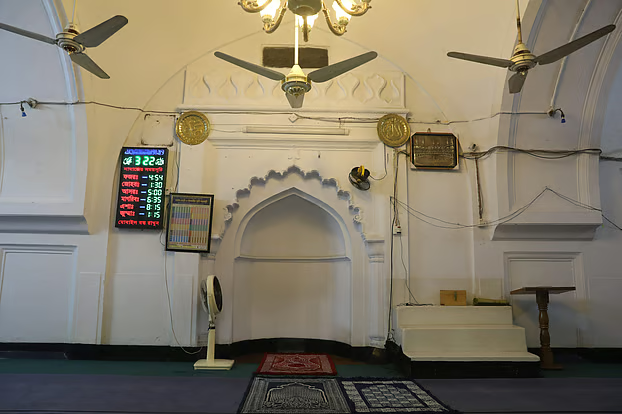
The Three Domes
The mosque’s prayer hall is crowned by three domes, a characteristic feature of many historic mosques in Bengal.
The three-domed arrangement creates a balanced and harmonious appearance.
The central section is emphasized through the principal entrance and central mihrab, while the two side sections complete the symmetrical composition.
Although the mosque is relatively small compared with some monumental Mughal structures, its proportions give it a dignified presence.
This is an important lesson in historic architecture: grandeur does not always depend on enormous scale.
Kherua Mosque: A Timeless Masterpiece of Bengal’s Sultanate Architecture
zazafee
Arches and Entrances
The eastern façade contains the principal entrances to the prayer hall.
The arches are among the most visually distinctive elements of the building. Their curved forms soften the strong geometric lines of the brick structure and provide rhythm to the façade.
Inside, the central mihrab is similarly emphasized.
The Persian inscription above the central mihrab is particularly important from a historical perspective, as it forms part of the evidence used to date and identify the construction of the mosque.
Brick: The Language of Bengal’s Architecture
Khan Mohammad Mridha Mosque is primarily a brick-built structure, reflecting one of the defining characteristics of traditional architecture in Bengal.
Bengal’s geography played a major role in the development of brick architecture.
The region had abundant clay but comparatively limited supplies of natural building stone. As a result, generations of Bengali craftsmen became highly skilled in brick construction and decoration.
Brick was not treated simply as a basic construction material.
It became part of the artistic language of the building.
At Khan Mohammad Mridha Mosque, the warm tones and carefully arranged masonry contribute to the structure’s historic character.
The Madrasa Connection
The mosque complex was also associated with educational activities.
Historical accounts mention a madrasa near the mosque. The educational institution is traditionally connected with Mawlana Asadullah, who taught subjects including fiqh, philosophy and logic in Arabic and Persian.
This detail is important because it shows that the complex was not simply a place where people came to pray.
It was also connected with learning.
In the eighteenth-century Muslim intellectual environment of Dhaka, religious institutions could function as centres of education, scholarship and community life.
The mosque therefore offers a glimpse into more than architectural history—it provides clues about the intellectual culture of historic Dhaka.
A Mosque Surrounded by Open Space
Another interesting characteristic of the historic complex was the open space around the main mosque.
The spacious area in front of the prayer hall allowed air to circulate freely. This was particularly useful in Bengal’s warm and humid climate.
The arrangement demonstrates how historic architects considered environmental conditions when designing religious buildings.
Architecture was not simply about appearance.
It was also about creating spaces that worked well for the people who used them.
A Witness to Old Dhaka’s Transformation
When Khan Mohammad Mridha Mosque was built in 1704–05, Dhaka looked dramatically different from the city we know today.
There were no modern roads filled with buses and cars, no high-rise buildings and no enormous urban population surrounding the monument.
Instead, Dhaka was a major Mughal city shaped by palaces, gardens, markets, mosques, administrative buildings and residential neighbourhoods.
More than three centuries later, the city has transformed almost beyond recognition.
Yet Khan Mohammad Mridha Mosque remains.
Its survival provides a physical link between modern Dhaka and the city of the early eighteenth century.
From Historic Neighbourhood to Modern Megacity
The story of Khan Mohammad Mridha Mosque is also the story of Old Dhaka.
The area around the mosque has experienced enormous change.
Historic buildings have disappeared, streets have become busier, and modern structures have emerged alongside centuries-old monuments.
This creates both an opportunity and a challenge.
Old Dhaka’s surviving heritage buildings give the city a unique identity. But preserving those structures in a densely populated and rapidly changing urban environment requires careful planning.
The survival of Khan Mohammad Mridha Mosque demonstrates what can be achieved when historic monuments are recognized and protected.
A Protected Archaeological Monument
Today, Khan Mohammad Mridha Mosque is under the care of the Department of Archaeology of Bangladesh and is recognized as an archaeological heritage site.
Its protected status is important because historic structures require specialized conservation.
The mosque has undergone restoration over the years, and conservation remains an ongoing responsibility.
Preserving an old building is not simply about making it look new.
In heritage conservation, the goal is to retain the historic character, materials and architectural features that make a monument valuable in the first place.
Still a Place of Worship
One of the most remarkable things about Khan Mohammad Mridha Mosque is that it is not merely a museum piece.
The mosque continues to be used for prayer.
This gives the monument a special character.
Visitors can observe an architectural structure that has survived for more than three centuries while remaining part of the living religious landscape of Dhaka.
The building is therefore both heritage and living history.
Why Khan Mohammad Mridha Mosque Matters
There are many reasons why this mosque deserves attention.
1. It is more than 300 years old
Its construction dates to 1704–05, making it a valuable surviving monument from the Mughal period of Dhaka.
2. Its architecture is distinctive
The elevated platform and three-domed prayer hall make it a notable example of Bengali platform mosque architecture.
3. It preserves historical inscriptions
The Persian inscriptions provide valuable evidence about the mosque’s origins and construction.
4. It is connected with education
The historic complex included a madrasa, showing the relationship between religious worship and learning.
5. It remains part of living Dhaka
Unlike many archaeological ruins, the mosque continues to function as a place of worship.
A Lesson for a New Generation
For young people, historic buildings can sometimes seem distant from everyday life.
But Khan Mohammad Mridha Mosque offers a different way of understanding history.
Think about standing on the same platform that people climbed more than three centuries ago.
The people who built the mosque are long gone. The city around it has changed dramatically. Yet the structure remains.
Its survival tells us something powerful:
Buildings can become witnesses.
They observe changes that human beings cannot live long enough to see.
A monument such as Khan Mohammad Mridha Mosque allows today’s generation to experience a small part of the world that existed hundreds of years ago.
Visiting Khan Mohammad Mridha Mosque
Because the mosque is located near Lalbagh Fort, it can be included in a historical tour of Old Dhaka.
Visitors can combine a visit to the mosque with other nearby heritage sites and explore the area’s historic streets and architecture.
However, it is important to remember that the mosque remains an active place of worship.
Visitors should therefore respect prayer times, dress appropriately, maintain silence and follow any instructions from mosque authorities or heritage officials.
Final Thoughts
Khan Mohammad Mridha Mosque is one of Old Dhaka’s quiet architectural treasures.
Built in 1704–05, the mosque has survived more than three centuries of political change, urban expansion and social transformation. Its three domes, elevated platform, vaulted chambers, Persian inscriptions and brick construction make it an important example of Bengal’s Mughal-era architectural heritage.
But its greatest significance may be the way it connects different generations.
The mosque belongs to the past, but it continues to exist in the present.
Surrounded by modern Dhaka, it quietly reminds us that the capital was once a very different city—a city of Mughal officials, scholars, merchants, artisans and religious institutions.
Today, Khan Mohammad Mridha Mosque stands as a silent witness to that lost Dhaka.
And as the city continues to grow, preserving monuments like this ensures that future generations will still have a physical connection to the stories that shaped their city.
Frequently Asked Questions
Where is Khan Mohammad Mridha Mosque?
Khan Mohammad Mridha Mosque is located in the Atish Khana area of Old Dhaka, less than half a kilometre west of Lalbagh Fort.
When was Khan Mohammad Mridha Mosque built?
Historical inscriptions date its construction to 1704–05 CE.
Who built Khan Mohammad Mridha Mosque?
The mosque is traditionally associated with Khan Mohammad Mridha. Historical sources also state that its construction was ordered by Qazi Ibadullah.
How many domes does the mosque have?
The main prayer hall has three domes.
Why is the mosque built on a high platform?
The mosque follows the Bengali platform-mosque tradition. Its large raised platform also contains vaulted rooms beneath the prayer hall.
Is Khan Mohammad Mridha Mosque still used?
Yes. The mosque continues to function as a place of worship while also being preserved as an archaeological heritage monument.
What is the architectural significance of the mosque?
Its elevated platform, three-domed prayer hall, brick construction, arches and historic inscriptions make it an important example of Mughal-era Bengali mosque architecture.
The Mystery Behind the Name
At the time, Emperor Aurangzeb was seated on the throne of Delhi. The deputy governor of Dhaka was Farrukhsiyar, who later ascended the Mughal throne as the ninth Mughal emperor and met a tragic death. During this period, Khan Mohammad Mridha built the mosque at Atish Khana on the orders of Qazi Ibadullah, the chief judge of Dhaka. According to historian Muntasir Mamun, it is the seventeenth-oldest mosque in Dhaka in terms of antiquity.
An inscription written in Persian still survives inside the mosque. It states that Khan Mohammad constructed the mosque in Hijri 1116 at the direction of the chief Qazi. Based on this inscription, the mosque was built in 1704 or 1705 CE.
Very little is known about the identity of its builder, Khan Mohammad. Interestingly, the inscription does not mention the surname “Mridha” after his name. How the name “Khan Mohammad Mridha” came into use, and how the surname became permanently associated with the mosque, remains an unsolved mystery.
In front of the mosque stands an old grave paved with red bricks and brick chips. According to Munshi Rahman Ali Taish, the author of Tawarikh-e-Dhaka, this is believed to be the tomb of Khan Mohammad Mridha.
Architectural Style
Khan Mohammad Mridha Mosque occupies an area of approximately three bighas and is enclosed by an iron grille. Nearly one bigha of the area in front of the mosque is occupied by a garden, where various seasonal flowers bloom. Rows of coconut trees line the edges of the garden.
Beyond the garden stands the mosque in the middle of an open courtyard. The southern section of the courtyard has been paved with concrete and is also used for congregational prayers. The northern section contains various fruit trees, including mango, almond and baheda.
The mosque itself was constructed on a platform approximately 17 feet above ground level. A staircase rises from the ground to the elevated platform, and visitors must climb these steps to reach the mosque.
The main platform, or roof terrace, measures approximately 125 feet in length and 100 feet in width. The original mosque is elongated from north to south and measures approximately 48 feet long and 24 feet wide.
Another building stands to the north of the mosque. It contains two rooms where the assistant imam, muezzin and caretakers live. The rooms are also used as an office.
Inside the main mosque, there is space for three rows of worshippers, with approximately 30 people in each row. Thus, around 90 worshippers can pray together inside the mosque. However, congregational prayers are also held on the elevated platform on both sides of the mosque, as well as in the front and rear areas and in the northern, eastern and southern courtyards below. Altogether, approximately 2,000 worshippers can participate in congregational prayers across the entire complex.
During the holy month of Ramadan, Tarawih prayers are held at the mosque from the beginning of the month. For this reason, a temporary tarpaulin shelter has been installed over the elevated platform. As a result, the domes of the mosque can no longer be seen clearly from the front.
According to Banglapedia, the architectural style of Khan Mohammad Mridha Mosque closely resembles that of the Kartalab Khan Mosque in Begum Bazar. The roof features three decorated domes: one large dome in the centre and two slightly smaller domes of similar size on either side. Four ornamental towers rise from the four corners of the mosque.
In addition, six slender towers are positioned along the front and rear walls. The tops of these towers are decorated in the form of enclosed minarets.
Inside the mosque, there are two small doors on the northern and southern sides. The western wall contains a large arched central mihrab, flanked by two smaller arched mihrabs. On the eastern wall are three doors positioned directly opposite the mihrabs on the western wall.
The frames and upper portions of the arches of these doors are made of black stone. There are also two large towers on either side of the eastern wall of the elevated terrace. The upper portions of these towers are now damaged.
The mosque is listed as an archaeological heritage site under the Department of Archaeology of Bangladesh. Two signboards belonging to the department stand in front of the mosque. The department carried out the most recent major renovation of the mosque approximately seven years ago.
An Unusual Architectural Structure
One of the most remarkable features of Khan Mohammad Mridha Mosque is its unusual structural design.
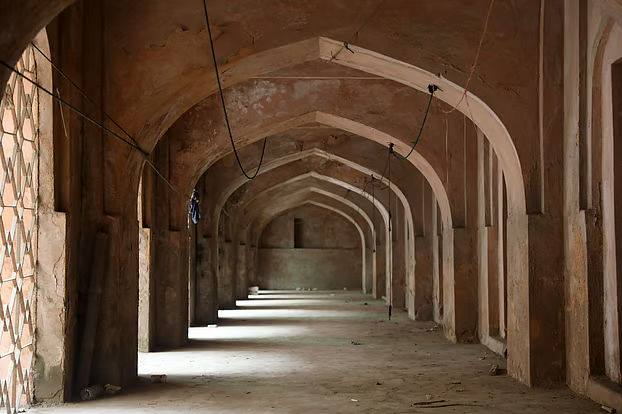
The lower level beneath the main platform appears to be solid, and it is difficult to determine what lies within the core of the structure. Along the western and southern walls of the foundation are a series of small rooms, with a continuous verandah running in front of them.
The sections of the verandah corresponding to each room are marked by arched openings extending down from the roof. The rows of arches create an aesthetically striking interplay of light and shadow.
Munshi Rahman Ali Taish wrote in his book Tawarikh-e-Dhaka that these rooms were once used to keep horses and cattle.
Today, some of these rooms are reportedly occupied by workers involved in conservation and restoration work under the Department of Archaeology.